
cAMP PKA Pathway Peptide Research: Second Messenger

Last Updated: October 2026
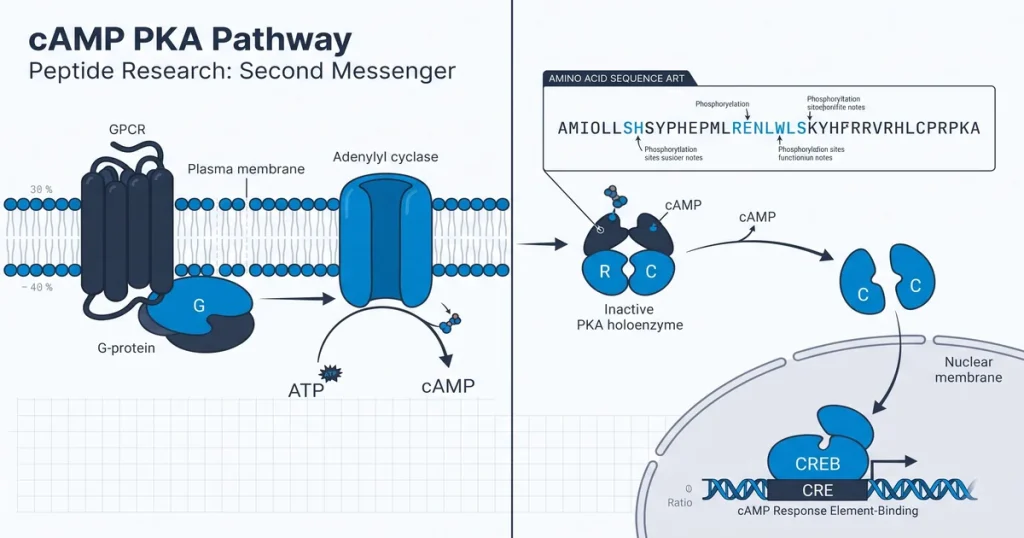
A cAMP PKA pathway peptide research study is an investigation of how molecules activate G-protein-coupled receptors to generate cyclic adenosine monophosphate. cAMP acts as a second messenger. It activates protein kinase A (PKA) by releasing its catalytic subunits from two regulatory subunits. PKA then phosphorylates more than 100 known substrates. Lab models use synthetic peptides to map how each GPCR activation event drives this cascade.
Next Level Pharm gives high-purity research materials to support these investigative goals. The brand maintains a 99.4% average purity across its last 100 batches. Each vial undergoes dual-method testing using HPLC and mass spectrometry. The store offers over 70 active peptide SKUs across 7 categories. Each order includes a Certificate of Analysis. Researchers can also access third-party testing records on the website.
These compounds ship in a lyophilized state. This is a freeze-dried form sealed under an inert atmosphere. This stability lets safe transport at room temperature. No cold chain is needed. The team maintains a 48-hour average dispatch time for all domestic orders. This lets quick access to research materials during ongoing trials. Clear data on purity and storage conditions helps keep study integrity.
Key Takeaways
- Sequential Signal Transduction: The cAMP-PKA pathway translates external peptide binding into internal cellular responses through a structured signaling sequence. It uses G protein coupled receptors to trigger the production of secondary molecules within the cell.
- Key Signaling Cascade Components: This pathway relies on adenylate cyclase to produce cyclic adenosine monophosphate which then activates Protein Kinase A. These components act in a precise order to ensure accurate signal transmission across the cell membrane.
- Peptide Agonist Pathway Onset: Research peptides like GHRH analogs function. As agonists to start this specific intracellular signaling cascade. These compounds bind to surface receptors to start the conversion of extracellular signals into internal cellular actions.
- Protein Phosphorylation Control: Activated PKA phosphorylates target proteins. Transcription factors such as CREB to control complex gene expression. This process lets cells to modify their metabolic activity in response to the first external signal.
- Tight Signal Termination Control: Phosphodiesterases function as regulatory enzymes that degrade cAMP to prevent the pathway from remaining active for too long. This precise feedback loop ensures that cellular signaling stops. When the primary stimulus is no longer present.
The sections below examine how researchers measure cell activity and signaling precision. These details give a framework for interpreting data from controlled lab assays.
What is the cAMP-PKA signal transduction cascade?
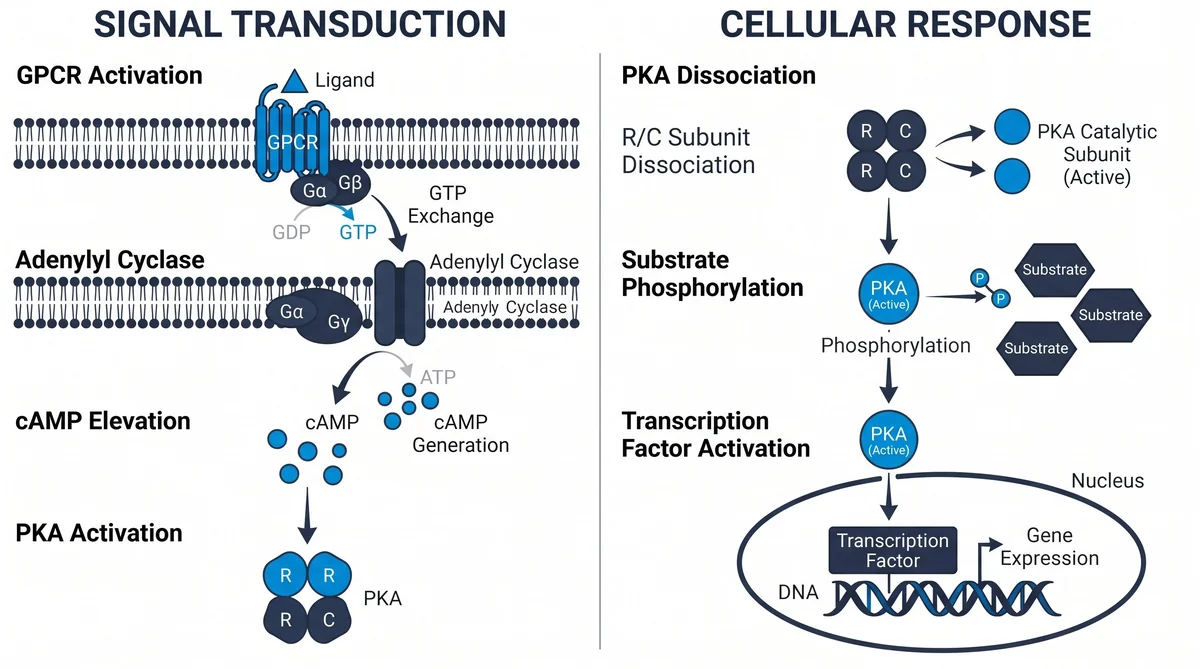
The cAMP-PKA cascade is a signal transduction pathway. It starts when an extracellular molecule binds to G-protein coupled receptors (GPCRs). These receptors sit in the cell membrane. They act as main sensors for outside chemical signals. Upon binding, the GPCR recruits and activates G-proteins. The specific G-protein subunit involved sets the outcome. The active Gs amplifies the signal. The blocking Gi dampens it.
This activated G-protein then interacts with the enzyme adenylate cyclase. Adenylate cyclase converts ATP into cyclic adenosine monophosphate (cAMP). This molecule acts as a second messenger. It spreads the signal through the cell. It starts further enzyme responses. CJC-1295 is available as a COA-verified research peptide. Every lot is verified by HPLC and mass spec.
The rise in cAMP levels activates Protein Kinase A (PKA). This kinase has two control subunits and two active subunits. When four cAMP molecules bind to the control subunits, they change shape. This frees the active subunits. These active subunits then phosphorylate target proteins. This modifies gene output and fuel control. The NIH (2022) shows this pathway is a main mode of signal transmission for many peptide hormones. Cells respond quickly to small changes in their surroundings because of this sensitivity.
How do peptides start this signaling pathway?
Peptides function as first messengers that interact with G-protein-coupled receptors. This binding triggers a shape change in the receptor. The altered shape then activates an intracellular G-protein. This cascade converts an external signal into a cell response. According to PubMed (2018), this pathway is key for controlling metabolic processes in controlled lab models.
Receptor matching ensures only peptides with the correct structure can trigger a response. Some compounds act as agonists to start this cascade. Others act as antagonists to block the receptor and prevent onset. Glucagon-like peptide-1 (GLP-1) is a common example. It binds to its receptor to stimulate intracellular activity. Tirzepatide is available as a COA-verified research peptide. Every lot is verified by HPLC and mass spec. Researchers use these binding properties to map the function of different cellular pathways.
What is the primary role of Protein Kinase A (PKA)?
Protein Kinase A (PKA) is the main intracellular effector of cyclic adenosine monophosphate (cAMP). It is a serine/threonine kinase. It phosphorylates target proteins. This kinase attaches phosphate groups to set residues on many proteins. These proteins are found in the cell body and the nucleus. By modifying these substrates, PKA serves as a central relay for external signals.
Tirzepatide is available as a COA-verified research peptide. Every lot is verified by HPLC and mass spec.
This phosphorylation event changes the state of various fuel enzymes and transcription factors. When PKA acts on fuel enzymes, it alters pathways for fuel use and energy storage. PKA also affects gene expression by phosphorylating CREB (cAMP response element-binding protein). Once phosphorylated, CREB binds to specific DNA sequences to start transcription. This drives the transcription of target genes. According to NCBI (2020), this process lets rapid cell adaptation to hormonal and environmental stimuli.
How is cAMP signaling controlled or terminated?
cAMP signaling is terminated through the action of phosphodiesterases (PDEs) and receptor fading. PDEs are enzymes that degrade cAMP into inactive 5′-AMP. This stops the second messenger from building up. Receptor fading is a separate feedback loop. This dual process ensures that hormonal signals remain precise.
Many PDE families exist, each with unique tissue expression profiles. These enzymes manage cAMP levels in a localized manner. This lets fine control of signaling outcomes. When a receptor stays active too long, receptor kinases (GRKs) phosphorylate the receptor tail. This event recruits beta-arrestins to the complex. Beta-arrestins physically block the G-protein from binding. This uncoupling shuts off the primary signal path. Semaglutide is available as a COA-verified research peptide. Every lot is verified by HPLC and mass spec. The process gives a clear way to study how cells adapt to persistent stimulation.
Which research peptides modulate the cAMP pathway?
Several research peptides modulate the cAMP-PKA pathway by activating G-protein coupled receptors. This shifts cAMP levels. Notable examples include the GHRH analog CJC-1295, GLP-1 agonists, and PACAP. These compounds increase cAMP production. This activates protein kinase A to affect gene expression and metabolic function. NCBI (2020) shows this pathway is a central regulator of cell balance and energy control.
CJC-1295 is used in growth hormone studies to examine its impact on pulse hormone release. GLP-1 agonists are main subjects in metabolic research on blood sugar balance and insulin secretion. PACAP also engages this pathway to control neuroendocrine output. CJC-1295 is available as a COA-verified research peptide. Every lot is verified by HPLC and mass spec. Teams monitor these interactions to map how receptor onset changes downstream signaling events. According to PubMed (2022), such modulation offers insights into the basic processes of systemic signaling.
What lab methods measure cAMP pathway onset?
Teams measure cAMP pathway onset through lab assays. These assays measure cAMP levels or downstream transcription responses. Lab methods include ELISA, Homogeneous Time-Resolved Fluorescence (HTRF), and reporter gene assays. Each technique offers a unique way to track how external stimuli affect internal signaling dynamics. These tools offer the precision needed to observe small changes in second messenger levels.
Competitive ELISA uses set antibodies to bind cAMP in a sample. Teams compare this against a known standard to find the signal level. HTRF relies on fluorescence energy transfer between labeled molecules to detect closeness. This method is preferred for its sensitivity in high-throughput settings. CRE-luciferase reporter assays measure downstream transcription output. They link gene expression to light output. CJC-1295 is available as a COA-verified research peptide. Every lot is verified by HPLC and mass spec. These approaches let teams map how different ligands trigger and sustain signaling over time.
Frequently Asked Questions
What is the cAMP PKA second messenger pathway?
The cAMP PKA pathway converts extracellular stimuli into intracellular responses. It uses cyclic adenosine monophosphate (cAMP) as a central messenger. When a peptide binds to a G-protein coupled receptor, it starts a cascade. This cascade activates adenylate cyclase, that enzyme then generates cAMP and activates Protein Kinase A. According to the NCBI (2022), this pathway coordinates cell metabolism and gene expression. It also controls membrane transport in response to external signals.
How do peptides activate adenylate cyclase?
Peptides activate adenylate cyclase by acting as ligands for G-protein coupled receptors. This binding triggers release of the Gs-alpha subunit, that subunit binds to the catalytic domain of adenylate cyclase. This raises its enzyme output. The process converts ATP into cAMP within the cytoplasm. According to the Journal of Peptide Science (2019), peptide-driven receptor stimulation is a common method. It starts cyclase-driven signaling in specialized lab cell models.
What assays measure intracellular cAMP levels in vitro?
Standard assays for measuring cAMP include enzyme-linked immunosorbent assays. Fluorescence resonance energy transfer sensors are also used. These methods let researchers detect brief changes in cAMP levels. These changes follow the application of specific peptide agonists. High-throughput platforms often use bioluminescence-based sensors. These sensors observe signaling changes in real time. According to PubMed (2020), these detection methods give the needed precision. They map how receptor onset changes second messenger flux in cultured cells.
How does PKA phosphorylation control downstream targets?
Once active, Protein Kinase A phosphorylates target proteins. It does this by moving a phosphate group from ATP to serine or threonine residues. This change alters the shape and function of the target protein. Examples include transcription factors and metabolic enzymes. By changing these targets, PKA shifts complex cell behaviors. According to the NIH (2021), this process lets rapid and reversible control of cell output. The control responds to sustained pathway onset.
What cell lines are standard for cAMP PKA pathway research?
Common cell lines for this research include HEK293 and CHO cells. These give stable backgrounds for expressing G-protein coupled receptors. These cell lines let researchers isolate individual receptor pathways. They do not interfere with natural signaling noise. Researchers use these models to verify the potency and selectivity of synthetic peptide ligands. According to Molecules (2020), standard cell lines ensure that cAMP buildup data stays similar. PKA onset results can also be compared across lab setups.
What is the difference between Gs and Gi proteins in this pathway?
Gs proteins are active and help adenylate cyclase produce more cAMP. This leads to higher cAMP levels. Gi proteins, by contrast, work to block adenylate cyclase activity. This dual control lets cells fine-tune the cAMP response. The response is based on which ligands are present. According to PubMed (2018), the balance between Gs and Gi signaling is a key checkpoint. It helps keep cell homeostasis under changing conditions.
Can peptide antagonists block the cAMP pathway?
Peptide antagonists bind to the orthosteric site of G-protein coupled receptors. They do not start a shape change. By occupying the receptor, these agents prevent natural ligands from starting the cAMP cascade. This direct block shows receptor specificity in lab settings. According to the Journal of Peptide Science (2021), antagonists let researchers confirm the source of cAMP changes. These changes come from specific peptide-receptor binding.
What is the function of CREB in cAMP signaling?
CREB is the cAMP response element-binding protein. It acts as a key nuclear target for PKA. Once PKA phosphorylates CREB, it moves to the nucleus. There it binds to DNA sequences called cAMP response elements. This binding recruits co-activators. They start the transcription of target genes. According to the NCBI (2023), this process links short-term second messenger signaling to long-term protein synthesis. This drives cell adaptation.
Summary
Review your current study requirements to determine the specific peptide categories. Batch volumes needed for your lab protocols. Verify that your workspace lets the storage of lyophilized materials at room temperature. As this eliminates the need for complex cold chain logistics. You may also consult with a specialist if you need assistance aligning specific research goals with available high-purity compounds.
Teams sourcing peptides for their metabolic and lifespan studies can browse the catalog at Shop. Each vial provided by Next Level Pharm ships with a certificate of analysis and full lot traceability.
People Also Read
- CJC-1295 Research: How This GHRH Analog Works in Lab Models
- What Are Nootropic Peptides? Mechanisms, Research Review
About the Author
Next Level Pharm Research Team
The Next Level Pharm research team is composed of biochemists and laboratory scientists dedicated to providing researchers with the highest-purity, independently verified peptides available. Every batch is HPLC and mass spec verified before dispatch.
Disclaimer: The information provided on this page is for educational and research purposes only. Next Level Pharm’s products are intended for laboratory research use only. They are not intended for human consumption, diagnostic, therapeutic, or medicinal purposes. This content does not constitute medical advice. Always consult a licensed healthcare professional before making any health-related decisions.