
Orexin Hypocretin Peptide Research: Receptor Studies

Last Updated: October 2026
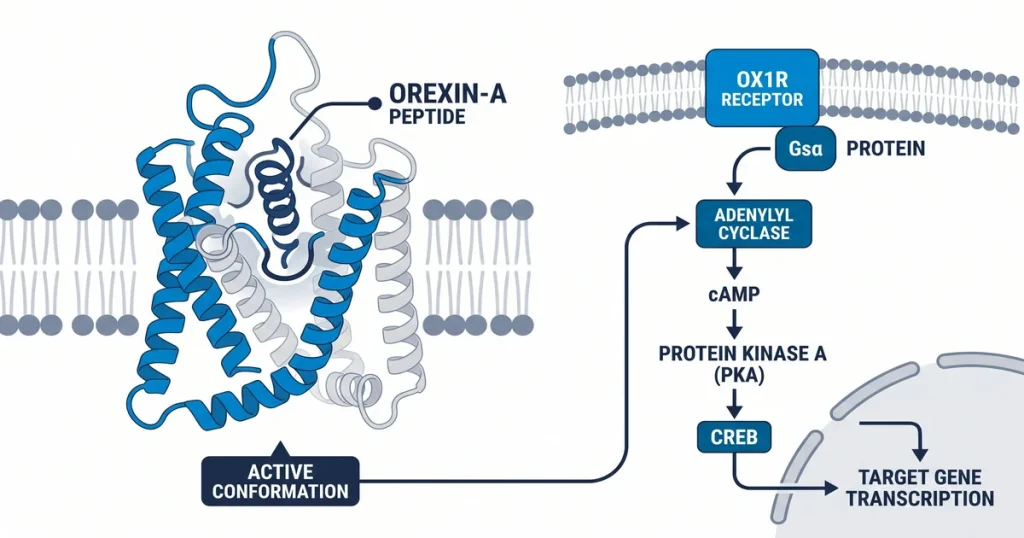
An orexin hypocretin peptide research study is an investigation of how orexin-A and orexin-B bind to OX1 and OX2 receptors in vitro. Orexin-A is a 33-amino-acid peptide. Orexin-B contains 28 amino acids. Both peptides activate Gq-linked signaling. Lab models track these binding events to study wakefulness regulation and energy balance at the receptor level.
Next Level Pharm offers research compounds with high standards for data accuracy. Each batch holds 99.4% average purity. This is the average across 100 batches. The team tests every vial. HPLC and mass spectrometry are used. All compounds are lyophilized. They are sealed under an inert atmosphere. No cold chain is needed. They stay stable at room temperature. A COA comes with every order. It ensures full traceability.
This model gives labs reliable materials. Consistency is built in. Standardized testing confirms peptide quality. All lab benchmarks are met. Every batch is third-party tested.. Researchers can access them anytime. High purity helps isolate natural variables. Detailed testing adds precision. Every vial arrives with records. Results are validated.
Key Takeaways
- Orexin receptor regulation: Orexin-A and orexin-B peptides regulate sleep. Hunger by targeting hypothalamic pathways. These peptides act on G-protein coupled receptors. The two main ones are OX1R and OX2R.
- Selective receptor binding: Orexin-A shows selectivity for OX1R, while orexin-B binds to both receptors. These proteins occupy different brain sites. Each manages distinct signaling cycles.
- Neuronal signaling activation: Binding triggers calcium increases. Neuron depolarization to initiate wakefulness. This process promotes transmitter release throughout the CNS.
- Primary role in sleep studies: Orexin deficiency links directly to the development of narcolepsy with cataplexy. Teams study this system. The goal is to learn about sleep disorders. Sleep science guides each study.
- Modulation of neural pathways: Ongoing research explores receptor agonists. Antagonists to alter sleep states. These molecules let teams track responses. The pathways are tied to hypersomnia.
Recent studies clarify these roles. The peptides act in neural circuits. Teams can examine the sections below. These show how receptor binding affects signaling. These findings give a basis for lab models. They study sleep science and metabolic balance.
What are orexins and their primary functions?
Orexins, also called hypocretins, are neuropeptides. They are made in the lateral hypothalamus. They regulate the sleep-wake cycle, appetite, and arousal. The dual name arose from two research groups. They worked on their own. One group linked them to feeding. The other noted their hypothalamic origin. They consist of two forms: orexin-A and orexin-B. Both bind to receptors. Each transmits signals in the CNS. According to the NCBI (2018), orexins keep stable alertness. Sudden sleep transitions are prevented.
Loss of orexin neurons causes narcolepsy type 1. This is the main driver. This condition shows a fragmented sleep-wake cycle. It is hard to maintain wakefulness. Orexin-A and orexin-B activate arousal centers. This promotes daytime wakefulness. Researchers study these molecules to understand energy balance. Metabolic shifts are also tracked. Orexin-A is a COA-verified research peptide. HPLC verifies each lot. Mass spec confirms. Next Level Pharm provides these compounds. They are for lab models. Sleep and neural signaling are the focus. Stable orexin output keeps the system in balance.
How do the OX1 and OX2 receptors differ?
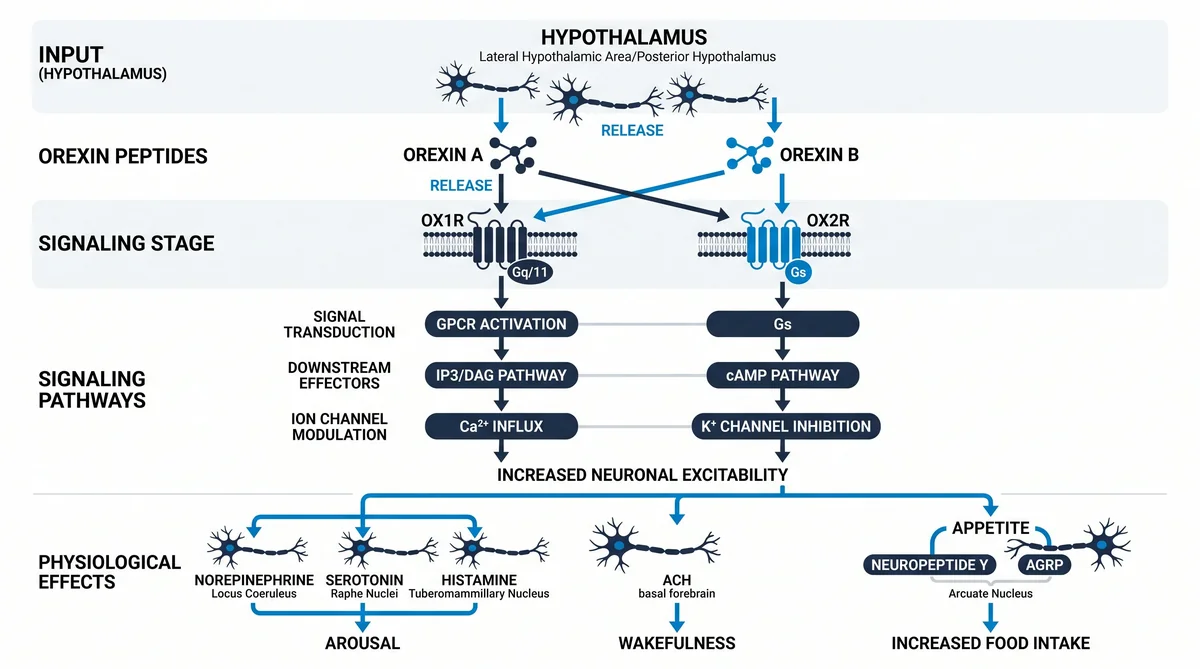
OX1R and OX2R are G-protein coupled receptors. Each has distinct binding affinity for orexin peptides. OX1R shows higher binding affinity for orexin-A. It couples mainly to the Gq/11 pathway. OX2R binds both orexin-A and orexin-B. Its binding is non-selective. It couples to both Gq/11 and Gi/o pathways.
Orexin-A and Orexin-B are each COA-verified research peptides. HPLC verifies each lot. Mass spec confirms. These two receptor types show varied distribution. They are found across brain regions. OX1R is found in limited areas. OX2R shows broader presence in the hypothalamus. Nearby structures are also involved. According to PubMed (2015), spatial differences help isolate neural signaling. Teams track the responses. Controlled assays use this data.
What is the mechanism of orexin signaling?
Orexin signaling starts at OX1R or OX2R. Peptide binding triggers a cascade. This triggers intracellular calcium release. Calcium release induces neuron depolarization. This is an active CNS signal. These peptides shift cells toward a firing threshold. Active signaling becomes more likely. According to Peptides (ScienceDirect) (2010), this cascade drives arousal. Mammalian models confirm this.
Orexin-A is a COA-verified research peptide. HPLC verifies each lot. Mass spec confirms. This depolarizing effect triggers transmitter release. Key messengers go to local networks. These include norepinephrine, dopamine, and histamine. This promotes alertness and wakefulness. Research links this contact to sleep-wake control.
What are orexin receptor antagonists and agonists?
Orexin receptor antagonists block orexin receptors. This promotes sleep in lab models. Receptor agonists activate these receptors. Wakefulness increases as a result. Both rely on the orexin system. This system governs the sleep-wake cycle. Teams adjust receptor activity. This maps neural circuit shifts. Rest versus alertness states are tracked.
Suvorexant is a dual orexin receptor antagonist. It is called a DORA. It binds to both OX1R and OX2R. It is a common sleep research tool. Labs use it to study insomnia. It stops orexin action. Wakefulness signals are reduced. Suvorexant is a COA-verified research peptide. HPLC verifies each lot. Mass spec confirms. Current research focuses on stable oral orexin agonists. They are studied for wakefulness pathways. Narcolepsy models are used.
How are orexin levels measured in research?
Orexin levels are measured via RIA (radioimmunoassay) or ELISA. CSF samples are used. CSF stands for cerebrospinal fluid. These detect the neuropeptide in the fluid. This gives data for sleep-wake cycle studies. These methods detect low protein levels. Sensitivity is key. Orexin A and Orexin B are each COA-verified research peptides. HPLC verifies each lot. Mass spec confirms.
Measuring these peptides is challenging. Their level in peripheral blood is very low. This complicates standard screening. CSF is the standard medium for diagnostics. It gives a direct window into hypothalamic output. CSF is collected via lumbar puncture. It is the gold standard. Peptide levels are mapped. Narcolepsy and other states are tracked. Teams use these assays to compare concentrations. This confirms detected levels are real. Activity is confirmed. Test precision is key. High-quality data depends on it.
What are future directions for orexin research?
What are future directions for orexin research?
Future research aims to develop selective OX2R agonists. Teams map their influence on diverse neural circuits. They study compound interactions with addiction pathways. Lab settings are used. Further metabolic research may clarify orexin’s role. It integrates with hunger cues. Labs examine downstream targets. Targeted control may support cognitive functions. Lab models are used. This moves beyond sleep science. It deepens knowledge of hypothalamic neuropeptides.
Orexin-B is a COA-verified research peptide. HPLC verifies each lot. Mass spec confirms. Selective OX2R agonist research may stabilize neural signals. Standard approaches often fall short here. These receptors affect stress responses. Reward pathways are also tracked. This gives a new angle for neural studies. According to PubMed (2020), OX2R density mapping is key. It refines lab designs. Isolating these pathways allows high-resolution signal tracking. This applies to stress and satiety conditions. These advances support precision research.
Frequently Asked Questions
What is the structure of orexin-A and orexin-B?
Orexin-A is a 33-amino-acid peptide that contains two disulfide bonds, which provide a stable, folded structure. Orexin-B is a 28-amino-acid chain that lacks these disulfide bonds. This results in a more flexible linear shape. According to PubMed (1998), these structural variations influence how each peptide interacts with its respective receptor proteins. Both molecules are derived from a single precursor protein called prepro-orexin through post-translational processing within the hypothalamic neurons.
How do OX1R and OX2R differ in selectivity?
The OX1R receptor shows high selectivity for orexin-A,, while the OX2R receptor binds to both orexin-A and orexin-B with equal affinity. This difference in binding profiles allows each peptide to trigger distinct neural signaling circuits throughout the brain. Research shows that OX1R is often linked to emotional. Reward-related pathways, whereas OX2R activity is more closely associated with the primary maintenance of wakefulness. Sleep architecture in many studied models.
What signaling pathways do orexin receptors activate?
Both receptors activate G protein-coupled pathways that trigger the release of intracellular calcium from stored pools. This rise in calcium leads to the activation of enzymes such. As phospholipase C and protein kinase C. According to the NCBI (2018), this cascade causes neuron depolarization. Increases the excitability of hypothalamic cells. These pathways facilitate the release of various neurotransmitters, including histamine and norepinephrine, which are necessary for maintaining arousal and alertness.
How is orexin receptor binding affinity measured?
Teams measure binding affinity using radioligand displacement assays in cell membrane preparations that express the receptors. By adding labeled ligands and observing how a test compound replaces them. Researchers calculate the inhibition constant. This provides data on how strongly a peptide or drug interacts with the receptor surface. According to the Journal of Peptide Science (2014), these assays remain the standard for testing potential receptor agonists. They are used in controlled lab environments.
What cell lines express orexin receptors for research?
Researchers often use Chinese Hamster Ovary (CHO) or Human Embryonic Kidney (HEK293) cells that are modified to express either OX1R or OX2R. These cell lines allow for the controlled study of receptor signaling without the interference of other neural variables. By isolating these receptors in a cell culture environment. Teams can obtain precise measurements of ligand binding and intracellular calcium responses. This approach provides a clear way to verify how specific peptide structures initiate biological signals.
What is the link between orexin deficiency and narcolepsy?
The loss of orexin-producing neurons in the lateral hypothalamus disrupts the brain circuits that stabilize states of wakefulness. This deficiency leads to fragmented sleep and the sudden onset of REM sleep during the day. According to the NIH (2020), this loss of chemical signaling directly causes narcolepsy type 1. Teams study this connection by observing how the lack of peptide input disrupts the neural networks responsible for maintaining alert states in living models.
What is hypocretin and how does it relate to orexin?
Hypocretin is an alternate name for the same neuropeptides identified as orexins. The two terms exist because different research groups discovered the peptides independently. With one group naming them for their production site. The other for their appetite-stimulating effects. Both labels are used interchangeably in scientific literature to describe the same regulatory molecules. Understanding this nomenclature is necessary when reviewing the broad history of research regarding hypothalamic function and sleep regulation.
Can orexin peptides cross the blood-brain barrier?
Orexin peptides are large, hydrophilic molecules that cannot easily cross the blood-brain barrier under normal natural conditions, because of this, studies focusing on systemic administration often encounter limitations regarding how much of the peptide reaches the target receptors in the brain. Researchers use specialized delivery methods or modified peptide structures to increase central nervous system penetration in lab models. These efforts provide insights into how to bypass existing biological barriers to achieve targeted receptor activation.
Summary
Map your research design with clear baselines. Measure neural activity in your chosen model. Track metabolic markers too. Select samples based on OX1 or OX2 affinity. This aligns with your study parameters. Confirm storage protocols keep integrity at room temperature. This is checked before experiments start.
Researchers sourcing orexin peptides can browse the neuropeptide catalog at Shop. Every vial ships with a COA and full lot traceability.
People Also Read
- What Are Nootropic Peptides? Mechanisms, Research Review
- Semax Research Review: BDNF, Dopamine, and Neuroprotection Studies
About the Author
Next Level Pharm Research Team
The Next Level Pharm research team is composed of biochemists and laboratory scientists dedicated to providing researchers with the highest-purity, independently verified peptides available. Every batch is HPLC and mass spec verified before dispatch.
Disclaimer: The information provided on this page is for educational and research purposes only. Next Level Pharm’s products are intended for laboratory research use only. They are not intended for human consumption, diagnostic, therapeutic, or medicinal purposes. This content does not constitute medical advice. Always consult a licensed healthcare professional before making any health-related decisions.