
Does Peptide Shipping Require Cold Chain? Research

Last updated: August 2026
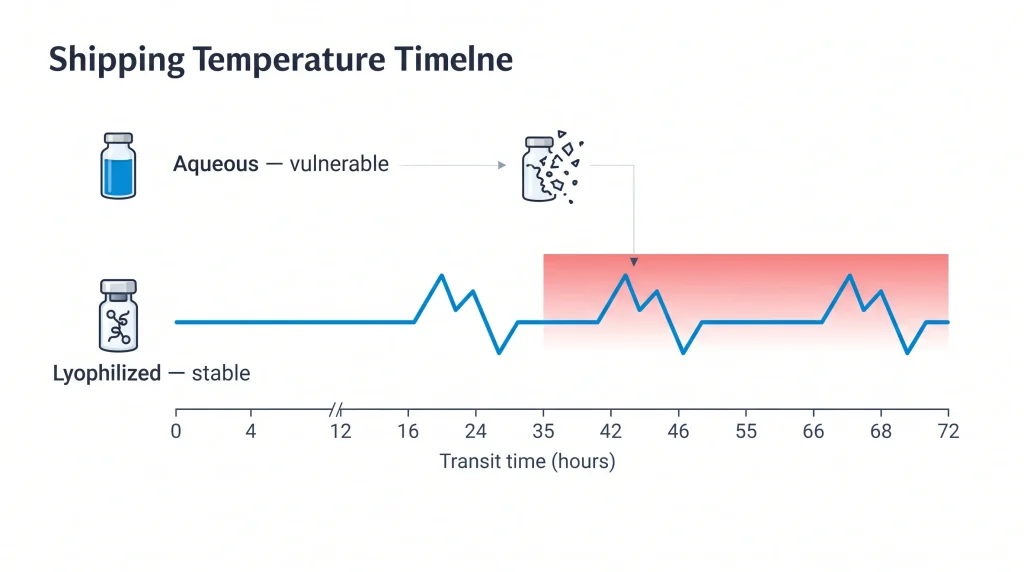
A peptide cold chain shipping protocol uses cold transport (2°C to 8°C) to keep liquid peptide compounds stable. According to PubMed (2000), freeze-dried peptide forms remove more than 95% of moisture. This cuts breakdown risk at room heat. Whether cold chain shipping applies to a research peptide depends on one factor: the physical form of the compound.
Next Level Pharm supplies only freeze-dried research peptides. Each batch is HPLC and mass spec verified before dispatch, with a COA on every order.
Knowing the science of freeze-drying and transit heat helps researchers pick the right storage and handling steps from the moment a shipment arrives.
Key Takeaways
- Freeze-Dried Stability: Freeze-dried peptides hold their structure at room heat (15°C to 30°C) during transit. Residual moisture falls below 1%, removing the main driver of breakdown.
- Liquid vs. Freeze-Dried: Liquid peptides break down faster at higher heat. Freeze-dried forms stay stable until mixing, which removes the need for cold transit in dry vials.
- Heat Risk Zone: Temperatures above 40°C can speed up peptide bond breakdown in any form. Extreme heat during shipping is a risk for all peptide types.
- After Mixing: Once a freeze-dried peptide is dissolved in the buffer, cold storage (2°C to 8°C) is needed. This applies regardless of the pre-mixing state of the dry form.
- Validation Standard: ICH Q1A stability testing runs at 40°C and 75% RH for up to 6 months. This confirms whether a freeze-dried compound can ship at ambient heat.
- COA at Delivery: Third-party HPLC and mass spec confirm purity from the lab through dispatch. This gives researchers a pre-transit reference for each lot.
Each of these factors is covered below, with citations from peer-reviewed research sources.
Are Freeze-Dried Peptides Stable at Room Temperature?
Freeze-dried peptides are often stable at room heat during transit. The freeze-drying process removes water to below 1% residual moisture. Water is the main driver of peptide bond breakdown and oxidation. Without water, most peptide bonds hold intact at standard ambient conditions (15°C to 30°C). Some longer-chain peptides with cysteine residues show slightly lower ambient strength, but most freeze-dried research compounds tolerate ambient shipping with no notable purity loss.
The freeze-drying process removes moisture in two stages. Primary drying removes free water under vacuum. Secondary drying removes bound water. Together, these steps create a stable, glass-like matrix. This slows molecular motion and limits breakdown reactions. According to PubMed (2010), freeze-dried peptide forms stored at 25°C showed no notable purity loss over a 12-month test period. This supports ambient shipping as a viable option for freeze-dried research compounds.
What Does Cold Chain Actually Protect?
Cold chain shipping (2°C to 8°C) protects liquid peptide forms from heat-driven breakdown. In aqueous solution, peptide bonds are vulnerable to hydrolytic cleavage. High heat speeds up this reaction. Cold chain also slows oxidation of methionine and cysteine residues. For freeze-dried peptides, where moisture is absent, the cold chain becomes relevant only after mixing, not during transit.
This distinction matters for lab sourcing. Researchers ordering freeze-dried peptides do not need cold-receiving procedures. They can accept a vial at ambient heat, verify the certificate of analysis lot number, and store the sealed vial at room heat until mixing. Researchers ordering liquid compounds, however, need intake steps that keep cold from carrier to storage.
Cold chain protects against three main breakdown pathways in liquid peptides:
- Heat cleavage: water cuts peptide bonds faster at higher heat.
- Oxidation: reactive residues (methionine, cysteine, tryptophan) modify faster with heat.
- Clumping: peptide clumping rises when heat raises molecular contact rates.
How Does Transit Temperature Affect Potency?
Transit heat affects peptide strength through two main chemical paths: hydrolysis and oxidation. Cleavage cuts peptide bonds when water is present. Oxidation modifies residues such as methionine, tryptophan, and cysteine. Both reactions speed up with heat: each 10°C rise raises the rate. According to PubMed (2016), a 10°C rise in storage heat can double or triple the breakdown rate of peptide compounds in water.
For freeze-dried compounds, the risk is lower but not zero. Extreme heat above 50°C can affect the glassy matrix by raising molecular mobility. Standard US transit conditions rarely exceed 40°C for extended periods. Each lot carries HPLC data generated before dispatch, confirming purity before the shipment leaves the facility. Packaging is tested to buffer brief heat spikes during transit.
Which Peptides Require Refrigerated Transport?
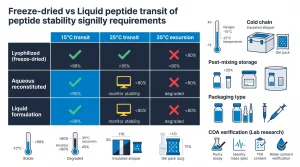
Liquid peptides require refrigerated transport at 2°C to 8°C. Peptides dissolved in water or buffer break down even at room heat, because water drives the reaction at all temperatures. The rate rises sharply with heat. Once a freeze-dried peptide is dissolved, cold storage is required and the compound should be shipped on ice if transferred between labs. Sealed, dry vials do not require a cold chain. The table below shows the key differences.
| Feature | Freeze-Dried Peptide | Liquid Peptide |
| Cold chain during transit? | Not required | Required (2°C to 8°C) |
| Room-temperature stability | Stable (15°C to 30°C) | Unstable (breakdown begins immediately) |
| After-mixing storage | Cold (2°C to 8°C) required | Cold (2°C to 8°C) required |
| Packaging | Sealed vial with barrier foil | Insulated box with cold packs |
| Main transit risk | Moisture exposure if seal fails | Heat excursions degrade purity |
| COA relevance | Purity at manufacture; stable reference | Purity at manufacture; risk of transit loss |
Some complex peptides have extra stability concerns even in freeze-dried form. Peptides with multiple disulfide bonds can shift under high moisture during transit. Barrier foil with desiccant is used alongside freeze-drying for this reason. Reviewing peptide purity testing data before and after transit helps confirm form integrity regardless of shipping method.
How Is Transit Stability Validated?
Transit testing follows ICH Q1A(R2) accelerated stability protocols. The standard test runs at 40°C and 75% relative humidity (RH) for 6 months. Samples are tested at 1, 3, and 6 months. Purity, potency, and visual appearance are recorded at each point. If results show no major change (less than 5% purity loss), the compound is deemed stable under ambient conditions. Some suppliers also run real-time shipping studies with heat loggers.
According to PubMed (2015), test data from ICH Q1A conditions matches real-world outcomes for freeze-dried peptide forms when moisture is held below 60% RH. COA-confirmed compounds from quality suppliers include batch-specific test data. Researchers can request lot-specific records when sourcing compounds for long studies. This is separate from the standard COA, which confirms purity at time of manufacture.
What Should Researchers Check After Receiving a Shipment?
Researchers should check three things after receiving a freeze-dried peptide vial. First, inspect the vial for cracks, broken seals, or visible particles. Second, confirm the lot number on the vial matches the COA provided with the order. Third, check the powder for a uniform white or off-white color with no signs of caking or moisture exposure.
Browse research-grade peptides at Next Level Pharm. Each vial ships with a COA and third-party testing records card. HPLC and mass spec data confirm purity before dispatch.
The fourth step is cross-referencing the COA purity percentage with the product spec. Research peptides from quality suppliers average 99.4% purity across the last 100 batches, confirmed by HPLC and mass spec. Any lot outside the ≥99% threshold is held before dispatch. Researchers should log the lot number and purity value before mixing or storing the compound.
Frequently Asked Questions
Does cold chain shipping affect peptide purity?
For freeze-dried peptides, ambient shipping does not greatly affect purity when the vial is sealed and protected from moisture. Liquid peptides can show purity loss if temperatures rise above 8°C for extended periods. A COA documents purity at manufacture. Researchers should request lot-specific data to set a pre-transit baseline and compare it against any post-receipt tests they run in the lab.
What temperature damages a freeze-dried peptide?
Freeze-dried peptides begin to show clear breakdown above 50°C to 60°C in tests, depending on the peptide sequence. Standard US ambient transit heat (15°C to 35°C) stays within the safe zone for most freeze-dried compounds. Brief exposure to 40°C is usually tolerated for less than 24 hours. Moisture control through barrier foil packaging is the greater protective factor for dry vials during transit.
Which peptide properties affect ambient shipping stability?
Amino acid composition is the primary factor. Peptides with methionine, cysteine, or tryptophan residues are more prone to oxidation even in dry form. Chain length plays a role as well: longer sequences have more sites for potential breakdown. Peptides with multiple disulfide bonds face shifting risk under high moisture. Most freeze-dried research peptides tolerate ambient transit without major change when properly packaged and sealed.
Is BAC water affected by transit heat?
BAC water is a separate lab reagent with its own storage label. It is stable at room heat when sealed. It does not require a cold chain during transit when the seal is intact. Researchers should follow the product label for their BAC water source and confirm the lot number and sterility before use in any lab reconstitution step.
How do researchers confirm purity after shipping?
The COA with each batch documents purity at the time of manufacture and serves as the pre-transit reference. After receipt, researchers who need post-transit confirmation can run HPLC on a small test portion. Mass spec can confirm the molecular weight profile matches the reference standard. For most freeze-dried peptide research, the supplier COA and proper cold storage after mixing are sufficient records.
Do GLP-1 receptor agonist research peptides need a cold chain?
GLP-1 receptor agonist research peptides in freeze-dried form do not require a cold chain during transit. Like other freeze-dried research compounds, these peptides are stable at ambient heat when sealed. Once dissolved in a buffer, they require cold storage and should be handled per standard lab storage protocols for liquid peptides. The physical form (freeze-dried vs. liquid) determines transit requirements, not the compound class.
What packaging is used for peptide shipments?
Most research peptide suppliers ship freeze-dried compounds in sealed glass vials inside barrier foil pouches with desiccant packets. The outer packaging is a cardboard mailer or rigid box. Liquid peptides ship in insulated packaging with cold packs. Freeze-dried peptides ship in sealed vials with a COA and third-party testing records card, in packaging tested for ambient transit without cold chain.
What is the difference between accelerated and real-time stability testing?
Real-time stability testing stores samples at the intended long-term conditions (for example, -20°C or 4°C) for the full study duration. These studies may last years. Fast testing runs at high heat (40°C) and moisture (75% RH) for 3 to 6 months. ICH Q1A defines the science link between accelerated and real-time data. Both methods help predict shelf life and confirm ambient shipping strength for freeze-dried peptide forms.
How long can a freeze-dried vial sit at room temperature?
Under controlled conditions (below 25°C, below 60% RH, sealed vial), most freeze-dried research peptides remain stable for 12 to 24 months. Peptides with reactive residues may have shorter windows. Suppliers list shelf life on the COA or product data sheet. For highest purity at point of use, store sealed vials in a cool, dry spot away from direct light. Use them within the documented shelf life.
Summary
Cold chain shipping is required for liquid peptides that are susceptible to heat-driven breakdown. Freeze-dried research peptides are stable at ambient transit heats because the freeze-drying process removes the moisture that drives these reactions. Once dissolved in the buffer, cold storage becomes necessary for all peptide forms. Transit validation through ICH Q1A accelerated stability protocols provides the research basis for ambient shipping claims. Researchers should verify the COA lot number upon receipt and confirm purity meets specification before any lab work.
What Should You Do Next?
Review the batch-specific COA for any research peptide before ordering to confirm purity and test records. Check whether the compound is supplied as freeze-dried or liquid, as this determines transit storage requirements. Shop research-grade peptides at Next Level Pharm. Each batch is HPLC and mass spec verified before dispatch. Average purity is 99.4% across the last 100 batches.
People Also Read
- What Is Lyophilization? How Freeze-Drying Preserves Peptide Integrity
- What Makes a Peptide Research Grade? Standards and Testing Explained
About the Author
Next Level Pharm Research Team
The Next Level Pharm research team is composed of biochemists and lab scientists dedicated to providing researchers with the highest-purity, COA-verified research peptides available. Every batch is HPLC and mass spec verified before dispatch.
Disclaimer: The information provided on this page is for educational and research purposes only. Next Level Pharm’s products are intended for lab research use only. They are not intended for human consumption, diagnostic, therapeutic, or medicinal purposes. This content does not constitute medical advice. Always consult a licensed healthcare professional before making any health-related decisions.