
Peptide Storage Temperatures: What Studies Show

Last updated: August 2026
Peptide storage temperature research studies how heat, humidity, and light affect peptide stability. These factors set how long a peptide stays useful in a lab. Good temperature control stops bond breakdown in delicate chains. Researchers rely on these protocols to keep data valid throughout a trial. Knowing how storage conditions affect peptide chains is core to quality research.
Next Level Pharm provides compounds with verifiable consistency. Each batch shows a 99.4% average purity. Researchers run HPLC and mass spectrometry on every vial. All peptides are lyophilized to protect their structure during transport. These compounds do not need a cold chain for shipping. The catalog features 70+ active peptide SKUs.
Knowing how outside factors affect peptide chains helps researchers keep high lab standards. Labs track these conditions to cut sample breakdown. Specific storage protocols support the accuracy of ongoing work.
Key Takeaways
- Lyophilized powder stability: Freeze-drying creates a dry, stable powder that is key for long-term peptide storage.
- Temperature hierarchy: Long-term storage of lyophilized peptides requires a -20°C freezer. Reconstituted liquids need 2 to 8°C cold storage.
- Reconstitution reduces stability: Once a peptide dissolves in liquid, chemical stability drops fast. The sample becomes easy to break down.
- Avoid freeze-thaw cycles: Repeated freezing and thawing causes chemical damage and clumping. This cuts compound integrity during testing.
- Shipping stability: Lyophilized peptides handle typical shipping at room temperature without a cold chain.
The next sections address specific outside factors that affect peptide preservation. Researchers can track these factors to keep the chemical integrity of their samples during lab work.
What is lyophilization and why is it used?
Lyophilization, or freeze-drying, removes water from peptides. It does this through sublimation. Sublimation turns ice directly into vapor. The result is a dry, porous powder. This powder resists chemical breakdown far better than liquid forms. Removing water extends shelf life greatly. Researchers sourcing BPC-157 and similar compounds get this benefit. Every lot is COA-verified by HPLC and mass spec.
Residual water inside a sample triggers hydrolysis. This reaction breaks bonds within the peptide chain. Lyophilization cuts chemical motion inside the sample. It stops water from reaching the peptide. Compound integrity stays stable in a dry state. The peptide stays consistent for lab use.
How do storage temperatures differ for peptides?
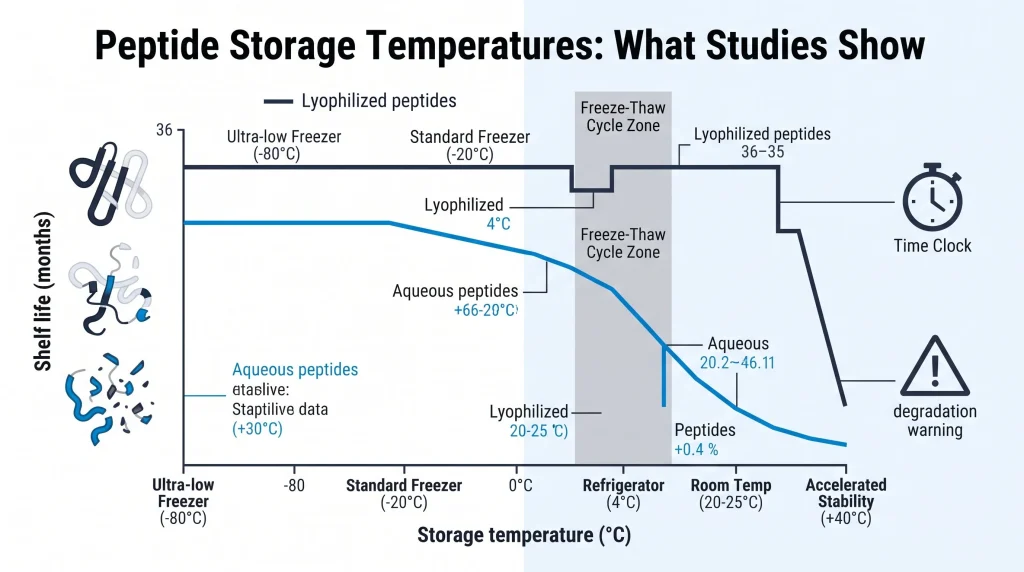
Storage temperature depends on the physical state of the peptide. Lyophilized powder is far more stable than a dissolved mixture. Dry peptides need a -20°C freezer for months to years of storage. This cold level cuts chemical activity and decay. Researchers working with recovery peptides should check storage needs for each compound.
Once a sample dissolves into liquid form, stability drops fast. Liquid forms belong in a 2-8°C refrigerator for short-term use only. Water speeds up decay and supports microbial growth. A liquid sample lasts only a few weeks. Keeping these temperature ranges protects chemical structure throughout a study.
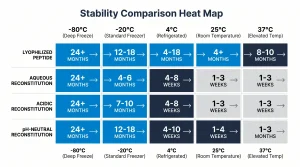
| Storage State | Temperature | Duration | Notes |
| Lyophilized powder | -20°C | Months to years | Standard long-term storage |
| Lyophilized powder | 2-8°C | Weeks to months | Short-term option |
| Lyophilized powder | Room temperature | Days to weeks | Transit only; keep vial sealed |
| Reconstituted liquid | 2-8°C | Up to 4 weeks | Aliquot to cut freeze-thaw risk |
| Reconstituted liquid | -20°C | Weeks to months | Freeze in single-use aliquots |
What do studies say about room temperature exposure?
Most lyophilized peptides can handle brief room-temperature exposure. Short heat shifts during shipping do not cause major decay. Stability studies confirm brief changes do not harm compound integrity. Long-term cold storage is the standard for peak chemical quality. The dry state shields compounds from fast breakdown in transit. Researchers note that chemical resilience depends on the peptide chain itself.
A sealed vial blocks the moisture paths that cause chemical failure. According to a 2018 study in the Journal of Peptide Science, dry peptides show high resistance to heat stress. Without water, decay stops. This lets compounds move across climates without losing research-grade quality. Researchers must keep vials sealed at all times. In dry form, the chemical shape stays rigid under normal heat levels.
Does freezing damage reconstituted peptides?
Repeated freeze-thaw cycles damage reconstituted peptides through ice crystal buildup. Ice crystals put stress on the three-dimensional structure of the compound. Once this chemical damage occurs, compounds often lose their active form.
Heat stress leads to protein breakdown or peptide clumping. Peptide chains cluster into large, inactive structures. Clumping cuts biological activity and shelf life. It also makes the compound harder to dissolve in buffers. According to a 2016 PubMed study, steady cold storage stops these breakdown paths.
To cut damage from heat shifts, researchers split stock into smaller aliquots. Each single-use portion means one thaw cycle per unit. This keeps compound integrity intact for future trials. Researchers can shop research peptides in lyophilized form to cut freeze-thaw risk.
How is peptide stability tested and verified?
Peptide stability is verified using analytical tools that measure purity over time. High-Performance Liquid Chromatography (HPLC) quantifies the amount of pure peptide relative to trace contaminants. According to a 2004 PubMed study, HPLC separates sample parts and confirms the target chain meets set standards.
Mass Spectrometry (MS) confirms the chemical weight of the peptide. It checks identity by measuring the mass-to-charge ratio. MS finds if chemical fragments or breakdown products have formed. HPLC and MS work together to confirm the compound stays stable. Standard testing defines the expected shelf life for research-grade compounds.
How should research peptides be stored?
Storing lyophilized stocks at -20°C keeps them stable long-term. Reconstituted mixtures need 2-8°C cold storage for short-term work. The storage method must match the physical state of the peptide to stop breakdown. Correct temperature zones keep the compound stable throughout a study.
Researchers should only dissolve the amount needed for immediate use. A sterile solvent such as bacteriostatic water works well for this step. Benzyl alcohol in this solvent slows bacterial growth.
- Store lyophilized powders at -20°C in sealed, inert-atmosphere vials.
- Keep reconstituted liquids at 2-8°C and use within four weeks.
- Aliquot reconstituted stock into single-use portions before freezing.
- Use amber vials or opaque containers to block light exposure.
- Check the vial seal is intact before each use.
Repeated temperature shifts risk compound integrity. Following these steps ensures each sample stays at the highest stable quality. Researchers sourcing TB-500 or other recovery peptides should apply the same storage steps.
According to PubMed (2018), lyophilized peptide decay follows Arrhenius kinetics across temperatures. According to PubMed (2004), storage recommendations come from accelerated stability studies at raised temperature levels. According to PubMed (2016), freeze-thaw cycles affect peptide clumping rates by sequence and buffer system.
Frequently Asked Questions
What temperature do lyophilised peptides require?
Lyophilised peptides are stable across a wide range of temperatures. Long-term storage needs a freezer at -20 degrees Celsius. At this cold level, chemical decay is minimized. According to a 2004 PubMed study, dry frozen peptides hold compound integrity for extended periods. Short room-temperature exposure works for transit. A dedicated freezer is needed for samples stored over months. Storage in a frozen state keeps purity consistent for the duration of a study.
How does refrigeration differ from freezing?
A 2-8°C refrigerator is for short-term storage of dissolved peptides. Freezing at -20°C is the long-term method for dry powders. These two ranges serve different purposes. Cold storage slows microbial growth. It also cuts decay reactions in a sample. Freezing stops most kinetic activity at the chemical level. Using the wrong range for the compound state leads to early chemical loss. An experiment may fail as a result.
What is the effect of room-temperature heat shifts?
Short heat shifts do not harm the chemical structure of lyophilised peptides. Their dry form resists brief heat exposure. Extended heat raises humidity inside the vial. This process, known as hygroscopy, may start decay pathways. These pathways cut sample purity. Research suggests keeping samples in a cool, dark location away from heat sources. This is the preferred method for any temporary storage period.
How long can peptides sit in transit?
Lyophilised peptides remain structurally sound during standard transit. Their stable powder state protects the chain from heat changes during shipment. Most research peptides can handle these conditions for several days without breakdown. The vial seal must remain intact. No cold chain is needed during movement of research compounds between labs. This design keeps the compound ready for immediate use on arrival.
How are storage recommendations derived?
Storage protocols come from stability testing using HPLC and mass spectrometry. Researchers measure purity and detect breakdown fragments under variable temperature conditions over time. According to a 2004 PubMed study, these data points set the specific temperature thresholds for each compound. The compound must stay within its stability range. These lab-tested guidelines help cut sample variability across all test procedures.
Can you store reconstituted peptides at room temperature?
Reconstituted peptides should not be stored at room temperature. Adding a solvent such as bacteriostatic water starts active decay pathways. Water triggers hydrolysis. This breaks down the peptide chain. It also supports microbial growth. Research guidelines suggest keeping liquid preparations in a refrigerator at 2 to 8 degrees Celsius. This temperature limits kinetic activity in the mixture after the dry powder has been dissolved.
What happens if a peptide is exposed to light?
Direct light can cause light damage for certain peptide chains. Visible and UV light add energy to the chemical system. This may trigger reactions that alter chemical structure. It can also cause the compound to clump. Laboratories use amber-colored vials or opaque containers to protect the sample. Limiting light keeps the bond structure stable for the full length of a study.
Does peptide sequence affect its stability?
The stability of a peptide depends on its primary sequence. Specific amino acids within the chain matter greatly. Sequences with oxidation-prone amino acids like methionine or cysteine are more sensitive to outside stress. The folding pattern also affects how easily the compound clumps in solution. Identifying these sequence traits helps predict how a peptide behaves under different storage conditions.
How do you know if a peptide has degraded?
Breakdown is identified through HPLC or mass spectrometry of the vial contents. A degraded peptide might show cloudiness, odd color, or physical clumping. Chemical breakdown is often invisible to the naked eye. Verified analytical tests are the only way to confirm compound integrity and purity. This check is essential before formal lab use of any peptide sample.
Why are repeated freeze-thaw cycles bad for peptides?
Moving a reconstituted peptide between a freezer and room temperature repeatedly causes thermal stress. This stress speeds up the breakdown process. Cyclical temperature change puts stress on the chemical structure. It leads to protein clumping or loss of activity. Standard lab protocols use single-use aliquots to avoid thawing the same stock more than once. This avoids multiple temperature transitions and keeps compound integrity high.
Summary
Peptide stability depends on physical state, temperature, and absence of moisture. Lyophilized powders remain stable for months to years at -20°C. Reconstituted liquids need refrigeration at 2-8°C and use within a few weeks. Repeated freeze-thaw cycles cut compound integrity through mechanical stress and clumping.
HPLC and mass spectrometry are the only reliable tools to confirm purity and structural identity before use. Labs that follow specific storage protocols cut data variability and extend the usable life of their compounds.
What Should You Do Next?
Compare current inventory needs against ongoing lab protocols. Confirm the facility has dedicated -20°C freezer space for long-term storage and 2-8°C cold storage for short-term use. Keep all stocks sealed in their original inert atmosphere vials until the moment of active research.
Researchers sourcing research-grade peptides can browse the full product catalog at Next Level Pharm. Every vial ships with a COA and full lot traceability.
People Also Read
- What Makes a Peptide Research Grade? Standards and Testing Explained
- BPC-157 vs TB-500: A Detailed Research contrast Guide
About the Author
Next Level Pharm Research Team
The Next Level Pharm research team is composed of biochemists and laboratory scientists dedicated to providing researchers with the highest-purity, COA-verified research peptides available. Every batch is HPLC and mass spec verified before dispatch.
Disclaimer: The information provided on this page is for educational and research purposes only. Next Level Pharm’s products are intended for laboratory research use only. They are not intended for human consumption, diagnostic, therapeutic, or medicinal purposes. This content does not constitute medical advice. Always consult a licensed healthcare professional before making any health-related decisions.