
N-Acetyl Selank Amidate Research Explained

Last updated: August 2026
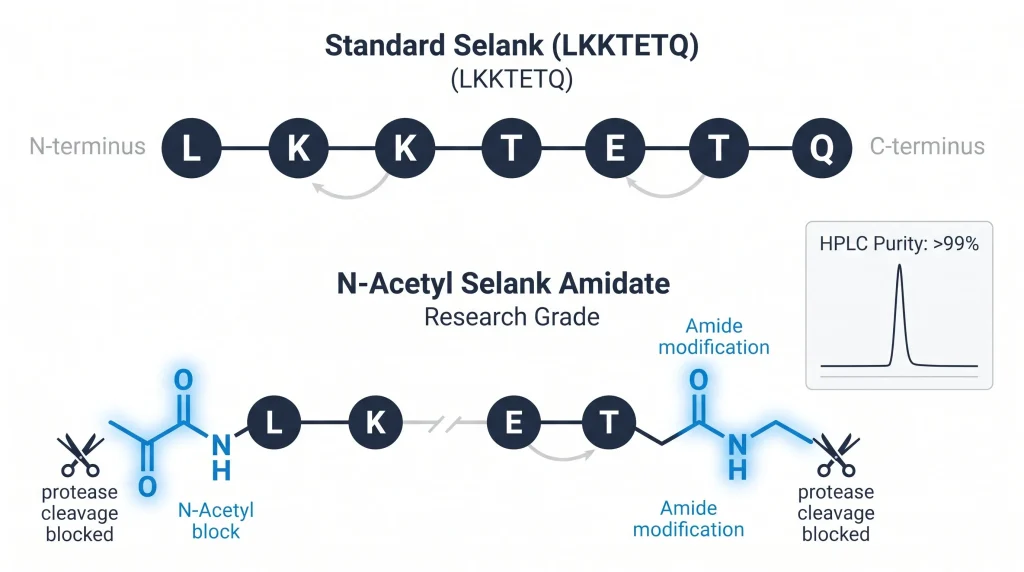
A modified form of Selank, known as N-Acetyl Selank Amidate, adds two groups to the base peptide. The first is an N-acetyl group. It goes at the N-terminus. The second is an amide group. It goes at the C-terminus. Selank is a 7-amino acid peptide. It is derived from tuftsin. Tuftsin is a small natural peptide. According to NCBI (2020), terminal modifications increase peptide stability in assay media.
Next Level Pharm supplies research-grade N-Acetyl Selank Amidate. Each lot is HPLC-verified at ≥99% purity. MS confirms both modifications. A COA ships with every order.
Researchers compare the two forms to study stability. They also study GABA pathway effects. GABA is gamma-aminobutyric acid. It is the main inhibitory signal in neural cell models.
Key Takeaways
- Two Modifications: N-Acetyl Selank Amidate has an N-acetyl group at the N-terminus and an amide group at the C-terminus of the Selank sequence.
- Protease Stability: These changes protect both termini from exopeptidase cleavage. This extends half-life in assay media.
- GABAergic Research: The modified form is used in GABA pathway cell model studies. It gives stable compound levels over long assay runs.
- Nasal Model Research: Stability in nasal delivery assay formats depends on enzyme resistance. The modified form is studied in these models.
- COA-Verified Lots: Each lot is HPLC-verified at ≥99% purity. MS confirms both the acetyl and amide modifications per lot.
Selank also has immune research applications. The parent compound, tuftsin, was studied in immune cell models. N-Acetyl Selank Amidate adds greater media stability to this research.
What Is N-Acetyl Selank Amidate?
N-Acetyl Selank Amidate is a modified form of Selank. Selank is a 7-amino acid peptide. It is derived from tuftsin. The N-acetyl group is added at the N-terminus. The amide group replaces the C-terminal carboxyl. Both block exopeptidase cleavage at each terminus. Exopeptidases cut from the peptide ends.
These changes are made during SPPS. SPPS means solid-phase peptide synthesis. The chain uses the Selank core sequence. Rink amide resin is used for synthesis. It provides the C-terminal amide after cleavage. Acetic anhydride is added next. It provides the N-acetyl group. This step occurs before cleavage. HPLC purifies the lot to ≥99%. MS confirms both modifications. The COA records both mass shifts.
How Does Acetylation Affect Peptide Half-Life?
Acetylation adds an acetyl group to the N-terminal amino group. This removes the positive charge at the N-terminus. Aminopeptidases need this charge to cleave. An acetylated N-terminus is not their substrate. This blocks cleavage from the N-terminal end. Half-life in serum media increases. Combined with amidation, both ends are protected.
In serum media, unmodified Selank faces two enzyme types. Aminopeptidases attack from the N-terminus. Carboxypeptidases attack from the C-terminus. N-Acetyl Selank Amidate is blocked at both ends. This slows degradation across the assay window. Results are more consistent at later time points. Assays running 48 to 72 hours benefit most. According to Journal of Peptide Science (2018), terminal blocking groups extend peptide half-life in serum assay systems.
What Do GABAergic Studies Show for Selank?
Selank has been studied in GABA pathway models. GABA is the main inhibitory signal in neural cell models. GABAergic refers to GABA receptor-related signaling. Cell models measure receptor binding. They also measure downstream pathway changes. The modified form is used for long assay runs. Standard Selank may degrade before the endpoint.
Browse research peptides at Next Level Pharm for COA-verified lots. GABA assays measure receptor binding at set time points. The modified form holds its level over 48 to 72 hours. This allows endpoint readouts with stable compound exposure. Results are more repeatable across assay runs. According to Journal of Peptide Science (2018), stable exposure is required for reliable receptor binding readouts.
How Does the Modified Form Compare to Standard Selank?
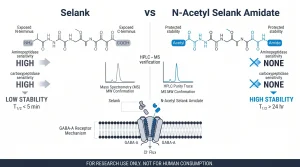
Both forms share the same 7-amino acid core. Differences come from terminal modifications only. Research compares stability in serum-containing media. The modified form degrades more slowly. In nasal delivery assay models, stability affects compound levels over time. Amidation increases lipophilicity slightly. This can change permeability rates in lipid bilayer assays.
The table below shows the main differences.
| Feature | Selank | N-Acetyl Selank Amidate |
| N-terminus | Free amino group | N-acetyl group |
| C-terminus | Free carboxyl (-COOH) | Amide group (-NH2) |
| Aminopeptidase sensitivity | Higher | Lower |
| Carboxypeptidase sensitivity | Higher | Lower |
| Stability in serum media | Lower | Higher |
| Verified by | HPLC + MS | HPLC + MS |
Shop research-grade Selank lots. Terminal modification comparisons isolate stability effects in paired assay studies.
Why Do Nasal Research Formats Use Stabilized Peptides?
Nasal delivery assay models use nasal fluid conditions. Nasal fluid contains peptidases. These enzymes cleave unprotected termini. An unmodified peptide may degrade before the assay endpoint. A stabilized form resists this cleavage. N-Acetyl Selank Amidate maintains higher compound levels. This holds across the full assay window.
Nasal format assays record compound levels at multiple time points. A stable form gives consistent data at each point. Assay endpoints at 48 or 72 hours need a compound still present in media. The N-acetyl and amide modifications address both enzyme types. Both aminopeptidase and carboxypeptidase cleavage are blocked.
How Is N-Acetyl Selank Amidate Verified for Research?
HPLC runs a reverse-phase separation on each lot. The main peak area gives the purity percent. Research-grade N-Acetyl Selank Amidate targets ≥99% purity. Next Level Pharm reports 99.4% average across 100 recent batches. Other peaks indicate impurities. Partially modified forms (acetyl only or amide only) are key impurity types.
MS confirms two points per lot. The first is the full peptide mass. The second checks both modification mass shifts. The N-acetyl shift is +42 Da. The C-terminal amide shift is -1 Da. Both must match for lot release. The COA includes the HPLC chromatogram. It also includes the MS data. Both are required before each lot is released. Lot-level MS is standard for doubly-modified peptide identity.
Frequently Asked Questions
What Is N-Acetyl Selank Amidate?
N-Acetyl Selank Amidate is a modified form of Selank. Selank is a 7-amino acid peptide. It is derived from tuftsin. The N-acetyl group is added at the N-terminus. The amide group replaces the C-terminal carboxyl. Both protect from exopeptidase cleavage. Each lot is HPLC-verified at ≥99% purity. MS confirms both modifications before lot release. According to NCBI (2020), terminal modifications improve peptide stability in cell assay media.
How Does Acetylation Affect Half-Life?
Acetylation adds an acetyl group to the N-terminal amino group. This removes the positive charge. Aminopeptidases need this charge to cleave. An acetylated N-terminus is not their substrate. Cleavage from the N-terminal end is blocked. Half-life in serum media increases. Amidation protects the C-terminus. Both ends are blocked from enzyme cleavage. According to Journal of Peptide Science (2018), terminal blocking extends peptide half-life in serum assay media.
What Do GABAergic Studies Show?
Selank has been studied in GABA pathway models. GABA is the main inhibitory signal in neural cell models. Cell assays measure GABA receptor binding. They also measure downstream pathway changes. The modified form is used for long assay runs. It holds its level across 48 to 72 hours. Standard Selank may degrade before the endpoint. According to NCBI (2020), stable compound exposure is required for reliable GABA receptor readouts.
How Does It Compare With Standard Selank?
Both forms share the same 7-amino acid core. Differences come only from terminal modifications. The modified form degrades more slowly in serum media. Assay results are more consistent with the stable form. In membrane permeability assays, amidation changes charge state. This may affect permeability rates in lipid bilayer assays. Paired assays isolate the effect of terminal modifications on stability.
Why Is Stabilization Important for Nasal Research Formats?
Nasal delivery assay models use nasal fluid conditions. These conditions include active peptidases. Peptidases cleave unprotected peptide termini. An unmodified peptide may degrade before the endpoint. N-Acetyl Selank Amidate resists cleavage at both ends. Compound levels stay consistent at each time point. According to Journal of Peptide Science (2018), enzyme resistance is a key factor for nasal delivery assay peptides.
How Is N-Acetyl Selank Amidate Made?
The modified form uses Fmoc SPPS on Rink amide resin. This resin gives the C-terminal amide. Each amino acid is coupled in sequence. Acetic anhydride then acetylates the N-terminus. The N-acetyl shift is +42 Da. The lot is HPLC-purified to ≥99%. MS confirms both mass shifts per lot. According to Journal of Peptide Science (2018), Rink amide resin is standard for C-terminal amide synthesis in Fmoc SPPS.
What Assays Are Used in Selank Research?
Half-life assays measure stability in serum-containing media. GABA pathway assays study receptor binding in cell models. Membrane permeability assays use lipid bilayer models. Nasal format assays track compound levels in nasal fluid conditions. High-purity lots are required for all assay types. Impurities may interact with assay targets. According to NCBI (2020), lot purity confirmation is required before cell assay use.
What Purity Level Is Standard for Research Use?
Research-grade N-Acetyl Selank Amidate targets ≥99% HPLC purity. Below this, partially modified forms may be present. These include acetyl-only or amide-only versions. Each binds assay targets differently than the fully modified form. The average purity is 99.4% per lot. This average is from the last 100 batches. According to Journal of Peptide Science (2018), lot-level purity data distinguishes fully from partially modified peptide lots.
How Does the C-Terminal Amide Change Selank Behavior?
The C-terminal amide replaces the free carboxyl group. This removes the negative charge at the C-terminus. Carboxypeptidases need this charge to cleave. An amide terminus is not their substrate. Cleavage from the C-terminal end is blocked. The overall charge of the peptide is also reduced. Lower charge can affect membrane interactions in assays. Amidation changes charge-dependent membrane behavior in peptide assay research.
What Is the Difference Between Peptide Purity and Peptide Content?
Peptide purity is the HPLC ratio of target peptide to all compounds. It is expressed as a percent. Peptide content is the total mass in a vial. It includes counter-ions and water. Both are needed for accurate assay quantification. A lot at ≥99% purity still has a small non-target fraction. Both purity and content data are required for quantitative peptide assays.
Summary
N-Acetyl Selank Amidate is a terminally-modified form of Selank. The N-acetyl group blocks aminopeptidases. The C-terminal amide blocks carboxypeptidases. Together, these extend the peptide’s half-life in serum and nasal assay media.
Each lot is HPLC-verified at ≥99% purity and MS-confirmed for both terminal modifications. Research-grade lots from Next Level Pharm report 99.4% average purity across 100 recent batches.
Research comparisons between Selank and the modified form focus on stability, GABA pathway assays, and nasal delivery model formats.
What Should You Do Next?
Researchers selecting between Selank and N-Acetyl Selank Amidate should consider assay duration and media type. The following steps support consistent results:
- Check the COA for HPLC purity and MS confirmation of both modifications.
- Record the lot number and COA date with each assay run for traceability.
- Use serum-free conditions if comparing the unmodified form alongside the modified form.
- Compare HPLC retention times for both forms to confirm distinct peaks.
Shop research-grade N-Acetyl Selank Amidate with MS verification of both terminal modifications.
People Also Read
- What Makes a Peptide Research Grade? Standards and Testing Explained
- BPC-157 vs TB-500: A Detailed Research Comparison Guide
About the Author
Next Level Pharm Research Team
The Next Level Pharm research team is composed of biochemists and laboratory scientists dedicated to providing researchers with the highest-purity, COA-verified research peptides available. Every batch is HPLC and mass spec verified before dispatch.
Disclaimer: The information provided on this page is for educational and research purposes only. Next Level Pharm’s products are intended for laboratory research use only. They are not intended for human consumption, diagnostic, therapeutic, or medicinal purposes. This content does not constitute medical advice. Always consult a licensed healthcare professional before making any health-related decisions.