
Enclomiphene Research: SERM System Studies


Last updated: July 2026
An enclomiphene SERM mechanism research compound is a non-steroid estrogen receptor modifier (SERM). It blocks estrogen receptors in the hypothalamus. This action breaks feedback loops. It triggers the pituitary gland to release more luteinizing hormone and follicle-stimulating hormone. Phase II lab trials tested this method. They showed it raised both hormones in study subjects (PubMed, 2011). These changes show a main effect on the hypothalamic-pituitary-gonadal axis in focused lab studies.
Next Level Pharm keeps strict quality standards for all research compounds. Its lab work checks each batch hits ≥99% purity. The last 100 batches hit 99.4% purity. Each vial has HPLC and mass spec testing to check makeup. These vials are freeze-dried and sealed in inert gas for shelf life. This keeps products steady at room temp. No cold chain is needed.
This compound is being studied as a tool. It helps scientists learn how the body’s hormone signals work. Unlike steroids, this substance binds less strongly to estrogen receptors. This creates a unique profile for study. Scientists study these pathways to learn how shifts in estrogen action change inner signals. These research models focus on testing how the hypothalamus works. They study gonadal axis changes in set terms. This uses exact chemical signals to track shifts in cell markers. This is done over set study times. Clear data lets scientists see steady results across many test runs.
Researchers can browse research-grade SERMs and related peptides at the research catalog.
Key Takeaways
- Estrogen receptor shifts: Enclomiphene blocks bad feedback in the hypothalamus. This is a set estrogen receptor action. It raises the body’s own hormone output.
- HPG axis action: Research shows that blocking estrogen receptors pushes the pituitary to release more LH and FSH. These hormones are the main focus for HPG axis studies.
- Difference from clomiphene: This compound is the trans-isomer of clomiphene citrate. It is other than the cis-isomer zuclomiphene. It has other traits than the mixed isomer form of the drug.
- Non-peptide chemical structure: The compound is a small molecule triphenylethylene product rather than a peptide chain. It does not contain amino acids used for chain-based signals in cell pathways.
- Focus on hormone research: Current research highlights its effect on test levels, LH, and FSH in study groups. It is often reviewed for its role in secondary hypogonadism research.
The key findings above clarify the chemical role this substance plays in the hypothalamic-pituitary-gonadal axis. Researchers now test how exact structure traits affect study results. They study long-term body shifts in set lab terms.
What is a Select Estrogen Receptor Modifier?
A Select Estrogen Receptor Modifier is a class of substance that binds to estrogen receptors. It acts as either an agent or blocker based on the target tissue. These compounds shift hormone pathways by showing tissue-based effects across the body.
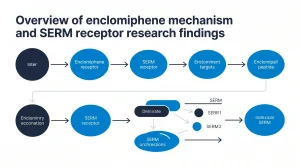
In the hypothalamus, a SERM-like enclomiphene acts as a blocker. It blocks the bad feedback loop of estrogen on the pituitary system. By filling those receptor sites, the compound stops its own estrogen’s signal. It stops the hypothalamus from cutting hormone output. This action often leads to a rise in gonadotropin-releasing hormone (GnRH). Raised levels push the pituitary gland to make more luteinizing hormone (LH) and follicle-stimulating hormone (FSH). Enclomiphene is offered as a COA-checked research tool. Every lot is tested by HPLC and mass spec. The research process focuses on how such receptor shifts affect these set inner signals.
How Does Enclomiphene Affect the HPG Axis?
Enclomiphene affects the hypothalamic-pituitary-gonadal (HPG) axis by acting as a select estrogen receptor blocker. It works at the pituitary gland and hypothalamus. The HPG axis is the key control center for sex hormones. In normal states, blood estrogen attaches to receptors in these tissues. This signals the body to slow hormone output through bad feedback. By blocking estrogen receptors, the compound stops this signal from reaching the brain.
This action forces the pituitary gland to sense a lack of estrogen. It prompts a rise in the release of luteinizing hormone (LH) and follicle-stimulating hormone (FSH). According to Warren et al. (2026), these signal molecules travel to the gonads to help make steroids. This surge in hormone output makes a clear shift in the body’s hormone state. The brain reads low estrogen receptor signals as a sign to raise sex output. This method lets scientists study the main feedback loop without adding new hormones.
Why is Enclomiphene a ‘trans-‘ Isomer?
Enclomiphene is a trans-isomer because its atomic-level structure is built a certain way. The diethylaminoethoxy phenyl group sits across the central double bond from the chlorine atom. Clomiphene citrate is a mix of two isomers. These are the trans-isomer (enclomiphene) and the cis-isomer (zuclomiphene). These forms have the same makeup but are arranged in other ways. This structure-based shift makes clear cell traits. Scientists test these when studying select estrogen receptor modifiers.
The trans-isomer is the key part that blocks estrogen. It helps boost gonadotropins in male research models. In contrast, zuclomiphene acts like estrogen and has a much longer half-life. These shifts in speed and strength mean the two isomers create other cell responses. Enclomiphene is offered as a COA-checked research tool. Every lot is tested by HPLC and mass spec. Researchers often separate these forms to observe the exact shifts of the hypothalamic-pituitary-gonadal axis.
Researchers studying hormone signal pathways can view the full list. Compounds are offered for study at Next Level Pharm.
What Are Enclomiphene’s Research Apps?
Enclomiphene is studied in secondary hypogonadism research. It is valued for its power to raise serum testosterone through hypothalamic push. In the brain, the compound blocks estrogen receptors. This forces the pituitary to signal the testes to make more hormones. Unlike mixed clomiphene compounds, this isolated isomer avoids certain estrogen side effects. Zuclomiphene buildup in research models typically causes these. Lab studies track these rises in their own hormone output. They check that this signal method works.
Lab model studies show that the compound raises release of luteinizing hormone and follicle-stimulating hormone. According to Tienforti et al. (2023), this process keeps serum testosterone in set ranges. This helps study subjects. Enclomiphene is offered as a COA-checked research tool. Every lot is tested by HPLC and mass spec. Researchers review this data. They verify that inner hormone levels stay steady during long-term testing sessions. The lack of unwanted estrogen effects helps lab testing get clearer results about gonadotropin control.
How is Enclomiphene Structurally Different?
Enclomiphene is a small molecule synthetic compound and not a peptide type. Its structure is based on a triphenylethylene core. Unlike peptides (chains of amino acids), this compound is a single, rigid structure. This gives it other body traits compared to larger, complex sequences in standard peptide lists.
Peptides are chains of amino acids. They often need set supply methods to keep their shelf life. The triphenylethylene molecule is a small synthetic item. It has good oral intake for use in lab terms. This, joined with its unique binding profile, shifts how it talks with cell targets. It does not copy the cell-surface receptor binding common in peptide hormones. Enclomiphene is offered as a COA-checked research tool. Every lot is tested by HPLC and mass spec. The structure-based shift ensures a unique role. It matters in hypothalamic-pituitary-gonadal axis research during set studies.
What Do Lab Tests for Enclomiphene Show?
Lab tests for enclomiphene show its purity and chemical identity through standard testing methods. Scientists use High-Performance Liquid Chromatography (HPLC) to gauge the purity. They confirm the identity of a compound. This process splits the mix into its single parts to spot any impurities.
Enclomiphene is offered as a COA-checked research tool. Every lot is tested by HPLC and mass spec.
Mass spectrometry (MS) checks the atomic weight of research chemicals. This is done at the same time during this stage to verify the exact mass. By checking the exact mass, labs verify the sample is the desired isomer. It is not a contaminant or another compound. This two-part testing routine serves as the base for quality check in chemical research. It ensures that the substance offered for private study stays steady with set science standards. Through these methods, researchers trust the material’s strength. They review test data to keep quality steady.
Frequently Asked Questions
What Is Enclomiphene?
Enclomiphene is a non-steroid select estrogen receptor modifier. It functions mainly by blocking estrogen receptors in the hypothalamus. This shift breaks the bad feedback loop. Without it, the body would slow hormone output. By blocking this signal, the compound causes the pituitary gland to act. It raises the release of luteinizing hormone and follicle-stimulating hormone. It is a research tool. Scientists use it to study how the hypothalamic-pituitary-gonadal axis responds to shifts in estrogen signals.
How Do SERMs Affect the HPG Axis?
Select estrogen receptor modifiers affect the hypothalamic-pituitary-gonadal axis by competing with estrogen at receptor sites. In male models, low levels of estrogen signals typically trigger the brain to lower gonadotropin output. By binding to these receptors without turning them on, the compound creates a state. The pituitary gland senses an estrogen lack. This triggers a rise in gonadotropin release. Research shows this pathway shifts hormone output of the testes (PubMed, 2011).
What Do LH and FSH Studies Show?
Studies focusing on follicle-stimulating hormone and luteinizing hormone show that this compound leads to a clear rise in both levels. Tests in set research terms show that the pituitary responds to the sensed estrogen lack by ramping up output of these gonadotropins. According to Achua et al. (2020), this shift is key for studying how the male endocrine system keeps baseline hormone levels. The natural blocking signal pathways are briefly blocked or shifted in these studies.
How Does Enclomiphene Differ From Clomiphene?
Enclomiphene is the trans-isomer of clomiphene. Clomiphene citrate exists as a mix holding both enclomiphene and the cis-isomer zuclomiphene. While enclomiphene has clear anti-estrogenic traits in the hypothalamus, zuclomiphene shows more estrogenic activity. It has a much longer cell half-life. Researchers favor the isolated isomer to avoid the unwanted estrogenic effects. These come with the long buildup tied to the mixed makeup found in standard clomiphene citrate.
Why Is It Not a Peptide?
This compound is not a peptide because it does not consist of a chain of amino acids. It is sorted as a small molecule derived from triphenylethylene. Peptides work through exact sequences of amino acids. They bind to surface receptors. In contrast, this molecule talks with inner nuclear estrogen receptors. Its chemical structure and method of activity do not match the meaning. They do not match the cell method held by peptide-based research agents.
What is the half-life of enclomiphene in research settings?
The half-life of this compound is relatively short compared to its isomeric match. Data shows that the trans-isomer is cleared from the system more quickly than zuclomiphene. While the exact time varies based on the lab model, it is generally tracked for its ability to clear the system. This avoids the long-term body buildup seen with other modifiers. Researchers shape their study cycles around this time profile. They observe steady hormone responses.
Is enclomiphene citrate the same as enclomiphene?
Enclomiphene is the active compound. The citrate form refers to the salt version of the molecule. The citrate part boosts the solubility of the substance for lab use. They are effectively the same in terms of cell activity once mixed in an aqueous setting. Research writing often uses the terms in the same way when discussing the exact isomer. Researchers should verify that the purity profile shows the trans-isomer amount set for their exact study.
How is enclomiphene purity verified for lab use?
Next Level Pharm verifies purity through high-performance liquid chromatography and mass spectrometry for every batch. These methods ensure that the compound meets the required standards for test accuracy. Each lot gets a full analysis to verify the atomic weight and identity of the isomer. This process lets researchers rely on steady data across studies. A detailed certificate of analysis is sent with every delivery. It gives complete clarity regarding the exact lot traits.
Summary
Review your exact research steps to set the needed amount of compound for your lab study length. Verify that your workspace has the storage space to keep the freeze-dried vials in a cool, dry area per your place’s safety rules. You should check the provided certificate of analysis for each lot number. Ensure the purity metrics meet your high standards for test precision.
Researchers sourcing these compounds can view the endocrinology research catalog. Visit Next Level Pharm. Every vial ships with a COA and full lot traceability.
What Should You Do Next?
Enclomiphene citrate is available for laboratory research through this catalog. Each vial is tested by HPLC and mass spec before dispatch. COAs ship with every order and are searchable by lot number online.
Research teams studying HPG axis modulation, SERM receptor binding, or pituitary-gonadal signaling can browse research-grade peptides and analogs in the catalog. Contact the team for technical support on reconstitution protocols for laboratory use.
People Also Read
- What Is PT-141? Melanocortin Receptor Research Explained
- Sermorelin vs CJC-1295: What Research Shows About Each GHRH Analog
About the Author
Next Level Pharm Research Team
The Next Level Pharm research team is composed of biochemists and lab scientists dedicated to providing researchers with the highest-purity, COA-verified research peptides available. Every batch is HPLC and mass spec verified before dispatch.
Disclaimer: The information provided on this page is for educational and research purposes only. Next Level Pharm’s products are intended for lab research use only. They are not intended for human consumption, diagnostic, therapeutic, or medicinal purposes. This content does not constitute medical advice. Always consult a licensed healthcare professional before making any health-related decisions.