
Batch-to-Batch Variance in Peptide Manufacturing

Last updated: July 2026
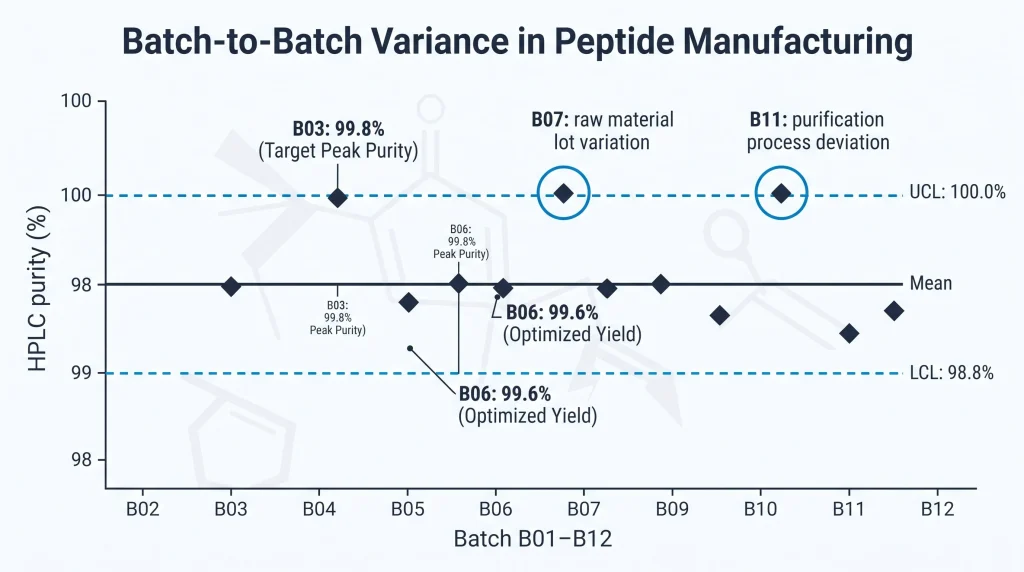
Batch-to-batch variance is the measured purity difference between separate production runs. Each run of the same compound can vary. Each run can also show a different impurity profile. These differences come from synthesis steps, purification, or storage conditions. Researchers must track these variances to keep study data accurate and repeatable. According to Journal of Peptide Science (2018), lot-specific HPLC purity data is the standard for synthetic peptide batch release. Each lot must have its own test record.
Next Level Pharm tests every vial with HPLC and mass spec (MS). Average purity holds at 99.4% across the last 100 batches. Every order includes a Certificate of Analysis (COA). Researchers can look up their lot data online. All peptides ship freeze-dried, which keeps them stable at room temperature.
Controlling batch variance starts with knowing how it forms and how to check it. The sections below explain the main causes, the tools for measuring purity, and how to document each lot.
Key Takeaways
- Inherent Process Variance: Chemical synthesis produces minor purity differences between batches. These variations are a normal result of step-by-step production methods.
- SPPS Step Origins: Solid-phase peptide synthesis (SPPS) involves many steps. Small errors at each stage are the main cause of batch-to-batch variance.
- Dual Verification Tools: HPLC measures purity by separating sample components. Mass spec (MS) confirms the molecular ID of the main peak on the chromatogram.
- Lot-Specific COA: A Certificate of Analysis (COA) covers one production run only. Researchers should not apply one lot’s data to a different batch.
- Sourcing for Transparency: Vendors who post a COA for every lot allow researchers to track batch-level quality. This is the primary control for lot-based variables.
The sections below explain how variance forms, how to measure purity, and how to control it in a lab setting.
What Causes Peptide Synthesis Variance?
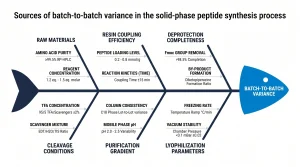
Peptide synthesis variance comes from errors in solid-phase peptide synthesis (SPPS). SPPS builds a peptide chain on a solid to support one amino acid at a time. Each step must be efficient to avoid structural defects. Even small errors in coupling reactions cause problems. These issues lead to unwanted byproducts. According to Journal of Peptide Science (2018), common SPPS errors include incomplete couplings and unintended side-chain reactions. These issues create impurities in the final batch. These reactions create batches with the target sequence mixed with impurities.
These impurities form in two main ways. First, deletion sequences form. They arise when the chain is missing one or more amino acids. Second, truncated sequences form when chain growth stops too early. The final cleavage step can also add more impurities. This happens when conditions are not tightly controlled. All of these outcomes lower the purity of the batch. They also change the impurity profile from run to run. BPC-157 COA data is available for every lot with HPLC and MS results.
How Is Peptide Purity Measured?
Peptide purity is measured with HPLC. HPLC forces a sample through a column. It separates the target peptide from impurities. Each component exits at a different time based on its chemical traits. The system records the exit time and signal as a chromatogram. Purity is the ratio of the main peak area to the total of all peak areas. A higher ratio means fewer impurities in the sample.
Mass spec (MS) is used alongside HPLC to confirm molecular ID. MS measures the m/z of the main peak. It compares this to the expected value for the target sequence. This step confirms the peak represents the correct compound. The table below compares the two methods.
| Feature | HPLC | Mass Spec (MS) |
| Measures | Purity (area %) | Molecular identity (m/z) |
| Output | Chromatogram | m/z spectrum |
| What it confirms | Impurity level | Correct sequence |
| Used for | Batch release purity | Structural check |
| Result type | Area-percent purity | Measured vs expected m/z |
What Is an Acceptable Purity Level?
For most research studies, a purity of at least 98% is the standard benchmark. Next Level Pharm confirms every lot meets its quality standards. These are set for research-grade materials. For sensitive assays, 99% purity is needed. This reduces interference from byproducts. According to Molecules MDPI (2021), impurity profiles are a key factor for reliable research data. Higher purity means fewer background signals to misread.
The required purity level depends on the study type. In cell-based assays, small amounts of impurities can act as unknown variables. They may trigger off-target effects. These effects can change the observed outcome. In animal studies, impurities can cause unexpected responses. These outcomes make it hard to link results to the target peptide. High purity standards limit these sources of error. Browse COA-verified research peptides with lot-specific HPLC and MS data.
Why Is a COA Lot-Specific?
A COA is lot-specific because it records the test results for one unique production run. Each lot number links to a homogenous batch where all vials share the same chemical profile. Each synthesis event introduces slight variations. This is why one lot’s data does not apply to another. The COA captures the HPLC purity and MS results for that specific set of material.
Research findings depend on consistent input materials. When a lot changes, the prior COA no longer applies. Researchers check the vial lot number against the COA to confirm the right record. Without this check, minor impurity changes go unrecorded. This creates gaps in the research log. These gaps are hard to resolve without a lot-specific COA. Keeping COA records separate for each lot confirms the exact quality of their materials. TB-500 COA data is available for every lot with HPLC and MS results.
How Does Lyophilization Affect Stability?
Freeze-drying converts a liquid peptide into a dry powder. It does this by removing water through sublimation under low pressure. This process preserves the chemical structure of the peptide without changing its purity. By removing water, freeze-drying stops the breakdown that damages peptides in liquid form. The resulting dry powder stays stable for extended periods at room temperature.
Freeze-drying allows room-temperature shipping. There is no need for a cold chain during transit. The dry state protects the molecular structure. The researcher reconstitutes the peptide in the lab when ready. According to NCBI (2020), keeping chemical quality through the post-production phase is key to preserving batch quality for research use. Proper freeze-drying is a critical step in long-term stability.
How Can Researchers Mitigate Variance?
Researchers mitigate batch variance by choosing vendors who provide a lot-specific COA for every vial. This document is the primary record of a sample’s chemical profile. Checking the COA before starting a study confirms the material meets specific needs. Linking each lot to its COA is the first control. It guards against unwanted interference in the study.
For long-term studies, source enough material from one lot. This is the most reliable approach. This limits the risk of new variables from different chemical sets. If a study needs more material than one lot provides, get a fresh COA for each additional lot. Carefully checking each new COA protects data quality across the full study timeline. Using lot-matched materials helps ensure results reflect the target peptide. This limits background noise from impurities.
Frequently Asked Questions
Why Do Peptide Batches Differ?
Synthesis is a step-by-step chemical process. Tiny variables in temperature, solvent quality, or resin efficiency lead to different outcomes. Even with the same protocol, changes in reagent batches or humidity affect the final yield. According to Journal of Peptide Science (2018), these small chemical shifts are expected in synthetic peptide production. This is why every batch needs HPLC and MS testing. Both tests confirm its make-up.
Can Impurities in a Peptide Sample Affect Research Outcomes?
Residual impurities from incomplete coupling steps act as unintended variables. They may confound test results in several ways. In cell-based models, they may trigger off-target effects. These effects mask the true activity of the target sequence. According to Molecules MDPI (2021), impurity profiles are a core factor for data reliability. High-purity samples reduce the risk of misreading background noise as biological activity in the assay.
What Is the Difference Between HPLC and MS Testing for Peptides?
HPLC separates the target peptide from impurities to determine the purity percent of a sample. HPLC shows how much of the sample is the target compound. MS shows what it is. MS confirms the molecular weight of the compound matches the target sequence. Scientists combine both methods to get a full picture of purity and structural ID. Using both provides stronger evidence than either method alone.
Does Lyophilization Alter the Purity of a Peptide Batch?
Freeze-drying improves the long-term stability of a peptide. This process does not change the chemical purity or the amino acid sequence of the batch. By removing residual moisture, it stops the breakdown that occurs in liquid form. Next Level Pharm seals every vial under an inert atmosphere after freeze-drying. This keeps the material stable during shipping until it arrives in the lab.
How Should Freeze-Dried Peptides Be Stored?
Freeze-dried peptides stay stable at room temperature, which makes lab storage simple. Once a vial arrives, store it in a cool, dark, and dry location. This keeps the powder from absorbing moisture. Keep the cap tightly sealed after each entry to reduce air exposure. Limit the time the vial sits open. These steps preserve the peptide until it is ready for lab work. A controlled, dry environment is the standard storage condition for freeze-dried compounds.
What Is Net Peptide Content and How Does It Differ From Purity?
Purity refers to the percent of the material that is the target peptide versus other impurities. Net peptide content is the peptide amount after removing counter-ions, non-peptide contaminants, and residual water. A sample can have high purity but lower net peptide content if it contains a high level of salts. Both values are needed to understand the total active material in a vial.
Is 99% Purity Better Than 98% for Lab Studies?
In sensitive studies, that 1% gap means double the impurity load. For long-term or specific assays, higher purity reduces baseline interference. Data from higher-purity samples are more stable. Fewer reactive byproducts interact with the target setting. Consistent results in long-term studies benefit from the higher purity levels provided by rigorous testing. This matters most for cell-based or receptor binding work.
How Do Counter-Ions Like TFA or Acetate Affect Peptide Studies?
Counter-ions are added during the final prep stage to stabilize the peptide powder. Trifluoroacetic acid (TFA) and acetate are the most common types used. TFA is often preferred for high purity but may show higher toxicity in some biological assays. Researchers should check the COA to identify which counter-ion is present. This affects total mass and potential interactions within the specific study model.
Can a Researcher Independently Verify the Purity on a COA?
A researcher can verify COA purity by sending a sample to a third-party lab. The lab runs HPLC and MS testing. Comparing those external results to the vendor COA confirms the stated purity. Many research labs use this process to validate their supply source before beginning a study. Transparency in testing is key to maintaining the quality of data collected over the full study period.
Why Use a Peptide From One Lot for a Long-Term Study?
Long-term studies need identical chemical inputs. This ensures observed changes come from the intervention. Using one lot stops differences in impurity profiles from shifting the study baseline over time. A lot change may add new variables such as varying salt levels or side-chain byproducts. These changes complicate the reading of results. Consistency in lot numbering is an essential control for any multi-phase research project.
Summary
Batch-to-batch variance is the measured purity difference between separate production runs. Each run may also show a different impurity profile. It comes from synthesis errors, prep steps, and storage conditions. HPLC measures purity by area percent. MS confirms the correct molecular ID. A lot-specific COA documents these results for each unique batch. Freeze-drying preserves chemical integrity from production through delivery. To control variance, researchers should source one lot for the full study and verify each COA before use.
What Should You Do Next?
Before starting a new study, check every peptide vial for a current COA. The COA should show HPLC purity and MS data. Match the lot number on the vial to its COA. For long-term work, source the full amount from one lot. This avoids introducing new variables. If a second lot is needed, request a fresh COA for that lot before use. Every batch is third-party tested..
People Also Read
- What Makes a Peptide Research Grade? Standards and Testing Explained
- BPC-157 vs TB-500: A Detailed Research Comparison Guide
About the Author
Next Level Pharm Research Team
The Next Level Pharm research team is composed of biochemists and laboratory scientists dedicated to providing researchers with the highest-purity, COA-verified research peptides available. Every batch is HPLC and mass spec verified before dispatch.
Disclaimer: The information provided on this page is for educational and research purposes only. Next Level Pharm’s products are intended for laboratory research use only. They are not intended for human consumption, diagnostic, therapeutic, or medicinal purposes. This content does not constitute medical advice. Always consult a licensed healthcare professional before making any health-related decisions.