
Lot-Specific vs Generic COA: What to Verify

Last updated: July 2026
A lot-specific COA (Certificate of Analysis) is a lab document tied to a unique production batch. It lists the HPLC purity result and mass spec data for that exact vial. Generic COAs are placeholder documents. They are reused across batches or products. According to NCBI (2020), lot-level documentation is the minimum standard for batch traceability in peptide research.
Next Level Pharm provides COA-verified research peptides for laboratory use. Every lot is tested by HPLC and mass spec. Average purity sits at 99.4% across the last 100 batches. Researchers can look up any lot number online to retrieve the full COA data.
Understanding the difference between lot-specific and generic COAs is a key quality skill. It helps researchers verify whether the data applies to the vial in hand. The sections below break down what a valid COA must contain and how to check it.
Key Takeaways
- Lot-Specific COA: A valid COA must carry the exact batch number from the vial label. Without this link, the test data may not apply to the material on hand.
- HPLC Purity: HPLC separates the target compound from all other material. The area percent of the main peak gives the purity value listed on the COA.
- Mass Spec Identity: Mass spectrometry confirms the compound by measuring its exact molecular weight. This verifies that the batch matches the intended peptide sequence.
- Batch Traceability: Linking a vial’s lot number to its COA is the basis of batch traceability. It ensures that the research materials and the analytical record stay in sync.
- Red Flags: A missing lot number, a purity of exactly 100%, or an old analysis date are common signs of a generic or fabricated COA.
The sections below cover each of these points. They focus on what to check, what to look for, and what makes a document valid for research use.
What Makes a COA Lot-Specific?
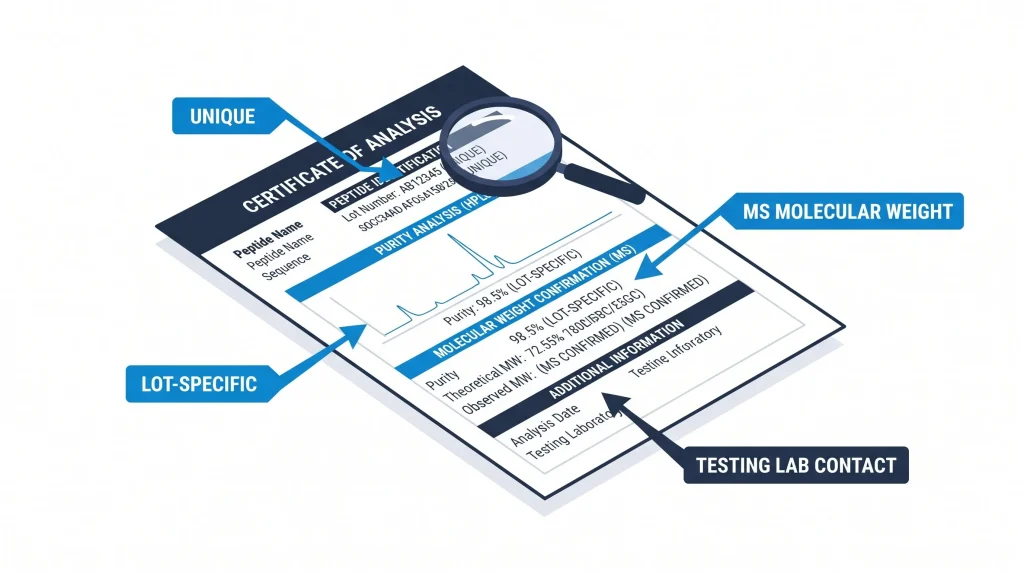
A lot-specific COA is generated for one production run. It carries a unique batch identifier. This matches the alphanumeric code on the vial label. This link ties the analytical data to the specific material being used. The document also lists the analysis date and the testing method used.
The HPLC chromatogram and mass spec output are both encoded in this record. Both tests are run on the actual batch. No reference standards or prior lots are used. This is what separates a lot-specific document from a template or placeholder. According to Journal of Peptide Science (2018), batch-level reports are required to ensure reproducibility in synthetic peptide research.
BPC-157 COA records include the lot number, analysis date, HPLC trace, and mass spec data for every batch shipped.
How Can a Generic COA Be Identified?
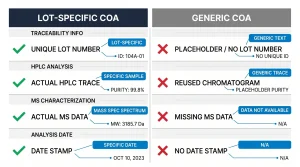
A generic COA lacks a unique batch identifier. Or it uses a lot number that does not match the vial. Other signs include a purity of exactly 100.0%. The analysis date may predate the shipment by many months. The chromatogram may look identical across different products.
Some generic COAs are templates with placeholder data. Others are real results from a different lot or even a different compound. In both cases, the data does not reflect the actual vial. Third-party verification from an accredited lab is the most reliable check. It confirms whether in-house COA data matches the material. According to NCBI (2019), independent re-testing is recommended when lot-level documentation cannot be verified by an online lookup portal.
Why Does Batch Traceability Matter?
Batch traceability links each vial to the specific production run and its test results. This lets researchers confirm whether two vials came from the same or different lots. It also supports audit trails and cross-experiment comparisons.
Without lot-level traceability, study results cannot be reliably compared. A batch change can affect purity, counterion load, or peptide identity. Lot-specific documentation is the only way to detect these changes. Tirzepatide COA records are linked to each order so researchers can track the exact lot used in each study run.
What Fields Must a Valid COA Contain?
A valid COA must contain the following fields to be research-usable.
| Field | What to Look For |
| Lot number | Must match the label on the vial exactly |
| Analysis date | Should be within 6 months of shipment |
| HPLC purity % | Area percent of the main peak; 99%+ for research grade |
| Mass spec m/z | Must match the theoretical molecular weight of the peptide |
| Testing method | HPLC and mass spec both listed; not just one |
| Lab contact | Issuing lab name and, ideally, accreditation details |
Any document without a lot number cannot confirm the material. A document with only one test cannot confirm both identity and purity. Both HPLC and mass spec data must appear for a complete analytical profile. HPLC alone confirms purity but not identity. Mass spec alone confirms identity but not purity.
How Is a Lot Number Matched to a Vial?
The lot number is printed or embossed on the vial label. It is an alphanumeric code specific to the production batch. Every batch is third-party tested.. The COA retrieved must show the same lot number to be valid.
If the COA arrived on paper, its lot number must match the vial label exactly. Even a single digit difference means the document does not apply to the vial. Researchers who work with multiple lots should log which lot was used in each experiment. This log, paired with each COA, provides full traceability for the study record. Every batch is third-party tested..
What Are Red Flags on a Peptide COA?
The most common red flags on a COA are: a missing lot number, a 100.0% purity result, an analysis date older than 6 months. Another sign is the same chromatogram appearing for multiple different products.
A 100.0% purity result is not achievable by standard HPLC. Real results always show trace peaks. Any 100.0% result was fabricated or rounded from a template. An old analysis date raises questions about compound degradation since testing. Identical chromatograms across products indicate a copied graphic, not a real test output. All of these signs suggest a generic or manipulated document. It does not reflect the actual vial.
Frequently Asked Questions
What makes a COA lot-specific?
A lot-specific COA contains a unique batch identifier that matches the code printed on the vial label. This link ties the HPLC and mass spec results to the specific production run. Without this link, the analytical data cannot be confirmed as applying to the material in hand. The document also includes an analysis date, the testing methods used, and the issuing lab’s contact information. These fields together make the report traceable to one specific batch.
How can a generic COA be identified?
A generic COA typically lacks a unique lot number or shows a lot number that does not match the vial. Other signs include a 100.0% purity result or an analysis date many months before shipment. The chromatogram may also look identical to those from other products. These documents are often templates with placeholder data. They cannot confirm the identity or purity of the specific vial received. Third-party re-testing is the most reliable check in these cases.
Why does batch traceability matter?
Batch traceability ensures that each vial used in a study can be traced to its exact test record. This matters when comparing results across experiments or across different orders. A change in lot can bring a change in purity or counterion profile. Without lot-level documentation, these differences go undetected. Lot traceability is also required in study logs and audit trails to maintain research integrity.
What fields must a valid COA contain?
A valid COA must include the lot number, analysis date, HPLC purity percentage, mass spec m/z value, testing method, and the issuing lab’s contact. The lot number must match the vial label. The HPLC and mass spec data must both appear. A report that shows only one test type is incomplete. The analysis date should be recent enough to reflect the current state of the material.
How is a lot number matched to a vial?
The lot number appears on the vial label as an alphanumeric code. A researcher enters this code into the supplier’s online lookup portal to retrieve the matching COA. The lot number on the COA must be identical to the one on the label. Even one character difference means the document does not apply to that vial. Paper COAs that arrived with the shipment must also show the same code for the match to be valid.
Is third-party testing needed if the supplier has an in-house COA?
Third-party testing provides an independent check on the in-house results. An accredited external lab has no conflict of interest and uses its own instrumentation. This removes any chance that the in-house results reflect only internal standards. Many researchers test a subset of their stock through a third party when starting with a new supplier. Every batch is third-party tested..
What does lyophilized mean on a COA?
Lyophilized means the peptide was freeze-dried to remove moisture and form a stable powder. This state is noted on the COA to confirm the compound was processed for long-term storage. Lyophilized peptides stay stable at room temperature during shipping. They do not require cold chain logistics. The COA for a lyophilized peptide reflects the quality of the powder in this stable, freeze-dried form.
What is the difference between HPLC and mass spec on a COA?
HPLC measures purity by separating the target compound from all other material. The result is a percentage of the total peak area. Mass spectrometry confirms identity by measuring the exact molecular weight of the compound. The result is a mass-to-charge (m/z) value that is compared to the theoretical weight for that peptide. Both tests are needed together: HPLC alone cannot confirm identity, and mass spec alone cannot confirm purity.
Why is a 100.0% purity reading a red flag?
A purity result of exactly 100.0% is not achievable by standard HPLC analysis. Real chromatograms always show trace baseline noise or minor peaks. A 100.0% result indicates the figure was either fabricated or rounded from a placeholder. Research-grade results typically fall in the 98 to 99.9% range after proper integration. Any COA showing 100.0% should be treated with caution and verified through third-party testing.
Summary
A lot-specific COA ties a unique batch number to the HPLC and mass spec results for that production run. A generic COA is a template or reused document that does not reflect the actual vial. The key check is simple. The lot number on the document must match the lot number on the vial label. Both HPLC purity and mass spec identity must be present for the COA to be complete.
What Should You Do Next?
When a new lot arrives, locate the lot number on the vial. Every batch is third-party tested.. Confirm the HPLC purity is at or above 99%. Check that the mass spec m/z matches the expected molecular weight. Keep a record of which lot number was used in each experiment. Every batch is third-party tested..
People Also Read
- What Makes a Peptide Research Grade? Standards and Testing Explained
- BPC-157 Mechanism of Action: What Research Shows
About the Author
Next Level Pharm Research Team
The Next Level Pharm research team is composed of biochemists and laboratory scientists dedicated to providing researchers with the highest-purity, COA-verified research peptides available. Every batch is HPLC and mass spec verified before dispatch.
Disclaimer: The information provided on this page is for educational and research purposes only. Next Level Pharm’s products are intended for laboratory research use only. They are not intended for human consumption, diagnostic, therapeutic, or medicinal purposes. This content does not constitute medical advice. Always consult a licensed healthcare professional before making any health-related decisions.