Cloudy Peptide Vial: What Research Says About It

Last updated: July 2026
A cloudy peptide vial means the compound is no longer dissolved in the solvent. Three main causes produce this visual change: settling from pH shifts, molecular clumping, and bacterial growth. Each cause has a different appearance and requires a different lab response. Researchers must identify which type is present before deciding whether to salvage or replace the sample. This finding protects research data and limits material waste across all active assays.
Next Level Pharm ships every peptide vial in a freeze-dried form. Average purity across the last 100 batches is 99.4%. All batches are tested by HPLC and mass spec before dispatch. Every batch is third-party tested.. Products ship at room temp with no cold chain required.
Cloudiness in a peptide vial affects the evenness of the liquid, which directly impacts the accuracy of all lab tests. Understanding each type of cloudiness and its cause allows researchers to respond correctly and quickly.
Key Takeaways
- Clumping is Permanent: Molecular clumping, also called aggregation, causes lasting structural damage to the peptide chain. Warming or diluting the vial will not restore the peptide to its active form.
- pH Drives Dissolve Rate: Each peptide has a charge-neutral point called the PI, or isoelectric point. The dissolve rate drops sharply when the buffer pH is near this point.
- Bacterial Growth Adds Toxins: Microbial growth in the vial releases endotoxins and waste products. These alter assay results and make the sample unusable for cell-based tests.
- Mixing Technique Matters: Adding solvent too fast creates dense local zones that push peptide out of solution. Slow addition along the inner vial wall reduces this risk.
- Dry Peptides Stay Stable: Removing water from the peptide stops bond breakdown and oxidation. Dry powder remains intact during storage and shipping without refrigeration.
Identifying the specific cause of cloudiness is the first step in any response plan. The H2 sections below explain each cause and what lab data supports each finding.
What causes a peptide solution to become cloudy?
A peptide solution turns cloudy when the compound stops dissolving in the solvent. The most common cause is low dissolve capacity at the current pH or temperature. Adding solvent too rapidly also triggers local high-density zones that push the peptide out of solution. According to NCBI (2011), physical instability is the leading driver of molecular clumping in aqueous peptide solutions stored at or near room temperature.
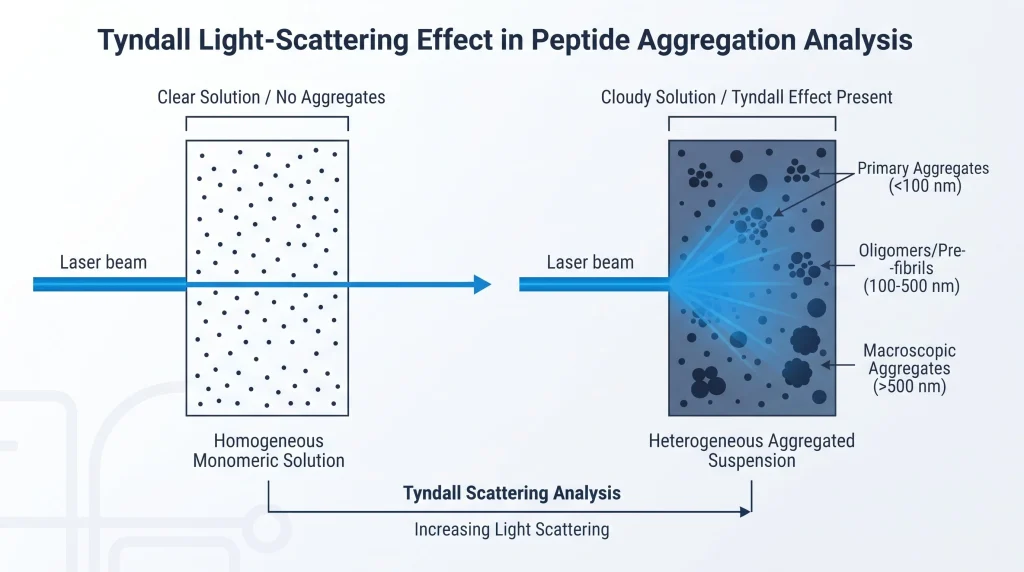
Each peptide has a maximum dissolved amount at any given pH. When the powder mass exceeds this limit, the extra material falls out as particles or haze. A mismatched pH pushes the compound toward its PI, where the net charge on each molecule drops to zero. With no charge, the molecules no longer repel each other. They begin to cluster, and the clusters scatter light. Cold temperatures also reduce dissolve rates and can cause brief cloudiness that clears when the vial warms.
Is cloudiness always a sign of degradation?
Not all cloudiness indicates permanent damage. Two distinct states cause visible turbidity but differ in what they mean for the sample. Reversible settling occurs when the compound leaves solution due to low temperature or pH shift. The chemical structure stays intact. Gentle warming or pH adjustment often restores clarity. According to NCBI (2020), distinguishing these two states requires both visual observation and lab confirmation from HPLC testing.
Irreversible clumping is the more serious state. Misfolded chains form stable bonds and cannot break apart again. The vial stays cloudy after warming. An HPLC trace will show a reduced peak area at the correct retention time, which confirms that intact peptide has been lost. Settled material may be salvageable after pH adjustment. Clumped material is not. Researchers should test the vial before discarding it, since an incorrect diagnosis wastes usable material.
How does molecular clumping affect research quality?
Clumping breaks down the three-dimensional shape of the peptide chain. A deformed chain cannot bind its target receptor with the expected binding force. Off-target binding adds noise to all assay data. Results lose consistency across repeated runs. According to Peptides (2005), structural changes from clumping altered binding profiles across several peptide types in controlled lab settings.
Data from clumped samples fails to replicate. When two labs use the same peptide in different states, their results diverge. The source of the gap often traces back to sample quality rather than biology. The fix is simple: run a purity check before each assay. If the sample does not meet purity specs, replace it. Research teams sourcing recovery peptides can request HPLC data before placing any order to confirm sample quality upfront.
Can bacterial growth cause cloudiness?
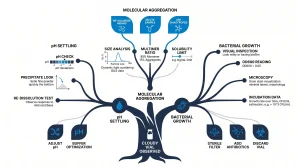
Bacteria multiply fast in open aqueous solutions. Their growth produces a turbid, hazy appearance that looks similar to clumping. This cloudiness differs because it comes from biological material, not peptide chains. Bacteria release cell-wall fragments called endotoxins into the vial. Even low endotoxin levels cause false-positive signals in cytokine and cell-viability assays.
Bacterial cloudiness does not clear with warming or pH changes. It stays turbid and often gets worse as the bacteria keep growing. Researchers should treat persistent cloudiness as a contamination signal. Discard the vial and rework the prep with sterile tools. BAC water, or bacteriostatic water, contains 0.9% benzyl alcohol as a preservative. This stops bacterial growth in the vial after reconstitution. Sterile water has no preservative and is for single use only.
What practices reduce cloudiness during mixing?
Good mixing technique cuts most cases of cloudiness before they start. Use the correct solvent for each specific peptide. Add solvent in small steps of 0.5 mL or less. Run each step along the inner wall of the vial. Swirl the vial gently between each step. Never shake it. Shaking creates force that can unfold peptide chains and start clumping.
BPC-157 is available as a COA-verified, HPLC-tested research peptide.
Allow full dissolving before drawing from the vial. A clear, particle-free look is the standard. If haze remains after the correct solvent volume has been added, try warming the vial at 30 degrees C for five minutes. Some peptides dissolve slowly and need more time. Adding a small extra volume of solvent also reduces the amount in solution and may clear the haze. Record all volume changes to keep concentration data accurate for the experiment.
How do suppliers ensure peptide stability before shipment?
Freeze-drying removes all water from the peptide before it is sealed in the vial. Without water, the bond-breaking and oxidation reactions that ruin peptides cannot occur. The dry form stays intact during storage and transit at room temperature. No cold chain is needed. Suppliers seal the vials under low oxygen to stop air-sensitive residues from reacting during shipping.
HPLC testing confirms purity as a percentage of the target compound. Mass spec, or mass spectrometry, confirms that the molecular weight matches the correct sequence. Both tests run on every batch before the product ships. A COA documents the results for each lot. Researchers can look up this data by lot number at the supplier’s online portal before any experiment starts.
| Cause | Appearance | Reversible? | Action |
| pH settling | Hazy, milky | Yes | Warm gently, adjust pH |
| Molecular clumping | Cloudy, persistent | No | Discard and replace |
| Bacterial growth | Turbid, persistent | No | Discard, use sterile method |
| High amount in solvent | Milky, diffuse | Sometimes | Add more solvent, recheck |
Frequently Asked Questions
What causes cloudiness in a peptide solution?
Cloudiness forms when a peptide stops dissolving in the solvent. This can occur when the dissolved amount exceeds the limit for that pH and temperature. It also occurs when the pH is close to the peptide’s PI, or isoelectric point, where the net charge on the molecule drops to zero. Without net charge, chains lose repulsion and begin to cluster. The clusters scatter light and create the visible turbidity seen in the vial.
Is cloudiness always a sign of degradation?
Cloudiness does not always signal permanent damage. Reversible settling causes brief haze that often clears with gentle warming or pH adjustment. Irreversible clumping is a different state. Misfolded chains form stable bonds that cannot break apart. The vial stays cloudy after warming. Researchers must run a lab test to confirm which state is present before deciding whether to discard the vial or attempt to restore clarity.
What is molecular clumping in peptides?
Molecular clumping, also called aggregation, is the process where dissolved peptide chains bond together and fall out of solution. This occurs when the forces between chains become stronger than the forces keeping them dissolved. Once clusters form, they cannot return to their single-chain state. Clumped peptides lose the specific shape needed for target binding. They may attach to off-target sites and produce noisy, non-repeatable data.
How does settling differ from bacterial growth cloudiness?
Settling is a physical change caused by pH or temperature shifts. It produces haze that may clear on warming. Bacterial growth cloudiness comes from microbial cells and their waste products growing inside the vial. This produces a turbid, often slimy or stringy appearance. Bacterial samples contain endotoxins that cannot be removed by warming or pH changes. The vial must be discarded and the prep redone with fully sterile technique and tools.
When does visual inspection fail to detect a problem?
Visual inspection misses chemical damage that does not change the appearance of the solution. Bond breakdown and oxidation degrade a peptide without making it cloudy. A clear vial may still hold a structurally altered compound. Only HPLC testing can confirm whether the main peak is intact at the correct retention time. If peak area drops, the peptide has degraded even though the solution appears clear to the eye.
How does temperature affect peptide dissolve rate?
Temperature controls both how fast a peptide dissolves and how much can stay dissolved at one time. Cold conditions slow the dissolving process and may cause brief haze in the vial. Warming the vial often clears this type of haze. High temperatures speed up dissolving but can break down heat-sensitive sequences. The recommended range for most peptides during mixing is 20 to 30 degrees C, which balances dissolving speed with structural safety.
Should you use a peptide solution if it is cloudy?
A cloudy solution is not suitable for standard research. Particles in the vial mean the dissolved amount is not uniform across the liquid. Each draw from the vial will contain a different mass of peptide, which makes any amount-dependent calculation unreliable. The standard response is to attempt recovery by warming or diluting. If the vial clears, run a purity check. If it stays cloudy, replace it with a fresh sample before continuing the experiment.
What role does pH play in peptide solubility and cloudiness?
pH controls the charge on a peptide molecule in solution. Acidic peptides dissolve better in slightly alkaline buffers. Basic peptides dissolve better in slightly acidic buffers. When the buffer pH matches the peptide’s PI, net charge drops to zero. Repulsion between molecules falls and clumping begins. Using the correct buffer keeps the pH in a range that maintains the charge needed for dissolving. Product data sheets from reputable suppliers list the recommended solvent and pH range.
Can a cloudy peptide solution be recovered?
Recovery depends on the cause. If settling is the issue, gentle warming or pH adjustment may restore a clear state. Adding more solvent reduces the dissolved amount and can dissolve remaining particles. If clumping is the cause, recovery is unlikely. Stable clusters do not break apart on their own. A brief HPLC run on a small volume confirms which state is present. If the main peak is intact, the sample may be usable. If the peak area is low, the vial should be replaced.
What is the recommended way to store reconstituted peptides?
The recommended approach is to split the solution into small aliquots right after dissolving. Each aliquot should hold a single-experiment volume. Store them at -20 degrees C in labeled, sealed vials. This avoids repeated freeze-thaw cycles that add thermal stress and raise the risk of clumping. Use one aliquot per run. Do not refreeze a thawed portion. This method protects sample integrity across the full run of a multi-experiment research project.
Summary
A cloudy peptide vial points to one of three conditions: settling from pH shift, molecular clumping, or bacterial growth. Each condition has a distinct appearance and a different correct response. Settling may be reversible. Clumping and bacterial growth require discarding the vial.
Analytical testing confirms the cause. Visual inspection alone cannot distinguish reversed settling from a permanently damaged sample. HPLC data provides the evidence needed to make that call with confidence.
Good mixing technique and proper storage cut most cloudiness issues before they occur. Slow solvent addition, the correct buffer, and aliquot storage at -20 degrees C protect sample integrity from the first mix through the last experiment.
What Should You Do Next?
Review the recommended solvent and storage conditions for each peptide in the active inventory. Confirm that all reconstituted vials are stored at the correct temperature. Run a purity check on any vial that showed cloudiness during the last research session.
Researchers sourcing COA-verified research peptides can browse the full catalog at Next Level Pharm. Every vial ships with lot-specific HPLC data and full batch traceability.
People Also Read
- What Makes a Peptide Research Grade? Standards and Testing Explained
- BPC-157 vs TB-500: A Detailed Research Comparison Guide
About the Author
Next Level Pharm Research Team
The Next Level Pharm research team is composed of biochemists and laboratory scientists dedicated to providing researchers with the highest-purity, COA-verified research peptides available. Every batch is HPLC and mass spec verified before dispatch.
Disclaimer: The information provided on this page is for educational and research purposes only. Next Level Pharm’s products are intended for laboratory research use only. They are not intended for human consumption, diagnostic, therapeutic, or medicinal purposes. This content does not constitute medical advice. Always consult a licensed healthcare professional before making any health-related decisions.