
Mazdutide Research: GLP-1 Glucagon Analog Studies

Last updated: July 2026
A mazdutide GLP-1 glucagon analog research compound is a lab-made peptide. It turns on two receptors: the glucagon-like peptide-1 (GLP-1) receptor and the glucagon receptor. This dual-action works to shift glucose balance and fat use in lab models. Current research looks at how these joined signal paths affect energy use and glucose handling. The compound has a fatty acid chain. This chain gives it a long half-life for longer study.
Next Level Pharm provides high-grade research compounds with 99.4% purity. This average is based on the last 100 batches. Each vial goes through lab testing with HPLC and mass spec. The stock is stored in a freeze-dried state under inert gas. This keeps shelf life long. These peptides stay stable at room temp and do not need cold chain shipping. Average dispatch times for orders are ~48 hours from USA-based storage sites.
Scientists study mazdutide through these paths to learn its role in metabolism. The dual-receptor approach lets researchers study paths with insulin release and glucagon-driven lipid release. Data from these tests help clarify how multi-hormone action affects body-wide metabolism shifts.
Key Takeaways
- Dual Receptor Action: Mazdutide works by binding to both glucagon and GLP-1 receptors at once. This dual agonist design aims to affect many metabolism paths in study models.
- Derived from Oxyntomodulin: The structure of this compound is modeled after the natural hormone known as oxyntomodulin. Scientists changed this base to boost shelf life and action length during lab tests.
- Energy Use Potential: The glucagon part may boost energy use while the GLP-1 receptor helps block appetite signals. This joint model offers a unique action next to single-receptor peptide studies.
- Metabolism Research Focus: Current trials examine how this peptide affects receptor signaling dynamics and downstream pathway activation in study models. Research also includes its impact on fat deposits in the liver.
- Treatment Difference: The action of mazdutide differs from single GLP-1 agonists like semaglutide. Its unique receptor profile lets study of wider metabolism shifts in lab models.
These findings clarify the chemical profile of dual-agonist signals in metabolism study. The next sections show how this structure and its multi-receptor action affect lab results.
What is Mazdutide’s mechanism of action?
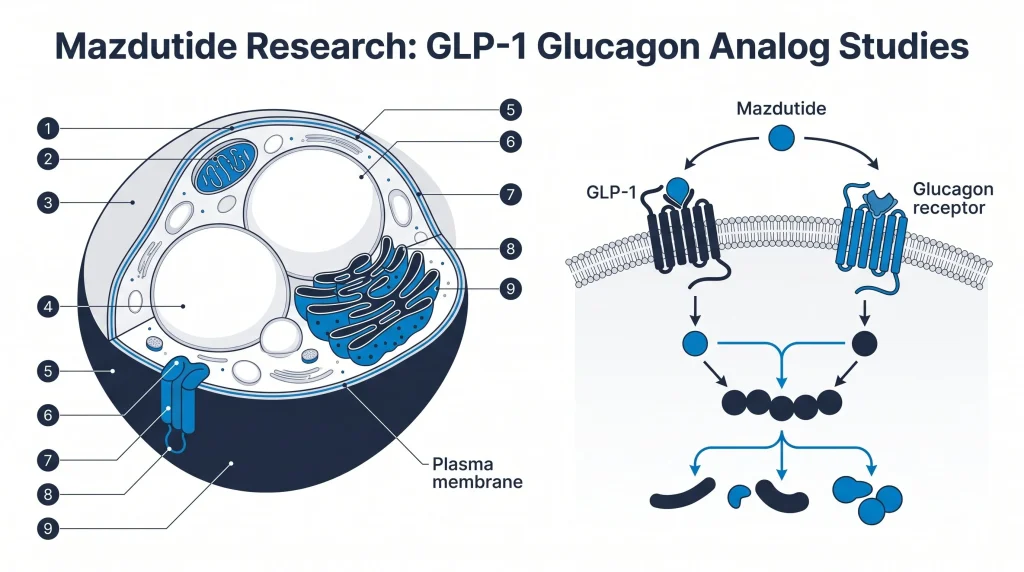
Mazdutide works as a dual agonist. It binds to and turns on both the GLP-1 receptor (GLP-1R) and the glucagon receptor (GCGR) at once. By acting on two distinct sites at once, the peptide is a tool for study. It tests joint hormone signals. According to Ji et al. (2022), this dual-receptor approach lets scientists study metabolism shifts. These shifts occur when both paths turn on at once in lab models.
This dual agonism makes a joint effect. GLP-1R action boosts insulin release and controls satiety cues. At the same time, GCGR action works to boost body-wide energy use. It may also help break down fat stores. Mazdutide is available as a COA-verified research peptide. Every lot is verified by HPLC and mass spec. By hitting both targets, the compound gives a way to study glucagon-based signals. It shows how these affect metabolism rate next to standard incretin-type appetite control. Researchers track how this peptide affects balance between the two receptors and lipid use.
How does its oxyntomodulin structure work?
Mazdutide works as a built form of oxyntomodulin (OXM). It is a naturally occurring gut hormone. This peptide shows balanced action at both glucagon-like peptide-1 (GLP-1) and glucagon (GCG) receptors. By turning on many receptor paths, it aims to affect energy use in research models. According to Dong et al. (2025), this dual-agonist action helps manage glucose balance and energy use. The compound design is based on the hormone’s native build. But it includes set changes to boost shelf life.
Scientists made mazdutide by using aimed amino acid swaps to the base OXM order. These changes stop fast breakdown by enzymes while keeping high binding strength for target receptors. The addition of a fatty acid side chain gives a long half-life. It allows for less frequent use during studies. Mazdutide is available as a COA-verified research peptide. Every lot is verified by HPLC and mass spec. These build changes keep the compound active in lab systems for longer periods. This is compared to the natural hormone. Through this stable design, scientists track steady action through the study cycle.
What do receptor binding strength studies show?
In vitro assays show mazdutide binds and turns on both GLP-1 and glucagon receptors. It shows high strength at both. But the compound turns on both sites with different strength. It often leans toward one receptor over the other.
These assays measure how well a substance fills a receptor to start a signal cascade. A balanced agonist turns on both receptors at roughly equal levels. This supports a stable metabolism profile. By contrast, an uneven agonist shifts the ratio of action toward one target. Researchers track this ratio as a main design trait. It changes how the peptide affects energy use and fat handling in lab models.
Mazdutide is available as a COA-verified research peptide. Every lot is verified by HPLC and mass spec.
Researchers can browse the current stock to view metabolic research peptides offered here.
How does mazdutide differ from semaglutide?
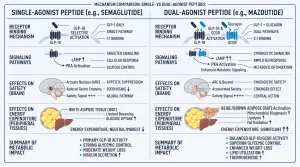
The main gap is that mazdutide works as a dual GLP-1/glucagon agonist. Semaglutide acts on the GLP-1 receptor only. This gap means the former hits two distinct receptor sites to shift metabolism. Semaglutide is a single GLP-1 receptor agonist. It focuses on GLP-1 paths to manage satiety and insulin signals. Mazdutide and semaglutide are each available as COA-verified research peptides. Every lot is verified by HPLC and mass spec. The build of mazdutide lets it bind to glucagon receptors. This adds a fat-burning part to its metabolism profile. Research shows this extra action is made to shift energy balance beyond standard single-agonist compounds. Semaglutide and liraglutide are examples.
The glucagon receptor action in mazdutide is thought to boost energy use in lab models. GLP-1 receptor signals involve incretin-mediated insulin secretion pathways. Glucagon paths involve more energy needs. Single-agonist compounds like liraglutide and semaglutide don’t make this dual-action response. This is shown by PubMed (2021). Researchers show this method may change how fat and liver lipids break down. This happens in the body through catabolic paths. By checking these gaps, labs can assess how joined receptor action affects energy shifts. This compares to standard GLP-1 types. These findings compare how varying receptor steps impact results. They help in lab energy studies.
What do phase 2 clinical trials report?
These lab studies often look at how dual-receptor agonism affects body makeup. They study dual-receptor agonism in metabolic research models to examine how simultaneous GLP-1R and GCGR activation alters receptor signaling compared to single-receptor agents.
Research also examines how GCGR agonism modulates lipid metabolism pathways at the receptor level. By turning on both glucagon and GLP-1 receptors, study subjects went through changes. Liver lipid storage shifted in ways that went beyond first guesses. This happened in some concentration levels.
Mazdutide is available as a COA-verified research peptide. Every lot is verified by HPLC and mass spec.
Researchers track these shifts to learn how glucagon signals work. They also track GLP-1 path appetite effects. Ongoing study review suggests that this joint approach gives a broader impact. It affects body-wide energy use more than GLP-1-only targeting. Future findings will clarify the link between metabolic changes and liver health. This is important for metabolism research.
What are primary areas for mazdutide research?
Mazdutide research focuses on its combined action on the GLP-1 and glucagon receptors. Studies examine metabolic signaling and glucose homeostasis in laboratory models. Scientists study how this dual agonism drives appetite blocking, keeps glucose levels steady, and boosts total energy use within lab models.
New studies now look at the likely impact of this peptide on non-alcoholic fatty liver disease (NAFLD) and non-alcoholic steatohepatitis (NASH). Because the compound targets the glucagon receptor, it may reduce liver steatosis by modulating lipid metabolism pathways through glucagon receptor signaling. According to ClinicalTrials.gov (2024), current studies are testing its impact on liver steatosis metrics in research subjects. By testing these paths, scientists seek to define how agonist action affects liver health marks. Mazdutide is available as a COA-verified research peptide. Every lot is verified by HPLC and mass spec. Tracking these paths keeps shaping the current view of complex metabolism breakdown.
Researchers studying GLP-1 receptor mechanisms may also find eloralintide relevant — it is a research-grade GIP/GLP-1 co-agonist analog available as a COA-verified, lyophilized research peptide.
Frequently Asked Questions
What Is Mazdutide?
Mazdutide is a lab-made dual-receptor agonist. It is designed to turn on both the GLP-1 receptor and the glucagon receptor. By binding to these sites, it works as a study tool. It tests joined energy signals in the body. Research data show it models natural oxyntomodulin action. It features build changes that extend its working half-life during lab tests.
How Does the Oxyntomodulin Backbone Work?
The compound uses the native oxyntomodulin peptide order as a base for energy studies. By turning on both GLP-1 and glucagon receptors, the build boosts energy use. It also shifts satiety signals at the same time. According to Dong et al. (2025), this dual-agonist action is studied. It shows the ability to control body-wide energy balance. It does this through joined hormone paths in a lab setting.
What Do Receptor Binding Studies Show?
Receptor binding research shows the compound has high strength for both GLP-1 and glucagon receptors. Binding assays show it works as an agonist. This means it starts a cell response when it binds to target sites. These studies show potency and focus. They look across many metabolism frames.
How Does Mazdutide Compare With Semaglutide?
The main gap is in the receptor profile. Mazdutide targets both glucagon and GLP-1 receptors. Semaglutide acts on the GLP-1 receptor only. Research tests how dual-pathway action affects energy use results. This is compared to single-path models. According to Ji et al. (2022), these shifts allow data gathering on receptor activation patterns and downstream signaling in dual-agonist lab models.
What Does Current Trial Data Report?
Lab trials show that the peptide is studied for its likely role. It shifts body weight and glucose levels. According to Ji et al. (2022), phase 1b research shows clear weight shifts. Subjects getting the compound reach these through targeted metabolism action. Ongoing studies keep looking at long-term effects of this dual-agonist approach. They track many metabolism marks in varying research groups.
What is a dual GLP-1/glucagon receptor agonist?
A dual agonist is a lab-made compound. It binds to two distinct hormone receptors to start cell-level signal cascades. This design lets researchers look at how glucagon and GLP-1 paths meet. Together they affect total energy use output. By turning on many receptors, the compound affects receptor binding kinetics, insulin secretion signaling, and hepatic lipid pathways. This all happens in a single lab step.
Is mazdutide related to tirzepatide?
While both compounds are incretin-based, they target other receptor groups for body study. Tirzepatide binds to GIP and GLP-1 receptors. Mazdutide targets glucagon and GLP-1 receptors instead. Researchers tell them apart based on which paths they turn on. Each unique receptor group affects body-wide response in lab subjects.
What is the significance of glucagon receptor action?
Glucagon receptor action is key in body research. It plays a role in fat burning and energy use. Turning on this receptor helps researchers study the release of lipids from the liver and fat tissue. According to PubMed (2023), this pathway is key for studying hepatic lipid metabolism changes in dual-agonist lab models.
What is a balanced vs. unbalanced agonist?
A balanced agonist gives about equal action for all target receptors. This keeps a stable energy use profile. By contrast, an uneven agonist shows a stronger lean toward one receptor over another. Setting these ratios lets scientists shift lab focus toward set chemical results. They can push appetite blocking or emphasize fat breakdown.
What Should You Do Next?
Review your lab protocols. Align your study needs with the known dual-agonist properties of your selected metabolism peptides. Compare the COA provided with your shipment against your set lab targets to note the purity and lot makeup. Cross-reference your results with current peer-reviewed findings to refine your metabolism signal models.
Researchers sourcing metabolism peptides can browse the catalog at Next Level Pharm. Every vial ships with a COA and full lot traceability. Shop research peptides.
Researchers studying dual-receptor agonism can browse the metabolic research catalog at Next Level Pharm. The weight management research category includes COA-verified compounds for laboratory investigation.
People Also Read
- Sermorelin vs CJC-1295: What Research Shows About Each GHRH Analog
- AOD-9604 Research: What Studies Show About This HGH Fragment
About the Author
Next Level Pharm Research Team
The Next Level Pharm research team is composed of biochemists and lab scientists dedicated to providing researchers with the highest-purity, COA-verified research peptides available. Every batch is HPLC and mass spec verified before dispatch.
Disclaimer: The information provided on this page is for educational and research purposes only. Next Level Pharm’s products are intended for lab research use only. They are not intended for human consumption, diagnostic, therapeutic, or medicinal purposes. This content does not constitute medical advice. Always consult a licensed healthcare professional before making any health-related decisions.