Peptide Freeze-Thaw Cycles: Stability Research

Last updated: August 2026
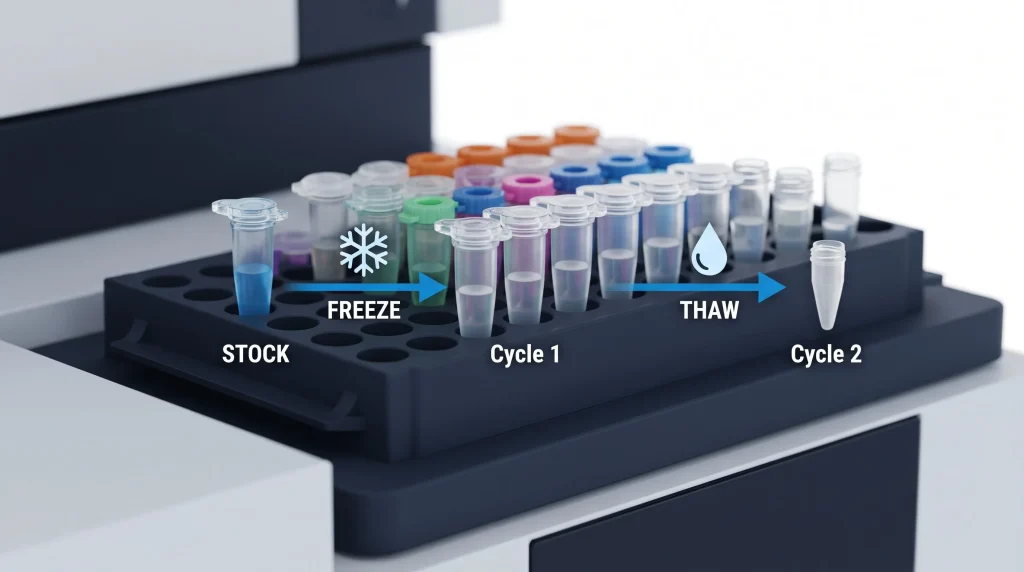
Peptide freeze-thaw stability refers to a peptide’s ability to retain its structure after being frozen and thawed one or more times. Each freeze-thaw cycle forms ice crystals, raises local salt levels, and shifts the pH inside the vial. These forces can cause clumping or structural breakdown in the peptide chain. According to NCBI (2011), repeated freeze-thaw cycles are a recognized cause of irreversible structural changes in protein and peptide research samples.
Next Level Pharm provides research peptides with an average purity of 99.4% across the last 100 batches. Every vial is verified by HPLC and mass spectrometry before dispatch. Compounds ship as freeze-dried solids sealed under an inert atmosphere. This format is stable at room temperature and does not need cold-chain transit.
Maintaining sample integrity after mixing requires attention to temperature cycling. Researchers who limit freeze-thaw events preserve more starting material across longer study periods. The sections below explain the mechanisms, thresholds, and measurement methods for freeze-thaw damage.
Key Takeaways
- Ice Crystal Damage: Freeze-thaw cycles create ice crystals that press on the peptide chain. This causes clumping and structural loss.
- Cycle Threshold: Many sensitive sequences show measurable purity loss within 3-5 cycles. Some fragile peptides degrade after even one cycle.
- Aliquoting: Dividing solution into single-use portions reduces the need to freeze and thaw the entire stock multiple times.
- Lyophilized Stability: Freeze-dried powder has no liquid water. It does not form ice crystals and resists freeze-thaw damage far better than solution.
- HPLC Detection: HPLC separates intact peptides from clumped products. It is the standard method for detecting and measuring freeze-thaw damage.
Every vial ships with a COA and full lot traceability. Shop research peptides with lab-verified purity.
What Happens to Peptides During Freeze-Thaw?
Freezing water forms ice crystals that press against the peptide chain. This causes clumping. Thawing reverses the ice but not the structural damage. Each cycle adds to the total harm.
When a solution freezes, water molecules form ice crystals. These crystals expand and press against the peptide chains. This pressure forces molecules into close contact. They clump together. Clumped peptide chains lose their original structure. They may not return to a dissolved form after thawing.
Freezing also causes salt buildup. As ice forms, the remaining liquid becomes dense with salts and solutes. This raises local salt levels and shifts the pH inside the vial. These shifts cause more chain-to-chain contact. The combined effect is cumulative. Each cycle adds to the total structural damage.
How Many Cycles Cause Measurable Degradation?
Most sensitive peptides show measurable degradation within 3-5 freeze-thaw cycles. Some sequences show purity loss after a single cycle. The threshold depends on the peptide sequence, its concentration, and the diluent.
There is no universal cycle limit that applies to all peptides. Most research labs aim to limit freeze-thaw events to no more than 3-5 per vial. Beyond this range, most sensitive sequences show significant clumping. Some fragile peptides with water-repelling regions degrade measurably after just one cycle.
The solution concentration also matters. Higher concentration solutions pack more peptide chains into the same volume. When ice forms, these chains are forced into closer contact. They clump more quickly. Using a lower concentration or dividing into smaller portions reduces this effect. HPLC analysis confirms that each cycle reduces the fraction of intact, dissolved peptide in the vial.
Which Practices Reduce Freeze-Thaw Damage?
Aliquoting into single-use portions is the most effective method. Flash-freezing with liquid nitrogen reduces ice crystal size. Storing freeze-dried powder rather than solution avoids liquid-phase damage entirely.
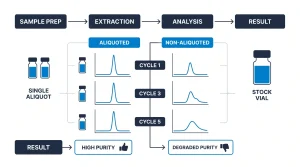
Aliquoting divides the stock into small, single-use portions. Each aliquot is only thawed once. The remaining stock stays frozen. This method limits the number of times any one portion undergoes a temperature cycle. It preserves the bulk of the material in a stable state throughout the study.
Flash-freezing reduces ice crystal size. By cooling the sample rapidly in liquid nitrogen or a dry ice bath, water molecules form many small crystals rather than fewer large ones. Small crystals press less on the peptide chain. This reduces structural damage per cycle. According to Searles et al. (2010), controlled freeze rate and aliquot size are the main variables for reducing clumping during thermal cycling.
Does Lyophilization Prevent Freeze-Thaw Loss?
Yes. Freeze-dried (lyophilized) peptide powder has no liquid water. It does not form ice crystals during freezing. Long-term storage should use freeze-dried powder when possible.
Lyophilization (freeze-drying) removes solvent from a peptide solution through sublimation. The result is a dry, stable powder. This powder has no free water. It cannot form ice crystals during freezing. The mechanical stress of freeze-thaw cycles does not apply to dry powder in the same way it does to liquid solution.
According to Peptides (2005), removing liquid water stops certain amino acid breakdowns and oxygen damage that degrade the peptide chain. Freeze-dried powder stored in a sealed, inert atmosphere at -20 degrees C or colder can remain intact for years. All Next Level Pharm compounds ship in this format for maximum pre-mixing stability.
How Is Freeze-Thaw Damage Detected by HPLC?
HPLC separates intact peptides from clumped fragments by their chemical properties. Clump peaks appear as extra signals on the readout. The ratio of intact peptide to total signal gives the purity percentage after cycling.
HPLC (High-Performance Liquid Chromatography) separates the intact peptide from clumps and broken pieces. It uses differences in polarity and size. Each component appears as a distinct peak on the readout. Comparing the intact peptide peak area to the total signal gives the purity percentage.
Mass spectrometry is often paired with HPLC for a full picture. It confirms the exact identity of each peak. This includes the specific breakdown products formed after clumping. This combination lets researchers track both the amount and type of degradation across successive cycles. Every lot from Next Level Pharm is verified by this dual-method process before dispatch.
Frequently Asked Questions
What happens to peptides during freeze-thaw?
During a freeze-thaw cycle, ice crystals press on the peptide chain. This forces molecules into close contact and causes clumping. Salt buildup also shifts the local pH inside the vial, adding further stress. According to NCBI (2011), this structural change can occur rapidly and often leads to irreversible sample loss. All products are for laboratory research use only.
How many cycles cause measurable degradation?
Most sensitive peptides show signs of degradation within 3-5 freeze-thaw cycles. Some fragile sequences show purity loss after a single cycle. The degree of damage depends on peptide sequence, concentration, and diluent choice. HPLC analysis confirms the reduction in intact, dissolved peptide after each cycle.
Why does aliquoting reduce freeze-thaw damage?
Aliquoting divides a stock solution into single-use portions. Each portion is only thawed once. The remaining portions stay frozen. This limits the number of thermal cycles any one aliquot experiences. It preserves the bulk of the material in a stable frozen state throughout the study.
Does lyophilization prevent freeze-thaw loss?
Yes. Freeze-dried powder has no free water, so it does not form ice crystals during freezing. It avoids the mechanical stress of freeze-thaw cycles that affect solutions. When stored in a sealed, inert atmosphere at -20 degrees C or colder, freeze-dried peptide remains intact for years.
How is freeze-thaw damage detected by HPLC?
HPLC separates the intact peptide from clumped fragments by their chemical properties. Clumping produces new peaks on the readout. The ratio of the intact peptide peak to the total signal gives the purity percentage. Mass spectrometry confirms the identity of each peak, including specific breakdown products.
Can you refreeze a peptide after reconstitution?
Refreezing a solution is not recommended. Each freeze-thaw cycle increases clumping. The more cycles a solution undergoes, the more intact peptide is lost. If storage is required, keeping the solution refrigerated rather than refreezing it is a lower-risk option for short-term holds.
What are visible signs that a peptide has been damaged by freeze-thaw cycles?
Visible signs include cloudiness, white clumps, or floating particles in the solution. These indicate the peptide has clumped or unfolded. However, chemical changes can occur before any visible indicator appears. HPLC is the only reliable method for confirming whether a sample retains its structural integrity after cycling.
Does the type of freezer affect peptide stability?
Yes. Frost-free freezers periodically raise internal temperatures to melt ice buildup. These warming events can trigger partial thawing inside stored vials. This creates unintended thermal cycles even when the researcher does not remove the vial. A manual-defrost freezer or cryogenic storage avoids this effect and keeps more stable temperatures.
What is flash-freezing and how does it reduce damage?
Flash-freezing cools a sample rapidly by placing it in liquid nitrogen or a dry ice bath. Rapid cooling produces many small ice crystals rather than fewer large ones. Smaller crystals press less on the peptide chain. This reduces structural damage per cycle compared to slow, conventional freezing methods.
What buffer reduces clumping during freeze-thaw?
Weakly acidic buffers are often chosen for freeze-thaw-sensitive peptides. They can limit certain amino acid breakdowns, a pathway activated by thermal cycling. Minimizing salt concentration in the buffer also reduces salt buildup effects during freezing. Researchers confirm buffer fit with the specific peptide sequence before use.
Summary
Freeze-thaw cycles damage peptide structure through ice crystal formation and salt buildup. Most sensitive sequences show measurable purity loss within 3-5 cycles. Some degrade after even one cycle, depending on their sequence and concentration.
Aliquoting into single-use portions is the most reliable way to reduce freeze-thaw damage. Flash-freezing with liquid nitrogen reduces ice crystal size per cycle. Freeze-dried powder avoids liquid-phase damage entirely and is the preferred long-term storage format.
Next Level Pharm verifies every lot by HPLC and mass spectrometry before dispatch. Average purity is 99.4% across 100 recent batches. COA data and lot-level traceability are available for every compound.
What Should You Do Next?
Researchers should aliquot solutions into single-use portions before freezing. Confirm the freezer maintains a steady temperature without auto-defrost cycles. Track the number of freeze-thaw events per aliquot in the lab notebook. Shop research peptides with full COA and lot traceability.
People Also Read
- What Is Lyophilization? How Freeze-Drying Preserves Peptide Integrity
- Research Peptide Shelf Life: What Science Shows
About the Author
Next Level Pharm Research Team
The Next Level Pharm research team is composed of biochemists and laboratory scientists dedicated to providing researchers with the highest-purity research peptides from independently verified batches. Every batch is HPLC and mass spec verified before dispatch.
Disclaimer: The information provided on this page is for educational and research purposes only. Next Level Pharm’s products are intended for laboratory research use only. They are not intended for human consumption, diagnostic, therapeutic, or medicinal purposes. This content does not constitute medical advice. Always consult a licensed healthcare professional before making any health-related decisions.