
Peptide Molecular Weight in Research Explained

Last updated: July 2026
A peptide molecular weight is the sum of the atomic masses of all atoms in the peptide chain, stated in daltons (Da). It is calculated from the amino acid sequence and confirmed by mass spectrometry (MS). For a ten-residue peptide, the average molecular weight falls between 1,000 and 1,500 Da. Accurate molecular weight data lets researchers confirm peptide identity, calculate molar concentration, and detect chemical changes. According to the Journal of Peptide Science (2012), mass accuracy within 0.1 Da is the standard for research-grade peptide lot release.
Next Level Pharm is a US-based supplier of research-grade peptides, verified to ≥99.4% purity by HPLC and mass spectrometry on every batch. Each lot ships with a COA that includes the measured molecular weight for direct comparison to the theoretical value.
Knowing a peptide’s molecular weight is the first step in preparing a stock solution, calculating molar concentration, and designing any lab assay. This guide explains the key concepts behind peptide molecular weight and how it is used in research.
Key Takeaways
- Daltons are the unit: Peptide molecular weight is measured in daltons (Da) or kilodaltons (kDa). One dalton equals one atomic mass unit.
- Sequence determines weight: Each amino acid residue adds a defined mass. The total mass is the sum of all residues plus water.
- Mass spec confirms identity: Mass spectrometry measures the observed mass. It is compared to the theoretical mass to confirm identity.
- COA-verified lots: Next Level Pharm ships lyophilized peptide lots with HPLC and mass spec data on every batch. Each lot has a traceable number.
- Research use only: All peptides in this catalog are for laboratory research use only. No clinical outcomes are claimed.
How Is Peptide Molecular Weight Calculated?
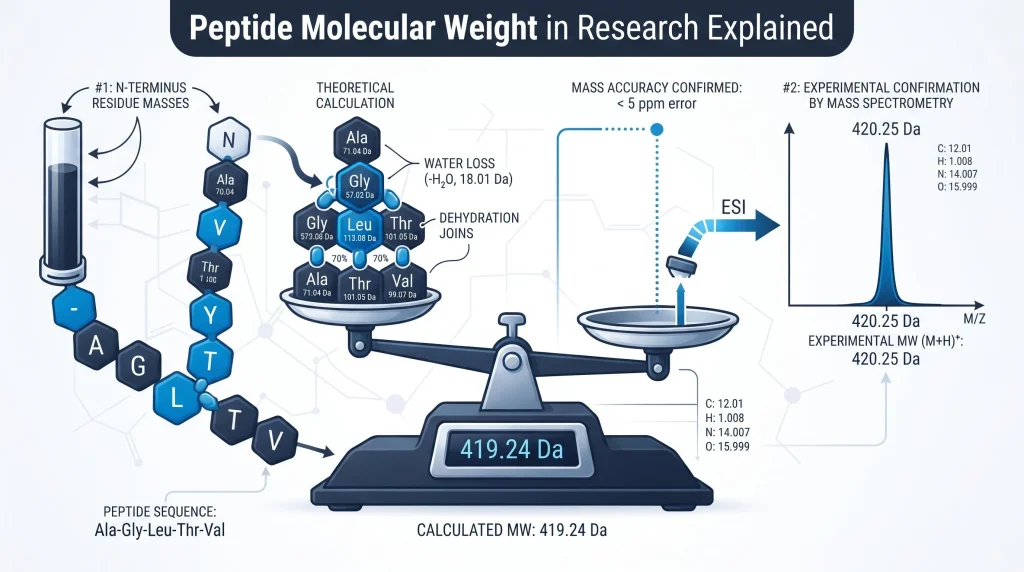
Peptide molecular weight is the sum of all residue masses plus one water molecule (18.02 Da).
Each amino acid residue has a defined monoisotopic mass and an average mass. The residue mass is the amino acid mass minus one water molecule (lost when the peptide bond forms). Adding all residue masses plus one water gives the peptide’s molecular weight. For example, a simple dipeptide Gly-Ala has a molecular weight of about 146.15 Da.
Two mass values are used in practice. Monoisotopic mass uses the lightest stable isotope of each element. Average mass uses the natural isotope abundance. For peptides below 2,000 Da, monoisotopic mass is preferred. For larger peptides, average mass is reported. The choice of mass type should be stated clearly in any COA or methods section.
According to Smart et al. (2007), monoisotopic values are more precise for small peptides. They allow comparison across instruments without the averaging effect of natural isotope distributions.
| Amino Acid | Single-Letter Code | Residue Mass (avg, Da) |
| Glycine | G | 57.05 |
| Alanine | A | 71.08 |
| Leucine | L | 113.16 |
| Lysine | K | 128.17 |
| Arginine | R | 156.19 |
| Aspartic acid | D | 115.09 |
| Glutamic acid | E | 129.12 |
| Tyrosine | Y | 163.18 |
What Is the Role of Mass Spectrometry in Peptide Research?
Mass spectrometry measures observed molecular mass and confirms the peptide matches its theoretical sequence.
Mass spectrometry (MS) separates ions by their mass-to-charge ratio (m/z). For a peptide, the instrument ionizes the compound and reports the detected mass. The detected mass is compared to the theoretical mass calculated from the sequence. A match within 0.1 Da confirms identity. A mismatch signals a synthesis error, a change, or an impurity.
Electrospray ionization (ESI) is the most common ionization method for peptide MS. It produces multiple charge states for the same peptide. Each charge state appears as a peak at a different m/z. The software deconvolutes the charge states to give the actual molecular mass. MALDI-TOF (matrix-assisted laser desorption ionization time-of-flight) is another method. It gives a single charge state and is fast, making it useful for lot-release testing.
Both ESI and MALDI-TOF data are accepted on COAs for research-grade peptides. The method used should be listed on the COA. Browse Epithalon and SS-31 product pages for examples of lot-specific mass spec data.
How Does Molecular Weight Affect Peptide Concentration?
Molecular weight is needed to convert mass (mg) to molar concentration (mM or uM) for assay planning.
Molar concentration (molarity) is calculated as: moles = mass (g) / molecular weight (g/mol). For a 1 mg vial of a 1,000 Da peptide, the moles equal 1 mg / 1,000 g/mol = 0.001 mmol = 1 umol. In 1 mL of solvent, that gives a 1 mM solution.
An error in molecular weight leads to an error in molar concentration. If a researcher uses the wrong molecular weight, every concentration in the study is off. This can cause concentration-response curves to shift. It can also make comparison to published data hard. Third-party COA data with confirmed mass spec values helps researchers start from the right molecular weight.
According to Skov et al. (2014), gaps between theoretical and observed peptide mass are a leading source of concentration errors in early-stage research studies.
What Chemical Changes Alter Peptide Molecular Weight?
Oxidation, deamidation, and disulfide bond formation all shift the observed molecular weight of a peptide.
Oxidation adds 16 Da per oxidized site. Methionine (Met) and tryptophan (Trp) are the most common targets. An oxidized peptide shows a +16 Da peak in mass spec. If the expected mass is 2,000 Da but the observed mass is 2,016 Da, one Met or Trp has oxidized. This shift can affect how the peptide behaves in binding assays.
Deamination of asparagine (Asn) or glutamine (Gln) adds 1 Da. This small shift is hard to detect by HPLC alone but clear in high-resolution mass spec. Disulfide bonds lose 2 Da per bond (two hydrogen atoms removed when sulfur atoms link). Researchers who work with Cys-containing peptides must confirm the disulfide state. A reduced vs. oxidized peptide differs by 2 Da per bond, and the two forms have very different behavior in cell models.
Browse KPV and NAD+ product pages for lot data including mass spec confirmation and purity from the same batch.
How Is Molecular Weight Used to Confirm Peptide Identity?
Mass spec data on a COA confirms that the peptide’s measured mass matches the theoretical mass of the correct sequence.
Identity confirmation using molecular weight is a two-step process. First, the theoretical mass is calculated from the stated amino acid sequence. Second, the observed mass from mass spec is compared to this value. If both values agree within 0.1 Da, the peptide is confirmed as the correct compound. If not, the lot is rejected.
This check is especially important when a supplier makes multiple similar peptides. Two peptides with the same length but different sequences can have masses that differ by just a few daltons. Mass spec can distinguish them. HPLC alone cannot, because retention time depends on charge and hydrophobicity, not identity.
High-resolution mass spec data (resolving power >10,000) gives sub-0.01 Da accuracy. This level is required to detect deamidation (+1 Da) and single-residue swaps.
What Tools Support Peptide Molecular Weight Research?
Mass spectrometers, COA-verified peptide lots, and sequence calculators are the core tools for molecular weight research.
Research teams need a verified peptide lot to run any study. The lot must match the published reference standard for molecular weight and purity. Next Level Pharm verifies each peptide lot by HPLC and mass spectrometry before shipping. Standard tools include an ESI or MALDI-TOF mass spectrometer and a peptide mass calculator (Peptide 2.0, ExPASy PeptideMass, or similar). The COA must list both theoretical and observed mass. View the research peptide catalog for lot-specific COA and mass spec data.
Frequently Asked Questions
What is peptide molecular weight in research?
Peptide molecular weight is the total mass of all atoms in a peptide chain, stated in daltons (Da). It is calculated from the amino acid sequence and confirmed by mass spectrometry. Researchers use it to confirm peptide identity, calculate molar concentration, and detect chemical changes such as oxidation or deamidation. An accurate molecular weight is required before preparing any working stock solution for a lab assay.
How is molecular weight different from molecular mass?
Molecular weight and molecular mass are used as synonyms in peptide science. Both refer to the mass of one molecule in atomic mass units (Da). In strict chemistry, molecular mass is the mass of one molecule, while molecular weight is a dimensionless ratio to the carbon-12 standard. In practice, peptide COAs use both terms to mean the same thing: mass in daltons (Da) or kilodaltons (kDa).
What is the difference between monoisotopic and average molecular mass?
Monoisotopic mass uses the lightest stable isotope of each element in the calculation. Average mass uses the natural abundance of all stable isotopes. For peptides below 2,000 Da, monoisotopic mass is more precise and preferred. For larger peptides or proteins, average mass is reported. The COA or methods section should state which value is used to avoid confusion when comparing observed mass spec data to calculated values.
Why does oxidation change peptide molecular weight?
Oxidation adds an oxygen atom to a susceptible residue. Each oxygen atom has a mass of about 16 Da. Methionine and tryptophan are the most common targets. An oxidized peptide shows a mass 16 Da higher than expected in mass spec data. Oxidation changes the chemical properties of the residue and can reduce or eliminate binding activity in assays. Third-party mass spec testing on each lot catches oxidation before it reaches the researcher.
How do I calculate molar concentration from molecular weight?
Molar concentration (M) equals moles per liter. To calculate: convert the peptide mass to grams, then divide by the molecular weight in g/mol. For a 1 mg vial of a 1,000 Da peptide: 0.001 g / 1,000 g/mol = 0.000001 mol = 1 umol. In 1 mL, that is a 1 mM solution. Using the wrong molecular weight shifts this calculation and every concentration in the study. Always verify molecular weight on the COA before calculating stock concentration.
What is MALDI-TOF and how is it used for peptides?
MALDI-TOF (matrix-assisted laser desorption ionization time-of-flight) is a mass spectrometry method. It ionizes the peptide using a laser and a matrix compound. The ions fly down a tube and are detected by arrival time, which converts to mass. MALDI-TOF produces one main charge state per compound, making it easy to read. It is fast and used for lot-release testing. The result is the molecular mass in daltons. It is accepted on COAs for research-grade peptide lot release.
How close must observed mass be to theoretical mass for a peptide?
For research-grade peptide lot release, the observed mass from mass spec should match the theoretical mass within 0.1 Da. High-resolution instruments achieve sub-0.01 Da accuracy. This level is needed to detect deamidation (+1 Da) or single-residue swaps. For standard lot-release testing on an ESI-MS or MALDI-TOF, matching within 1 Da is the minimum floor. Anything outside that range indicates a synthesis error or change.
Do post-translational changes change peptide molecular weight?
Yes. Post-translational changes (PTMs) change the mass of the affected residue. Phosphorylation adds 80 Da. Acetylation adds 42 Da. Methylation adds 14 Da. N-terminal acetylation is common in synthetic peptides and adds 42 Da to the expected mass. If a change is part of the intended sequence, the COA should state the modified mass. Unexpected PTMs show as mass shifts in the spectrum and indicate unwanted side reactions during synthesis.
Can peptide molecular weight change during storage?
Yes. Chemical changes during storage alter mass. Oxidation adds 16 Da per site. Deamidation adds 1 Da. Hydrolysis of peptide bonds reduces mass by 18 Da per cleavage. Lyophilized peptides stored cold and dry are most stable. Solution stocks degrade faster, especially at room temperature. Re-confirm molecular weight by mass spec if a lot has been stored for more than 12 months. Re-test also if results become inconsistent across experiments.
Summary
Peptide molecular weight is a fundamental property used to confirm identity, calculate concentration, and detect chemical changes. It is stated in daltons and confirmed by mass spectrometry on every lot. The observed mass must match the theoretical value within 0.1 Da for research-grade lot release.
Changes in molecular weight signal important chemical events: +16 Da for oxidation, +1 Da for deamidation, -2 Da for disulfide bond formation. These shifts affect how a peptide behaves in any assay. Tracking mass from lot to lot ensures data consistency.
Next Level Pharm provides lot-specific mass spec data on every COA. Researchers can confirm the measured mass against the theoretical sequence value before starting any experiment.
What Should You Do Next?
Researchers should calculate the theoretical molecular weight before ordering a peptide. Compare that value with the COA mass spec result and confirm the reported mass type. Use the verified molecular weight for concentration calculations and record the lot number in the protocol. Researchers sourcing these lab peptides can shop research peptides with full COA and lot traceability.
People Also Read
About the Author
Next Level Pharm Research Team
Alex M covers peer-reviewed findings in peptide science for Next Level Pharm, a US-based supplier of research-grade peptides verified to ≥99% purity via HPLC and mass spectrometry on every batch.
Disclaimer: For research purposes only. Not intended for human consumption. Next Level Pharm products are not intended for diagnostic, therapeutic, or medicinal use. This content does not constitute medical advice. Always consult a licensed healthcare professional before making any health-related decisions.