
How Peptides Cross the Blood-Brain Barrier

Last updated: July 2026
A blood brain barrier peptide research study is a lab model of how short protein chains interact with the selective border between blood and brain tissue. The blood-brain barrier (BBB) is a dense layer of specialized cells. This blocks most large compounds from entering the central nervous system (CNS). labs examine which peptides can cross this layer and what structural features allow entry. According to NCBI (2015), tight junctions between vessel lining cells form the core barrier that limits chemical transit.
Next Level Pharm supplies research-grade peptides for lab use, like CNS compounds like Semax, Selank, and Cerebrolysin. Every batch is tested to 99.4% average purity via HPLC and mass spectrometry. Each order includes a COA with lot number for full traceability. All peptides are lyophilized and shipped from the USA.
Blood-brain barrier research matters because the CNS is hard to reach. Most drug-like compounds fail to cross. Understanding how peptides interact with the BBB guides neuroscience research and compound design.
Key Takeaways
- BBB Structure: The blood-brain barrier is a layer of vessel lining cells joined by tight junctions. Pericytes and astrocytes reinforce this barrier from outside.
- Size and Charge Limits: Most peptides are too large or too polar to cross the barrier by passive diffusion. size above 500 Da rarely crosses freely.
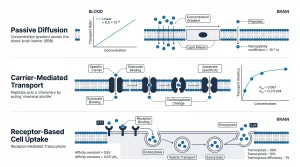
- Three Transport Routes: Peptides may use passive diffusion, carrier-mediated transport (CMT), or receptor-based cell uptake (RMT) to enter the brain.
- Known CNS Peptides: Semax, Selank, and DSIP are studied for their ability to reach the CNS in lab models. Their amino acid sequences allow specific barrier contacts.
- Structural changes: labs add fatty acid chains (lipidation) or sugar groups (glycosylation) to improve peptide BBB entry. nano-carrier wrapping is also studied.
These five findings set the stage for the sections below. This examine each route, known CNS peptides. And methods used to study BBB transport.
What Is the Blood-Brain Barrier’s Structure?
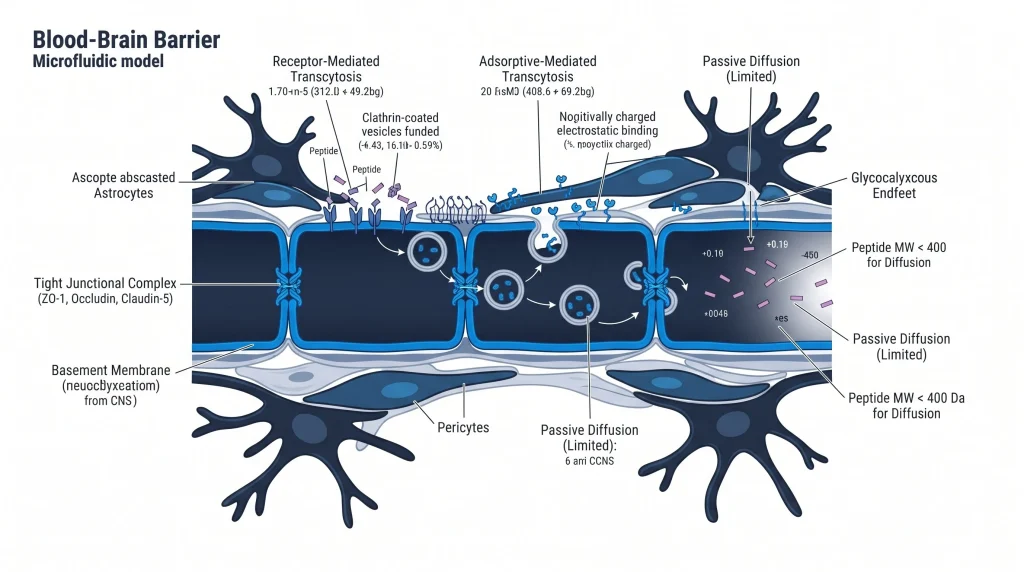
The BBB is made of vessel lining cells lining brain blood vessels. Tight junctions seal the gaps between these cells, blocking most large or polar compounds. Pericytes wrap around the outside of the vessels to give structural support. Astrocytes extend foot processes onto the vessel wall to regulate the junction proteins. needed nutrients like glucose and amino acids cross via specific transport proteins. According to NCBI (2015), astrocyte-vessel lining binding stabilizes tight junctions and controls barrier function.
Astrocytes release chemical signals that tell vessel lining cells to tighten or loosen their junctions. Pericytes control blood flow and vessel tone from outside the cell layer. Tight junctions are made of proteins like claudin and occludin, which form a near-impermeable seal. This system keeps most compounds in the blood and out of the brain.
Why Do Most Peptides Fail to Cross the BBB?
Most peptides are too large and too water-soluble to pass through the fatty cell walls by passive diffusion. Rapid enzyme breakdown in the blood also shortens their life before they reach the brain. A peptide must survive blood flow long enough to contact the BBB surface. According to NCBI (2016), size, charge, and lipid affinity all limit CNS entry in research models.
Peptides above 500 Da are generally too large to slip between or through lipid bilayers. Hydrogen bonding to water compounds keeps polar peptides trapped in the bloodstream. Peptidases in blood and at the BBB surface break peptide bonds and destroy many compounds before they reach the brain. Each of these barriers operates in parallel.
| Property | BBB-able to enter Peptides | BBB-Blocked Peptides |
| size | Below 500 Da | Above 500 Da |
| lipid affinity | High | Low (hydrophilic) |
| Charge | Positive (cationic) | Negative or neutral |
What Transport paths Do Peptides Use?
Three main routes carry peptides across the BBB in lab models. Passive diffusion works for small, lipid-soluble peptides that can dissolve into the cell membrane. Carrier-mediated transport (CMT) acts as a chemical shuttle. There specific proteins carry compounds that mimic natural nutrients. receptor-based cell uptake (RMT) occurs when peptides bind cell surface receptors and get pulled across in a sac. According to PubMed (2017), adsorptive cell uptake is a fourth route for cationic (positively charged) peptides.
CMT is used by amino acids and glucose in normal brain nutrition. A peptide that mimics one of these substrates can hijack the shuttle. In RMT, a receptor like transferrin binds the peptide. The cell then pulls the group inside and releases it on the brain side. Adsorptive cell uptake works when cationic peptides bind to negatively charged cell surface compounds. Cerebrolysin, available as a COA-verified research peptide.
Which Peptides Are Known to Cross the BBB?
Semax, Selank, and DSIP are studied for CNS entry in lab models. Their unique amino acid sequences allow specific barrier contacts. According to PubMed (2012), the amino acid arrangement in Selank and Semax supports central entry in preclinical work.
Semax is an ACTH (adrenocorticotropic hormone) analog. labs study its effects on BDNF (brain-derived neurotrophic factor) levels in neural cell models. Selank is a tuftsin analog studied for contacts with GABA (gamma-aminobutyric acid) signal paths. DSIP (delta sleep-inducing peptide) is examined for sleep-related CNS signals in animal models. All three are available as COA-verified research compounds in the Next Level Pharm brain peptide category. labs can also explore Adamax research, another CNS-related compound on the platform.
How Can Peptides Be Modified for BBB Entry?
Lipidation attaches a fatty acid chain to the peptide, boosting fat solubility and passive diffusion through the cell membrane. Glycosylation adds a sugar group that masks polar surface charges. The chemical Trojan horse strategy fuses a peptide to a carrier that binds natural transport receptors. According to Journal of Peptide Science (2018), structure changes often control receptor binding and BBB entry rates in research models.
nano-carrier wrapping wraps a peptide in a protective shell, shielding it from enzyme breakdown during transit to the brain. Each approach targets a different barrier:
- Lipidation: adds fatty acid chain for membrane entry rate.
- Glycosylation: sugar group reduces polar surface area.
- Trojan horse: joins peptide to a receptor-binding carrier.
- nano-carrier wrapping: shields peptide from enzymatic breakdown.
Semax and Selank are available as COA-verified research peptides at Next Level Pharm.
labs studying brain peptides can browse Semax, Selank. Also, other CNS compounds at Next Level Pharm.
How Is BBB Peptide Transport Studied?
labs use three main methods. In vitro hCMEC/D3 cell monolayers mimic the BBB and let labs test how fast a compound crosses. In vivo microdialysis samples brain fluid in real time during animal experiments. In silico models predict chemical transit based on fat solubility and surface charge. According to PubMed (2017), this multi-method approach gives the most reliable data on CNS peptide entry.
Cell monolayers measure top-to-bottom flux, the rate at which a compound moves from blood-side to brain-side. TEER (transendothelial electrical resistance) confirms the barrier is intact before each test. Microdialysis gives real-time brain level data in animal models. In silico tools screen hundreds of peptide variants before lab work begins, saving time and resources. Browse the full catalog at the shop.
Frequently Asked Questions
Can peptides cross the blood-brain barrier?
A small fraction of peptides can cross the BBB in lab models. Most rely on specific transport systems or structural features to gain entry. Small, lipid-soluble peptides may pass by passive diffusion. Larger or polar peptides need carrier proteins or RMT. According to NCBI (2015), tight junctions between vessel lining cells block most compounds from crossing freely.
What structural properties make a peptide BBB-able to enter?
Low size, high lipid affinity, and positive charge all support BBB entry in lab models. Peptides below 500 Da may cross by passive diffusion. Those above this level need structural changes to enter the CNS. Hydrogen bonding to water compounds traps most polar peptides in blood. According to the Journal of Peptide Science (2018), surface charge and fat solubility are primary predictors of CNS entry rate in research settings.
How do shuttle compounds transport peptides across the BBB?
Shuttle compounds bind to natural receptors on the BBB surface. This triggers RMT, pulling the attached peptide across in a sac. Shuttles mimic natural nutrients like transferrin or glucose to exploit existing transport systems. This strategy is called the chemical Trojan horse. According to PubMed (2017), this method delivers large compounds. This would otherwise be blocked by size or charge.
Does Selank cross the blood-brain barrier?
Lab studies show Selank can cross the BBB in preclinical models. As a tuftsin analog, it has biochemical features that support CNS binding. Its short amino acid sequence keeps size low, which helps barrier passage. labs study its effects on GABA-related signal paths. According to PubMed (2012), Selank’s amino acid arrangement supports central entry in preclinical work. It is studied in lab settings only, not for human use.
How does intranasal delivery help peptides bypass the BBB?
The nasal route connects to the brain through olfactory and trigeminal nerve paths. This path bypasses tight junctions in the BBB entirely. Peptides travel along nerve fibers straight to CNS tissue. This avoids enzyme breakdown in the bloodstream. According to NCBI (2015), intranasal delivery increases CNS peptide levels in lab models without requiring the compound to cross vessel endothelium.
Are any peptides studied for BBB repair?
Some peptides interact with astrocytes and pericytes in lab models to stabilize tight junctions. They may reduce vessel leakage under oxidative or swelling-related stress in research settings. These effects are studied in cell culture and animal models only. No peptide is approved for BBB repair in humans. According to PubMed (2017), pericyte-astrocyte signal plays a key role in BBB integrity in preclinical research.
What is the difference between active and passive BBB transport?
Passive transport moves a compound down its level gradient with no energy needed. The compound must be small and lipid-soluble to cross the cell membrane. Active transport uses energy and specific carrier proteins or receptors. It can pull compounds against the gradient. According to NCBI (2015), most CNS-active compounds use active routes because the BBB blocks passive crossing for large or polar compounds.
Why must nootropic peptides cross the BBB?
Nootropic peptides must reach neural receptors in the CNS to affect cognition or brain protection in research models. Without crossing the BBB, they stay in blood and miss their targets. The barrier keeps out most blood-borne compounds as a protective mechanism. Peptides that do not cross can only exert peripheral effects. According to PubMed (2012), CNS delivery is the defining challenge for most brain peptides research compounds.
What is a chemical Trojan horse for BBB entry?
A chemical Trojan horse joins a research compound to a ligand. This binds a BBB transport receptor. The group mimics a natural nutrient, like transferrin or insulin. The receptor pulls the group into a sac and moves it across the cell. The cargo is released on the brain side. According to NCBI (2015), this strategy allows large or polar compounds to enter the CNS by exploiting natural transport paths in lab models.
How is BBB entry rate quantified in vitro?
labs use TEER (transendothelial electrical resistance) to measure how tight a cell cell sheet is. High TEER means a tight, intact barrier model. They also calculate entry rate coefficients, which measure how fast a compound crosses from one side to the other. The hCMEC/D3 cell line is commonly used for these assays. According to PubMed (2017), combining TEER with flux measurements gives a reliable picture of BBB entry rate in vitro.
Summary
Blood-brain barrier peptide research maps the structural and chemical features. This allows short protein chains to enter the CNS. The BBB blocks most compounds via tight junctions, enzyme action, and charge-based exclusion. Only peptides with low size, high lipid affinity, or specific transport contacts can cross in lab models.
Three routes, passive diffusion, CMT, and RMT, govern BBB entry for research peptides. Semax, Selank, and DSIP are among the compounds studied for CNS entry in preclinical settings. Labs also explore lipidation, glycosylation, and nano-carrier wrapping to expand which peptides can cross.
4% average purity, shipped lyophilized from the USA.
What Should You Do Next?
Researchers should select a blood-brain barrier model and peptide with published transport data. Match permeability endpoints and controls to the planned CNS study. Confirm purity, molecular identity, and lot traceability before the compound enters the assay. Researchers sourcing these lab peptides can shop research peptides with full COA and lot traceability.
People Also Read
- Semax Research Review: BDNF, Dopamine, and brain protection Studies.
- PE-22-28 Research: BDNF Mimetic and Neuroplasticity Studies.
About the Author
Next Level Pharm Research Team
Alex M covers peer-reviewed findings in peptide science for Next Level Pharm, a US-based supplier of research-grade peptides verified to ≥99% purity via HPLC and mass spectrometry on every batch.
Disclaimer: For research purposes only. Not intended for human consumption. Next Level Pharm products are not intended for diagnostic, therapeutic, or medicinal use. This content does not constitute medical advice. Always consult a licensed healthcare professional before making any health-related decisions.