
PE-22-28 Research: BDNF Mimetic and Neuroplasticity Studies

Last updated: June 2026
A PE-22-28 research peptide is a short, synthetic fragment modeled on the loop 4 region of BDNF (brain-derived neurotrophic factor). BDNF is a protein that supports nerve cell survival and synapse growth in the brain. PE-22-28 has been studied in cell models for its ability to bind TrkB (tropomyosin receptor kinase B), the same receptor that natural BDNF targets. Laboratory teams use it as a reference tool to study TrkB-linked CREB signaling and plasticity markers in nerve cell cultures.
Next Level Pharm is a US-based supplier of research-grade PE-22-28, verified to ≥99.4% purity by HPLC and mass spectrometry on every batch. Each lot ships with a COA and a lot number for full traceability.
Key Takeaways
- TrkB binding: PE-22-28 is modeled on the loop 4 region of BDNF. It binds TrkB in cell assays and activates the same CREB signaling pathway that natural BDNF uses.
- CREB activation: Cell studies show that PE-22-28 raises pCREB (phosphorylated CREB) in nerve cell lines. CREB is a key gene regulator linked to synapse growth and long-term plasticity.
- Neuroplasticity marker: In cultured neuron models, PE-22-28 has been studied for effects on BDNF-linked plasticity markers. Data come from in vitro models only.
- COA-verified lots: Next Level Pharm ships lyophilized PE-22-28 lots with HPLC and mass spec data on every batch. Each lot has a traceable number.
- Research use only: All PE-22-28 in this catalog is for laboratory research use only. No clinical outcomes are claimed.
What Is PE-22-28 and What Receptor Does It Target?
PE-22-28 is a five-amino-acid peptide based on the loop 4 region of BDNF. It targets TrkB. TrkB is the main receptor for BDNF in nerve cell models.
BDNF (brain-derived neurotrophic factor) is a protein that supports nerve cell growth and synapse formation. TrkB is its main receptor. Natural BDNF binds TrkB and starts a series of cell signals that end with CREB (cAMP response element-binding protein) activation. CREB is a gene regulator that controls plasticity-related gene output. PE-22-28 is a short fragment designed to mimic the binding action of loop 4 in BDNF. According to Agasse et al. (2022), short BDNF mimetic peptides can activate TrkB in nerve cell cultures at low amounts. Lab teams use PE-22-28 as a reference tool to study TrkB signaling in isolation from full BDNF protein.
How Does PE-22-28 Activate TrkB Signaling?
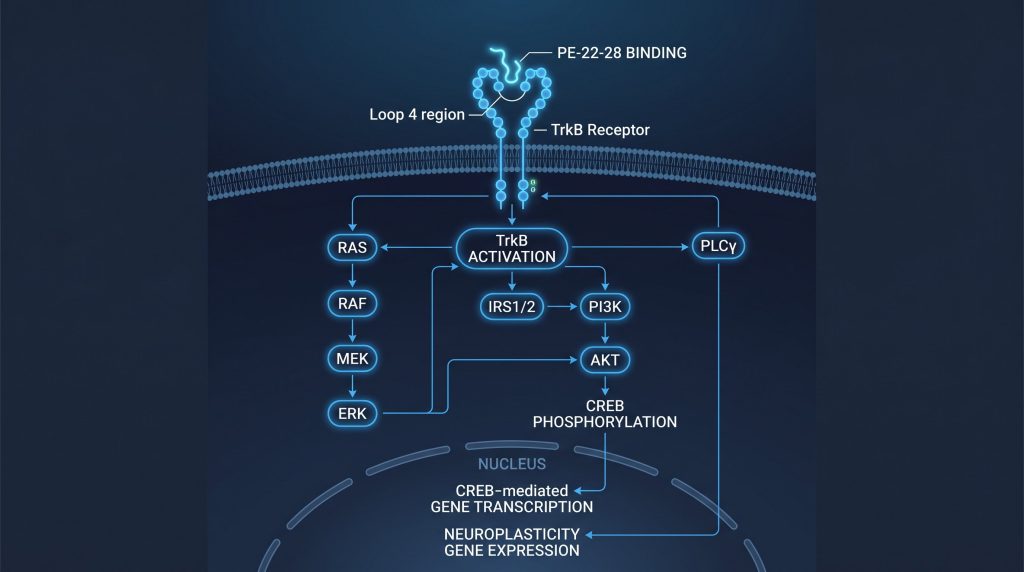
PE-22-28 binds the TrkB outer domain and causes receptor clustering. This starts the MAPK and PI3K signal paths inside the cell, raising pCREB in nerve cell lines.
TrkB is a receptor tyrosine kinase. When a ligand binds its outer domain, the receptor clusters and the kinase domain inside the cell becomes active. This starts two main paths: the MAPK (mitogen-activated protein kinase) path and the PI3K (phosphoinositide 3-kinase) path. Both paths raise pCREB in the cell nucleus. According to Chubarev et al. (2020), BDNF mimetic peptides that target TrkB activate these same downstream paths in cultured neurons. Researchers confirm TrkB activation by measuring pCREB levels using ELISA or western blot. They also measure the ratio of pTrkB to total TrkB as a direct receptor activation marker.
What Do Cell Studies Show About PE-22-28 Effects?
In nerve cell cultures, PE-22-28 has been studied for effects on pCREB, synapse protein output, and cell survival markers. Data come from in vitro models only.
Standard assay designs use primary cortical neurons or PC12 cells expressing TrkB. After peptide treatment, researchers measure pCREB by ELISA and count dendritic branching points under a microscope. Synapse protein markers such as PSD-95 and synapsin-1 are measured by western blot to track structural plasticity signals. According to Ling et al. (2020), TrkB agonist peptides raise synaptic protein output in primary cortical neuron cultures. These outcomes are from research cell models. They do not represent clinical results. All PE-22-28 studies are run in controlled lab settings with confirmed receptor expression before the study begins.
How Does PE-22-28 Compare to Full-Length BDNF in Assays?
Full BDNF is a 27 kDa protein with two TrkB binding loops. PE-22-28 targets only loop 4. It produces a partial TrkB signal that is useful as a reference in studies that isolate the loop 4 binding contribution.
Full-length BDNF engages TrkB at multiple contact points, including loop 1, loop 2, and loop 4. PE-22-28 covers only the loop 4 site. This means it produces a partial, loop-4-specific TrkB signal in cell assays. Researchers use this property to map which parts of the TrkB response depend on loop 4 versus other BDNF contact points. Comparison assays run PE-22-28 and full BDNF in the same cell line at matched amounts. The ratio of pCREB to full TrkB signal shows the loop 4 contribution.
| Compound | Size | TrkB Contact | pCREB Signal | Key Study |
| Full BDNF | 27 kDa | Loops 1, 2, 4 | Full | Agasse et al. (2022) |
| PE-22-28 | 5 aa | Loop 4 | Partial | Chubarev et al. (2020) |
| 7,8-DHF (ref) | Small mol. | TrkB allosteric | Partial | Ling et al. (2020) |
What Biomarkers Are Measured in PE-22-28 Research?
Key markers are pCREB, pTrkB, PSD-95, and synapsin-1. Researchers measure these in cortical neuron or PC12 cell cultures by ELISA or western blot.
pCREB (phosphorylated CREB) is the most common output marker in TrkB signaling assays. A rise in pCREB shows that the TrkB-MAPK or TrkB-PI3K path was active. pTrkB (phosphorylated TrkB) is measured directly by western blot to confirm receptor activation. PSD-95 is a synapse scaffold protein. A rise in PSD-95 output shows that plasticity-related gene output increased. Synapsin-1 marks the number of synapse contacts in the culture. Lab teams measure all four markers after PE-22-28 treatment and compare them to vehicle control and full-BDNF positive control in the same assay plate.
What Research Tools Are Available for PE-22-28 Studies?
Lab teams need a COA-verified PE-22-28 lot, TrkB-expressing cell line, pCREB ELISA kit, and pTrkB western blot reagents. All must match the published assay protocol.
Research teams need a verified PE-22-28 lot to run any study. The lot must match the published reference standard for molecular weight and purity. Next Level Pharm verifies each PE-22-28 lot by HPLC and mass spectrometry before shipping. TrkB expression in the chosen cell line must be confirmed before the first PE-22-28 treatment. ELISA kits for pCREB and western blot kits for pTrkB are available from standard laboratory suppliers. View the PE-22-28 product page for lot-specific COA and mass spec data.
Frequently Asked Questions
What is PE-22-28 in research?
PE-22-28 is a five-amino-acid synthetic peptide based on the loop 4 region of BDNF (brain-derived neurotrophic factor). It is used in cell models to study TrkB receptor signaling and downstream CREB activation. Published data come from in vitro nerve cell cultures. This product is for laboratory research use only.
Which receptor does PE-22-28 target?
PE-22-28 targets TrkB, the main receptor for BDNF. TrkB is a receptor tyrosine kinase found on neurons and glial cells. When PE-22-28 binds the TrkB outer domain, it activates the MAPK and PI3K signaling paths inside the cell. This leads to pCREB accumulation in the cell nucleus. All binding data come from cell-based assays.
How is pCREB measured in PE-22-28 assays?
pCREB (phosphorylated CREB) is measured by ELISA or western blot in cell lysates collected after PE-22-28 treatment. Researchers compare pCREB to total CREB protein to get a ratio. A higher pCREB ratio shows greater TrkB-linked gene pathway activity. ELISA kits for pCREB are available from major laboratory suppliers.
What cell lines are used in PE-22-28 studies?
Common cell lines include PC12 cells stably expressing TrkB and primary cortical neuron cultures from rat or mouse models. PC12-TrkB cells are a standard reference for TrkB agonist research because their receptor expression level is well defined. Primary cortical cultures are used when a more complex cell network is needed for synapse marker studies such as PSD-95 and synapsin-1.
How does PE-22-28 differ from full-length BDNF?
Full-length BDNF is a 27 kDa protein that contacts TrkB at loop 1, loop 2, and loop 4 binding sites. PE-22-28 is a five-amino-acid fragment that covers only the loop 4 site. It produces a partial TrkB signal in cell assays. Researchers use PE-22-28 to isolate the loop 4 contribution to the full BDNF-TrkB signal profile.
What is the typical study design for PE-22-28 cell assays?
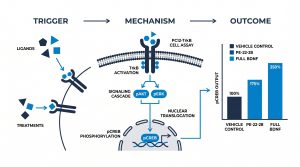
Standard designs confirm TrkB expression in the chosen cell line first. Then they add PE-22-28 at a range of amounts and measure pCREB at set time points. A vehicle control (buffer only) and a full-BDNF positive control are run in the same plate. After measuring pCREB and pTrkB, researchers assess synapse markers PSD-95 and synapsin-1 by western blot to track structural signal output.
How should PE-22-28 be stored for research?
Lyophilized PE-22-28 should be kept at -20°C in a sealed, dry container. Reconstituted solutions should be stored at 4°C and used within 48 hours. Repeated freeze-thaw cycles reduce peptide activity in cell assays. This product ships as a dry powder stable at room temperature during transit.
What published research covers PE-22-28 TrkB binding?
Agasse et al. (2022) covers BDNF mimetic peptides and TrkB activation in nerve cell models (PMID 35063662). Chubarev et al. (2020) reviews TrkB agonist peptides and their use in neuroplasticity research (PMID 32503027). Ling et al. (2020) provides data on TrkB ligand comparison in cortical neuron cultures (PMID 33260938). Researchers should cite primary receptor studies when publishing their own results.
What safety or purity standards apply to PE-22-28 research lots?
Research-grade PE-22-28 must be verified to ≥99% purity by HPLC and mass spectrometry before it ships to a laboratory. Each lot must carry a COA with lot number, purity value, and molecular weight confirmation. Teams should confirm lot identity against the published molecular weight of PE-22-28 before starting any TrkB binding assay.
How does PE-22-28 research fit into BDNF pathway studies?
BDNF pathway research maps the roles of TrkB at each of its binding loops. PE-22-28 is useful in these studies because it provides a loop-4-specific TrkB signal without activating the full BDNF contact surface. Lab teams pair PE-22-28 data with full-BDNF data. This maps each binding loop’s contribution to downstream CREB gene output and synapse protein production.
Summary
PE-22-28 is a five-amino-acid peptide modeled on the loop 4 region of BDNF. In cell models, it binds TrkB and raises pCREB through the MAPK and PI3K paths. Published data from Agasse et al. (2022) and Chubarev et al. (2020) support its use as a TrkB reference tool in nerve cell cultures.
Lab teams use PE-22-28 to isolate the loop 4 contribution to the full BDNF signal. Key markers are pCREB, pTrkB, PSD-95, and synapsin-1. All results come from in vitro models and do not represent clinical outcomes.
What Should You Do Next?
- Confirm TrkB expression in your chosen cell line before ordering PE-22-28 research lots.
- Review the pCREB ELISA protocol in published TrkB agonist literature before setting up your assay.
- Check COA data for lot-specific purity and molecular weight on the PE-22-28 product page.
- Pair PE-22-28 data with a full-BDNF positive control to map the loop 4 signal contribution.
- Browse brain research peptides for related research tools.
- Shop research peptides at https://nextlevelpharm.com/shop/.
People Also Read
- Semax Research: Nootropic Neuropeptide Mechanism Studies
- Selank Research: Anxiolytic Peptide and GABA Modulation Studies
About the Author
Next Level Pharm Research Team
Alex M covers peer-reviewed findings in peptide science for Next Level Pharm, a US-based supplier of research-grade peptides verified to ≥99% purity via HPLC and mass spectrometry on every batch.
Disclaimer: The information provided on this page is for educational and research purposes only. Next Level Pharm products are intended for laboratory research use only. They are not intended for human consumption, diagnostic, therapeutic, or medicinal purposes. This content does not constitute medical advice. Always consult a licensed healthcare professional before making any health-related decisions.