
What Is an Incretin? GLP-1 and GIP Explained

Last updated: July 2026
An incretin is a gut hormone released after eating that signals through receptors in metabolic research models. It tells the pancreas to release insulin when blood glucose rises. Two incretins drive this response: GLP-1 (glucagon-like peptide-1) and GIP, an insulin-triggering hormone made in the gut. Together, they account for about 50 to 70 percent of the insulin released after a meal. Scientists study these hormones to map metabolic signaling in preclinical models.
Next Level Pharm supplies COA-verified, research-grade incretin analog peptides for lab use. All batches are tested by HPLC and mass spectrometry. Average purity across the last 100 batches is 99.4%. Each vial ships lyophilized and sealed. Every batch is third-party tested..
Incretins are key tools in metabolic research. They let scientists study how the gut and pancreas talk to each other. The sections below explain how GLP-1 and GIP work and what makes them useful in lab studies.
Researchers studying GLP-1 receptor mechanisms may also find eloralintide relevant — it is a research-grade GIP/GLP-1 co-agonist analog available as a COA-verified, lyophilized research peptide.
Key Takeaways
- Incretin Hormones: GLP-1 and GIP are gut hormones. They trigger insulin release after a meal in a glucose-dependent way.
- The Incretin Effect: Oral glucose triggers more insulin than the same amount given intravenously. This gap shows the gut’s role in beta-cell signaling.
- GLP-1 Pathways: GLP-1 has been studied for beta-cell signaling, gastric emptying control, and glucagon regulation in preclinical models.
- GIP Pathways: GIP has been studied for beta-cell signaling and lipid storage in adipose tissue research models.
- DPP-4 Degradation: The DPP-4 enzyme cleaves GLP-1 and GIP within minutes. Synthetic analogs are made to resist this breakdown.
- Research Tools: Incretin analogs give labs a way to study metabolic signaling over longer timeframes than native hormones allow.
These six points cover the core facts behind incretin research. The sections below go deeper into each area.
What Are the Main Incretin Hormones?
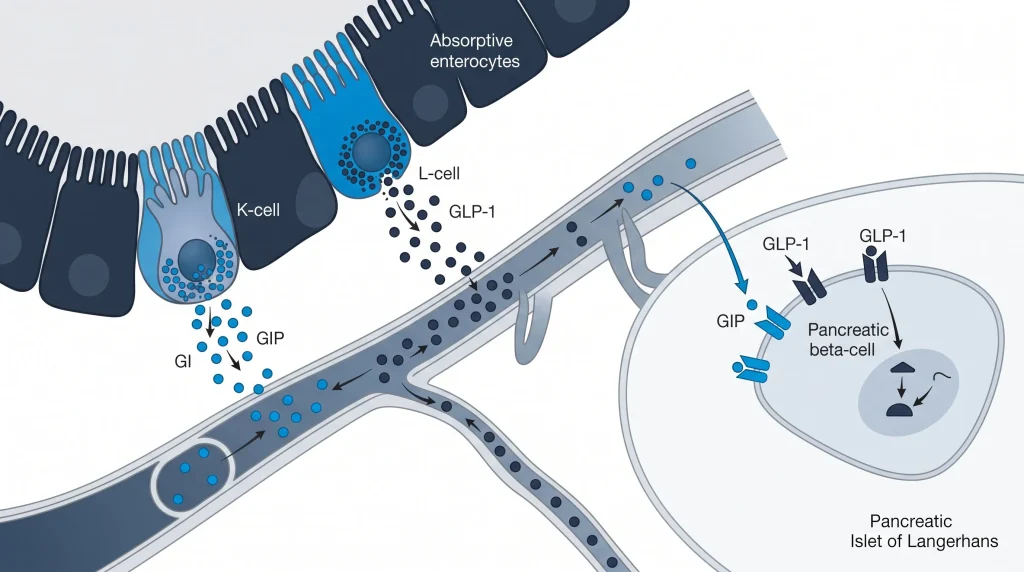
GLP-1 and GIP are the two main incretins. GLP-1 is made in L-cells in the distal gut. GIP is made in K-cells in the proximal small intestine. Both are released after eating. Both bind to receptors on pancreatic beta-cells to trigger insulin release.
According to Nauck et al. (2009), GLP-1 and GIP together drive the incretin effect in healthy preclinical models. Each hormone acts on a separate receptor. GLP-1 binds the GLP-1R receptor. GIP binds the GIPR receptor. These receptors are found in the pancreas and other tissues. Scientists study each hormone’s receptor binding to map metabolic signaling in controlled lab settings.
How Does the Incretin Effect Work?
The incretin effect is the larger insulin response seen after oral glucose than after the same amount given through a vein. The gap occurs because food in the gut triggers hormone release. These hormones prime beta-cells before glucose arrives from the bloodstream.
According to Drucker (2006), GLP-1 triggers insulin release in a glucose-dependent manner. This means insulin is only released when glucose levels are also high. The gut hormones send the signal early. The pancreas responds in tight pulses. This tight control keeps the insulin response matched to the glucose signal in the blood.
What Are GLP-1’s Roles in Metabolic Research?
GLP-1 has been studied for several pathways beyond basic beta-cell signaling. It has been studied for its role in slowing gastric emptying in preclinical models. It has also been studied for its role in controlling glucagon release from alpha-cells. Each action is a separate focus area for lab teams working in metabolic research.
Shop research peptides at Next Level Pharm
The semaglutide research overview covers GLP-1 receptor agonist binding in detail. According to Baggio and Drucker (2006), the GLP-1R receptor is found in the pancreas, gut, brain, and heart. Scientists study these tissue sites to map where GLP-1 signaling reaches beyond the pancreas. Each site is a target area for future study design.
How Does GIP Differ From GLP-1 in Labs?
GIP acts on the GIPR receptor. Like GLP-1, GIP has been studied for insulin signaling at beta-cells. But GIP has also been studied for lipid storage in adipose tissue. This is a distinct research area. GIP’s role in fat cell biology makes it a tool in lipid research models.
Dual agonist research peptides target both GLP-1R and GIPR in one molecule. The tirzepatide research overview shows how dual receptor targeting works in preclinical models. Labs use these tools to study the combined signaling effects from both receptors at once.
What Are Incretin Mimetics in Research?
Incretin mimetics are synthetic peptides made to act on the GLP-1R or GIPR. Native GLP-1 breaks down in about 2 minutes via the DPP-4 enzyme. Mimetics are made with amino acid changes that block DPP-4 cleavage. This extends the half-life from minutes to hours or days.
These longer-acting forms let labs study sustained receptor activation. Short-lived native hormones make it hard to track downstream effects. Mimetics solve this by keeping the signal active longer. Next Level Pharm offers research-grade incretin analog peptides for lab use. All lots are HPLC and mass spec tested before dispatch. The metabolic peptide catalog lists available analogs with full COA data.
How Is Incretin Function Studied in Labs?
Incretin function is studied by comparing insulin output from oral glucose to output from intravenous glucose. The oral test triggers gut hormones. The intravenous test does not. The gap between the two values shows how much insulin came from incretins. Scientists call this the incretin contribution to beta-cell output.
Plasma insulin and C-peptide levels are tracked with immunoassay methods during each test. C-peptide is released in equal amounts with insulin. It is a clean marker for beta-cell output. Labs also measure GLP-1 and GIP levels in plasma to track how fast each hormone rises after eating. These methods map the full incretin response from start to finish.
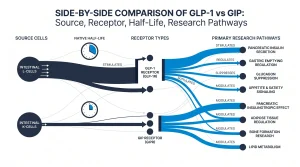
| Feature | GLP-1 | GIP |
| Source cells | Distal gut L-cells | Proximal small intestine K-cells |
| Receptor | GLP-1R | GIPR |
| Half-life (native) | About 2 minutes | About 5 to 7 minutes |
| Primary research pathway | Beta-cell signaling, gastric pathway, glucagon control | Beta-cell signaling, adipose lipid storage |
| Agonist type | GLP-1R agonist | GIPR agonist |
Frequently Asked Questions
What is the incretin effect in glucose metabolism?
The incretin effect is the larger insulin response seen after oral glucose than after the same amount given through a vein. This gap exists because food in the gut triggers hormone release. These hormones boost insulin output before glucose reaches the bloodstream. According to Nauck et al. (2009), this effect accounts for about 50 to 70 percent of total insulin released after a meal. This is a central area of metabolic research.
What are the two main incretin hormones?
The two main incretins are GLP-1 and GIP. GLP-1 is made in L-cells in the distal gut and colon. GIP is made in K-cells in the duodenum and jejunum. Both are released after eating and bind to separate receptors on pancreatic beta-cells. Each receptor type has distinct binding traits. Research teams study each hormone to map its signaling pathway in metabolic lab models.
How do incretin hormones trigger insulin secretion after eating?
Incretins bind to receptors on pancreatic beta-cells. This binding triggers a cascade inside the cell. The cascade raises cyclic AMP (cAMP) levels. High cAMP tells the cell to release insulin. This only happens when blood glucose is also elevated. The dual requirement of hormone signal plus glucose keeps insulin release tightly linked to food intake. Scientists study this pathway in cell-based lab models.
How are incretins broken down in the body?
Native GLP-1 and GIP are cleaved by the DPP-4 enzyme. DPP-4 cuts the N-terminal end of each hormone. GLP-1 breaks down in about 2 minutes. GIP breaks down in about 5 to 7 minutes. This fast breakdown makes native hormones hard to study over long timeframes. Researchers design stable analogs that resist DPP-4 cleavage to study longer-duration signaling in lab models.
What is the function of the DPP-4 enzyme?
DPP-4 (dipeptidyl peptidase-4) is a serine protease. It cleaves peptides with alanine or proline at the second position of their sequence. This cleavage inactivates GLP-1 and GIP. The result is a fast drop in hormone levels after each meal. By limiting incretin activity, DPP-4 keeps the insulin signal short. This is why researchers make DPP-4-resistant analogs for long-duration lab studies of incretin signaling.
Why is the incretin effect reduced in type 2 diabetes research models?
In type 2 diabetes research models, GIP’s insulinotropic action is much weaker than in healthy models. GLP-1 activity may stay more intact, but beta-cell response to it can also weaken. According to Drucker (2006), this blunted incretin response is linked to altered beta-cell signaling patterns in these models. Studying this resistance helps map where the incretin pathway breaks down and why.
What is the difference between an incretin mimetic and an incretin enhancer?
An incretin mimetic is a synthetic peptide that acts on GLP-1R or GIPR directly. It is made to resist DPP-4 cleavage. An incretin enhancer is a DPP-4 inhibitor. It works by blocking DPP-4 to keep native GLP-1 and GIP active longer. Mimetics act at the receptor directly. Enhancers rely on the body’s own hormone release. Both are used in lab studies to track incretin signaling over extended periods.
How does GIP affect fat cells in lab studies?
GIP has been studied for its role in lipid storage in adipose tissue. It has been shown to trigger lipoprotein lipase (LPL) activity in lab models. LPL breaks down fats in the blood so cells can store them. Scientists study this pathway to understand how GIP controls fat cell biology. According to Baggio and Drucker (2006), GIP’s GIPR receptor is found in adipose tissue, making fat cell signaling a core GIP research area.
Are there differences in incretin response between research models?
Yes. Incretin response varies across research models. Factors like receptor expression level, baseline metabolic state, and species type all shape how strong the response is. Some models show high GLP-1R sensitivity. Others show reduced GIPR signaling. Labs track these differences by measuring hormone levels and insulin output in each model type. Understanding model variability helps researchers build better controls and read results across study cohorts.
Summary
GLP-1 and GIP are the two main incretin hormones. They are released from the gut after eating. Both act on pancreatic beta-cells to trigger insulin release in a glucose-dependent way. This pathway is the basis of what researchers call the incretin effect.
GLP-1 has been studied for gastric pathway control and glucagon regulation. GIP has been studied for lipid storage in adipose tissue. Both break down fast in the body via DPP-4. Synthetic analogs with longer half-lives are used in labs to study these pathways in detail.
Next Level Pharm supplies COA-verified, research-grade incretin analogs for lab use. All batches are HPLC and mass spec tested before dispatch.
What Should You Do Next?
Researchers should confirm whether the model targets GLP-1R, GIPR, or both receptor systems. Check structural modifications and stability data against the planned signaling window. Review the COA and record purity, molecular identity, and the lot number before starting the assay. Researchers sourcing these lab peptides can shop research peptides with full COA and lot traceability.
People Also Read
About the Author
Next Level Pharm Research Team
Alex M covers peer-reviewed findings in peptide science for Next Level Pharm, a US-based supplier of research-grade peptides verified to ≥99% purity via HPLC and mass spectrometry on every batch.
Disclaimer: For research purposes only. Not intended for human consumption. Next Level Pharm products are not intended for diagnostic, therapeutic, or medicinal use. This content does not constitute medical advice. Always consult a licensed healthcare professional before making any health-related decisions.