SNAP-8 vs GHK-Cu: Skin Aging Research Compared

Last updated: July 2026
A SNAP-8 vs GHK-Cu research comparison is a review of two peptide classes with distinct lab-studied mechanisms. SNAP-8 (acetyl octapeptide-3) targets the SNARE complex in skin cell models. GHK-Cu works through copper chelation and TGF-beta-1 signaling. Both appear in peer-reviewed literature on skin biology. This article reviews what the research shows about each peptide’s mechanism, lab applications, and structural profile.
Next Level Pharm supplies both SNAP-8 and GHK-Cu as COA-verified, research-grade peptides. Each batch is tested via HPLC and mass spectrometry to 99% purity or higher. Lot numbers and third-party test results ship with every order.
Peptide research in skin biology has grown fast. Labs now study both SNARE-targeting peptides and copper-binding peptides in cell and tissue models. Understanding each compound’s mechanism helps researchers select the right tool for a given study design.
Key Takeaways
- SNARE vs. Copper Pathway: SNAP-8 targets SNARE complex formation; GHK-Cu works via copper chelation and TGF-beta-1.
- Distinct Research Areas: SNAP-8 is studied in muscle contraction signal models; GHK-Cu appears in collagen and antioxidant research.
- Both are Synthetic Peptides: SNAP-8 is acetyl octapeptide-3 (8 amino acids); GHK-Cu is a copper tripeptide (3 amino acids).
- Peer-Reviewed Coverage: SNAP-8 has data in Int J Cosmet Sci (2010); GHK-Cu has data in Cosmetics (2015) and Oxid Med Cell Longev (2012).
- Research Use Only: Neither compound is approved for human use or therapeutic application.
- COA-Verified Supply: Lot-specific certificates of analysis ship with every order of either peptide.
Researchers often ask how to compare these two peptides. The key is the mechanism. SNAP-8 and GHK-Cu do not work through the same pathway. Choosing between them depends on the study target, not on general skin aging claims.
What Is SNAP-8 and How Has It Been Studied?
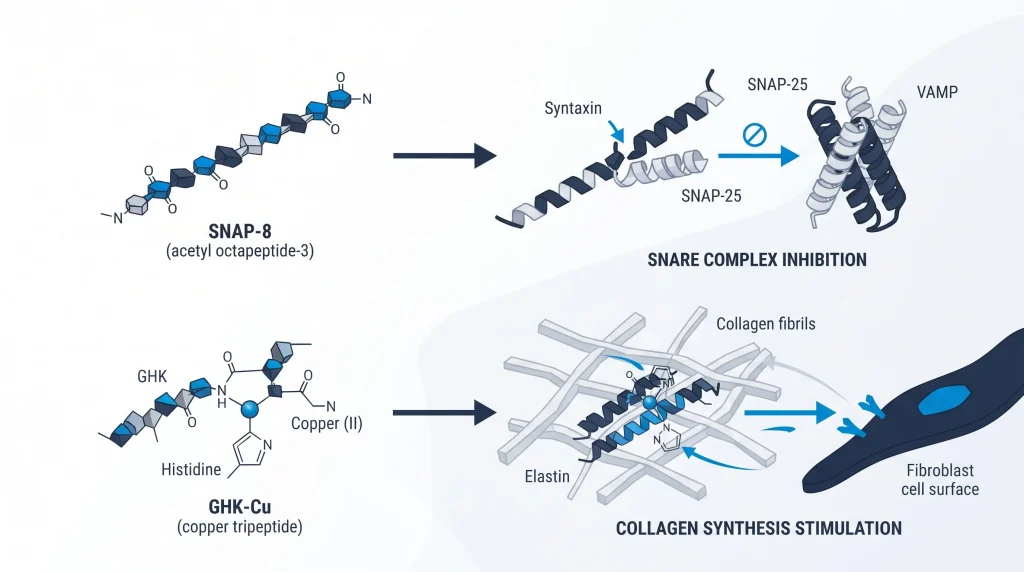
SNAP-8 is acetyl octapeptide-3, an 8-amino-acid chain. Lab research suggests it inhibits SNARE complex formation in skin cell models. The SNARE complex (soluble N-ethylmaleimide-sensitive factor attachment protein receptor) is a protein assembly that plays a role in vesicle fusion and muscle contraction signals.
According to Int J Cosmet Sci (2010), SNAP-8 was studied in vitro for its ability to block this complex. The research was conducted in cell models, not in human subjects. SNAP-8 is not an approved drug or cosmetic active cleared for human use. It is sold for lab research only.
What Is GHK-Cu and What Does the Research Show?
GHK-Cu is a copper tripeptide made of glycine, histidine, and lysine bound to a copper ion. It is one of the more studied copper peptides in skin biology. Research has examined its role in collagen production and antioxidant signaling via TGF-beta-1.
According to Cosmetics (2015), GHK-Cu was studied for its effects on skin remodeling markers in lab models. A separate study in Oxid Med Cell Longev (2012) reviewed its antioxidant activity at the cellular level. These findings are from lab and cell models. GHK-Cu is for research use only and is not approved for human use.
Shop research peptides at Next Level Pharm
How Do Their Mechanisms Differ?
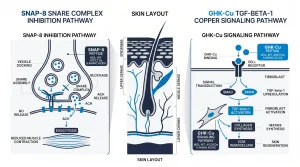
SNAP-8 targets the SNARE complex. GHK-Cu targets copper-dependent signals via TGF-beta-1. These are different cell pathways. SNAP-8 works at the level of vesicle fusion and nerve signal models. GHK-Cu works at the level of copper chelation and growth factor output.
The distinction matters for study design. A researcher studying contraction signals in skin tissue would look at SNAP-8. A researcher studying collagen-related markers or antioxidant response would look at GHK-Cu. The two peptides are not interchangeable in lab protocols.
What Are the Structural Differences?
SNAP-8 has 8 amino acids. Its full name is acetyl octapeptide-3. The acetyl group on the N-terminus is part of what gives it its SNARE-binding profile in cell models. GHK-Cu has 3 amino acids: glycine, histidine, and lysine. The copper ion binds to the histidine residue. This copper binding is central to its activity in lab models.
Size matters in peptide research. Smaller peptides like GHK-Cu (3 amino acids) tend to have different uptake profiles in cell models than longer ones like SNAP-8 (8 amino acids). Researchers should note these structural differences when designing protocols.
How Do Research Applications Compare?
SNAP-8 has been studied in models related to muscle contraction signaling in skin. GHK-Cu has been studied in models related to collagen synthesis, tissue remodeling, and oxidative stress. The research areas overlap only in the broad context of skin cell biology.
Some labs use both peptides in the same study series, but in separate assays. They are not studied together as a combination because their mechanisms do not converge. Each peptide requires its own control conditions and endpoint markers.
What Does Purity Mean for These Peptides?
Purity is a key variable in peptide research. Low-purity samples can produce noisy results. Next Level Pharm tests both SNAP-8 and GHK-Cu via HPLC (high-performance liquid chromatography) and mass spectrometry. Average purity across the last 100 batches is 99.4%.
Each order ships with a COA (certificate of analysis) that includes lot number, purity percentage, and test method. Researchers can look up a lot of data online. Batch tracking matters when repeating results across experiments.
| Feature | SNAP-8 | GHK-Cu |
| Sequence | Acetyl octapeptide-3 (8 AA) | Gly-His-Lys + copper ion (3 AA) |
| Primary target | SNARE complex | TGF-beta-1 / copper signaling |
| Research pathway | Nerve contraction signals | Collagen synthesis, antioxidant activity |
| Research area | Skin cell contraction models | Collagen and oxidative stress models |
| Key distinction | Blocks vesicle fusion proteins | Chelates copper, modulates growth factors |
Where Can Researchers Source These Peptides?
Both SNAP-8 and GHK-Cu are available as lyophilized (freeze-dried) powders. Lyophilized form is stable at room temperature during shipping. No cold chain is needed in transit. Storage guidance for lab use is included with each order.
Browse beauty peptides to view both compounds. Researchers can also access lot-specific COA data via the third-party testing records tool. Both peptides ship to all 50 US states, with free shipping on orders over $150.
Frequently Asked Questions
What is SNAP-8 peptide?
SNAP-8 (acetyl octapeptide-3) is an 8-amino-acid synthetic peptide studied in skin cell models. Lab research has examined its ability to inhibit SNARE complex formation, a protein assembly involved in vesicle fusion and muscle contraction signaling. According to Int J Cosmet Sci (2010), this activity was studied in vitro. SNAP-8 is sold for research use only and is not approved for human use.
What is GHK-Cu peptide?
GHK-Cu is a copper tripeptide made of glycine, histidine, and lysine bound to a copper ion. It is studied in lab models for its role in collagen production and antioxidant activity through TGF-beta-1 signaling. Research has been published in Cosmetics (2015) and Oxid Med Cell Longev (2012). GHK-Cu is for research purposes only and not approved for human use.
How do SNAP-8 and GHK-Cu differ?
SNAP-8 targets the SNARE complex in nerve signal models. GHK-Cu works through copper chelation and TGF-beta-1 pathway activity. These are separate mechanisms studied in different lab contexts. SNAP-8 is an 8-amino-acid peptide; GHK-Cu is a 3-amino-acid copper complex. Researchers should select based on study endpoint, not general category.
Are these peptides studied together?
No published research has studied SNAP-8 and GHK-Cu as a combined protocol. Their mechanisms do not converge on a shared pathway. Labs may study both in separate assays within the same research series, but they require distinct control conditions and endpoint markers.
What purity level is needed for peptide research?
Most peptide research protocols require 98% or higher purity to cut signal noise from impurities. Both SNAP-8 and GHK-Cu are available at 99% purity or above, with an average of 99.4% across the last 100 batches. Purity is confirmed by HPLC and mass spectrometry on every lot.
What does COA-verified mean?
COA stands for certificate of analysis. It is a document that lists purity percentage, lot number, test method, and results for a given batch. A COA ships with every order. Researchers can also verify lot data online using the third-party testing records tool on the site.
Is SNAP-8 the same as argireline?
No. Argireline is acetyl hexapeptide-3 (6 amino acids). SNAP-8 is acetyl octapeptide-3 (8 amino acids). Both target the SNARE complex in cell models, but they have different sequences and distinct research profiles. They are separate compounds and should not be used interchangeably in study designs.
What does TGF-beta-1 do in GHK-Cu research?
TGF-beta-1 (transforming growth factor beta-1) is a signaling protein involved in cell growth and matrix production. In GHK-Cu lab research, copper chelation by the peptide has been studied in relation to TGF-beta-1 pathway activity and collagen-related markers. This is a cell-level observation, not a human outcome. For research use only.
How is GHK-Cu stored in the lab?
GHK-Cu ships as a lyophilized powder. It is stable at room temperature during transit. For long-term lab storage, researchers typically keep lyophilized peptides at -20 degrees Celsius in a dry space. Lab reconstitution steps are not covered here; researchers should follow their own lab protocols.
What shipping options are available for these peptides?
Both peptides ship to all 50 US states. Orders over $150 qualify for free shipping. Average dispatch time is about 48 hours. Both peptides ship as lyophilized powder, stable at room temperature during transit. No cold chain is needed in transit.
Summary
SNAP-8 and GHK-Cu are two distinct research peptides with separate mechanisms and study applications. SNAP-8 (acetyl octapeptide-3) has been studied in cell models for its ability to inhibit SNARE complex formation. GHK-Cu (copper tripeptide) has been studied for collagen-related markers and antioxidant activity via TGF-beta-1 signaling. Both compounds appear in peer-reviewed literature. Both are available as COA-verified, research-grade powders with lot-specific test data. Choosing between them depends on the specific pathway a researcher is targeting in a given lab study.
What Should You Do Next?
Researchers should review the cited SNAP-8 and GHK-Cu studies before writing the protocol. Compare the two mechanisms and select endpoints that match the planned cell model. Check each lot for HPLC purity, mass spec identity, lyophilized format, and a traceable lot number. Researchers sourcing these lab peptides can shop research peptides with full COA and lot traceability.
People Also Read
- SNAP-8 Research: SNARE Complex and Skin Cell Studies
- GHK-Cu Research Explained: What Peer-Reviewed Studies Show
About the Author
Next Level Pharm Research Team
Alex M covers peer-reviewed findings in peptide science for Next Level Pharm, a US-based supplier of research-grade peptides verified to ≥99% purity via HPLC and mass spectrometry on every batch.
Disclaimer: For research purposes only. Not intended for human consumption. Next Level Pharm products are not intended for diagnostic, therapeutic, or medicinal use. This content does not constitute medical advice. Always consult a licensed healthcare professional before making any health-related decisions.