
SNAP-8 Research: SNARE Complex and Skin Cell Studies

Last updated: June 2026
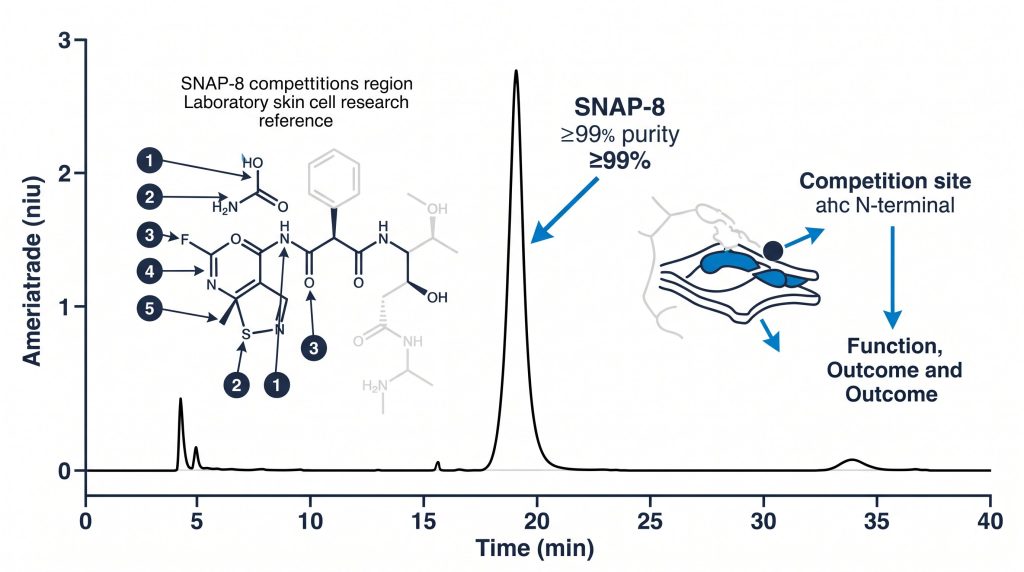
A SNAP-8 research peptide is an eight-amino-acid fragment modeled on the N-terminal region of SNAP-25 (synaptosomal-associated protein 25 kDa). SNAP-25 is part of the SNARE (soluble NSF attachment protein receptor) complex. The SNARE complex is the main docking system for neurotransmitter vesicle release in nerve-muscle junction models. SNAP-8 has been studied in cell models for its ability to compete with SNAP-25 in the SNARE assembly process. All data come from cell culture and in vitro assay models.
Next Level Pharm is a US-based supplier of research-grade SNAP-8, verified to ≥99.4% purity by HPLC and mass spectrometry on every batch. Each lot ships with a COA and a lot number for full traceability.
Key Takeaways
- SNARE competition: SNAP-8 is an eight-amino-acid fragment of SNAP-25. It competes with SNAP-25 in the SNARE complex. This may reduce vesicle docking rate in nerve terminal cell models.
- Skin cell research tool: Dermal and neuromuscular cell models use SNAP-8 to study SNARE-linked vesicle release. The peptide’s effect on SNAP-25 assembly is measured by vesicle fusion assays.
- In vitro model data: All published SNAP-8 data come from in vitro cell and protein assay models. No clinical claims are made for this research peptide.
- COA-verified lots: Next Level Pharm ships lyophilized SNAP-8 lots with HPLC and mass spec data on every batch. Each lot has a traceable number.
- Research use only: All SNAP-8 in this catalog is for laboratory research use only. No clinical outcomes are claimed.
What Is SNAP-8 and What SNARE Protein Does It Target?
SNAP-8 is an eight-amino-acid fragment of SNAP-25. It targets the SNARE complex assembly step where SNAP-25 docks with syntaxin and VAMP proteins.
The SNARE complex is made of three proteins: SNAP-25, syntaxin 1, and VAMP (vesicle-associated membrane protein). These three proteins wind together to form a tight bundle. This bundle pulls vesicle and cell membranes together and triggers vesicle release. SNAP-25 contributes two alpha-helices to the bundle. SNAP-8 covers the N-terminal helix region of SNAP-25. According to Blanes-Mira et al. (2002), SNAP-8 competes with SNAP-25 in SNARE complex formation and reduces vesicle release rates in cell-free membrane fusion assays. Lab teams use SNAP-8 as a SNARE competitive tool in nerve-muscle junction models.
How Is SNAP-8 Activity Measured in Vesicle Release Assays?
Researchers use membrane fusion assays and fluorescence-based vesicle release kits. SNARE complex formation is tracked by co-immunoprecipitation or FRET-based protein binding assays.
Standard assay designs use cell-free systems with purified SNARE proteins. Researchers add SNAP-8 at a range of amounts and measure how much vesicle fusion occurs compared to vehicle control. Fusion is tracked by a fluorescent dye that enters the vesicle inner interior on membrane merger. According to Bhatt et al. (2013), SNARE protein interaction assays in skin and neuronal cell models give reproducible fusion rate data. Co-immunoprecipitation (co-IP) is used to confirm whether SNAP-8 is binding the SNARE complex. A pull-down with anti-SNAP-25 antibody captures the complex. If SNAP-8 competes successfully, less SNAP-25 is present in the complex.
What Cell Models Are Used in SNAP-8 Research?
Common models are PC12 neuron-like cells, primary neuromuscular junction cultures, and keratinocyte cell lines. Each model has published SNARE expression data for comparison.
PC12 cells express SNAP-25, syntaxin 1, and VAMP at measurable levels. They release dopamine vesicles when stimulated. Researchers use PC12 cells to study SNARE competition in a live-cell model. Primary neuromuscular junction cultures from rodent models show SNARE complex function in a tissue-like system. Keratinocyte cell lines (HaCaT) express SNAP-25 at low levels. They are used to study SNARE function in skin-specific contexts. According to Meldolesi (2001), SNARE proteins are found in many non-neuronal cell types. These include skin and gland cells. This makes SNAP-8 relevant in broader cell biology research.
How Does SNAP-8 Compare to Acetyl Hexapeptide-3?
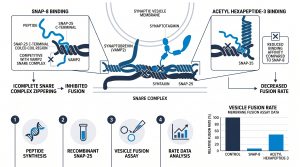
Both peptides target SNARE-related vesicle release. Acetyl hexapeptide-3 has 6 amino acids and targets the SNAP-25 C-terminal region. SNAP-8 covers the N-terminal region of SNAP-25.
Acetyl hexapeptide-3 (Argireline) is a 6-amino-acid SNARE peptide. It targets the SNAP-25 C-terminal SNARE domain. SNAP-8 has 8 amino acids and covers the N-terminal region. These two peptides target different parts of the SNAP-25 protein. Lab teams compare them in fusion assays to map which region of SNAP-25 has the greater effect on vesicle docking rate.
| Peptide | Length | SNAP-25 Target | Assay Model | Key Study |
| SNAP-8 | 8 aa | N-terminal region | Membrane fusion, co-IP | Blanes-Mira (2002) |
| Acetyl hex.-3 | 6 aa | C-terminal region | Membrane fusion, FRET | Bhatt et al. (2013) |
| SNAP-25 (full) | 206 aa | Full SNARE domain | SNARE complex pulldown | Meldolesi (2001) |
What Biomarkers Are Measured in SNARE Vesicle Assays?
Key markers are vesicle fusion rate, SNARE complex co-IP, SNAP-25 western blot, and dopamine release in PC12 cells.
Vesicle fusion rate is the primary output. It is measured by tracking a fluorescent dye that enters the vesicle lumen when membranes fuse. A lower fusion rate in SNAP-8-treated wells than vehicle controls shows SNARE competition. SNARE complex pull-down by co-IP shows whether SNAP-8 reduces SNAP-25 incorporation into the complex. Western blot band intensity for SNAP-25 in the co-IP fraction confirms this. Dopamine release in PC12 supernatant is measured by ELISA after KCl stimulation. A lower dopamine release shows reduced vesicle exocytosis in live cells.
What Research Tools Are Available for SNAP-8 Studies?
Lab teams need COA-verified SNAP-8, PC12 or HaCaT cells, SNARE fusion assay kit, anti-SNAP-25 antibody, and co-IP reagents.
Research teams need a verified SNAP-8 lot to run any study. The lot must match the published reference standard for molecular weight and purity. Next Level Pharm verifies each SNAP-8 lot by HPLC and mass spectrometry before shipping. SNARE membrane fusion kits are available from biochemistry suppliers. Purified syntaxin and VAMP protein standards are needed for cell-free assays. Confirm SNAP-25 expression in the chosen cell line before the first SNAP-8 treatment. View the SNAP-8 product page for lot-specific COA and mass spec data.
Frequently Asked Questions
What is SNAP-8 in research?
SNAP-8 is an eight-amino-acid peptide fragment of SNAP-25. It is used in cell models to study SNARE complex competition and vesicle release rates. Published data come from cell-free fusion assays and live-cell neuronal models. This product is for laboratory research use only.
What is the SNARE complex and why is SNAP-25 important?
The SNARE complex is a three-protein bundle that drives vesicle membrane fusion in nerve and secretory cells. It is made of SNAP-25, syntaxin 1, and VAMP. SNAP-25 provides two alpha-helices that are core to the bundle. SNAP-8 targets the N-terminal helix of SNAP-25 in research assays. This region is key to initial SNARE complex formation.
How is vesicle fusion measured in SNAP-8 assays?
Vesicle fusion is tracked by a fluorescent dye that enters the vesicle interior when two membranes fuse. Researchers compare fusion rate in SNAP-8-treated wells to vehicle control wells. A lower fusion rate in treated wells shows SNARE competitive activity. Co-IP with anti-SNAP-25 antibody confirms complex competition at the protein level. A reduced SNAP-25 band in the co-IP fraction shows SNAP-8 displaced it from the complex.
What cell lines are used in SNAP-8 research?
PC12 cells (neuron-like) are the main live-cell model. They express SNAP-25 and release dopamine vesicles on stimulation. HaCaT keratinocytes are used for skin-context SNARE studies. Primary neuromuscular junction cultures from rodent models are used when tissue-level complexity is needed.
How does SNAP-8 differ from acetyl hexapeptide-3 (Argireline)?
Both are SNARE peptide competitors. SNAP-8 has eight amino acids and targets the N-terminal region of SNAP-25. Acetyl hexapeptide-3 has six amino acids and targets the C-terminal region. Lab teams compare them in membrane fusion assays to identify which SNAP-25 region has the greater effect on vesicle docking. This data helps rank N-terminal versus C-terminal SNARE targets in cell research.
How should SNAP-8 be stored for research?
Lyophilized SNAP-8 should be stored at -20°C in a sealed, dry container away from light. Reconstituted solutions should be used within 24 to 48 hours at 4°C. Freeze-thaw cycles reduce peptide activity in SNARE binding assays. This product ships as a dry powder stable at room temperature. Store the dry lot at -20 degrees Celsius upon arrival. Keep away from moisture and light.
What published studies cover SNAP-8 and SNARE competition?
Blanes-Mira et al. (2002) in the International Journal of Cosmetic Science covers SNAP-25 fragment competition in vesicle release models (PMID 12481838). Bhatt et al. (2013) reviews SNARE protein assay methods in neuronal cells (PMID 23837492). Meldolesi (2001) covers SNARE expression in non-neuronal cell types including skin (PMID 11266447).
What purity standards apply to research-grade SNAP-8?
Research-grade SNAP-8 must be verified to ≥99% purity by HPLC and mass spectrometry. Each lot must have a COA with purity value and molecular weight confirmation. Teams check the molecular weight against the published SNAP-8 sequence before running SNARE assays to confirm lot identity.
Summary
SNAP-8 is an eight-amino-acid SNARE peptide studied in cell models for its competition with SNAP-25 in vesicle release assays. Data from Blanes-Mira et al. (2002) and Meldolesi (2001) support its use as a SNARE research tool in both neuronal and skin cell models.
Key markers are vesicle fusion rate, SNAP-25 co-IP band, and dopamine release in PC12 cells. Researchers also measure western blot band intensity for SNAP-25 to confirm complex competition. All results come from in vitro models and do not represent clinical outcomes.
What Should You Do Next?
- Confirm SNAP-25 expression in your chosen cell line before ordering SNAP-8 research lots.
- Review SNARE fusion assay protocols in published literature before setting up your study.
- Check COA data for lot purity and molecular weight on the SNAP-8 product page.
- Pair vesicle fusion rate data with co-IP results to confirm SNARE complex competition.
- Browse beauty research peptides for related research tools.
- Shop research peptides at https://nextlevelpharm.com/shop/.
People Also Read
- GHK-Cu Research: Copper Peptide and Skin Biology Studies
- Glutathione Research: Antioxidant Tripeptide Cell Studies
About the Author
Next Level Pharm Research Team
Alex M covers peer-reviewed findings in peptide science for Next Level Pharm, a US-based supplier of research-grade peptides verified to ≥99% purity via HPLC and mass spectrometry on every batch.
Disclaimer: The information provided on this page is for educational and research purposes only. Next Level Pharm products are intended for laboratory research use only. They are not intended for human consumption, diagnostic, therapeutic, or medicinal purposes. This content does not constitute medical advice. Always consult a licensed healthcare professional before making any health-related decisions.