
SLU-PP-322 Research: ERR Agonist and Metabolic Studies

Last updated: June 2026
An SLU-PP-322 research compound is a synthetic small molecule that activates ERR nuclear receptors. ERR, or estrogen-related receptor, is a DNA switch inside cells. It controls genes that manage how muscle and heart tissue burn energy. SLU-PP-322 binds all three ERR types: ERRalpha, ERRbeta, and ERRgamma. According to research published in Nature Communications (2023), mice treated with SLU-PP-322 ran about 50% longer on a treadmill than untreated controls.
Next Level Pharm stocks SLU-PP-322 as a lyophilized research compound. Lyophilized means freeze-dried for stable room-temperature shipping. Every vial is tested to >=99% purity via HPLC and mass spectrometry. HPLC is a lab method that checks compound purity. Mass spectrometry confirms the exact molecular weight. A COA, or certificate of analysis, ships with every order. The average purity across the last 100 batches is 99.4%.
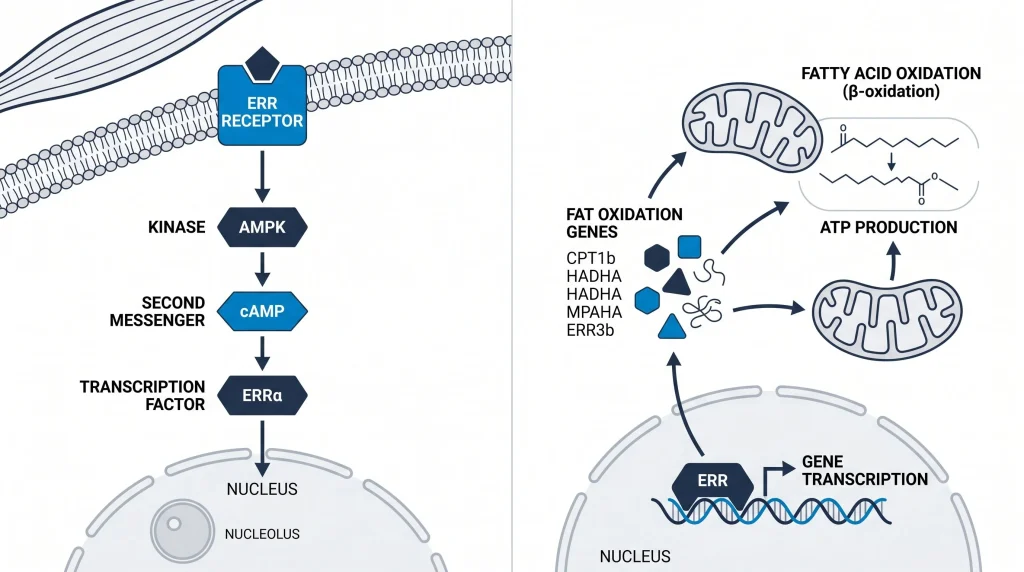
Researchers studying fat burning in muscle cells have used SLU-PP-322 to study what happens when all three ERR types are active at once. ERR is a DNA switch, meaning it attaches to DNA and turns on gene clusters. When ERR is on in muscle, the cell burns more fat and builds more energy centers called mitochondria.
Key Takeaways
- Mechanism: SLU-PP-322 binds ERRalpha, ERRbeta, and ERRgamma. These are DNA switches that control fat oxidation and mitochondria growth in muscle cells.
- Endurance data: Rodent studies showed about a 50% rise in treadmill run time. Fat oxidation genes in skeletal muscle were upregulated after treatment.
- Cardiac research: Heart function markers improved in rodent models. ERR activity in heart tissue raised expression of genes tied to energy output.
- No hormonal activity: SLU-PP-322 does not bind androgen or estrogen receptors. ERRs share a name with estrogen receptors but control energy, not hormones.
- Research stage: No human trials have been registered as of June 2026. All published data comes from cell and rodent models only.
SLU-PP-322 was one of the first compounds to activate all three ERR types with high strength. Earlier ERR ligands hit only one subtype. Activating all three at once let researchers study the full ERR network in muscle and heart. The compound helped separate ERR-driven gene effects from other exercise pathways like AMPK and PGC-1alpha.
What Is SLU-PP-322 and How Does It Work?
SLU-PP-322 is a synthetic compound made by researchers at Washington University School of Medicine. It is not a peptide. Its molecular weight is about 400 daltons. The structure was designed to fit the binding pocket of ERR receptors. When it fits, it locks ERR into its active form.
Active ERR then attaches to DNA response elements. These are short DNA sequences near metabolic genes. Once attached, ERR turns on a set of fat oxidation and energy genes. According to research in NCBI (2023), the gene set activated by SLU-PP-322 overlaps with the gene changes seen in trained athletes. This is why the compound is called an exercise mimetic. It mimics some of the gene-level effects of aerobic exercise.
What Did Rodent Studies on SLU-PP-322 Show?
The main rodent study ran in 2023 and was published in Nature Communications. Researchers gave mice daily SLU-PP-322 over several weeks. The treated mice ran about 50% longer than untreated controls on a treadmill test. Fat oxidation in muscle tissue increased. Mitochondria density in muscle fibers also rose. Researchers used citrate synthase, an energy enzyme, as a marker for mitochondria count.
Heart tissue also responded. Several markers of cardiac energy output improved. Respiratory output per mitochondria rose in treated mice. This heart data showed that ERR activity is not limited to skeletal muscle. It also affects how heart cells manage energy. These two tissue effects made SLU-PP-322 useful for studying ERR biology across different cell types.
How Does SLU-PP-322 Affect Fat Oxidation?
SLU-PP-322 raises the activity of CPT1. CPT1 is the enzyme that moves fatty acids into mitochondria for fuel. More CPT1 means more fat can enter and burn for energy. The compound also activates MCAD. MCAD, or medium-chain acyl-CoA dehydrogenase, is an enzyme in the fat-burning chain inside mitochondria.
According to research published in PubMed (2023), these gene changes in treated mice matched the metabolic shifts seen in endurance-trained animals. Glucose uptake was not strongly changed in the same models. This means SLU-PP-322 shifts energy use toward fat rather than sugar. For muscle biology researchers, this lets them study fat-burning signals apart from glucose and insulin pathways.
What Is the Research Status of SLU-PP-322?
As of June 2026, all published SLU-PP-322 data comes from cell and rodent studies. No human trials have been registered. The compound was first described in the 2023 Nature Communications paper. After that, it appeared in follow-up lab studies on heart failure and obesity models.
The research profile is early-stage. Cell and animal data show clear effects. Human safety data, absorption data, and concentration-to-effect data in humans are not yet published. Researchers treat it as a lab tool for studying ERR pathways, not as a clinical candidate.
How Does SLU-PP-322 Compare to Other Exercise Mimetics?
Several compounds have been studied as exercise mimetics. Each hits a different path. AICAR activates AMPK, a cell energy sensor. GW501516 activates PPARdelta, a fat-use receptor. SLU-PP-322 hits ERR DNA switches. The paths overlap but produce different gene patterns. Researchers can browse fitness and GH research compounds in the catalog to compare related compounds.
| Compound | Target | Primary Effect | Research Stage |
| SLU-PP-322 | ERRalpha/beta/gamma | Fat oxidation, endurance | Rodent models (2023) |
| AICAR | AMPK | Glucose use, mitochondria | Rodent and human Phase 1 |
| GW501516 | PPARdelta | Fat use, endurance | Discontinued (toxicity) |
| MOTS-c | AMPK (indirect) | Mitochondria health | Rodent models |
What Parameters Have Been Used in SLU-PP-322 Studies?
The 2023 study gave mice oral SLU-PP-322 at 25 mg/kg per day. Oral means given by mouth in a vehicle solution. The study ran for several weeks. Muscle and heart tissue were collected at the end. Researchers measured gene expression and enzyme output in the tissue samples.
In cell studies, researchers used low nanomolar concentrations. These in vitro amounts are much smaller than the in vivo amounts given to rodents. This is normal for ERR agonists. Cell lines respond at lower levels because absorption is not a factor. Researchers can view lot-specific COA data for the current batch before starting their study.
SLU-PP-322 is for laboratory research only. It is not intended for human administration or any human application. Researchers should use the published rodent and cell study data as a reference for model design.
What Are the Structural Features of SLU-PP-322?
SLU-PP-322 is a small molecule, not a peptide. It has an indane core with aromatic rings and polar groups. These groups fit the binding pocket of ERR. Its molecular weight is about 400 daltons. This is much smaller than most peptide research compounds, which range from 500 to several thousand daltons.
The compound is stable in lyophilized form at room temperature. In cell studies it dissolves in DMSO. For in vivo work in rodents, it is mixed into a vehicle solution for oral administration. Its small size lets it enter cells and reach the nucleus where ERR is found. Peptide compounds generally cannot cross cell walls to reach nuclear receptors.
Frequently Asked Questions
What is SLU-PP-322 used for in research?
SLU-PP-322 is used in lab studies to activate ERR receptors in muscle and heart cells. Researchers have studied its effects on fat oxidation, mitochondria growth, and treadmill endurance in rodent models. It is a research tool for exploring how ERR controls cell energy. It is for laboratory use only and is not a clinical treatment.
How does SLU-PP-322 activate ERR receptors?
SLU-PP-322 fits into the binding pocket of ERRalpha, ERRbeta, and ERRgamma. Binding locks the receptor into its active form. Active ERR then attaches to DNA near metabolic genes. This turns on a set of genes that control fat transport and mitochondria energy output. The process is called gene switching.
What did rodent studies on SLU-PP-322 find?
Rodent studies showed about a 50% rise in treadmill run time. Muscle tissue showed higher fat oxidation gene output, including CPT1 and MCAD. Mitochondria density in muscle also increased. Heart energy markers improved in the same studies. These results suggested that ERR activation can copy some exercise-driven energy changes in rodent tissue.
Does SLU-PP-322 affect testosterone in research models?
Published rodent data does not show any change in testosterone or androgen levels. ERRs share a name with estrogen receptors but do not bind hormones. They control energy genes, not hormone production. No androgenic or estrogenic effects were reported in the 2023 Nature Communications study or follow-up work.
How does SLU-PP-322 compare to AICAR in research?
Both are studied as exercise mimetics but hit different paths. AICAR activates AMPK. SLU-PP-322 activates ERR DNA switches. AICAR has a longer research record and has been tested in short human studies. SLU-PP-322 data is newer and limited to cells and rodents. The two compounds let researchers study two separate exercise-linked pathways.
What is the absorption profile of SLU-PP-322 in rodent models?
The 2023 study used oral administration in mice, which shows adequate absorption for rodent work. Exact absorption percentages were not reported. In cell studies the compound works at nanomolar levels. Full absorption data including half-life and tissue spread in mammals has not been published as of June 2026.
What purity level should research-grade SLU-PP-322 meet?
Research-grade SLU-PP-322 should be tested by HPLC and mass spectrometry on every batch. HPLC measures compound purity as a percentage. Mass spectrometry confirms the molecular weight matches the target. Both tests run on every vial. A COA with lot number ships with each order. The average purity across the last 100 batches is 99.4%.
Where can researchers source SLU-PP-322?
Next Level Pharm stocks research-grade SLU-PP-322 verified to >=99% purity via HPLC and mass spectrometry. Every order includes a COA with lot number and purity data. The compound ships lyophilized for stable room-temperature delivery within the USA. Researchers can shop research peptides and confirm purity on every lot.
Summary
SLU-PP-322 is a synthetic compound that activates all three ERR receptor types to switch on fat oxidation and mitochondria growth genes. First described in 2023, it showed clear energy effects in rodent models. Treated mice ran about 50% longer than controls.
All data as of June 2026 comes from cell and rodent studies. No human trials have been registered. The compound does not affect androgen or estrogen pathways and is distinct from hormone-based compounds.
Researchers studying ERR biology, exercise response, or cell energy should verify purity via HPLC and mass spectrometry. COA-verified, lyophilized SLU-PP-322 at >=99% purity with USA storage and fast dispatch is available for laboratory research.
What Should You Do Next?
Read the 2023 primary study at Nature Communications (2023) for the full rodent endurance and energy data. Review the NCBI record (PMID 37060572) for citation details and study design. When you are ready to source compound for your studies, shop research peptides and confirm purity on every lot.
Related research: AICAR and AMPK activation research, AMPK signaling and peptide research, and MOTS-c mitochondrial and metabolic research.
People Also Read
About the Author
Next Level Pharm Research Team
Alex M covers peer-reviewed findings in peptide science for Next Level Pharm, a US-based supplier of research-grade peptides verified to >=99% purity via HPLC and mass spectrometry on every batch.
Disclaimer: The information provided on this page is for educational and research purposes only. Next Level Pharm’s products are intended for laboratory research use only. They are not intended for human consumption, diagnostic, therapeutic, or medicinal purposes. This content does not constitute medical advice. Always consult a licensed healthcare professional before making any health-related decisions.