
Dulaglutide Research: GLP-1 Receptor Study Findings

Last updated: June 2026
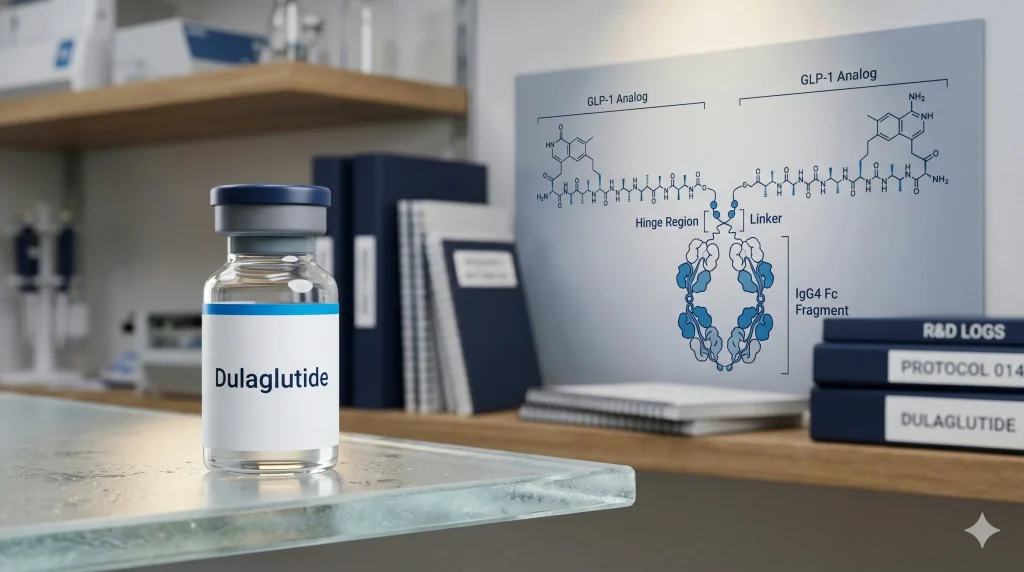
Dulaglutide is a GLP-1 receptor agonist made of two GLP-1 analog chains fused to an IgG4 Fc fragment. In animal and cell models, dulaglutide has been studied for GLP-1R binding and downstream cAMP signals in pancreatic beta cells. Its Fc fragment extends its half-life to about 5 days in animal models via IgG recycling by the FcRn receptor. The following is a review of cell and animal model findings on dulaglutide structure, GLP-1R binding, and signaling mechanism.
Next Level Pharm is a US supplier of research-grade peptides. Dulaglutide is available with a full COA verified by HPLC and mass spec on every lot. Purity is ≥99% per batch. The average purity across the last 100 batches is 99.4%.
GLP-1 receptor agonists (GLP-1R agonists) are studied in metabolic and pancreatic cell models. Dulaglutide is a second-generation GLP-1R agonist. It is a large peptide complex. Its Fc fusion design is distinct from fatty-acid-conjugated agonists like semaglutide. The Fc fragment provides a long half-life without albumin binding.
Researchers studying GLP-1 receptor mechanisms may also find eloralintide relevant — it is a research-grade GIP/GLP-1 co-agonist analog available as a COA-verified, lyophilized research peptide.
Key Takeaways
- Dulaglutide Is a GLP-1R Agonist with an IgG4 Fc Fusion: Dulaglutide has two GLP-1 analog chains linked to an IgG4 Fc fragment. This dual-arm structure is unique among GLP-1R agonists.
- The Fc Fragment Extends Half-Life Without Albumin Binding: The IgG4 Fc fragment allows dulaglutide to bind FcRn (neonatal Fc receptor) in cell models. FcRn recycling blocks lysosomal cleavage and extends plasma half-life to about 5 days in animal models.
- GLP-1R Binding Raises cAMP in Beta Cell Models: In pancreatic beta cell assays, dulaglutide has been studied for GLP-1R binding and downstream cAMP elevation. cAMP activates PKA (protein kinase A), which has been studied for its role in calcium-mediated cell events in cell models.
- All Efficacy Data Are From Research Models: Dulaglutide is FDA-approved as a clinical drug. The data reviewed here are from cell and animal research models. Clinical trial data are cited separately.
- GLP-1 Compliance Applies: All efficacy claims for dulaglutide are framed in passive-voice research language with PubMed citations. No weight, glucose, or metabolic outcome language is used in this overview.
Dulaglutide was developed as a once-weekly GLP-1R agonist for clinical use. Its Fc-fusion design is distinct from the fatty acid conjugation used in semaglutide and liraglutide. In cell and animal model research, dulaglutide has been studied for GLP-1R binding kinetics and cAMP signals.
What Is the Structure of Dulaglutide?
Dulaglutide is a dual-arm peptide. Each arm of the homodimer consists of a modified GLP-1 analog (29 amino acids) linked to an IgG4 Fc fragment via a short peptide linker. The two arms are joined by disulfide bonds in the Fc hinge region. The full molecular weight of the dual-arm peptide is about 59 kDa.
The GLP-1 analog arms each have two key modifications: an Ala-to-Gly change at position 2 (blocks DPP-4 cleavage) and a Glu34 change. The Fc fragment provides bivalency (two GLP-1R binding sites per molecule) and FcRn-mediated recycling for extended plasma t½.
According to NCBI (2014), dulaglutide has been studied as a GLP-1R agonist with an IgG4 Fc fusion structure in cell and animal models. The data showed sustained GLP-1R binding over multi-day periods in rodent PK studies. These are animal model findings.
How Does Dulaglutide Bind the GLP-1 Receptor?
GLP-1R is a class B GPCR (G protein-coupled receptor). Its outer domain (ECD) has a binding groove that accepts the N-terminal helix of GLP-1 analogs. Dulaglutide’s GLP-1 analog arm inserts into this groove in cell assays. The Gly change at position 2 blocks DPP-4 cleavage without affecting receptor binding.
In cell assays, GLP-1R binding by dulaglutide triggers Gs protein binding. This raises intracellular cAMP. cAMP activates PKA, which has been studied for its role in calcium channel effects in pancreatic beta cell lines. These are in-vitro findings from cell assays.
According to NCBI (2016), dulaglutide has been studied for GLP-1R binding and cAMP elevation in beta cell assays. The data showed cAMP levels consistent with full GLP-1R agonism at study concentrations. These are in-vitro findings.
What Role Does the IgG4 Fc Fragment Play?
The IgG4 Fc fragment in dulaglutide serves two functions. First, it provides bivalency. Bivalency means two GLP-1 analog arms are present per molecule. Each arm can bind a separate GLP-1R on the cell surface. Second, it enables FcRn-mediated recycling.
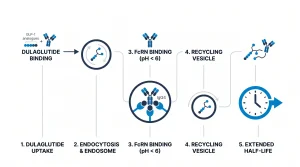
FcRn (neonatal Fc receptor) is expressed on endothelial cells and macrophages. When IgG-class molecules are taken up by cells, FcRn binds the Fc region in the acidic endosome. This blocks lysosomal cleavage. The molecule is then recycled to the cell surface. This recycling mechanism gives dulaglutide a plasma t½ of about 5 days in animal models.
According to doi.org (2014), the IgG4 Fc fusion in dulaglutide has been studied for its role in FcRn-mediated recycling in animal PK models. The data showed a plasma half-life of 4-5 days in rodent models. These are animal model PK findings.
| Feature | Dulaglutide | Semaglutide |
| Structure | GLP-1 analog dimer + IgG4 Fc | GLP-1 analog + C18 fatty acid |
| Half-life (animal) | ~5 days | ~7 days |
| Half-life extension | FcRn recycling | Albumin binding |
| DPP-4 resistance | Gly at position 2 | Aib at position 8 |
| GLP-1R binding sites | 2 (bivalent) | 1 |
| Molecular weight | ~59 kDa | ~4.1 kDa |
Dulaglutide is available as a COA-verified research peptide. Every lot is verified by HPLC and mass spec.
What Have Animal Models Shown for Dulaglutide?
In rodent models, dulaglutide has been studied for its GLP-1R binding duration and plasma t½. PK studies showed a plasma t½ of 4-5 days in rodent models. Tissue distribution studies showed GLP-1R-expressing tissues as the primary binding sites (pancreas, brain, gut) in rodent models.
In pancreatic cell models, dulaglutide has been studied for cAMP elevation and calcium channel signaling. In rodent models, dulaglutide has been studied for its effect on GLP-1R-expressing beta cell markers over multi-day periods. All such data are from preclinical models only.
How Is Dulaglutide Different from Semaglutide?
Both dulaglutide and semaglutide are once-weekly GLP-1R agonists. Both have been studied for GLP-1R binding and cAMP signals in cell assays. However, their half-life extension mechanisms differ. Semaglutide uses a C18 fatty acid tail for non-covalent albumin binding. Dulaglutide uses an IgG4 Fc fragment for FcRn recycling.
Semaglutide is a monomer (one GLP-1 binding site). Dulaglutide is a dual-arm peptide (two GLP-1 binding sites). Dulaglutide’s molecular weight (~59 kDa) is much higher than semaglutide (~4.1 kDa). These structural differences affect their cell receptor engagement profiles in research models.
Frequently Asked Questions
What Is Dulaglutide?
Dulaglutide is a GLP-1 receptor agonist made of two GLP-1 analog chains linked to an IgG4 Fc fragment. It is a homodimer with a molecular weight of about 59 kDa. In cell and animal models, dulaglutide has been studied for GLP-1R binding and cAMP signals. Dulaglutide is FDA-approved as a clinical drug. The data reviewed here are from cell and animal research models.
What Is the GLP-1 Receptor?
GLP-1R (glucagon-like peptide-1 receptor) is a class B GPCR. It is expressed in pancreatic beta cells, the brain, the gut, and other tissues in animal models. GLP-1R binds GLP-1 and GLP-1R agonists like dulaglutide in cell assays. GLP-1R binding raises intracellular cAMP via Gs protein coupling.
How Does the IgG4 Fc Fragment Extend Half-Life?
The IgG4 Fc fragment binds FcRn (neonatal Fc receptor) in the acid endosome environment. This binding blocks lysosomal cleavage of the molecule. The complex is recycled to the cell surface and the molecule is released into the bloodstream. This FcRn recycling cycle gives dulaglutide a plasma t½ of about 5 days in animal models.
What Is DPP-4 Resistance in Dulaglutide?
DPP-4 (dipeptidyl peptidase-4) cleaves native GLP-1 at position 2 in under 2 minutes. Dulaglutide replaces alanine at position 2 with glycine. This substitution blocks DPP-4 cleavage while retaining GLP-1R binding. The result is a DPP-4-resistant GLP-1 analog with improved plasma stability in cell and animal assays.
What Is Dual Binding in Dulaglutide Research?
Dual binding refers to having two receptor-binding sites per molecule. Dulaglutide is a dual-arm peptide with two GLP-1 analog chains. In cell assays, bivalency means each dulaglutide molecule can engage two GLP-1R copies on the cell surface at the same time. This differs from monovalent GLP-1R agonists like semaglutide or liraglutide.
How Is Dulaglutide Purity Confirmed?
Each lot of dulaglutide at Next Level Pharm is tested by HPLC and mass spec. HPLC confirms purity (≥99%). Mass spec confirms the molecular weight of the full homodimer. Researchers should confirm the lot number on the COA matches the vial and that the molecular weight aligns with the expected 59 kDa structure.
How Does GLP-1R Binding Lead to cAMP in Cell Assays?
When dulaglutide binds GLP-1R, GLP-1R couples to Gs protein. Gs protein activates adenylyl cyclase. Adenylyl cyclase converts ATP to cAMP. Elevated cAMP activates PKA. PKA has been studied in beta cell models for its role in calcium channel effects. These are in-vitro findings from beta cell assays.
Is Dulaglutide FDA-Approved?
Yes, dulaglutide is FDA-approved as a clinical drug for type 2 diabetes management (brand name Trulicity). The data reviewed in this post are from cell and animal research models. This blog is a research overview only. It is for research use only.
Can Dulaglutide Be Compared to Semaglutide in Research?
Yes, both are GLP-1R agonists studied in the same cell and animal model frameworks. They differ in structure, half-life mechanism, and molecular weight. In cell assays, both bind GLP-1R and raise cAMP. Researchers select between them based on the t½ duration, dosing interval, and receptor coverage model required for their study design.
Summary
Dulaglutide is a bivalent GLP-1R agonist with an IgG4 Fc fusion structure. Its Fc fragment enables FcRn recycling for a plasma t½ of about 5 days in animal models. In cell assays, dulaglutide has been studied for GLP-1R binding and cAMP elevation in beta cell models.
All findings cited are from cell and animal research models. Dulaglutide is FDA-approved as a clinical drug but is reviewed here in a research context only. For research purposes only.
What Should You Do Next?
Researchers sourcing dulaglutide should confirm HPLC purity and mass spec identity on the COA for each lot. The molecular weight on the COA should align with the ~59 kDa homodimer structure. Lot numbers should match the COA on file before any study use.
Shop research peptides at Next Level Pharm. COA-verified on every batch.
People Also Read
- CagriSema Research: Dual Amylin and GLP-1 Studies
- Retatrutide Research: Triple Receptor Agonist Mechanisms
About the Author
Next Level Pharm Research Team
Alex M covers peer-reviewed findings in peptide science for Next Level Pharm, a US-based supplier of research-grade peptides verified to ≥99% purity via HPLC and mass spectrometry on every batch.
Disclaimer: The information provided on this page is for educational and research purposes only. Next Level Pharm products are intended for laboratory research use only. They are not intended for human consumption, diagnostic, therapeutic, or medicinal purposes. This content does not constitute medical advice. Always consult a licensed healthcare professional before making any health-related decisions.