What Is a Peptide Reference Standard?

Last updated: July 2026
A peptide reference standard is a tested compound with a confirmed purity value. Another name for it is a CRM (certified reference material, a substance with a known purity and stated measurement uncertainty). According to the United States Pharmacopeia (USP) (2023), certified peptide standards are validated for identity, purity, and potency by HPLC and mass spec. These standards are used to calibrate lab instruments before testing research batches.
Next Level Pharm is a US-based supplier of research-grade peptides. Each lot is tested to ≥99% purity by HPLC and mass spec. Calibration against certified standards is part of the HPLC method process.
Analytical labs use reference standards to confirm their HPLC methods give accurate, repeatable results.
Key Takeaways
- A CRM Has a Certified Purity Value: A CRM has a confirmed purity with stated uncertainty. It is traceable to an international standard (SI unit or USP monograph).
- Reference Standards Calibrate HPLC Systems: HPLC needs a reference compound to convert peak area into a purity percentage. Without a standard, peak area data are relative, not absolute.
- USP Standards Are the Benchmark: The United States Pharmacopeia (USP) issues certified peptide standards. Labs use these for HPLC method validation.
- Method Validation Requires a CRM: To validate a new HPLC method, labs run the reference standard alongside samples. This confirms the method is accurate before it is used on research batches.
- SI Traceability Ensures Comparability: SI (International System of Units) traceability links a purity value to a base measurement unit. This makes results from different labs comparable.
Reference standards are the backbone of analytical quality assurance. Understanding them helps researchers evaluate the reliability of COA data from peptide suppliers.
What Is a Certified Reference Material?
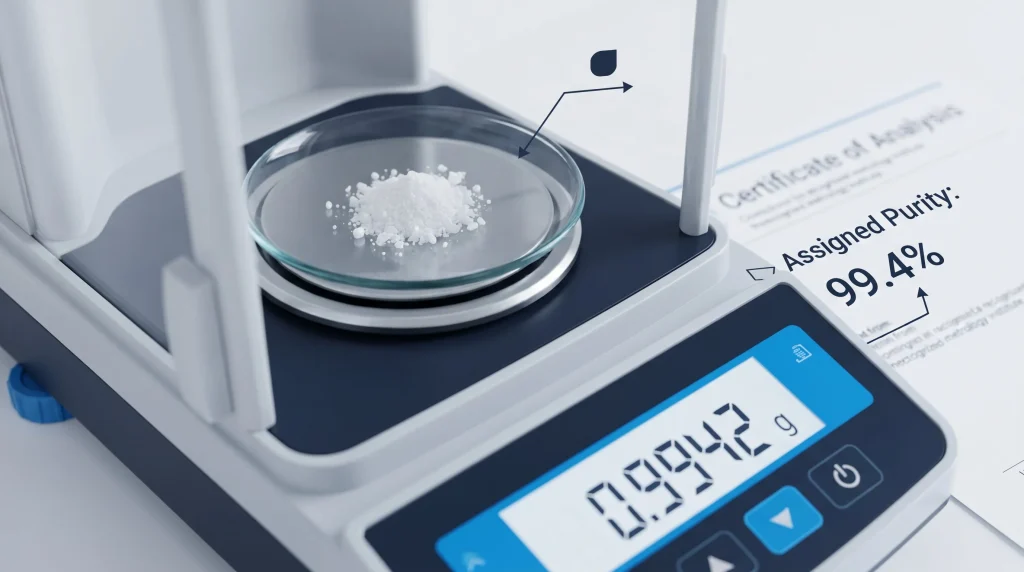
A CRM is a substance with a well-confirmed purity. It is a key lab tool. For peptides, the main property is the purity percentage. The certified value includes an uncertainty range (for example, 99.2 ± 0.3%). The range shows how confident the lab is in the stated value.
CRMs are made by national labs or recognized bodies (such as USP). The process involves multiple labs testing the same material. Results are combined to get a consensus purity value. This multi-lab step removes single-lab bias.
CRMs are costly to make and test. Labs use them in small amounts. Labs typically buy vials of 50 to 100 mg. A small portion is used for each calibration run.
According to Taverniers I et al. (2004), certified reference materials are the foundation of analytical quality assurance. Without them, purity data from different labs cannot be compared.
How Are Peptide CRMs Made and Certified?
Peptide CRMs start with high-purity synthesis. The compound is made, purified, and then tested by several independent labs. Each lab runs HPLC and mass spec. Their results are pooled to get a consensus value.
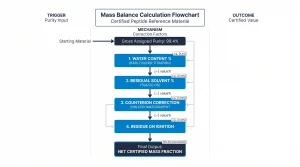
The test also covers water content, residual solvents, and counterion levels. All of these affect the true amount of peptide in the material. The “assigned value” states the final purity after all corrections.
According to Shah VP et al. (1992) (PMID 1448695), analytical method validation requires reference standards of known purity. This ensures accuracy, precision, and linearity in quantitative assays. Multi-lab characterization is the standard way to produce accepted reference materials.
How Are CRMs Used in HPLC Calibration?
HPLC gives a graph called a chromatogram. Each compound shows up as a peak. Peak area is in lab units (mAU). These units are not the same across runs or machines. A reference standard converts peak area into a purity percentage. This is a key step.
The lab runs the CRM at a known amount. The detector gives a peak area for that amount. This sets a response factor: area per unit of mass. Unknown samples are then run. Their area is split by this factor to get their purity.
Without a CRM, purity is a ratio of peak areas. This is called relative purity. With a CRM, labs get absolute purity. Absolute purity is more precise. It can be compared across sites.
What Is SI Traceability for Standards?
SI traceability means every step in the chain links back to a base unit. For mass, the base SI unit is the kilogram. A scale is used to weigh the CRM. That scale is calibrated against a national standard. The national standard links back to the world reference.
This chain is called the traceability chain. It makes lab results comparable. One lab can check its results against another lab. Without it, two labs may get different purity values. There is no way to resolve the gap.
Browse quality and testing peptides. COA data from every batch, with HPLC and mass spec results included.
How Do USP Peptide Standards Work?
The USP publishes rules for drug compounds. For some peptides (such as oxytocin), USP issues certified reference standards. These are made using USP test protocols. The purity value and its error range are in the USP catalog.
Labs that buy USP standards can use them as primary reference materials. Not all research peptides have a USP standard. For those that do not, labs make in-house reference standards. These are tested against primary standards to set their purity value.
What Purity Does a CRM Guarantee?
A CRM does not guarantee a single exact purity. It gives a purity value with an error range. For example, 99.2 ± 0.3% (k=2) means the true purity is between 98.9% and 99.5%. The k=2 value is a math term for the confidence level used.
A CRM with a small error range (±0.1%) is more precise. A large error range (±1.0%) gives less certainty. High-precision CRMs give better calibration factors. Labs prefer them for HPLC method work. According to Mischak H et al. (2012), reproducible peptide measurement requires consistent use of certified reference materials with stated uncertainties. This reduces inter-lab variability in purity reporting.
Frequently Asked Questions
What Is the Difference Between a Reference Standard and a COA?
A reference standard is a certified material used to calibrate an HPLC method. A COA records the test results for a specific research batch. The COA purity result is reliable only if the HPLC method was calibrated against a certified standard. A COA from a lab that uses certified reference standards gives more reliable data. One without CRM calibration may use area normalization only. Both show purity, but CRM calibration gives absolute, not just relative, purity data.
What Is the United States Pharmacopeia?
The USP is a non-government body that sets quality standards for pharmaceutical compounds. It issues certified reference standards and publishes analytical test monographs. USP standards are used in pharmaceutical HPLC method validation. Labs that use USP standards can report results as meeting USP specifications. Not all research peptides have USP monographs. For peptides without a monograph, labs produce in-house or supplier-defined standards and validate those instead.
What Is Method Validation?
Method validation confirms that an HPLC test gives accurate and repeatable results. Validation includes several checks: accuracy, precision, linearity, range, and specificity. It also covers detection and quantification limits. A reference standard is used in accuracy tests. It confirms the method gives the right result for a compound of known purity. Validation must be done before an HPLC method is used for quality control.
What Is an Uncertainty Statement?
An uncertainty statement gives a range around the certified purity value. It shows how confident the lab is in the number. For example, 99.2 ± 0.3% (k=2) means the true purity is between 98.9% and 99.5% at about 95% confidence. A smaller range means the certified value is more precise. High-precision CRMs are preferred for HPLC calibration because they give more accurate conversion factors.
What Is the Difference Between Primary and Secondary Reference Standards?
A primary reference standard is certified by a recognized body (such as USP or NIST). A secondary standard is characterized by comparing it to a primary standard. Secondary standards are used in routine lab work to save the expensive primary stock. The purity of the secondary standard comes from its agreement with the primary standard. Both are used in HPLC calibration. Primary standards have higher authority. Secondary standards are a practical and cost-effective option for most labs.
Why Is Moisture Content Important in CRM Certification?
Peptides absorb moisture from the air. If a sample has 99.5% peptide but 2% of the total weight is water, the true peptide content is below 99.5%. CRM certification corrects for moisture by measuring water (by Karl Fischer titration) and subtracting it from the total mass. This gives the anhydrous peptide content. That number is used for HPLC calibration. Without this correction, the calibration factor would be wrong, making all purity results slightly too high.
What Is a USP Peptide Monograph?
A USP monograph is a set of specifications and tests for a specific compound. It includes identity tests, purity tests, and potency assays. For peptides like oxytocin, the monograph defines the HPLC method, the reference standard, and the acceptable purity range. Labs that follow the USP monograph can confirm their results meet a globally recognized standard. Research peptides without a USP monograph are tested using in-house or supplier-defined methods with their own validated reference standards.
How Often Are CRMs Recertified?
The stability of a CRM determines how long its certified value is valid. Most peptide CRMs are stable for one to five years when stored correctly (typically frozen and dessicated). After this period, the material may degrade. The certified purity value may no longer be accurate. Labs track expiry dates on reference standards and reorder before the current stock runs out. Using an expired CRM can cause systematic error in all HPLC calibrations that rely on it.
Can I Use a Supplier COA as a Reference Standard?
No. A supplier COA records test results for a research compound batch. It is not a CRM. A COA result depends on the supplier’s HPLC method. That method may or may not have been calibrated against a CRM. For research that needs absolute purity data, source a separate CRM and use it to calibrate your own HPLC method. The COA purity is a useful quality check. But it is not a primary calibration standard.
What Happens If No CRM Exists for a Peptide?
Labs produce in-house reference standards for novel or rare peptides. The peptide is synthesized and purified to the highest possible purity. Multiple methods (HPLC, mass spec, NMR, amino acid analysis) are used to characterize it. An assigned purity value with uncertainty is calculated. This in-house standard is then used for all routine HPLC calibrations for that peptide. It is less authoritative than a USP standard but is still better than area normalization alone.
Summary
A peptide reference standard (CRM) is a substance with a certified purity and a traceable measurement chain. Labs use it to calibrate HPLC systems and validate analytical methods.
USP standards are the primary benchmark for pharmaceutical peptide testing. For peptides without USP monographs, secondary or in-house CRMs are used. Uncertainty-aware calibration gives more reliable purity data than area normalization. All COA purity results depend on the calibration standard used.
What Should You Do Next?
Researchers setting up HPLC methods should source a certified reference standard before running validation experiments. Record the CRM lot number, certified purity, and uncertainty value in the method validation file.
Shop research peptides. All batches are tested by HPLC and mass spec with full COA documentation.
People Also Read
- Peptide Purity Testing: What HPLC and Mass Spec Confirm
- What Is Mass Spectrometry? How It Confirms Peptide Identity
About the Author
Next Level Pharm Research Team
Alex M covers peer-reviewed findings in peptide science for Next Level Pharm, a US-based supplier of research-grade peptides verified to ≥99% purity via HPLC and mass spectrometry on every batch.
Disclaimer: The information provided on this page is for educational and research purposes only. Next Level Pharm products are intended for laboratory research use only. They are not intended for human consumption, diagnostic, therapeutic, or medicinal purposes. This content does not constitute medical advice. Always consult a licensed healthcare professional before making any health-related decisions.