
GLP-1 Analog Comparison: A Research Overview

Last updated: July 2026
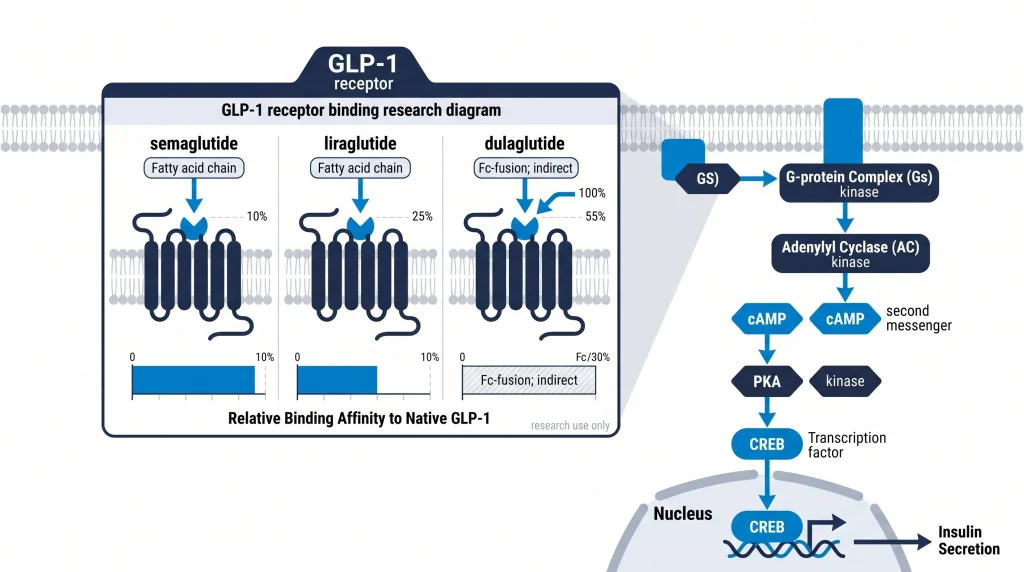
A GLP-1 analog comparison studies three key peptides: semaglutide, liraglutide, and dulaglutide. Each binds the GLP-1 receptor (GLP-1R) and has been studied for its role in metabolic signaling. They differ in fatty acid chain length, half-life, and binding profile. According to PubMed (2022), these three analogs differ mainly in fatty acid chain length, receptor binding kinetics, and half-life. These three analogs are the focus of active metabolic receptor research.
Next Level Pharm is a US-based supplier of research-grade peptides. All products are verified to ≥99% purity via HPLC and mass spectrometry. COA documentation is included on every batch. Researchers can browse metabolic research peptides for GLP-1 analogs and related compounds.
GLP-1 analogs are synthetic peptides built to mimic the native GLP-1 hormone. Native GLP-1 has a half-life of only 1 to 2 minutes due to DPP-4 enzyme breakdown. Analogs use structural changes to resist this breakdown. This allows longer receptor binding in lab settings.
Key Takeaways
- Structural Changes: Fatty acid chains and amino acid swaps extend analog half-life in lab models.
- Efficacy Comparison: Each analog binds the GLP-1 receptor with a distinct affinity and binding kinetics in cell assays.
- Half-Life Range: Liraglutide has a 13-hour half-life. Semaglutide and dulaglutide have weekly profiles.
- Dual Agonist Research: Tirzepatide adds GIP receptor binding. Retatrutide adds glucagon receptor binding as well.
- Future Analogs: Tri-agonist research on retatrutide has been studied in Phase 2 trials.
Researchers compare these three analogs to map how structural changes affect receptor binding and metabolic outcomes. Each analog offers a distinct model for studying GLP-1R pharmacology. The table below summarizes their key features.
What Is a GLP-1 Receptor Agonist?
A GLP-1 receptor agonist is a peptide that binds the GLP-1R and mimics the action of native GLP-1. Native GLP-1 is released from intestinal L-cells after a meal. It signals glucose-dependent insulin release from beta cells. It also suppresses glucagon from alpha cells.
Research has studied GLP-1R agonists for their role in metabolic signaling since the 1990s. The key challenge was extending their short half-life. DPP-4 enzymes break down native GLP-1 within 2 minutes. Structural changes in analogs resist this enzyme. This allows sustained receptor binding in lab assays.
How Do Semaglutide and Liraglutide Differ?
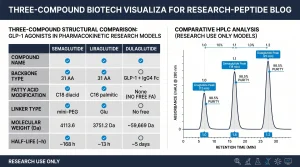
Semaglutide and liraglutide are both fatty acid-acylated GLP-1 analogs. They differ in chain length and binding affinity. Liraglutide uses a C16 fatty acid chain. This gives a 13-hour half-life and requires daily use in research protocols.
Semaglutide uses a C18 diacid chain with an Aib substitution at position 8. The Aib change blocks DPP-4 binding. The C18 chain binds albumin more tightly. This extends the half-life to about 168 hours. Researchers use it in weekly dosing schedules for lab assays.
What Makes Dulaglutide Unique in Structure?
Dulaglutide is built differently from the other two. It fuses a modified GLP-1 peptide to an IgG4-Fc protein. This large fusion protein resists renal clearance and protease breakdown. The half-life is about 90 hours. Researchers use it for weekly study schedules.
The IgG4-Fc region adds size and stability. This changes how dulaglutide clears the body. Studies compare its receptor binding to liraglutide and semaglutide in assay settings. The larger size may affect tissue distribution in animal models.
How Do Their Receptor Binding Profiles Compare?
Semaglutide, liraglutide, and dulaglutide have each been characterized in GLP-1 receptor binding assays. They differ in binding affinity and how long they occupy the receptor, which follows from their structural changes. These binding profiles make them useful reference tools in GLP-1 receptor pharmacology research.
Semaglutide’s C18 diacid design, liraglutide’s C16 chain, and dulaglutide’s IgG4-Fc fusion each produce distinct binding kinetics. These structural classes are studied in the receptor assays used to characterize GLP-1 analogs.
| Analog | Receptor | Structure | Half-Life | Admin Frequency |
| Semaglutide | GLP-1R | C18 diacid, Aib at pos 8 | ~168 hours | Weekly |
| Liraglutide | GLP-1R | C16 fatty acid | ~13 hours | Daily |
| Dulaglutide | GLP-1R | IgG4-Fc fusion | ~90 hours | Weekly |
What Are Dual GIP/GLP-1 Receptor Agonists?
Dual agonists target both the GIP receptor and the GLP-1R in one molecule. Tirzepatide is the key example. It was designed to study how combined receptor binding affects metabolic signaling. Research has shown additive effects vs. single GLP-1R agonists.
Studies examine whether GIP receptor binding improves outcomes beyond GLP-1R alone. According to PubMed (2021), dual agonism has been studied for greater metabolic effects than GLP-1 alone. This makes dual agonists a useful reference class in GLP-1 analog comparison studies. Researchers can view semaglutide as a single-receptor reference alongside dual agonists.
What Does Future GLP-1 Research Involve?
Researchers are studying tri-agonist compounds like retatrutide. This peptide targets GLP-1R, GIP receptor, and the glucagon receptor at once. It has been studied in Phase 2 research for how binding three receptors at once affects metabolic signaling. This triple-receptor design is the key structural variable in current comparison research.
Oral formulations of GLP-1 analogs are also under study. These use absorption enhancers to allow gut uptake of the peptide. Research has focused on how bioavailability changes when the molecule passes through the gut wall. This is an active area of peptide delivery research.
Researchers studying GLP-1 receptor mechanisms may also find eloralintide relevant — it is a research-grade GIP/GLP-1 co-agonist analog available as a COA-verified, lyophilized research peptide.
Frequently Asked Questions
What are the main GLP-1 analogs available for research?
The three core GLP-1 analogs studied in metabolic research are semaglutide, liraglutide, and dulaglutide. Each binds the GLP-1 receptor and has been studied in animal and cell models. Semaglutide has the longest half-life at about 168 hours. Liraglutide has a shorter 13-hour profile. Dulaglutide uses an IgG4-Fc fusion to reach about 90 hours. All three are used as reference compounds in GLP-1 receptor pharmacology assays.
How do GLP-1 analogs differ in receptor binding affinity?
Semaglutide shows high GLP-1 receptor binding affinity due to its C18 diacid chain and Aib substitution. Liraglutide binds via a C16 fatty acid chain with moderate albumin binding. Dulaglutide binds the receptor through a peptide fused to an IgG4-Fc protein. According to PubMed (2019), these structural differences produce distinct binding kinetics in receptor assays. Researchers use these differences to model how small structural changes affect receptor pharmacology.
How do the three analogs compare in receptor binding?
Semaglutide’s C18 diacid chain and Aib substitution give it high GLP-1 receptor binding affinity and the longest half-life of the three. Liraglutide’s C16 chain and dulaglutide’s IgG4-Fc fusion produce different binding kinetics. These structural differences are studied in receptor assays to compare how each analog engages the GLP-1 receptor. All findings are from cell and animal model research.
How does a dual GIP/GLP-1 agonist differ from a single GLP-1 analog?
A dual GIP/GLP-1 agonist binds two receptors: the GLP-1 receptor and the GIP receptor. A single analog like semaglutide binds GLP-1R only. Tirzepatide is the main dual agonist studied for metabolic effects. Research has linked dual agonism to greater metabolic outcomes than single receptor binding. These studies use cell and animal models to compare signaling downstream of each receptor. The extra GIP receptor signal is the key variable in these GLP-1 analog comparison assays.
What structural features distinguish different GLP-1 analogs?
Structural differences include fatty acid chain length, amino acid substitutions, and protein fusion partners. Liraglutide uses a C16 chain. Semaglutide uses a C18 diacid chain with an Aib at position 8. Dulaglutide fuses the peptide to an IgG4-Fc protein. Each change affects albumin binding, receptor affinity, and half-life in different ways. These structural variables are studied to understand how to engineer longer-acting and more selective GLP-1 receptor tools for metabolic research.
What is the role of the DPP-4 enzyme in GLP-1 metabolism?
DPP-4 (dipeptidyl peptidase-4) cleaves native GLP-1 at position 2. This breaks down the peptide within 1 to 2 minutes. GLP-1 analogs are designed to resist DPP-4 cleavage. Semaglutide uses an Aib substitution at position 8 to block DPP-4 access. Liraglutide’s albumin binding sterically hinders DPP-4. Dulaglutide’s large size also limits DPP-4 access. Each method is studied to see how much it extends receptor binding time in cell and animal models.
Are there oral formulations of GLP-1 analogs under study?
Yes. Oral semaglutide has been studied using an absorption enhancer called SNAC. SNAC protects the peptide from gut enzymes and helps it pass through the stomach wall. According to PubMed (2019), oral semaglutide has been studied for bioavailability in research models. Oral delivery of peptides is challenging due to gut enzyme breakdown. This is an active area of formulation research comparing GLP-1 analogs in non-injectable delivery systems.
What is meant by the incretin effect in metabolic research?
The incretin effect refers to greater insulin release after oral glucose than after IV glucose at the same level. This extra release is driven by gut hormones like GLP-1 and GIP. Researchers study the incretin effect to understand how gut signals shape beta cell response. GLP-1 analogs are used as tools to amplify or isolate this effect in cell and animal models. Comparing how different analogs affect the incretin signal is a key goal of GLP-1 analog comparison research.
How is the half-life of a peptide analog extended for research?
Half-life is extended by reducing enzyme cleavage and slowing kidney clearance. Fatty acid chains on liraglutide and semaglutide bind albumin. This slows renal clearance and limits DPP-4 access. Dulaglutide uses an IgG4-Fc fusion for size-based protection. Amino acid changes like the Aib substitution at position 8 block cleavage sites. Each method is studied alone and in combination to map how much each change adds to the peptide’s active research window.
Why do semaglutide and liraglutide have different admin schedules in research?
Semaglutide has a 168-hour half-life vs. liraglutide’s 13-hour half-life. This 13-fold difference comes from stronger albumin binding via the C18 chain. Liraglutide’s shorter C16 chain releases from albumin faster. Research protocols use liraglutide on a daily schedule and semaglutide weekly. This allows researchers to study each analog within its active binding window. The schedule difference also makes them useful for comparing acute vs. sustained receptor effects in GLP-1 analog comparison assays.
Summary
Semaglutide, liraglutide, and dulaglutide are three GLP-1 receptor agonists studied in metabolic research. They share GLP-1R binding but differ in structure, half-life, and binding profile. Semaglutide’s C18 chain and Aib substitution give it the longest active window.
Half-life ranges from 13 hours for liraglutide to 168 hours for semaglutide. Dulaglutide’s IgG4-Fc fusion sits at 90 hours. These differences drive distinct research protocols across metabolic assays.
Dual and triple agonists like tirzepatide and retatrutide extend this research by adding GIP and glucagon receptor binding. These newer classes are the focus of growing metabolic research interest.
What Should You Do Next?
Researchers comparing GLP-1 analogs should start with COA-verified, HPLC-confirmed peptides. This ensures lot-to-lot consistency across study arms. Next Level Pharm provides ≥99% purity peptides with mass spectrometry verification on every batch.
Shop research peptides or view semaglutide and liraglutide product pages. COA documentation is available on every order.
People Also Read
- Sermorelin vs CJC-1295: What Research Shows About Each GHRH Analog
- What Makes a Peptide Research Grade? Standards and Testing Explained
About the Author
Next Level Pharm Research Team
Alex M covers peer-reviewed findings in peptide science for Next Level Pharm, a US-based supplier of research-grade peptides verified to ≥99% purity via HPLC and mass spectrometry on every batch.
Disclaimer: The information provided on this page is for educational and research purposes only. Next Level Pharm’s products are intended for laboratory research use only. They are not intended for human consumption, diagnostic, therapeutic, or medicinal purposes. This content does not constitute medical advice. Always consult a licensed healthcare professional before making any health-related decisions.