
What Is Mass Spectrometry? How It Confirms Peptide Identity

Last updated: June 2026
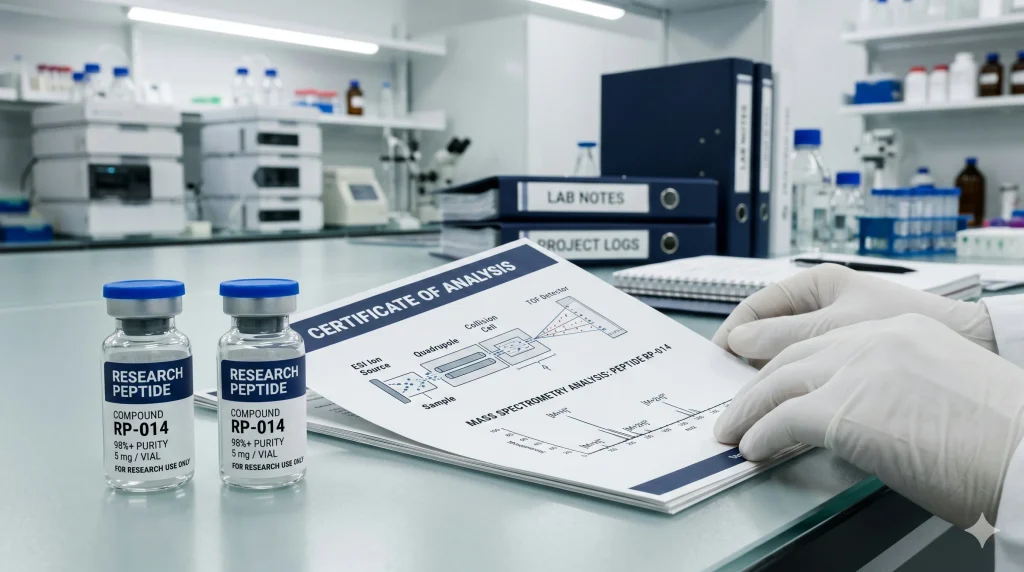
A mass spectrometry test records the mass of a molecule by ionizing it and sorting the resulting ions. For peptide research, the technique confirms that a synthesized sequence has the correct molecular weight. This rules out truncations, deletions, and impurities from the synthesis process. Mass spec is used alongside HPLC (high-performance liquid chromatography) to verify both purity and identity in lab-grade peptide vials. Research-grade peptides must pass both tests before any lab study.
Next Level Pharm is a US-based supplier of research-grade peptides verified to ≥99% purity. Every batch is tested by HPLC and mass spec. The COA (certificate of analysis) includes both the HPLC trace and the observed versus expected mass for each lot.
Knowing how mass spectrometry works helps researchers read COA data. The key value is the observed molecular weight. It must match the expected mass of the full peptide sequence. Any mismatch signals a structural problem in the batch.
Key Takeaways
- Mass Spec Records Molecular Weight: It ionizes a sample and sorts the ions by mass-to-charge ratio (m/z). The result is a spectrum that shows the molecular weight of each ion present.
- ESI Is the Common Ion Source for Peptides: Electrospray ionization (ESI) is used for peptide mass spec. It adds protons to the peptide without breaking the sequence.
- The Observed Mass Must Match Expected Mass: A correct m/z peak confirms the full sequence is present in the batch.
- HPLC and Mass Spec Work Together: HPLC confirms purity (percentage of the target compound). Mass spec confirms identity (correct sequence and molecular weight).
- COA Data Shows Both Results: A valid COA includes the HPLC purity percentage and the mass spec observed versus expected mass. Both must pass for a research-grade vial.
Researchers who read COA data can check two values. First, the HPLC purity should be ≥99%. Second, the observed mass should match the expected mass of the full peptide sequence.
What Is Mass Spectrometry and How Does It Work?
Mass spectrometry (mass spec) is an analytical technique. It measures the mass-to-charge ratio (m/z) of ions in a sample. The instrument has three parts. First is the ion source, which ionizes the sample. Second is the mass analyzer, which separates ions by m/z. Third is the detector, which records the signal.
A peptide sample is introduced into the ion source. The source adds charge to the molecules. The resulting ions travel through the analyzer and hit the detector. The detector records the m/z values and intensity of each ion. The output is a mass spectrum.
According to a review in JASMS (2021), mass spectrometry is the gold-standard technique for confirming the molecular identity of a synthesized peptide. The observed mass must match the theoretical mass calculated from the full amino acid sequence and any modifications.
How Does Electrospray Ionization Work?
Electrospray ionization (ESI) is the ion source used for most peptide mass spec. In ESI, the sample is dissolved in a solvent. It is pushed through a fine needle at high voltage. The voltage causes the solvent to form a fine spray of charged droplets. The droplets shrink as the solvent evaporates. This leaves the peptide ions in the gas phase.
ESI is called a soft ionization method. It adds charge without breaking the peptide bonds. This keeps the full sequence intact. The ions that form in ESI are called multiply charged ions. A peptide with 10 residues may carry 2-4 charges. The instrument records the m/z ratio for each charge state.
According to a study in PubMed (2022), ESI produces multiply charged ions that allow large peptides to be analyzed on instruments with moderate m/z ranges. The multiple charge states all correspond to the same peptide mass, which can be calculated by deconvolution.
What Is Mass-to-Charge Ratio in Mass Spec?
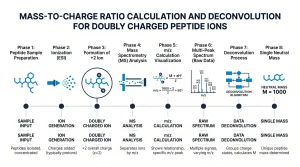
The mass-to-charge ratio (m/z) is the key readout from a mass spectrum. It is the mass of the ion divided by its charge number (z). For a peptide that carries 2 protons, z = 2. If the peptide has a neutral mass of 1000 Da, the observed m/z is (1000 + 2) / 2 = 501.
A peptide can appear at multiple m/z peaks if it carries different charges. The set of peaks is called an isotope envelope. Deconvolution software converts the set of m/z peaks back to a single neutral mass. This neutral mass is compared to the expected mass for the full sequence.
How Does Mass Spec Verify a Peptide Sequence?
The expected mass of a peptide is calculated from its amino acid sequence. Each amino acid has a known residue mass. The masses are summed and adjusted for the water molecule at the chain ends. This gives the monoisotopic mass of the full sequence.
The mass spec test records the observed mass of the sample. If the observed mass matches the expected mass within a small error range (typically 0.01-0.1 Da), the sequence is confirmed. If the masses differ by a large amount, the peptide may be incomplete, oxidized, or contain a different sequence.
According to a review in Molecules (2015), mass spec can detect truncated sequences, oxidized residues, and missed cleavages from solid-phase peptide synthesis (SPPS). These impurities appear at a different mass from the full-length target sequence.
Shop research peptides at Next Level Pharm. Every BPC-157 vial and other research peptides include a COA with observed versus expected mass data.
How Does HPLC Differ from Mass Spectrometry?
HPLC and mass spec measure different things. HPLC measures purity. It separates the sample components by their travel time through a column. The area under each peak shows what percentage of the sample is the target compound.
Mass spec measures identity. It confirms that the compound has the correct molecular weight. Purity and identity together confirm a research-grade batch. A peptide can be 99% pure but have the wrong mass if the synthesis produced a consistent impurity.
| Test | What It Measures | Output | Required Standard |
| HPLC | Purity (% of target compound) | Chromatogram with peak areas | ≥99% purity |
| Mass Spec | Identity (molecular weight) | m/z spectrum and neutral mass | Observed mass matches expected |
| Both together | Purity and identity | COA with both results | Required for research-grade vials |
How Is Research-Grade Peptide Purity Confirmed?
A research-grade peptide COA includes two data sets. First is the HPLC result, which shows the percentage of the target compound in the batch. Second is the mass spec result, which shows the observed and expected molecular weight.
Every batch gets HPLC and mass spec testing before release. Beauty peptides and recovery peptides follow the same two-test standard. Batches below ≥99% purity or with a mass mismatch are rejected before shipping. The COA lot number traces each vial to its specific production run.
Frequently Asked Questions
What Is Mass Spectrometry?
Mass spectrometry is an analytical technique that measures the mass of a molecule by ionizing it and sorting the ions by mass-to-charge ratio. For peptide research, it confirms the molecular weight of a synthesized sequence. The instrument has three parts: an ion source, a mass analyzer, and a detector. The output is a spectrum of m/z peaks that correspond to the masses of the ions in the sample.
How Does ESI Work in Peptide Mass Spec?
ESI (electrospray ionization) dissolves the peptide sample in a solvent and sprays it through a charged needle. The solvent evaporates and leaves the peptide ions in the gas phase. ESI adds protons to the peptide without breaking the bonds between amino acids. The resulting ions carry multiple charges. This makes ESI a soft ionization method that keeps the full peptide sequence intact during analysis.
What Is m/z Ratio and How Is It Read?
The m/z ratio is the mass of the ion divided by its charge number. A peptide with a mass of 1000 Da carrying 2 protons has an m/z of 501. The same peptide with 3 protons has m/z of 334. Deconvolution software reads the full set of m/z peaks and calculates the neutral mass of the peptide. This neutral mass is then compared to the expected mass for the sequence.
How Does Mass Spec Detect Truncated Peptides?
A truncated peptide has a lower mass than the full-length sequence. Its m/z peaks appear at different positions in the spectrum. Mass spec can detect these shorter sequences as separate peaks. If the observed mass matches a truncated form rather than the full sequence, the batch contains incomplete synthesis products. This is one reason mass spec is required alongside HPLC for research-grade peptide verification.
What Is the Difference Between HPLC and Mass Spec?
HPLC (high-performance liquid chromatography) measures purity. It records what percentage of the sample is the target compound. Mass spec measures identity. It confirms that the compound has the correct molecular weight. Both tests are required for a valid research-grade COA. A peptide can pass HPLC at ≥99% purity but still fail mass spec if the molecular weight is wrong.
What Is Monoisotopic Mass in Peptide Research?
Monoisotopic mass is the mass of a peptide calculated using the lightest stable isotope of each element. For carbon, that is carbon-12. For hydrogen, it is hydrogen-1. Monoisotopic mass gives a single precise value for a given sequence. Mass spec instruments measure this value directly from the lowest m/z peak in the isotope envelope. The expected monoisotopic mass is calculated from the amino acid sequence before the test.
What Is a COA and What Mass Spec Data Does It Include?
A COA (certificate of analysis) is a document that records test results for a specific production batch. For peptide mass spec, the COA shows the observed molecular weight from the mass spec run and the expected molecular weight for the target sequence. It also includes the lot number, date of test, and instrument used. A valid COA with both HPLC and mass spec results is the minimum standard for research-grade peptide sourcing.
How Is Mass Spec Used with HPLC for Peptide Research?
HPLC and mass spec are used together as a two-test quality standard. HPLC runs first and separates the sample into its components. Each component is recorded as a peak with an area percentage. Mass spec then confirms the molecular weight of the main peak. Together, the two tests confirm that the dominant compound in the batch is the intended peptide with ≥99% purity and the correct mass.
What Is Deconvolution in Mass Spectrometry?
Deconvolution is the computational process of converting the set of multiply charged m/z peaks from a mass spectrum into a single neutral mass value. A peptide with 3 charges appears at three different m/z values. Deconvolution uses the spacing between those peaks to calculate the true neutral mass. This value is then compared to the expected mass for the full amino acid sequence to confirm or reject identity.
Summary
Mass spectrometry confirms the molecular identity of a research-grade peptide by measuring the mass-to-charge ratio of its ions. The observed neutral mass must match the expected mass for the full amino acid sequence. HPLC confirms purity. Mass spec confirms identity. Both results appear on the COA.
For research use, a valid COA must include the HPLC purity percentage (≥99%) and the mass spec observed versus expected mass. Any batch with a mass mismatch signals a structural problem and should not be used in a lab study.
What Should You Do Next?
Researchers sourcing peptides for lab use should check three items on every COA. First, confirm HPLC purity is ≥99%. Second, confirm the observed mass matches the expected mass for the full sequence. Third, record the lot number to trace the vial back to production records.
Shop research peptides at Next Level Pharm. Every batch ships with a COA that includes HPLC and mass spec data and a traceable lot number.
People Also Read
- Peptide Purity Testing: What HPLC and Mass Spec Confirm
- What Is a Peptide COA? Testing Standards Explained
About the Author
Next Level Pharm Research Team
Alex M covers peer-reviewed findings in peptide science for Next Level Pharm, a US-based supplier of research-grade peptides verified to ≥99% purity via HPLC and mass spectrometry on every batch.
Disclaimer: The information provided on this page is for educational and research purposes only. Next Level Pharm products are intended for laboratory research use only. They are not intended for human consumption, diagnostic, therapeutic, or medicinal purposes. This content does not constitute medical advice. Always consult a licensed healthcare professional before making any health-related decisions.