Thymulin Peptide Research: FTS Thymic Serum Factor

Last updated: October 2026
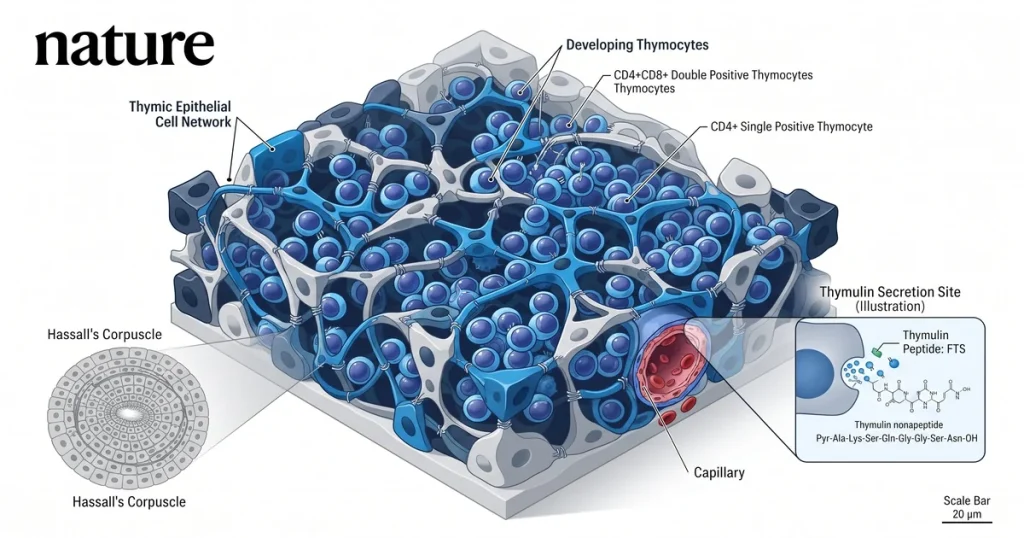
A thymulin FTS thymic peptide is a small hormone made by cells in the thymus gland that helps control the immune system and T-cell growth. Also called thymic serum factor, or FTS, this peptide has a chain of nine amino acids and needs zinc to become active. Researchers study how it guides raw T-cells into mature immune cells, and data indicate blood levels decrease by over 90% past age 60.
Next Level Pharm keeps strict quality standards for all research compounds. Its catalog of 70+ active peptide SKUs carries a verified average purity of 99.4% across the last 100 batches. Each vial is checked by both HPLC (high-performance liquid chromatography) and mass spec.
Researchers rely on this data to keep their lab results precise. All products are stored as freeze-dried powders and sealed under inert gas for extended shelf life.
The study of FTS provides data on how thymic peptides influence the immune system. Labs focus on how it affects cell pathways and triggers T-cell surface markers. This data forms the basis for comparing thymulin with other immune agents in future studies.
Key Takeaways
- Thymic Hormone Origin: Thymulin is a small hormone made by the thymus gland. This organ controls how the body’s adaptive immune system develops.
- Zinc-Based Activity: Thymulin needs zinc to function. The zinc binds to the peptide and forms an active complex that triggers its effects.
- Immune System Effects: Research suggests thymulin guides T-cell development in lab models. Its effects help scientists observe immune cell progress.
- Nerve Cell Studies: Researchers test whether thymulin can protect nerve cells from damage by reducing swelling in brain tissue.
- Age-Linked Decline: Thymulin levels decrease with age. This decline is connected to weaker immune responses in older models.
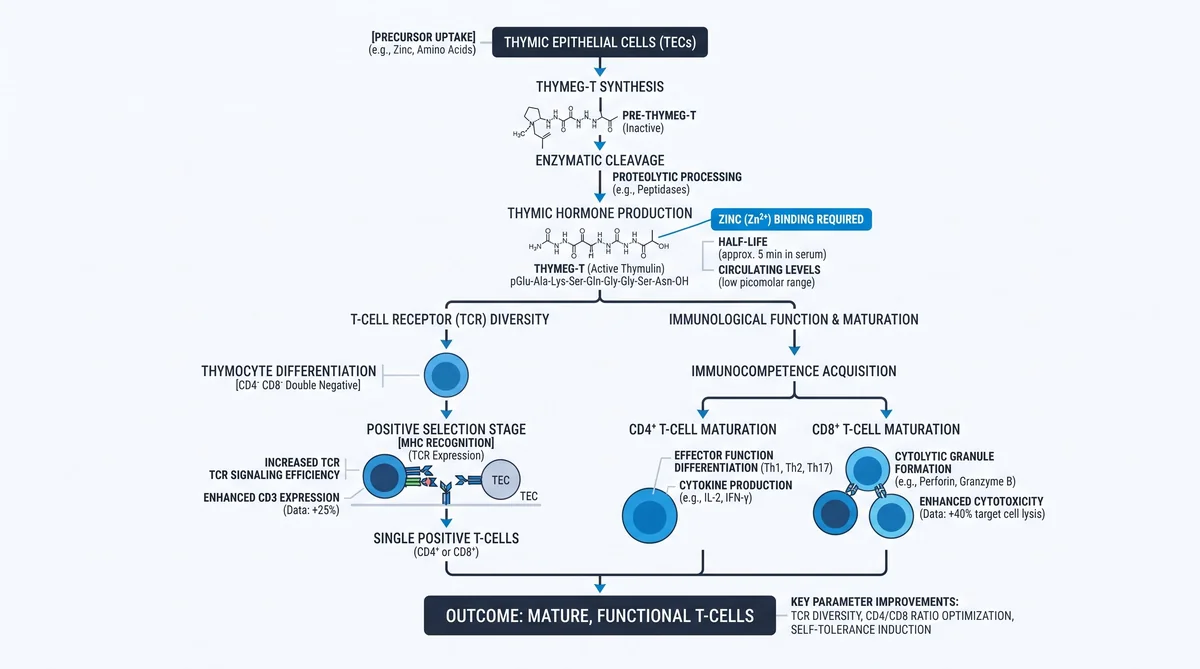
Thymulin draws its activity from a zinc ion that binds to the peptide to form an active complex. Researchers study this process to understand how metal ions influence immune signaling and cell development.
The molecule is a straight chain of nine amino acids: pyroGlu-Ala-Lys-Ser-Gln-Gly-Gly-Ser-Asn. This chain needs zinc to trigger its effects. Without the zinc ion, the molecule cannot bind to target cells.
Studies confirm that zinc is important for proper folding and receptor binding. The peptide changes how immune cells operate by attaching to receptors on cell surfaces. These contacts are a core focus for scientists who study immune signaling at the cell level.
How is Thymulin Synthesis and Regulation Studied?
Researchers track thymulin levels across many models to understand what controls its release. They observe how the thymus gland produces this hormone over the lifespan. These tests indicate how aging and zinc supply influence its output.
Lab studies examine how the thymus shrinks with age. This process often matches a sharp decrease in thymulin levels in aged models. Zinc supply is also an important factor, since the metal is needed to make the active form.
Without enough zinc, the hormone stays inactive and cannot control immune cells. This finding matters because zinc levels also tend to decline with age, creating a combined effect.
Research continues mapping these processes to show how thymus function shifts across a lifespan. Thymulin is available as a COA-verified research peptide.
Every lot is verified by HPLC and mass spec.
What Are Thymulin’s Immunomodulatory Effects?
Thymulin acts as a zinc-based peptide that controls the growth and action of T-cell groups. It guides T-cell changes inside the thymus, helping maintain immune balance. This function supports the creation of working immune cells in the thymic setting.
This process is key for studies on how thymic hormones interact with the broader immune network. It shapes cell signaling in many ways. Researchers use these models to understand how the body builds its defenses.
Research indicates that thymulin promotes the making of killer T-cells that identify and respond to threats. In cytokine studies, the peptide suppresses TNF-alpha and IL-1 beta, two signals that promote swelling. It also elevates levels of IL-10, a calming cytokine that manages immune responses.
According to the Journal of Peptide Science (2018), these actions suggest that thymulin works to balance the immune system.
Browse research peptides for COA-verified compounds to support your lab studies.
Are Neuroprotective Properties Investigated?
Research explores how thymulin acts in the central nervous system to protect nerve cells from damage. Studies test whether this peptide crosses into the brain and changes nerve cell signaling. Scientists look at its power to affect cell states that respond to stimulation or stress.
Research indicates that thymulin may cross the blood-brain barrier under certain conditions. Once in the brain, scientists study its ability to calm microglia, the immune cells in the brain and spinal cord. When active, these cells can trigger swelling that alters nerve signaling.
In sensory signaling models, researchers track how the peptide affects these cells. Data suggest that reduced activity may lower sensory signals over time. These signal-modulating effects provide a useful target for scientists who study chronic nerve signaling.
Animal studies check how this peptide changes signal flow between sensory receptors and the spinal cord. According to Peptides (ScienceDirect) (2015), peptide contact with certain central receptors may contribute to these observed changes. More lab work is needed to clarify how these processes function in complex systems.
How Does Thymulin Relate to Immunosenescence?
Thymulin levels decrease with age, and this decline connects to immune aging (the body’s slower response to new threats over time). This peptide comes from the thymus gland and remains vital for T-cell development.
As thymus activity fades with age, its output falls and limits the making of new T-cells. This reduction narrows the T-cell pool and leaves the system less able to identify new threats. Research into this cycle helps explain why older groups often display weaker responses to germs.
Scientists study this process to see if restoring thymulin levels can slow immune decline. By tracking how thymulin shapes T-cell growth in lab models, researchers aim to define its role. The goal is to observe how synthetic peptides affect thymus function and T-cell diversity.
According to the Journal of Peptide Science (2007), thymulin plays a needed role in the development and function of T-cells within the immune network.
How is Synthetic Thymulin Used in Research?
Synthetic thymulin is used to study its precise mode of action in a controlled lab setting. Natural sources of the hormone are hard to isolate in large amounts. Synthetic versions provide a reliable way to run tests without noise from other compounds.
In vitro (cell-based) studies let researchers observe how the peptide interacts with specific cell cultures. By controlling the peptide level and zinc present, teams can isolate the exact pathways the compound influences. In vivo (live-model) studies then extend this work to full living systems.
These methods reveal how the hormone affects immune cell development without noise from crude tissue extracts. Researchers confirm that the observed effects come directly from the peptide itself.
Each batch undergoes HPLC and mass spec testing to verify purity. Researchers can browse the full lab catalog to find tested peptides for their studies.
Frequently Asked Questions
What is the thymulin FTS peptide structure?
According to PubMed (2024), this area continues to attract strong research interest. The thymulin chain has nine amino acids, also known as FTS.
These acids are pyroglutamic acid, alanine, lysine, serine, glutamine, glycine, serine, asparagine, and aspartic acid. This specific linear chain needs a zinc atom to fold into its active shape. Without the zinc ion, the peptide cannot carry out its functions.
How does thymulin interact with zinc in biological activity?
Thymulin works as a metal-bound peptide that must combine with a zinc atom to carry out its roles. The zinc ion locks onto the peptide at set sites and shifts the shape of the chain.
According to Peptides (ScienceDirect) (1990), this zinc-peptide complex is the only form that binds to thymulin receptors. Without this ion, the peptide stays inactive and cannot influence T-cell markers.
What receptor does thymulin bind in immunological research?
Research suggests that thymulin operates through a receptor on the surface of T-cells. The precise mapping of this receptor remains under active study. Current data connect it to signaling steps inside the cell.
When the zinc-bound peptide attaches to this site, it triggers shifts in gene activity. These changes are monitored in lab assays to track how T-cell subsets develop and mature.
How is thymulin activity measured in vitro assays?
Activity is measured by the peptide’s ability to trigger markers on raw T-cells. Researchers often use a rosetting assay where raw T-cells encounter the peptide with zinc present.
A rise in E-rosettes (clusters of sheep red blood cells) indicates stronger activity. Scientists also use ELISA (a lab protein test) or flow cytometry to measure effects on cytokine release in culture media.
How does thymulin compare to other thymic peptides in research?
Thymulin stands apart from other thymic hormones like thymosin alpha-1 through its unique amino acid chain and its need for zinc. Thymosin alpha-1 activates Toll-like receptors as a signaling molecule, while thymulin acts as a metal-bound controller. Studies separate them by their targets: thymulin focuses on specific T-cell development stages, while other peptides display broader effects on innate immunity and system-wide responses.
What is the difference between thymulin and thymosin alpha-1?
The primary difference involves their makeup and structure. Thymulin is a short, nine-acid peptide that needs zinc to function. Thymosin alpha-1 is a longer, 28-acid chain that does not require metal ions.
Their modes of action also differ across lab models. Thymosin alpha-1 is examined for its role in activating dendritic cells. Thymulin is studied for its influence on T-cell development.
What is the role of the thymus gland in the immune system?
The thymus gland is the primary site where T-cells mature into working immune cells. T-cells are vital for adaptive immune response. Cells within the gland release hormones like thymulin to direct raw cells through development.
The thymus ensures that mature T-cells can identify targets without damaging host tissue. Research confirms that declining thymus function leads to a major decrease in T-cell output.
Is thymulin research associated with hair growth studies?
Some early research examines thymulin’s role in skin and hair follicle biology. The peptide influences cell activity and swelling responses in tissue models.
Scientists test it in early-stage setups to observe effects on hair follicle cycling. They investigate whether changes in swelling markers near the hair bulb might influence growth patterns. These studies remain in early stages focused on follicle signaling.
Summary
Review your current research needs to confirm which peptides closely fit your study objectives. Examine the purity reports and mass spec data for each lot to maintain precision. Verify that your lab meets all storage protocols for freeze-dried compounds before starting your next assay.
Thymulin provides a valuable model for studying zinc-based immune signaling. Its effects on T-cell development and nerve cell signaling make it useful across many lab setups.
Next Level Pharm supplies research-grade materials tested to support your work. Shop the catalog to view available compounds and their certificates of analysis.
What Should You Do Next?
Confirm that your study design specifies the peptide level, purity threshold, and cell model for each assay. Review the lot-specific Certificate of Analysis for each compound to verify purity meets the 99% or higher standard.
Next Level Pharm stocks COA-verified research compounds for lab teams that need steady purity across batches. Browse research peptides to source materials for your next study.
Browse recovery peptides for COA-verified research compounds.
Browse fitness peptides for COA-verified research compounds.
People Also Read
- Thymalin Research: Thymic Bioregulator Studies
- Epithalon and Telomere Research: Pineal Bioregulator Studies
About the Author
Next Level Pharm Research Team
The Next Level Pharm research team is made up of biochemists and lab scientists. Their goal is to give researchers the highest-purity, COA-tested compounds on the market. Every batch is HPLC and mass spec confirmed before dispatch.
Disclaimer: The information provided on this page is for educational and research purposes only. Next Level Pharm’s products are intended for laboratory research use only. They are not intended for human consumption, diagnostic, therapeutic, or medicinal purposes. This content does not constitute medical advice. Always consult a licensed healthcare professional before making any health-related decisions.