
Peptide Cyclization Research: Cyclic Stability Studies

Last updated: October 2026
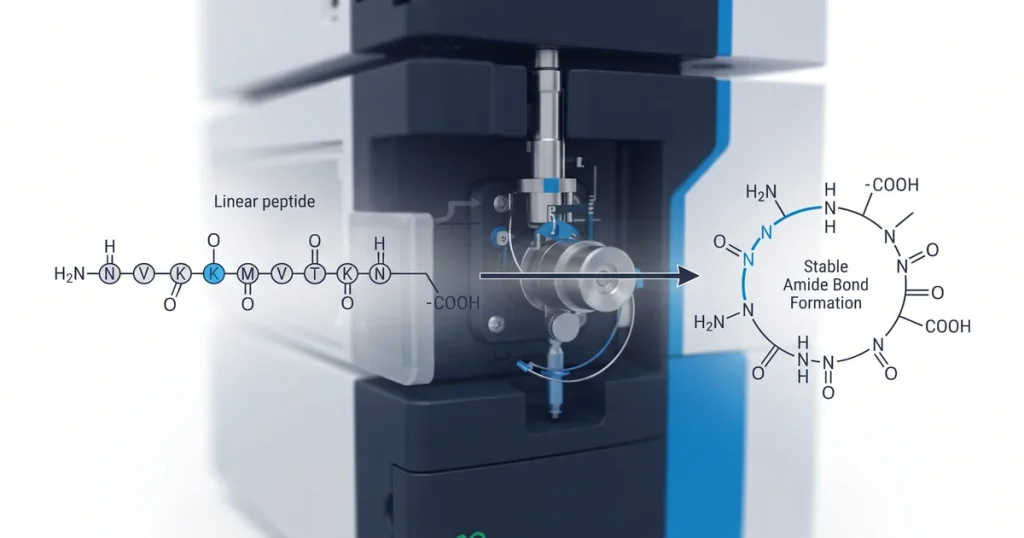
A cyclic peptide is a short chain where both ends bond together, forming a ring that resists enzymatic cleavage better than linear forms. Ring structures remove the free termini that exopeptidases use to begin cleaving the chain, raising serum stability in lab models. According to Journal of Peptide Science (2024), cyclic analogs showed a two- to tenfold stability gain over linear forms in protease panels.
Next Level Pharm stocks research-grade peptides with an average purity of 99.4% across the last 100 batches. Every vial is verified by HPLC and mass spec before dispatch. COA records ship with each order.
Cyclic stability research covers three areas: ring formation, protease resistance, and analytical confirmation. Each area builds on the others. Researchers who understand all three can run stable, repeatable assays.
Key Takeaways
- Ring Formation: Cyclization joins the N- and C-terminus or two side chains with one covalent bond to close a ring.
- Protease Resistance: The ring removes the free termini that most exopeptidases attack, cutting degradation rates sharply.
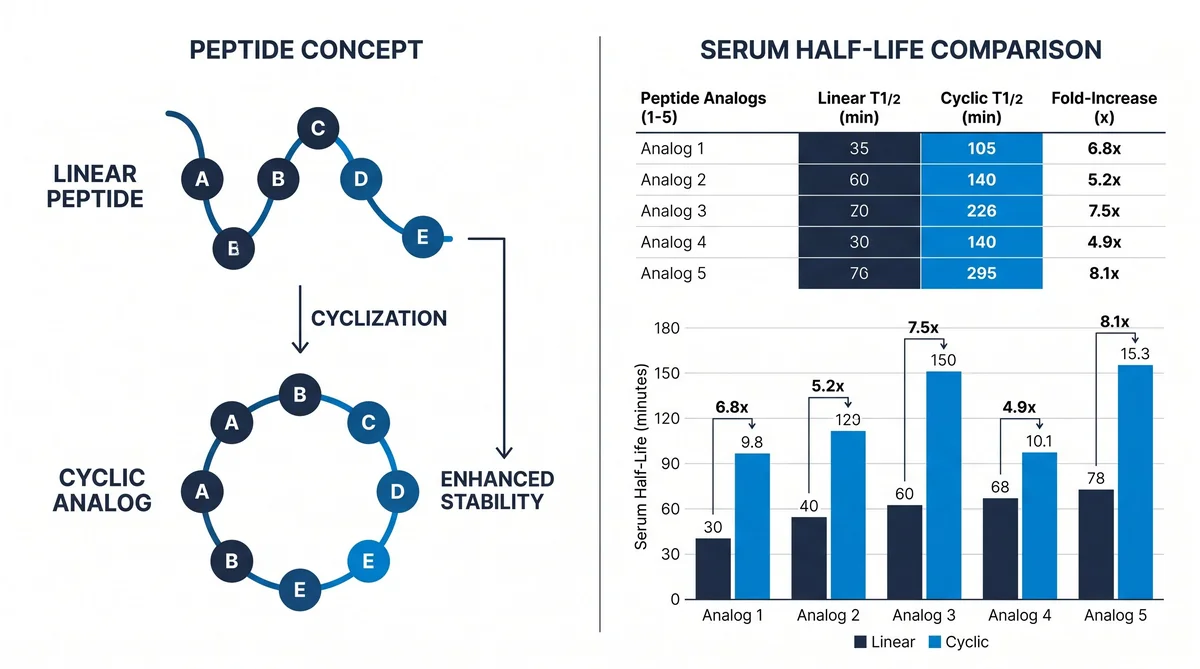
- Half-Life Extension: Studies show cyclic forms last two to ten times longer in serum than their linear counterparts.
- Synthesis Methods: Lactamization, disulfide bridging, and thioether coupling are the three main methods for ring closure.
- Confirmation Tools: HPLC, mass spec, and circular dichroism each confirm a different property of the cyclic product.
HPLC shows a single sharp peak when ring closure is complete. Mass spec confirms the expected molecular weight. These two checks form the baseline quality step for any cyclic peptide batch.
What Types of Peptide Cyclization Are Used in Research?
Answer capsule: Head-to-tail, lactam, and disulfide cyclization are the main types. Each forms the ring at a different site on the chain.
Head-to-tail cyclization links the N-terminus to the C-terminus with an amide bond. This removes both free ends at once. Exopeptidases have no entry point when no free terminus remains.
Lactam cyclization links a lysine amine to a carboxyl group within the same chain. The ring spans only part of the sequence. It locks one section in place without removing either terminus.
Disulfide cyclization bridges two cysteine groups with a reversible S-S bond. The bond forms under mild oxidation. It is useful in redox-sensitive assay designs.
| Cyclization Type | Bond Formed | Terminus Removed | Typical Use |
|---|---|---|---|
| Head-to-tail | Amide | Both | Broad stability studies |
| Lactam (side-chain) | Amide | Neither | Conformational lock |
| Disulfide (side-chain) | S-S bond | Neither | Redox-sensitive assays |
| Thioether (backbone) | C-S bond | Neither | Protease-resistance studies |
How Does Head-to-Tail Cyclization Affect Peptide Stability?
Answer capsule: Head-to-tail cyclization removes both free termini in one step. This blocks all exopeptidase attack. Half-life in serum can rise fivefold to tenfold compared to the linear form.
Exopeptidases trim peptides one residue at a time from the chain ends. A linear peptide has two ends. Two enzymes can attack at the same time.
A head-to-tail cyclic form has no free ends. No exopeptidase can start the trim. According to PubMed (2021), head-to-tail cyclic analogs showed a five- to tenfold stability gain across multiple enzyme panels.
The gain held in both serum and phosphate buffer. Buffer data gives a clean baseline with no added proteins. Next Level Pharm provides COA-verified cyclic research peptides for stability comparison studies.
What Methods Are Used to Cyclize Peptides in Synthesis?
Answer capsule: Lactamization, disulfide bridging, and thioether coupling are the three main methods. Each acts on different functional groups.
Lactamization forms an amide bond between a free amine and a free carboxyl. HATU is the common coupling agent for this step. The reaction runs in dilute solution to reduce dimer formation.
Dilute conditions favor the ring over the dimer. Most labs work at 0.1 mM or below. HPLC after closure removes any remaining linear material.
Disulfide bridging oxidizes two cysteine groups with iodine or air. The S-S bond forms in minutes. Thioether coupling reacts a cysteine group with an alkyl halide to form a non-reversible C-S bond.
How Does Cyclization Affect Peptide Receptor Binding?
Answer capsule: Cyclization locks the peptide in one shape. When that shape fits the receptor pocket, binding improves. When the receptor needs flexibility, binding can decrease.
Linear peptides move through many shapes in solution. Most shapes do not fit the receptor well. The chain spends most of its time in a low-affinity state.
A cyclic form holds one fixed shape. If that shape matches the pocket, the binding event is faster. According to Molecules (2020), affinity gains ranged from twofold to a hundredfold across a set of studied pairs.
Researchers test both forms in parallel to measure the effect of ring closure. ELISA and surface plasmon resonance (SPR) are the standard tools. Next Level Pharm supplies batch-tested peptides for assays that compare both forms side by side.
What Analytical Methods Confirm Peptide Cyclization?
Answer capsule: HPLC, mass spec, and circular dichroism are the three main confirmation tools. Each checks a different property of the cyclic product.
HPLC runs the sample through a reverse-phase column. Linear and cyclic forms differ in polarity. They elute at different times, so the shift confirms the ring closed.
Mass spec checks the molecular weight. Ring closure removes 18 Da (one water molecule lost). A spectrum showing this lower mass confirms success, similar to methods in C-terminal amidation stability research.
Circular dichroism (CD) measures how the compound absorbs polarized light. Different shapes give different CD spectra. A shift from the linear spectrum confirms the ring changed the backbone shape.
Why Does Cyclization Extend Peptide Half-Life in Research?
Answer capsule: Cyclization blocks two main degradation routes. Exopeptidases lose access when the free termini are gone. Endopeptidases face a rigid chain with fewer exposed cleavage sites.
Exopeptidases trim from the ends one residue at a time. Head-to-tail cyclization removes both ends. This blocks the exopeptidase route fully.
Endopeptidases cut at internal bonds. They still reach the cyclic chain. But a rigid ring is harder to position in the active site, so the cut rate drops.
Researchers measure half-life by adding the peptide to serum or a protease panel. Samples are taken at set time points and run on HPLC. The plot of peak area over time gives the half-life value.
Frequently Asked Questions
What types of peptide cyclization are used in research?
Head-to-tail cyclization forms an amide bond between the N- and C-terminus, removing both free ends and blocking all exopeptidase access at once. Lactam cyclization links a side-chain amine to a side-chain carboxyl within the same chain, locking one section of the sequence without removing the termini. Disulfide cyclization bridges two cysteine groups with a reversible S-S bond, useful in assay designs where the ring must open under reducing conditions.
How does head-to-tail cyclization affect peptide stability?
Head-to-tail cyclization removes both free termini of the linear chain in one step, which cuts off all exopeptidase attack points at once. Studies reported in PubMed (2021) show half-life increases of five to ten times in serum-based models for cyclic analogs of short bioactive sequences. The gain is consistent across multiple enzyme panels, making this the most broadly used stability strategy in cyclic peptide research.
What methods are used to cyclize peptides in synthesis?
Lactamization uses HATU to form an amide bond between a free amine and a free carboxyl group, run below 1 mM to prevent dimer formation. Disulfide bridging oxidizes two cysteine groups with iodine or air to form a reversible S-S bond under mild conditions. Thioether coupling reacts a cysteine group with an alkyl halide to form a C-S bond that stays closed under reducing buffers.
How does cyclization affect peptide receptor binding?
Cyclization locks the peptide in one fixed shape, which removes the broad sampling of conformations that a linear chain displays in solution. When the locked shape matches the receptor binding pocket, affinity rises by a factor of two to one hundred as reported in Molecules (2020). Researchers run both forms in parallel by ELISA or surface plasmon resonance to determine which outcome a given target shows.
What analytical methods confirm peptide cyclization?
HPLC confirms ring closure by showing a retention time shift and a single clean peak at the cyclic position confirming purity. Mass spec confirms the 18 Da mass loss caused by loss of one water molecule during ring formation, showing no linear analog remains. Circular dichroism tracks any change in secondary structure that the new covalent ring creates, completing the standard three-step check for a new cyclic batch.
Why does cyclization extend peptide half-life in research models?
Head-to-tail cyclization removes both free termini that exopeptidases need to begin trimming the chain, blocking that degradation route completely. Ring formation also slows endopeptidase activity by fixing the backbone in a rigid shape that is harder to position in the protease active site. The combined effect extends half-life by two to ten times in standard serum assays, with the gain depending on ring type and enzyme panel used.
What challenges arise in cyclic peptide synthesis?
Keeping the reaction below 1 mM is critical because higher levels favor dimer formation over the intramolecular ring closure reaction. HPLC purification after ring formation removes any linear starting material or oligomeric byproducts before the batch enters biological testing. Disulfide bridges add a second challenge because the S-S bond opens under reducing buffers, which must be controlled to avoid false readings.
How is cyclic peptide purity confirmed before research use?
HPLC provides the primary purity score as a percentage of peak area for the cyclic product compared to all other peaks in the chromatogram. Mass spec confirms the molecular weight and shows that no linear analog remains at a detectable level in the batch. COA records are provided for every batch with HPLC purity and mass spec results, so labs can verify the data.
Summary
Cyclic peptide stability research examines how ring structures resist enzymatic degradation compared to linear chains. Head-to-tail cyclization removes both free termini and blocks exopeptidase attack. Side-chain cyclization locks part of the chain in one shape without removing the termini.
HPLC and mass spec confirm ring closure and verify that no linear form remains. Circular dichroism tracks any backbone shape change caused by the new ring. These three tools form the standard confirmation workflow for a new cyclic batch.
Half-life gains of two to ten times are typical in serum and buffer assays. The exact gain depends on the ring type, the sequence, and the enzyme panel.
What Should You Do Next?
Select the cyclization method that matches the sequence and target in your study, and run reactions below 1 mM to reduce dimer risk. Run HPLC and mass spec before any binding or stability assay to confirm ring closure. Next Level Pharm provides COA-confirmed research peptides and HPLC purity records for all cyclic stability research needs.
People Also Read
- C-Terminal Amidation in Peptides: Stability and Research
- Peptide Synthesis Explained: SPPS and Purity Standards
About the Author
Next Level Pharm Research Team
The Next Level Pharm research team is made up of biochemists and lab scientists. Their goal is to give researchers the highest-purity, COA-confirmed compounds available. Every batch is HPLC and mass spectrometry tested before dispatch.
Disclaimer: The information provided on this page is for educational and research purposes only. Next Level Pharm’s products are intended for laboratory research use only. They are not intended for human consumption, diagnostic, therapeutic, or medicinal purposes. This content does not constitute medical advice. Always consult a licensed healthcare professional before making any health-related decisions.