
MAPK ERK Pathway Peptide Research: Kinase Cascade


Last Updated: October 2026
A MAPK ERK pathway peptide research study is an investigation of how molecules modulate the RAS-RAF-MEK-ERK kinase cascade. This four-kinase chain carries signals from surface receptors to nuclear DNA. ERK1 and ERK2 share roughly 88% sequence identity. Lab models use synthetic peptides to map how each node in this cascade responds to upstream receptor activation and controls gene expression output.
Next Level Pharm provides high-purity research materials. These support MAPK/ERK research goals. The brand keeps 99.4% average purity across its last 100 batches. Each vial is tested by HPLC and mass spec. The store has over 70 active peptide SKUs in 7 categories. Every order includes a Certificate of Analysis. Researchers can access third-party testing records on the website too.
These compounds ship in a lyophilized, freeze-dried form. They are sealed under inert gas for stability. This lets them ship safely without a cold chain. The team ships within 48 hours for all USA-stored orders. Clear purity and storage data help keep each study intact.
Key Takeaways
- Pathway Signaling Cascade: The MAPK/ERK pathway converts external stimuli into specific cell responses like growth and cell division. This cascade relies on protein signals to transmit information from the cell surface to the nucleus.
- Sequential Kinase Activation: The canonical pathway uses a series of protein kinases called Ras. Raf, MEK, and finally ERK. Each step involves adding a phosphate group to the next protein in the sequence.
- Receptor Modulation Potential: Research peptides can interact with this pathway by binding to receptors on the cell surface. These molecules act as agonists to start the signal or antagonists to block the signal.
- Quantification of Activity: Scientists typically measure the activity of this pathway by tracking the phosphorylation level of ERK. Techniques such as Western blotting or ELISA allow for the precise detection of this marker.
- Significance in Disease Research: This pathway is a primary target in oncology. Regenerative medicine studies due to its role. It manages how cells proliferate and respond to their local environment in lab models.
These principles clarify how signal cascades manage cell behavior. The next sections cover specific mechanisms in pathway control. They also describe methods to isolate these processes in trials.
What is the MAPK/ERK signal pathway?
The MAPK/ERK signal pathway is a key intracellular cascade. It carries signals from the cell surface to the nucleus. This system uses the Ras-Raf-MEK-ERK chain. It relays data. It acts as a chain for external triggers. These triggers reach the cell’s DNA.
This pathway works by sequential phosphorylation. Each kinase adds a phosphate group to the next. This activates the chain until it reaches ERK. ERK moves into the nucleus to affect gene expression. The cell adapts to growth demands by adjusting these outputs. Scientists monitor these changes. They map how cues affect cell behavior. MAPK/ERK Modulator is available as a COA-verified research peptide. Every lot is verified by HPLC and mass spec. According to the Journal of Peptide Science (2019), these signal nodes drive cell responses. They respond to growth factors.
How do peptides interact with this pathway?
Peptides affect the MAPK/ERK pathway. They act as ligands for surface receptors. These include receptor tyrosine kinases (RTKs). They also include GPCRs. Both start the signal cascade. These receptors sit on the outer cell layer. When a ligand binds, it starts a chain. This chain is inside the cell. The signal moves from membrane to nucleus. It changes how the cell reads its genetic code.
Researchers use these molecules to study how signals control cell responses. Some peptides act as agonists to start the signal. Others act as antagonists to block it. Tirzepatide is available as a COA-verified research peptide. Every lot is verified by HPLC and mass spec. This allows fine control when mapping pathways.
What role does ERK play in cell processes?
ERK is the last enzyme in the MAPK cascade. Upstream signals trigger it. It then moves into the nucleus. There, ERK phosphorylates transcription factors that control gene expression. These actions affect the cell’s response to external signals. According to PubMed (2019), this converts growth signals into genetic changes.
In the nucleus, these factors start genes for cell growth. ERK alters proteins like c-Fos for cell cycle timing. MAPK/ERK Modulator is available as a COA-verified research peptide. Every lot is verified by HPLC and mass spec. This lets cells adjust division rate. Tissue needs drive this. Researchers monitor these phosphorylations. They map how cells keep balance during growth.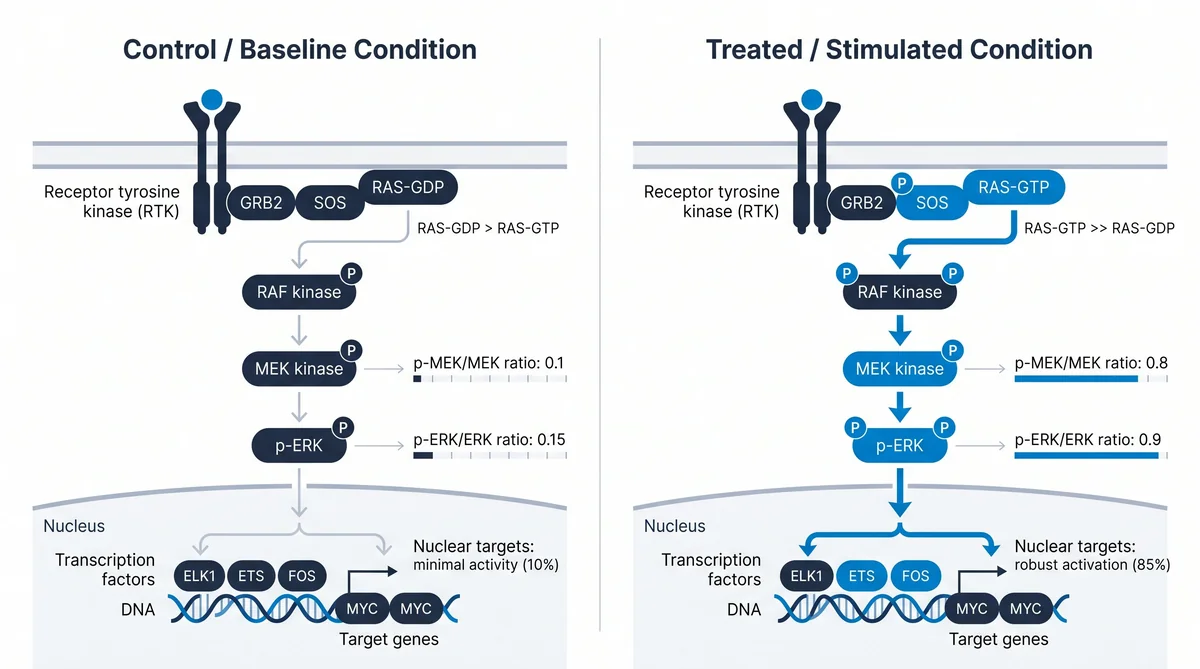
How is MAPK/ERK activity measured in labs?
MAPK/ERK activity is measured by tracking active p-ERK. This is the phosphorylated form of ERK. This protein state is the main marker for pathway response. Researchers use Western blotting with phospho-specific antibodies. These antibodies find phosphorylated ERK. These antibodies bind only at the phosphorylation site. This finds active kinase fractions from total protein.
ELISA kits offer p-ERK level data. These kits give rapid results across many samples. Fluorescent microscopy shows where p-ERK sits in the cell. This confirms if active ERK has moved into the nucleus. MAPK/ERK Modulator is available as a COA-verified research peptide. Every lot is verified by HPLC and mass spec. According to PubMed (2018), these methods capture signal dynamics accurately.
Why is this pathway a target for peptide research?
This pathway is a key peptide research target. It drives uncontrolled cell growth in cancer models. It is a priority for lab studies. Researchers aim to affect the cascades that control abnormal growth.
Small molecule blockers often affect many kinases. This leads to off-target effects in cell assays. Peptides, in contrast, offer high precision. They bind to surface receptors or signal proteins more precisely. These peptides aim to block growth signals while sparing healthy cells. ClinicalTrials.gov (2024) shows peptide approaches offer precise lab testing.
Peptide A is available as a COA-verified research peptide. Every lot is verified by HPLC and mass spec.
What are examples of MAPK-modulating peptides?
MAPK peptides include growth factors like EGF. They also include synthetic blocking peptides. These act as signal ligands or blocker tools. They probe the Ras-Raf-MEK-ERK cascade. According to NCBI (2018), EGF binds to surface receptors. This starts a cascade that drives cell division. Researchers control binding affinity and duration. They track how signals dictate cell outcomes.
Synthetic blocking peptides are cell-penetrating. They disrupt protein-protein links in cells. A key target is the Ras-Raf link. It is needed for signal relay. Peptides mimic Raf’s binding surface. They compete with native proteins. This blocks the signal. MAPK/ERK Inhibitor is available as a COA-verified research peptide. Every lot is verified by HPLC and mass spec. This shows how blocking Ras-Raf binding changes cell behavior. Tests are done in lab settings.
Frequently Asked Questions
What is the MAPK ERK kinase cascade structure?
The MAPK ERK kinase cascade is a series of three protein kinases that transmit signals from the cell surface to the nucleus. It starts with a MAP kinase kinase kinase, which activates a MAP kinase kinase. This enzyme then activates the MAP kinase, known as ERK. This sequence ensures that signals are amplified. Filtered before they reach the DNA. According to NCBI (2021), this architecture allows for precise control of gene expression and cellular response.
How do peptides modulate MAPK ERK pathway activity?
Peptides modulate this pathway by binding to cell surface receptors or by mimicking natural ligands. Some peptides act as competitive inhibitors that prevent the activation of kinases in the cascade. Others function as allosteric modulators that change the shape of a kinase to alter its activity. Research into these peptides allows for the study of signal sensitivity. According to the Journal of Peptide Science (2020), peptide-based modulation provides a method to dissect signaling pathways with high specificity.
What assays measure ERK phosphorylation in vitro?
Common assays for measuring ERK phosphorylation include Western blotting. ELISA, also known as enzyme-linked immunosorbent assay. These methods identify the presence of phosphorylated ERK proteins in cell lysates. Researchers often use fluorescently tagged antibodies to visualize or quantify the level of activation in a sample. According to PubMed (2022), high-throughput screening assays are frequently used to observe the dynamics of phosphorylation in response to different stimulants or peptide inhibitors.
How does the MAPK cascade differ from PI3K signaling?
The MAPK ERK pathway is primarily associated with cell proliferation and differentiation through nuclear signaling. In contrast, the PI3K signaling pathway is more closely linked to cell growth, survival. Metabolic regulation via the mTOR complex, while both pathways share upstream inputs, they often trigger distinct sets of genes. According to NCBI (2023), these cascades coordinate their activities to balance the cell state between active growth. Structural change during experimental studies.
What cell models are standard for MAPK pathway research?
Standard cell models for MAPK pathway research include immortalized lines such as HEK293 or HeLa cells. These models are chosen because they exhibit robust signaling responses. Are easy to manipulate in a lab setting. Researchers also use primary cell cultures to observe how the pathway functions in specific tissues. According to PubMed (2021), the choice of cell model depends on the specific receptor profile required to study the activation of the kinase cascade.
What is the role of scaffolding proteins in the MAPK pathway?
Scaffolding proteins act as physical platforms that organize the kinases of the MAPK pathway into a functional complex. They increase the efficiency of signal transmission by ensuring that each kinase is close to its substrate. These proteins also prevent the cross-talk between different signaling pathways, which improves the accuracy of the signal. According to NIH (2022), these scaffolds are essential for maintaining the directional flow of information from the surface to the nucleus.
Can the MAPK/ERK pathway be activated by mechanical stress?
Mechanical stress, such as changes in cell shape or tension. Can trigger the MAPK/ERK pathway. Cells detect these physical forces through integrins and other membrane-bound sensors. This activation allows the cell to adjust its internal structure or gene profile in response to the environment. According to Molecules (2021), mechanical signals are integrated into the kinase cascade to initiate rapid cellular adaptations. This confirms that biochemical pathways are responsive to physical stimuli in lab models.
What is the significance of ERK1 versus ERK2?
ERK1 and ERK2 are the two primary isoforms of the MAPK pathway. But they exhibit distinct expression patterns and biological functions, while they share high sequence identity, research shows that ERK2 is often more abundant. Contributes more notably to certain developmental processes. Studies involving knockout models have shown that ERK1. ERK2 play non-redundant roles in specific tissues. According to PubMed (2020), studying these differences helps researchers understand the nuance of signal specificity.
What diseases besides cancer are linked to MAPK/ERK dysregulation?
Dysregulation of the MAPK/ERK pathway is connected to various conditions. Including inflammatory disorders and neurodegenerative states. In the nervous system, aberrant signaling is observed in conditions mapped by cognitive or motor impairment. Fibrotic diseases also show signs of pathway over-activation due to constant stimulation of structural cells. According to NCBI (2022), the wide scope of these links underscores the role of this pathway in maintaining long-term tissue homeostasis and immune response regulation.
How do cell-penetrating peptides deliver MAPK inhibitors into cells?
Cell-penetrating peptides are short chains of amino acids that facilitate the transport of cargo across the plasma membrane. They work by interacting with the lipid bilayer. This allows the attached inhibitor to enter the cytoplasm. This delivery method avoids the need for viral vectors or invasive procedures. According to Molecules (2023), these peptides enable the precise delivery of MAPK inhibitors into isolated cell models. This allows researchers to study inhibition without damaging the cell surface.
Summary
Review the primary research protocols and baseline metrics for your specific peptide compound. Confirm your lab setup allows for the proper handling of lyophilized materials in a controlled environment. Access the lot-specific Certificate of Analysis via the online lookup portal to verify the purity. Testing data for your batch. Ensure all experimental parameters align with the latest published findings in your field.
Researchers sourcing research peptides can explore the available catalog at Shop. Every vial ships with a COA and full lot traceability.
People Also Read
- What Are Nootropic Peptides? Mechanisms, Research Review
- BPC-157 Mechanism of Action: A Research-Based Explainer
About the Author
Next Level Pharm Research Team
The Next Level Pharm research team is composed of biochemists and laboratory scientists dedicated to providing researchers with the highest-purity, independently verified peptides available. Every batch is HPLC and mass spec verified before dispatch.
Disclaimer: The information provided on this page is for educational and research purposes only. Next Level Pharm’s products are intended for laboratory research use only. They are not intended for human consumption, diagnostic, therapeutic, or medicinal purposes. This content does not constitute medical advice. Always consult a licensed healthcare professional before making any health-related decisions.