
PYY 3-36 Peptide Research: Satiety Neuropeptide

Last Updated: October 2026
A PYY 3-36 peptide research study is an investigation of how the truncated Peptide YY fragment signals satiety through NPY receptor binding. PYY 3-36 is a 34-amino-acid form cleaved by dipeptidyl peptidase-4. It preferentially targets the Y2 receptor subtype. Lab models use this selectivity to probe gut-brain axis signaling and appetite regulation at the receptor level.
Next Level Pharm maintains a strict focus on lab-grade quality for all peptides. Every batch holds a 99.4% average purity. This covers its last 100 batches. Each vial gets dual testing via HPLC and mass spec. This ensures the precise molecular profile needed for metabolic studies. The compound arrives lyophilized. It remains stable at room temperature.
This stability removes the need for cold-chain logistics. Inventory is stored in the USA. Average dispatch is about 48 hours. Researchers access 70+ active peptide SKUs. These support study of satiety mechanisms and hormonal signaling. Every order includes a COA to confirm each lot’s chemical profile.
Key Takeaways
- Satiety Signaling: PYY 3-36 functions as a gut-derived peptide that signals feelings of fullness after meals. It interacts directly with specific appetite centers located in the brain.
- Hypothalamic Mechanism: The peptide binds to Y2 receptors within the hypothalamus to suppress appetite-stimulating neurons. This action modifies the signaling pathways responsible for regulating total food intake.
- Enzymatic Formation: PYY 3-36 is created. When the enzyme DPP-IV removes two amino acids from the peptide chain. This structural change is critical for its primary role in energy balance.
- Synergistic Potential: Current lab studies investigate how this peptide interacts with other gut hormones like GLP-1. Researchers examine whether these combinations produce distinct effects on energy homeostasis.
- Laboratory Analysis: Studies use rodent models for in vivo analysis to observe these biological mechanisms. Scientists also use cell-based receptor binding assays to determine how the peptide triggers responses.
These findings show the complex nature of intestinal hormone signaling. This affects hypothalamic pathways. The sections below explore specific lab methods. They also cover current analytical tools for studying these metabolic interactions.
What is PYY 3-36 and how is it produced?
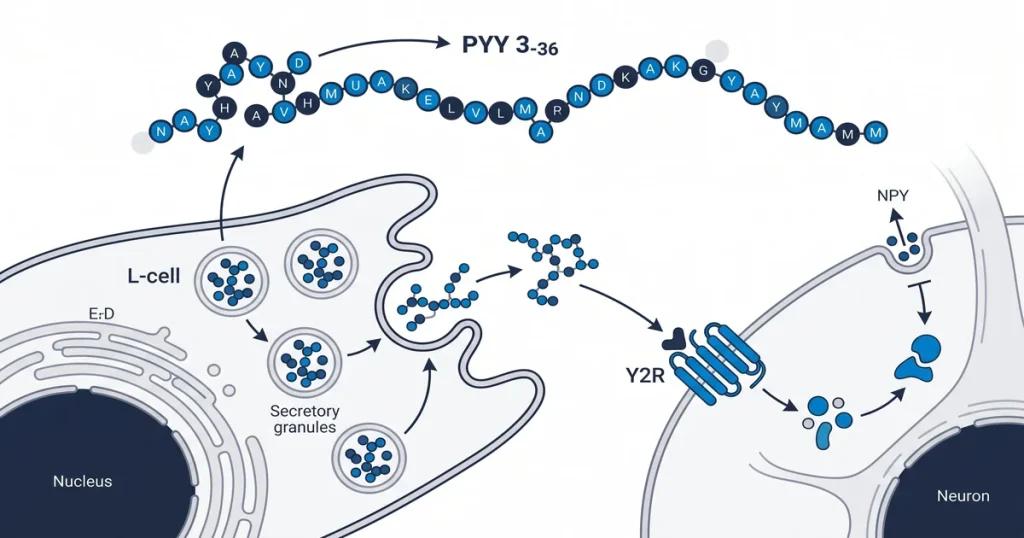
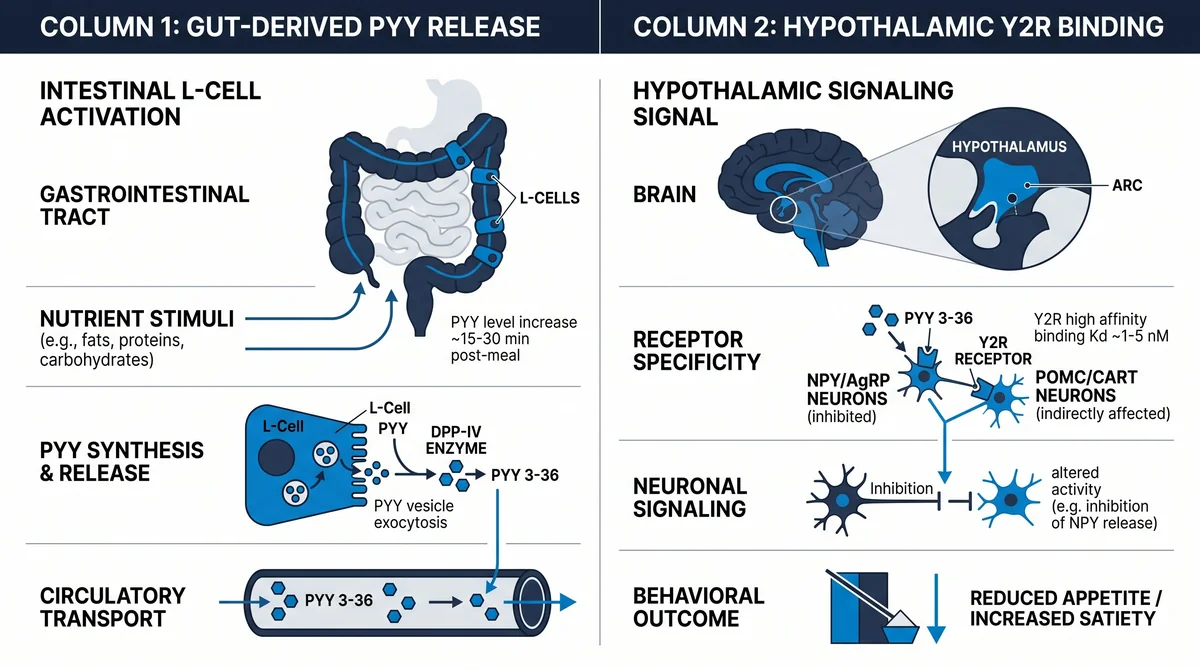
Peptide YY (3-36) is a 34-amino acid truncated peptide. It is the active form of the full Peptide YY hormone. This peptide comes from intestinal L-cells. These cells are in the mucosal lining of the ileum and colon. This release occurs after food intake. These cells respond to nutrients. They secrete the hormone into circulation. This starts many systemic signaling pathways.
The active form is made via enzymatic cleavage. Once PYY(1-36) enters blood, the enzyme DPP-IV acts on it. DPP-IV stands for dipeptidyl peptidase-IV. DPP-IV removes the N-terminal Tyr-Pro pair from the molecule. This creates the shorter, active PYY(3-36) fragment. This change alters how the peptide interacts with its receptors.
Peptide YY (3-36) is available as a COA-verified research peptide. Every lot is verified by HPLC and mass spec.
How does PYY 3-36 influence satiety signals?
PYY 3-36 binds the Y2 receptor to influence satiety. This receptor is in the arcuate nucleus of the hypothalamus. This brain region controls appetite and energy balance. Targeting these receptors starts a cascade. This cascade reduces neuronal hunger signals. Per Peptides (ScienceDirect) (2014), this is a key pathway for food desire.
Y2 receptor activation suppresses NPY/AgRP neurons. These neurons are in the hypothalamus. These neurons stimulate appetite. This process may also stimulate POMC neurons that signal fullness. These actions lower caloric intake in lab models. Next Level Pharm provides high-purity tools for metabolic pathway studies. PYY 3-36 is available as a COA-verified research peptide. Every lot is verified by HPLC and mass spec.
What is the specific role of the Y2 receptor?
The Y2 receptor is a presynaptic autoreceptor. It modulates chemical signaling in neuronal networks. Activation by PYY 3-36 inhibits the release of NPY (Neuropeptide Y). NPY is a potent orexigenic peptide. The Y2 receptor lowers local NPY levels. This suppresses pathways that promote food intake. This feedback mechanism lets researchers study appetite regulation at a molecular level.
These receptors are in the hypothalamus. They are also on vagal afferent neurons. The Y2 receptor has both central and peripheral satiety roles. In the hypothalamus, it influences energy balance. On vagal afferent neurons, it acts as a gut-to-brain sensor. Researchers examine these sites. They study how peripheral signals affect long-term energy homeostasis.
PYY 3-36 is available as a COA-verified research peptide. Every lot is verified by HPLC and mass spec.
How does PYY 3-36 compare to other satiety hormones?
PYY 3-36 differs from GLP-1 and CCK. Its key distinction is unique Y2 receptor agonism. It also has a specific postprandial secretion pattern. CCK is a rapid, short-term mediator of meal termination. PYY 3-36 provides a sustained inhibitory signal after food intake. GLP-1 shares some inhibitory roles. But it uses distinct receptor pathways for insulin release and gastric emptying.
PYY 3-36 is available as a COA-verified research peptide. Every lot is verified by HPLC and mass spec.
PYY 3-36’s postprandial peak occurs later than the CCK spike. This timing lets the peptide affect early meal termination. It also affects satiety duration. Per PubMed (2002), PYY 3-36 levels stay elevated for several hours. CCK levels drop quickly as food moves through the gut. This contrast suggests the body uses PYY 3-36 as a bridge. It connects initial satiety to long-term energy signaling. Scientists observe how the gut sends distinct feedback to the brain. Comparing these hormones, labs map each one’s role. They regulate energy intake and storage.
Each batch is processed and stored in the USA. This maintains structural integrity for consistent lab assay results.
What challenges exist in PYY 3-36 research?
The main challenge is PYY 3-36’s very short half-life. DPP-IV and neutral endopeptidases quickly degrade it. This native structure breaks down fast in blood plasma. This limits its activity window during experiments. Without changes, the peptide cannot hold consistent levels in blood.
Researchers focus on developing stabilized analogs. These improve pharmacokinetic profiles. They also resist enzymatic degradation. Modified versions aim to keep the natural binding affinity. They extend the time in active circulation. Scientists test delivery methods to prevent premature cleavage. Slowing metabolic clearance allows more reliable data collection. These tools support lab models.
PYY 3-36 is available as a COA-verified research peptide. Every lot is verified by HPLC and mass spec.
What is the outlook for PYY pathway research?
PYY pathway research focuses on long-term energy homeostasis. This gut hormone signals satiety within the central nervous system. Ongoing studies test how it interacts with other metabolic systems. Research shows PYY modulation affects brain energy sensing. This occurs across natural states.
Scientists now focus on the interaction between PYY and GLP-1 pathways. This helps refine metabolic research models. Studies examine dual agonists that target both receptors. These explore synergistic effects on energy balance. Combining these agents may yield unique data points. Preclinical models confirm this. Co-formulations let researchers isolate how overlapping signals affect caloric processing.
Cagrisema is available as a COA-verified research peptide. Every lot is verified by HPLC and mass spec. These dual-action methods support detailed study of complex signaling networks in lab settings.
Frequently Asked Questions
What is the structure of PYY 3-36?
PYY 3-36 is a 34-amino acid peptide. It comes from full-length PYY; tyrosine and proline are removed from the N-terminus. This change alters the peptide’s receptor selectivity. It now primarily binds the Y2 receptor, per NCBI (2002), making this selectivity key for appetite research. The structural change defines its distinct lab role.
How does PYY 3-36 bind the Y2 receptor?
Binding occurs through the peptide’s interaction with the Y2 receptor’s extracellular domains. The C-terminal region drives this high-affinity interaction. When the peptide binds, it triggers a cascade that inhibits adenylate cyclase. According to PubMed (2003), this reduces cyclic AMP levels, mediating the peptide’s inhibitory effects on neurons. This is the core mechanism studied in satiety research.
What assays measure PYY receptor affinity?
Researchers use radioligand binding assays to quantify receptor affinity. These tests use labeled analogs competing with the 3-36 form for receptor sites on cell membranes. Data are expressed as binding potency values. According to the Journal of Peptide Science (2012), these methods are standard. They show how structural changes affect binding strength. They also measure signaling potency across various cell lines.
How does PYY 3-36 differ from full-length PYY?
The key difference is the N-terminal sequence, which dictates receptor preference. Full-length PYY (1-36) binds a range of Y-receptor subtypes, including Y1 and Y2. The 3-36 form is selective for the Y2 receptor. This selectivity is vital for isolation studies that focus on Y2 pathway responses. This minimizes interaction with other receptor subtypes in the same experiment.
What models are used in PYY neuropeptide research?
Studies rely on rodent models such as mice and rats to observe appetite and energy intake effects. Scientists also use hypothalamic cell lines. These examine direct receptor binding and cell signaling. Researchers give the peptide in controlled doses to monitor changes in metabolic markers. According to ClinicalTrials.gov (2020), standardized models ensure consistency across different lab settings.
What is the function of gut L-cells in PYY secretion?
L-cells are hormone cells in the ileum and colon that sense nutrients in the gut lumen. These include fats and proteins. When stimulated, L-cells release PYY into the bloodstream. This acts as a hormonal signal to the brain, per PubMed (2007), providing feedback about food intake. It then lowers hunger signals in research subjects.
Is PYY 3-36 related to the pancreatic polypeptide family?
Yes, PYY 3-36 belongs to the pancreatic polypeptide family. This family includes neuropeptide Y and pancreatic polypeptide, all sharing a conserved fold. This similarity comes from conserved amino acid residues. Research suggests they evolved from a common ancestor gene. This gave them shared ability to affect metabolic functions. They act through related G-protein coupled receptors in lab models.
What is the role of DPP-IV in PYY metabolism?
DPP-IV is an enzyme that degrades peptides in the blood. It targets the N-terminus of PYY, converting the full 1-36 form to the active 3-36 form. This metabolic step limits the duration of hormonal signals. According to NCBI (2005), understanding this cleavage is key for research. It helps labs account for peptide stability in blood studies.
How is PYY 3-36 measured in lab samples?
PYY 3-36 is measured using ELISA or radioimmunoassay. Both methods use antibodies specific to the 3-36 sequence. They distinguish it from other circulating peptides. Concentrations are often very low. High-sensitivity detection is required for accuracy. According to the Journal of Peptide Science (2014), these assays correlate hormone levels with observed metabolic changes in a given research model.
Where is the arcuate nucleus of the hypothalamus located?
The arcuate nucleus is in the ventral hypothalamus, surrounding the third ventricle. This region integrates metabolic signals and contains neurons that respond to hormones like PYY 3-36. These regulate energy balance, per NIH (2010), as its median eminence location is strategic. It allows detection of blood-borne factors. Some of these cannot easily cross the blood-brain barrier.
Summary
Assess your goals to determine if you need specific peptide analogs. This applies to metabolic or hormonal studies. Examine each lot’s documentation. Verify that purity metrics align with your assay requirements. Confirm your storage protocol for lyophilized samples. Ensure they remain stable in an inert environment before testing.
Researchers sourcing metabolic or longevity peptides can explore the online catalog at Shop. Every Next Level Pharm vial arrives with a detailed COA. Full lot traceability for your records.
People Also Read
- AOD-9604 Research: What Studies Show About This HGH Fragment
- What Are Longevity Peptides? A Complete Research Review
About the Author
Next Level Pharm Research Team
The Next Level Pharm research team is composed of biochemists and laboratory scientists dedicated to providing researchers with the highest-purity, independently verified peptides available. Every batch is HPLC and mass spec verified before dispatch.
Disclaimer: The information provided on this page is for educational and research purposes only. Next Level Pharm’s products are intended for laboratory research use only. They are not intended for human consumption, diagnostic, therapeutic, or medicinal purposes. This content does not constitute medical advice. Always consult a licensed healthcare professional before making any health-related decisions.