Ghrelin Peptide Research: GHSR Receptor Mechanism

Last Updated: October 2026
A ghrelin peptide GHSR research study is an investigation of how ghrelin binds the growth hormone secretagogue receptor (GHSR). Ghrelin is a 28-amino-acid peptide. It requires serine-3 acylation to activate the GHSR. This receptor belongs to the rhodopsin family of G protein-coupled receptors. Lab models use this binding profile to map how hunger signals travel from receptor to nucleus.
Next Level Pharm provides high-purity compounds for research purposes. The brand holds a 99.4% average purity score. This covers its last 100 batches. Every vial gets dual testing. HPLC and mass spec both verify each lot. A COA ships with every order. All products arrive lyophilized. They seal under an inert gas. This removes the need for cold-chain shipping. The catalog holds 70+ active peptide SKUs.
This research shows how the GHSR handles molecular signals. Scientists probe GHSR sensitivity using these peptide sequences. Ligand-receptor binding is core to endocrine study design. These methods allow precise control in test settings.
Key Takeaways
- GHSR Receptor Binding: The GHSR is a G protein-coupled receptor primarily activated by acylated ghrelin. This activation occurs through a specific binding mechanism involving the receptor’s structure.
- Critical Acylation Requirement: The enzyme GOAT performs serine-3 acylation on ghrelin. This chemical change is essential for the peptide to bind and activate the receptor.
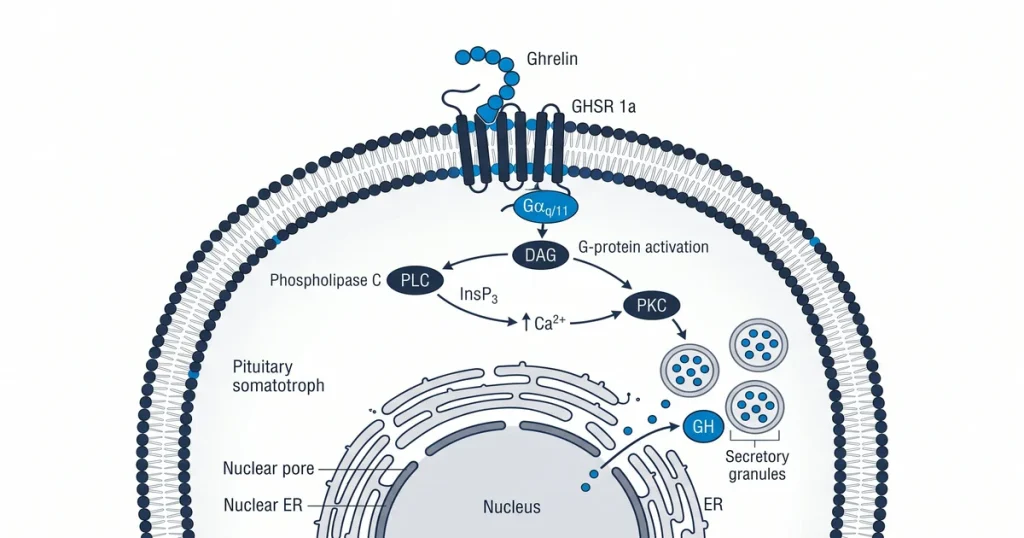
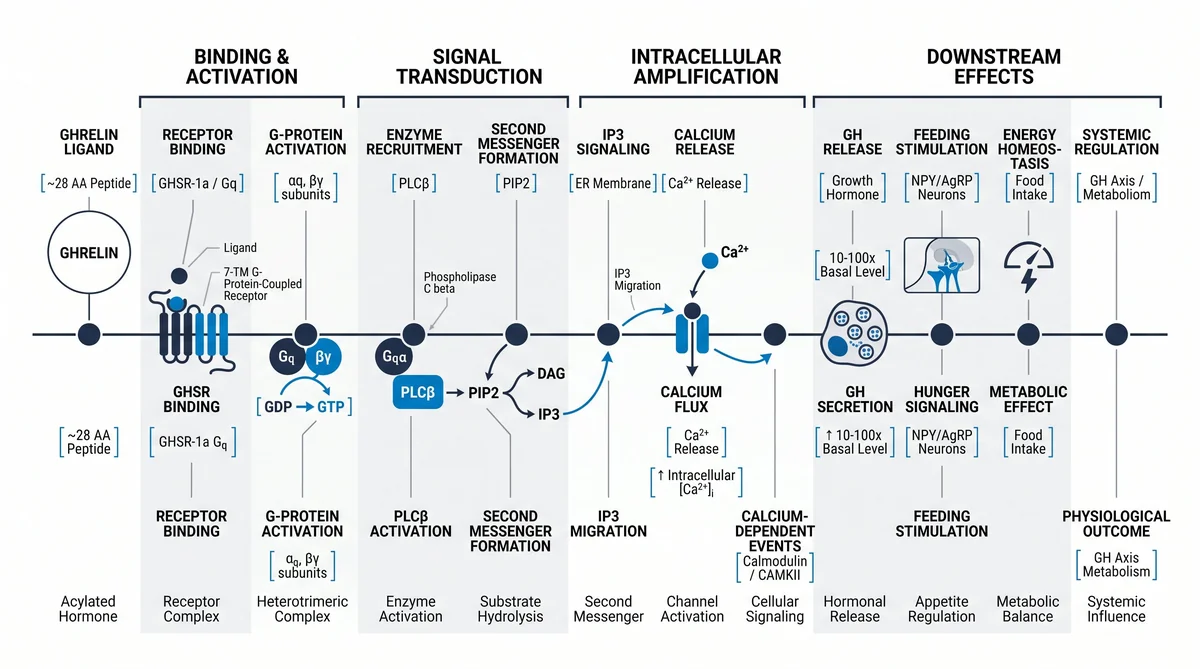
- Intracellular Signaling Cascade: Receptor activation triggers the Gq/11-PLC signaling pathway. This process increases intracellular calcium levels and stimulates hormone release in target tissues.
- Constitutive Baseline Activity: The GHSR shows a baseline level of activity without the presence of any ligand. Inverse agonists are studied for their potential to suppress this constitutive baseline state.
- Metabolic Research Focus: Scientific study of this receptor is vital for knowledge energy balance. Researchers study it to determine how it regulates appetite and growth hormone secretion.
The sections below detail key biochemical pathways. They cover signaling from ligand-receptor binding. Each section gives context for analyzing peptide behavior. They show how peptides perform in high-standard lab models.
What is the GHSR and where is it expressed?
The GHSR is a G protein-coupled receptor. It is the main site for ghrelin signaling. Scientists place it in the rhodopsin-like receptor family. It is most active in the hypothalamus and pituitary gland. These are key zones for endocrine control. Research shows it allows precise regulation of growth hormone release, per PubMed (2001).
Beyond the brain, the GHSR exists in peripheral tissues. Studies detect it in the pancreas, heart, and adrenal gland, per NIH (2012). This spread shows the GHSR does more than regulate appetite. Investigators study these sites to map the peptide’s full role in body signals.
How does acylated ghrelin activate the GHSR?
Acylated ghrelin activates the GHSR via an n-octanoyl group. This group sits on the serine-3 residue. It acts as an anchor. The anchor lets the peptide lock into the receptor pocket. Without this lipid group, no cell signaling can occur. The enzyme GOAT (ghrelin O-acyltransferase) adds this lipid. GOAT acts on the serine-3 position. This gives the peptide activity at the GHSR, per PubMed (2008).
Des-acyl ghrelin does not bind the GHSR. It lacks the n-octanoyl group for receptor contact. Data suggest it may act via separate natural pathways. But it stays inactive at the primary GHSR. GHRP-6 is available as a COA-verified research peptide. Every lot is verified by HPLC and mass spec.
What are the downstream signaling pathways?
Downstream signaling involves Gq/11 proteins. These couple to the GHSR. Activation triggers phospholipase C (PLC). PLC raises intracellular calcium levels. This cascade drives hormone release in pituitary somatotrophs. Per PubMed (2007), these ionic shifts move secretory vesicles to the cell wall.
Secondary pathways include the MAPK/ERK pathway. This works apart from hormone release. It drives cell growth and survival in lab models. Next Level Pharm provides high-purity compounds for these studies. GHRP-6 is available as a COA-verified research peptide. Every lot is verified by HPLC and mass spec. This secondary signaling is studied for non-secretory effects of ghrelin mimetics, per NIH (2012).
What are ghrelin receptor inverse agonists?
Ghrelin receptor inverse agonists bind the GHSR. They lower its constitutive activity. Neutral antagonists just block the site. Inverse agonists shift the receptor to an inactive state. This lowers baseline signaling even without ghrelin. These tools let researchers probe the natural role of GHS-R in cells.
This distinction is vital for metabolic study. Scientists use these agents to track baseline output effects. GHRP-6 is available as a COA-verified research peptide. Every lot is verified by HPLC and mass spec. Silencing the receptor helps labs separate two effect types. One comes from constitutive signaling. The other comes from external ligands. This gives a clearer view of homeostasis, per NCBI (2007).
How is GHSR trafficking and desensitization studied?
GHSR trafficking and desensitization are tracked by watching receptor movement. Researchers watch receptors move from the cell wall into the cell. This happens after ligand binding. When ghrelin binds too long, the cell starts internalization. This lowers signal response. The process is called desensitization. It stops the cell from over-responding to stimulation.
Researchers use fluorescently-tagged receptors to watch this in real time. Microscopy shows exactly when the receptor leaves the cell wall. Beta-arrestin proteins pull receptors into the cell. They bind the active receptor and stop its signals. They also mark it for moving inside. By studying these proteins, labs learn how cells adjust signal capacity. GHRP-6 is available as a COA-verified research peptide. Every lot is verified by HPLC and mass spec.
What are key research applications for GHSR?
Key GHSR research focuses on growth hormone release. It also covers appetite control and energy balance. Researchers use this receptor to map endocrine signals. Studies examine how the receptor controls metabolic processes. Targeting this pathway helps labs learn how the body manages energy.
Synthetic GHSR agonists and antagonists are used in preclinical models. These probes define how the receptor starts hormonal cascades in tissue. Scientists study how changing this pathway affects outcomes. GHRP-6 is available as a COA-verified research peptide. Every lot is verified by HPLC and mass spec. This lets researchers observe how agonist binding affects appetite, per PubMed (2007). Such studies give data on GHS-R activation across diverse states.
Frequently Asked Questions
What is the GHSR ghrelin receptor?
The GHSR is a G protein-coupled receptor. GHSR stands for growth hormone secretagogue receptor. It is found in many tissues throughout the body. It is the main docking site for ghrelin. This receptor has high constitutive activity. It signals even without a ligand present. According to PubMed (1999), it regulates endocrine functions and systemic energy balance in lab models.
How does acylated ghrelin differ from des-acyl?
The key difference is an octanoyl group at serine-3. Acylated ghrelin has this group, but des-acyl ghrelin does not. This makes acylated ghrelin the active form at the GHSR; des-acyl ghrelin cannot activate the receptor. It does not trigger the same signaling cascades. Studies in the [Journal of Peptide Science (2014)](https://pubmed.ncbi.nlm.nih.gov/?term=”Journal+of+Peptide+Science”+ghrelin%20ghsr%20receptor+2014) confirm this. Acylation lets the peptide bind and interact with the receptor.
What signaling cascades does ghrelin activate?
Ghrelin binding triggers the Gq/11 protein pathway. This activates phospholipase C, raising intracellular calcium levels. This drives activity in pituitary cells. The receptor also activates the MAPK/ERK pathway. This links to cell growth and survival, per NIH (2012), where both cascades are active. They facilitate growth hormone release and metabolic gene expression in target tissues.
How is ghrelin binding affinity measured in vitro?
Binding affinity is measured using radioligand displacement assays. Researchers label ghrelin to track how well test compounds compete for the receptor. They measure the ligand concentration needed to displace 50% of binding, giving the inhibition constant. According to PubMed (2007), these methods are standard. They assess the potency of synthetic peptides in lab settings.
What cell lines are used in GHSR studies?
HEK293 cells transfected with the GHSR gene are common in receptor studies. Pituitary cell lines like GH3 and alpha-T3-1 are also used. These naturally express the receptor, letting both cell types show growth hormone secretion. According to NCBI (2010), these cell lines provide stable conditions. They allow labs to test how ligands interact with the receptor membrane.
Does ghrelin affect systems other than appetite?
The GHSR is expressed in tissues beyond the hypothalamus. Studies show it in the pancreas, heart, and adrenal gland. Research links it to cardiovascular health and immune system modulation. PubMed (2013) data show ghrelin signaling affects cardiac function. This makes it a broader regulator than just appetite control. It acts across many body systems in lab models.
What is the role of the enzyme GOAT in ghrelin research?
GOAT (ghrelin O-acyltransferase) is an enzyme that adds a lipid group to ghrelin. Without GOAT, ghrelin stays in its inactive des-acyl form. It cannot then activate the GHSR, so scientists use GOAT inhibitors in lab studies. These probes show how the lack of acylated ghrelin affects signaling. According to PubMed (2008), GOAT acts as a gatekeeper. It controls whether ghrelin can start endocrine feedback loops.
Are there synthetic peptides that target the GHSR?
Yes, many synthetic peptides called GHRPs target the GHSR. They mimic ghrelin to activate the pituitary gland. They are used in research on hormone release. The Journal of Peptide Science (2018) documents their use. GHRPs help labs bypass natural regulatory feedback. This gives a clearer view of direct receptor activation. These analogs are key tools for GHSR signaling studies.
How does the GHSR receptor relate to cachexia research?
Cachexia involves muscle and fat loss. Researchers study the GHSR for its role in this process. The ghrelin pathway controls energy intake and hormone production. This makes it a key focus in disease models. According to NIH (2011) archives, labs examine GHSR modulation. They test whether it can stabilize energy balance. Research tracks how ghrelin mimetics affect the metabolic response in wasting states.
What is a ghrelin receptor inverse agonist?
An inverse agonist reduces the receptor’s baseline activity. A neutral antagonist just blocks ghrelin binding. An inverse agonist shifts the receptor to an inactive state. This lowers baseline signaling even without ghrelin present. These tools let researchers probe the natural role of the GHSR. According to PubMed (2007), they help separate two effect types. One comes from constitutive signaling, and the other from ligand activation.
How is GHSR desensitization studied in research?
Desensitization is observed by tracking loss of cell response. This occurs after repeated agonist exposure. Researchers monitor receptor internalization into intracellular vesicles. This is measured with fluorescence microscopy and beta-arrestin assays. According to the [Journal of Peptide Science (2012)](https://pubmed.ncbi.nlm.nih.gov/?term=”Journal+of+Peptide+Science”+ghrelin%20ghsr%20receptor+2012), these methods provide key data. They show how cells limit signaling to avoid over-activation. This applies during long-term peptide exposure.
Where is the ghrelin receptor expressed in the body?
The GHSR is dense in the pituitary gland and hypothalamus. Studies show it in the pancreas, adipose tissue, and cardiovascular system. This wide expression lets it affect many body systems. According to NCBI (2006), this distribution is consistent. It coordinates energy balance and growth-related signaling across many peripheral tissues.
Summary
Verify your current lab inventory first. Check that upcoming protocols align with your purity and concentration needs. Review your buffer systems. Confirm storage conditions keep compounds stable until use. Compare lot numbers against the updated COA documents in your account dashboard. These steps ensure material meets the molecular standards required for rigorous peptide research.
Researchers sourcing GHSR and growth hormone secretagogue peptides can browse the catalog at Shop. Every vial ships with a COA and full lot traceability.
People Also Read
- What Is Ipamorelin? Mechanism of Action and Research Overview
- CJC-1295 Research: How This GHRH Analog Works in Lab Models
About the Author
Next Level Pharm Research Team
The Next Level Pharm research team is composed of biochemists and laboratory scientists dedicated to providing researchers with the highest-purity, independently verified peptides available. Every batch is HPLC and mass spec verified before dispatch.
Disclaimer: The information provided on this page is for educational and research purposes only. Next Level Pharm’s products are intended for laboratory research use only. They are not intended for human consumption, diagnostic, therapeutic, or medicinal purposes. This content does not constitute medical advice. Always consult a licensed healthcare professional before making any health-related decisions.