
Wnt/β-Catenin Pathway in Peptide Research Studies

Last updated: September 2026
Wnt beta-catenin pathway research is the study of a complex protein cascade that transmits outside-the-cell signals through surface receptors to the nucleus to affect gene expression. This pathway controls fundamental cell processes, including cell fate and growth. Core structure within diverse tissue types. Research models frequently monitor this cascade to understand how targeted signals affect cell development and whole-body homeostasis.
Next Level Pharm gives high-purity research items to support these investigative goals. Each vial goes through rigorous HPLC and mass spectrometry testing to ensure consistency. The current catalog keeps an average purity of 99.4% across the last 100 batches. This approach allows researchers to source peptides with known lab profiles for their research models.
The Wnt/β-catenin pathway serves as a primary interest to staff focusing on signal transduction and cell change. By using checked compounds, researchers can better test how these signaling proteins interact within controlled settings. These studies are key for mapping the complex networks that govern cell behavior.
Key Takeaways
- Primary Signals Mechanism: The Wnt/β-catenin pathway acts as a main control for gene output and cell development. This cascade governs cell growth, cell change, and overall cell fate.
- Central Protein Function: β-catenin serves as the core protein that drives the signals process and avoids breakdown when the pathway activates and enters the cell nucleus.
- Cell Research importance: Staff study this pathway to understand its role in early development and tissue maintenance. Dysregulation of this system is a noted focus in many cancer research models.
- lab-made Peptide control: Research teams use set peptides to either activate or inhibit this complex pathway. These tools allow for precise study of how signals change at different points.
- Future Investigative Objectives: Modern research aims to develop stable peptides to see effects in disease models. These agents help record signals outcomes in lab model studies of tissue regeneration.
These fundamental concepts give a bridge to understanding the set lab applications of peptide control within the pathway. The following sections study how researchers apply these tools to measure signals responses. Test contact sites. Record the impact of lab-made agents on cell behavior in controlled models.
What is the Wnt signaling pathway?
The Wnt signaling pathway is a signal transduction system that controls cell growth and cell change through the contact of released Wnt proteins with Frizzled family receptors on the cell surface. These proteins bind to the receptor complex, triggering a series of events that transmit signals from the exterior to the interior of the cell. This process is key for maintaining the stability of cell settings in various tissue types.
Binding of Wnt proteins to their receptors limits the breakdown of beta-catenin by a cell structure known as the destruction complex. When the pathway remains inactive, this complex targets beta-catenin for breakdown. Action leads to the accumulation of beta-catenin in the cytoplasm, which then moves into the nucleus to start changes in gene output. This chain is a primary mechanism for development and tissue maintenance. Set Wnt-related peptides are ready as COA-checked research peptides. Each lot is checked by HPLC and mass spec.
How does β-catenin function in this pathway?
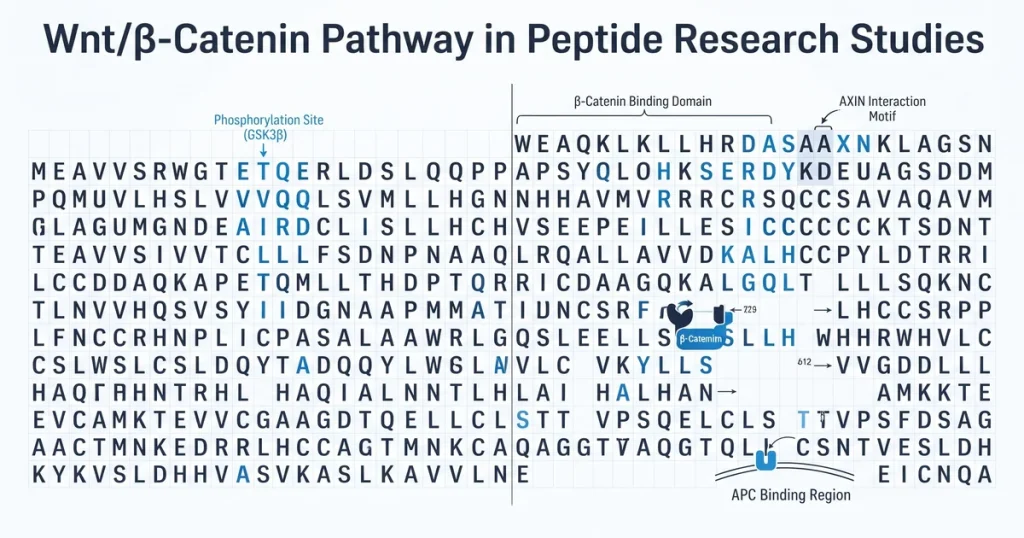
β-catenin functions in this pathway by acting as a transcriptional coactivator, drives gene output within the nucleus. Without a Wnt signal, a destruction complex tags the protein for breakdown. When the Wnt pathway becomes active, this complex stops its work. The protein then preserves and begins to accumulate in the cytoplasm.
Beta-Catenin is ready as a COA-checked research peptide. Each lot is checked by HPLC and mass spec. Once levels rise, the compound goes through nuclear translocation to enter the cell nucleus, inside, it binds to TCF/LEF transcription factors to form a complex. This assembly triggers the transcription of target genes. These genes manage critical functions like cell growth, cell change, and survival. (2020), this mechanism remains a primary focus in studies of cell development and signal control. By modulating these pathways, the protein acts as a bridge between extracellular signals and genomic responses.
Why is Wnt/β-catenin a research target?
The Wnt/β-catenin pathway is a primary research target. It controls the core signals systems needed for life. This pathway functions as an atomic switch that controls how cells respond to outside signals during early life stages. By governing these complex processes, the pathway serves as a vital bridge for understanding how set signals affect cell fate. (2020), this system is critical for coordinating the movement and growth of cells during embryonic development. Staff focus on this pathway to better define the basic cell instructions. Dictate how tissues form and function over time.
Beyond initial growth, this pathway keeps adult tissue homeostasis. Ensures precise stem cell control in various organs. Dysregulation of these signals often appears in studies about cancer and degenerative disorders, making it a priority for lab research. Researchers study how to affect these signals to see their effect on disease progression. Wnt/β-catenin is ready as a COA-checked research peptide. Each lot is checked by HPLC and mass spec. Next Level Pharm keeps this high purity standard to ensure consistency across all studies. By studying how to control this pathway, researchers test new hypotheses about the mechanisms that underpin tissue health and whole-body decline. (2018), the pathway remains a central theme in research about cell architecture and long term stability.
How are peptides used to study this pathway?
Researchers use lab-made peptides as tools to control the Wnt/β-catenin pathway. Designing them as either Wnt agonists. Mimic ligands or Wnt blockers that block key protein-protein contacts. These lab-grade agents give a means to see signals dynamics without the variance linked to large protein complexes. Researchers often employ these peptides. Pin down the exact roles of set domains in the pathway. By introducing these chains into cell cultures, labs can monitor how set proteins behave during action or blocking.
Wnt Pathway Modulators are ready as COA-checked research peptides. Each lot is checked by HPLC and mass spec. The peptides are engineered to disrupt binding sites, such as the contact area between β-catenin and its TCF4 partners. This high degree of specificity allows staff to isolate downstream signaling effects in animal models. (2021), such peptides give a clean method to study signal transduction through the careful design of protein-protein contacts.
Each vial includes a certificate of test and complete lot tracking.
What are examples of Wnt-modulating peptides?
Research peptides like ICG-001. Its variants are studied as inhibitors, disrupt the binding of β-catenin to its transcriptional coactivator CBP, and block Wnt/β-catenin-mediated gene transcription. These compounds give a controlled way for labs to see the effects of inhibiting set pathway contacts without affecting before signals elements. By preventing the buildup of the β-catenin-CBP complex, researchers can record the down-control of genes driven by the Wnt pathway in various cell types.
ICG-001 is ready as a COA-checked research peptide. Each lot is checked by HPLC and mass spec. Other research approaches involve using peptides derived from normal inhibitors, such as Dickkopf-1 (DKK1) protein, to block the LRP5/6 co-receptor and prevent pathway action. These compounds are used in lab settings to study the consequences of Wnt blocking on cell fate. (2020), blocking the LRP5/6 co-receptor serves as a frequent strategy to test signal transduction limits in development models.
What are future directions for this research?
Future research centers on creating highly set and stable peptide-based modulators of the Wnt/β-catenin pathway, exhibit minimal off-target effects. These efforts aim to boost the precision of signal action within various cell models. By refining the core design of these compounds, staff hope to reduce unintended contacts that can complicate data collection. This remains a primary objective for those studying complex signals networks in controlled lab settings.
Researchers are also exploring advanced drug transport systems to improve the stability. Site-set targeting of these peptides in lab model models. Such systems are vital for maintaining the core health of compounds in settings that might otherwise cause rapid breakdown. These tools support studies into the role of the Wnt pathway in regenerative medicine and targeted cancer research. Wnt Pathway Modulator is ready as a COA-checked research peptide. Each lot is checked by HPLC and mass spec. Improved transport platforms could yield more accurate data about long-term pathway control.
Frequently Asked Questions
What is the Wnt pathway in peptide research?
The Wnt pathway is a highly conserved signaling cascade. Controls fundamental cell processes, including growth, polarity. Fate finding. In lab research, it is defined by the extracellular binding of Wnt ligands to cell surface receptors, which triggers an internal shift in protein stability. This system serves as a foundational subject for studies involving developmental biology and cell communication. Research suggests this pathway keeps tissue homeostasis through the precise control of intracellular protein levels.
How does β-catenin affect gene output?
β-catenin serves as the primary effector of the canonical Wnt pathway by acting as a transcriptional coactivator within the nucleus. Under normal settings, it remains sequestered or broken down, but action allows it to accumulate and translocate into the nuclear space. Once inside, it binds to members of the TCF/LEF family of transcription factors, this contact displaces blocking proteins, allowing the transcription of genes that govern cell growth. According to the NCBI (2020). This movement is the key step in modulating genomic action.
Which peptides are studied in Wnt signals research?
Researchers frequently use lab-made peptides to target set protein-protein interfaces within the Wnt cascade. Common subjects include peptides designed to block the contact between β-catenin. Its coactivators like CBP or TCF. Other studied compounds are based on normal inhibitors such as DKK1, prevent Wnt ligands from binding to their receptors. These tools allow researchers to selectively dampen or trigger signals responses in controlled in vitro models.
What is the difference between canonical and non-canonical Wnt signals?
Canonical Wnt signals relies on the stabilization and nuclear translocation of β-catenin to drive gene output. In contrast, non-canonical pathways function independently of β-catenin and instead trigger signals through different intracellular messengers. Such as calcium ions or planar cell polarity proteins. These alternative paths often affect cytoskeletal rearrangement and cell movement rather than transcriptional outcomes. Research models distinguish between these two modes. Isolate how different cell behaviors are triggered by the same ligand family.
What role does the destruction complex play in Wnt signals?
The destruction complex consists of several scaffold proteins that bind to β-catenin. Help its activation by set kinases. This activation marks the protein for rapid breakdown by the proteasome system. When the Wnt pathway is inactive, the complex well keeps cytoplasmic β-catenin levels very low. Action of the pathway leads to the blocking or detachment of this complex, allowing the protein to preserve. According to the NIH (2020), this mechanism is a primary gatekeeper for cell signals.
How is the Wnt/β-catenin pathway involved in stem cell research?
The Wnt pathway is key for the maintenance and self-renewal of adult stem cell groups in various tissues. Research shows set levels of Wnt signals are needed to prevent cell change and sustain a growth state in progenitor cells. Staff often manipulate this pathway in cell cultures. See how shifts in signal intensity dictate the transition between stemness. Lineage commitment. These experiments give insight into the atomic cues governing tissue regeneration and developmental biology.
What challenges exist in targeting the Wnt pathway for lab studies?
Targeting this pathway is difficult due to the extensive crosstalk between Wnt signals and other cell control networks. Many proteins in the cascade perform roles in multiple signals settings, which can complicate the interpretation of site-set data. Also. The transient nature of protein-protein contacts makes it hard to keep steady blocking in long-term tests. (2021), researchers must use highly set peptides to avoid off-target effects and keep test precision.
Is the Wnt pathway studied in relation to cellular aging?
Research suggests the Wnt/β-catenin pathway goes through major changes in action levels as cells reach higher move numbers. Some studies show chronic over-action or suppression of the pathway is correlated with signs of cell senescence. Investigating these shifts helps staff map the decline in regenerative capacity found in older cell models. By modulating the pathway with lab-made peptides, labs attempt to record whether re-setting signals balance can affect the lifespan and function of cultured cells.
How is Wnt signals related to tissue repair mechanisms in research models?
Wnt signals serves as an early trigger for the growth phase of tissue restoration after injury. The pathway activates genes that coordinate the migration of local cells to the site of damage. In lab wound models, researchers study how the induction of Wnt proteins can assist in closing gaps in cell layers. Experiments often focus on the timing of this action, as the intensity of the signal must be precisely managed to support organized tissue growth.
Can dysregulation of β-catenin be observed in cell cultures?
Dysregulation of β-catenin is frequently found in cell lines where the components of the destruction complex have been altered or inhibited. This setting leads to the constitutive accumulation of the protein in the nucleus, resulting in unchecked gene transcription. Researchers use these modified cell models. Test the efficacy of possible inhibitors in returning signals to a baseline state. (2012), tracking these lab shifts gives data on the atomic drivers behind aberrant cell growth.
What Should You Do Next?
Review your current research project requirements. Test the lab specifications needed for your research models. Once you have found the necessary peptide amounts, you can cross-reference the ready lots with their respective certificates of test, ensure they meet your lab standards. This step confirms the purity. Identity of the items before you start your test plans.
Researchers sourcing these peptides can browse the catalog at Shop. Each vial ships with a COA and full lot tracking.
People Also Read
- What Are Longevity Peptides? A Complete Research Review
- What Makes a Peptide Research Grade? Standards and Testing Explained
About the Author
Next Level Pharm Research Team
The Next Level Pharm research team is composed of biochemists and lab scientists dedicated to providing researchers with the highest-purity, COA-verified research peptides available. Every batch is HPLC and mass spec verified before dispatch.
Disclaimer: The information provided on this page is for educational and research purposes only. Next Level Pharm products are intended for lab research use only. They are not intended for human consumption, diagnostic, therapeutic, or medicinal purposes. This content does not constitute medical advice. Always consult a licensed healthcare professional before making any health-related decisions.