
Peptide Contamination Testing: Beyond Purity

Last updated: August 2026
Peptide contamination testing is a process that detects harmful impurities beyond the target peptide chain. It ensures compound fitness for sensitive lab work. The method finds residue from synthesis steps or breakdown. It acts as a gate for research data quality. Labs use dual-method testing on each vial to confirm purity standards.
Next Level Pharm maintains strict quality standards through its dual-method testing protocol. All research compounds go through HPLC and mass spectrometry. This approach results in a 99.4% average purity across the last 100 batches. The brand provides a Certificate of Analysis (COA) with each order for full clarity. Each compound is freeze-dried and sealed under an inert gas to hold stability.
Removing contaminants lets researchers isolate the specific effects of the peptide chain under study. Contaminants add unwanted variables that skew results. By confirming compound purity, researchers set a clear baseline for their work. This step is standard in all peptide-based research today. Next Level Pharm ensures each batch goes through rigorous in-house and outside testing. This covers both purity and contaminant levels.
Key Takeaways
- Purity vs. contamination distinction: High purity does not ensure a sample is free from harmful contaminants. Even a highly pure peptide can carry trace residues that alter study results.
- Endotoxin risks to research: Bacteria shed endotoxins. These act as potent immune agents in cell systems. They can invalidate study data even at very low levels.
- Standard contaminant test panels: Research requires tests for endotoxins, bioburden, trace solvents, and heavy metals. A full panel accounts for all possible interference factors.
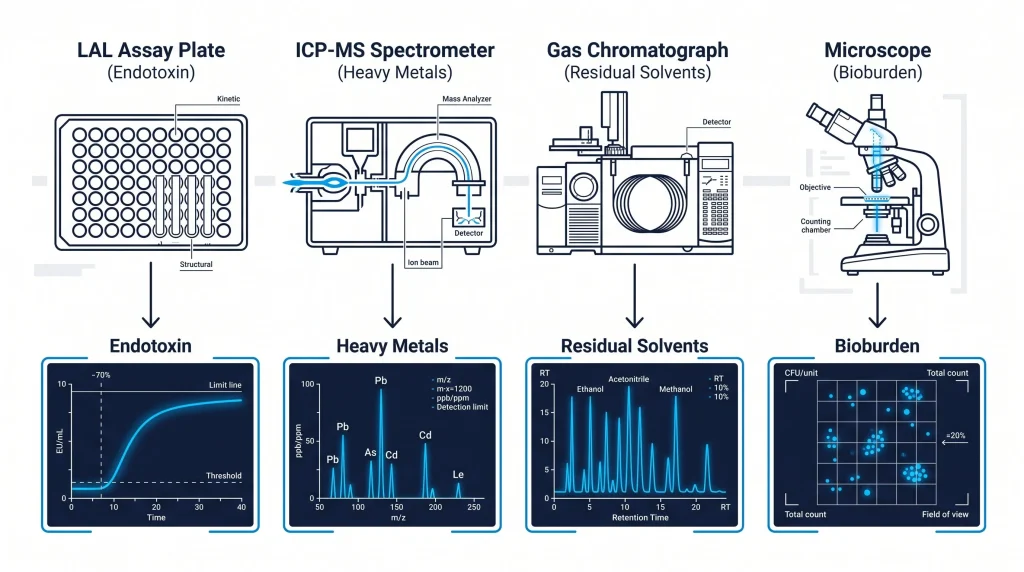
- Specific testing methods: Each contaminant class needs its own test. The LAL test screens for endotoxins. ICP-MS screens for metals. Distinct methods measure each type accurately.
- Value of detailed COA data: A lot-specific COA is the only way to check contamination test results. Researchers should review this data before using any peptide stock.
The next sections examine the specific testing methods used to measure common contaminant classes. This helps keep all research variables under control throughout a study.
What is contamination testing vs. purity analysis?
Purity testing confirms what percentage of the sample is the target peptide. Contamination screening finds harmful trace agents. Researchers must track both metrics to keep project accuracy. Purity testing uses HPLC to map the sample against expected chemical profiles. Contamination screening focuses on unsafe trace substances. This includes endotoxins, trace solvents, microbes, and heavy metals. These can all skew lab results.
A peptide sample may show 99% purity but still carry high contaminant levels. This is a real concern for data quality. Endotoxins or solvents can trigger unwanted reactions in cell studies. A full COA must give data for both purity and contaminant limits. Consistent testing protects the validity of study findings. Researchers sourcing recovery peptides benefit from lot-specific COA data covering both metrics.
Why is endotoxin screening critical for lab research?
Endotoxins are lipopolysaccharides (LPS) shed by bacteria. LPS acts as a potent immune agent in cell systems. Even at trace levels, LPS causes cells to activate and release cytokines. This masks the true effects of the primary peptide in study models. According to PubMed (2024), this is confirmed across both in vitro and in vivo study designs.
The Limulus Amebocyte Lysate (LAL) test is the standard method to detect endotoxins. The LAL test uses crab blood cells. These cells clot when exposed to trace LPS. By running this screen, researchers can count contamination levels. They can ensure levels stay within strict bounds for lab use. This step rules out possible toxicity or cell harm that might skew a study.
What does bioburden mean for research peptides?
Bioburden is the total count of live microbes on a non-sterilized product. This includes bacteria and fungi. Bioburden is measured in colony-forming units (CFUs). CFU counts show the microbial load in a sample. Freeze-dried peptides are not inherently sterile. But managing bioburden is a set rule for high-quality lab output. Testing for CFUs ensures the compound meets purity benchmarks before use.
Low bioburden is vital for the integrity of sensitive study models. High CFU counts often signal poor manufacturing hygiene. This may lead to rapid peptide breakdown. High counts also raise the risk of endotoxin buildup during synthesis and storage. Researchers sourcing BPC-157 can confirm bioburden data via the lot-specific COA. Proper bioburden control ensures researchers start with a stable compound for their studies.
How are trace solvents and reagents found?
Trace solvents and synthesis reagents are found through separation testing. Trifluoroacetic Acid (TFA) is one common example. TFA is used to cleave the peptide from its resin in solid-phase synthesis. These substances are byproducts of the manufacturing process. They must be removed through rigorous purification. Gas chromatography (GC) and reversed-phase HPLC detect and count these reagents. They can be toxic to cells and must be removed before lab use.
Each test provides a signal peak for the trace agent. This lets researchers confirm that levels remain below set limits. TFA and similar compounds can alter the pH of a sample. This may change how a peptide behaves in a lab model. Finding and removing these agents is key to data accuracy.
What is the purpose of heavy metal testing?
Heavy metal testing screens for toxic elements. These include lead (Pb), arsenic (As), cadmium (Cd), and mercury (Hg). These metals can enter peptide samples during raw material processing. Elemental exposure can change the cell activity of study models. It does this by inducing oxidative stress. Detecting these contaminants is key to ensuring results come from the peptide and not from metal harm.
Inductively Coupled Plasma Mass Spectrometry (ICP-MS) is the preferred method for this screen. ICP-MS counts elemental amounts at parts-per-billion levels. According to PubMed (2004), heavy metal contamination in peptide synthesis products is detectable by ICP-MS at parts-per-billion levels. If metals are present, they can trigger cell death or disrupt energy pathways. This confounds collected data. Each lot receives HPLC and mass spectrometry testing to ensure compound integrity.
What should a full contamination panel report show?
A full contamination panel report gives lot-specific data for each tracked contaminant. This lets researchers check compound quality. These reports include measured values for heavy metal levels, endotoxin units, and trace solvents. They also include peptide purity from HPLC. By reviewing these data points, labs can spot problem batches. Some compounds carry unwanted variables. Each batch needs this data to ensure study design relies on stable, defined inputs.
Researchers should look for endotoxin levels measured in EU/mg. Bioburden should be in CFU/g. Heavy metal levels must be in ppm or ppb. The report should also include total purity from HPLC and mass spectrometry. Researchers can shop research peptides with full COA access at Next Level Pharm. Verified data supports the consistency of findings when conducting cell-based research in a lab.
According to PubMed (2024), endotoxin testing using the LAL method detects gram-negative bacterial contamination at picogram-per-mL levels. According to PubMed (2020), microbial contamination in research-grade peptides can come from synthesis reagents or downstream handling steps. According to PubMed (2004), heavy metal contamination in peptide synthesis products is detectable by ICP-MS at parts-per-billion levels.
Frequently Asked Questions
What contaminants are tested for in peptide research?
Labs test for cell-based and chemical trace agents. This ensures results reflect the peptide and not outside factors. Testing panels screen for heavy metals like lead or arsenic. These may harm cell assays. Trace solvents from synthesis are also checked. They can alter sample behavior. Labs also screen for endotoxins. These are parts of bacterial cell walls. Even at low levels, these evoke strong immune responses in study models.
How does bioburden differ from endotoxin?
Bioburden is the total count of live microbes in a compound before sterility steps. Endotoxins are the toxic parts of bacterial cell walls. They remain after microbes are cleared. Bioburden measures possible ongoing microbial growth. Endotoxins stay chemically stable and need specific pyrogen tests for screen. Researchers track both to keep a setting free from cell harm during studies.
What are residual solvents?
Trace solvents are organic chemicals used during peptide purification. Common examples include acetonitrile and TFA. These are used to flush the peptide through chromatography columns. They may be harmful in research settings. Labs must test for their removal. USP guidelines set limits for these compounds to ensure the final product represents only the chain of interest. Proper drying keeps solvent levels below accepted standards.
Why is heavy metal testing performed?
Heavy metal testing detects toxic elements like mercury, cadmium, lead, and arsenic. These may enter via reagents or glassware. Metals can act as catalysts or blocks in research. They may mask the true effects of the peptide. According to PubMed (2004), elemental trace monitoring is a set practice. It ensures no inorganic matter harms the data. This test is vital for maintaining high standards in sensitive cell work.
What does a full contamination panel include?
A full panel covers chemical, elemental, and cell-based safety markers. It includes HPLC and mass spectrometry to set chemical identity and purity levels. The cell panel tests for bioburden through sterility culture. It tests endotoxin levels via the LAL test. Elemental panels use ICP-MS to find trace metals. This multi-layer approach ensures the final compound is free from all hazards. These hazards could compromise study data.
What is an acceptable endotoxin limit for research peptides?
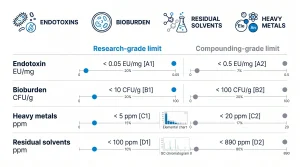
The acceptable limit for endotoxins depends on the experiment. Most studies require levels below 5 endotoxin units per mg. High levels may cause false results in immune-related research. They can trigger unwanted inflammation in cell models. According to PubMed (2024), keeping pyrogen levels low is key for consistent data across diverse trials. Researchers should compare specific endotoxin findings against the COA for each lot.
Why is TFA a concern in peptide synthesis?
TFA is a byproduct of the synthesis phase. It serves as a common ion-pairing agent in purification. TFA is a strong acid. It can stay in the final peptide salt if the desalting process is incomplete. It may block protein function or alter the pH of a solution. Researchers monitor TFA levels because trace acid can lead to changes in how a peptide binds to its target in vitro.
Are freeze-dried peptides considered sterile?
Freeze-drying removes moisture to preserve a compound. It does not guarantee sterility. The process limits bacterial growth. But it does not kill spores or neutralize endotoxins. True sterility requires aseptic handling, filtration, and verified cleanroom conditions. These must be in place during the final bottling phase. Researchers often perform secondary sterility checks if their study needs a setting free from foreign agents or traces.
How is peptide identity confirmed alongside purity?
Purity confirms the absence of contaminants. Identity verifies the specific sequence and mass of the intended peptide. Chemists use mass spectrometry (MS) to compare the actual mass of a sample. They check it against its expected weight. If the mass matches the amino acid sequence, researchers can be confident in the sample. Identity is confirmed only when MS data aligns with the target. Purity alone does not confirm identity.
What is the difference between HPLC and MS in peptide testing?
HPLC separates the parts of a sample to quantify the purity of the peptide. It creates a chromatogram to display peaks for the target compound versus contaminants. MS identifies the actual mass-to-charge ratio of the purified peptide. HPLC shows how much of a sample is the target chain. MS validates that the chain is chemically correct. Both tools are used together for full check of a research-grade compound.
Summary
Contamination testing extends well beyond standard purity checks. Labs must screen for endotoxins, bioburden, trace solvents, and heavy metals to build an accurate picture of quality. High purity alone does not confirm a peptide is free from trace contaminants that can invalidate study data.
Each contaminant class requires a specific test. Endotoxins need the LAL test. Bioburden requires sterility culture. Trace solvents need GC. Heavy metals need ICP-MS. A full panel COA covers all four alongside HPLC purity data.
Verifying lot-specific documentation before use is the only way to confirm a compound is suitable for sensitive lab research.
What Should You Do Next?
Researchers sourcing research-grade peptides for lab studies can follow these steps:
- Review purity documentation. Confirm that COA data is available for the batch before ordering. Next Level Pharm provides lot-specific COA access for each vial.
- Check compound storage requirements. Freeze-dried peptides stay stable at room temperature during shipping. Confirm your lab has the correct storage protocol before beginning work.
- Request technical support if needed. PhD-level biochemist support is available for researchers with protocol-specific questions about research applications.
People Also Read
- What Makes a Peptide Research Grade? Standards and Testing Explained
- BPC-157 vs TB-500: A Detailed Research contrast Guide
About the Author
Next Level Pharm Research Team
The Next Level Pharm research team is composed of biochemists and laboratory scientists dedicated to providing researchers with the highest-purity, COA-verified research peptides available. Every batch is HPLC and mass spec verified before dispatch.
Disclaimer: The information provided on this page is for educational and research purposes only. Next Level Pharm’s products are intended for laboratory research use only. They are not intended for human consumption, diagnostic, therapeutic, or medicinal purposes. This content does not constitute medical advice. Always consult a licensed healthcare professional before making any health-related decisions.