
GHRP-6 Research: Ghrelin Receptor Study Findings

Last updated: August 2026
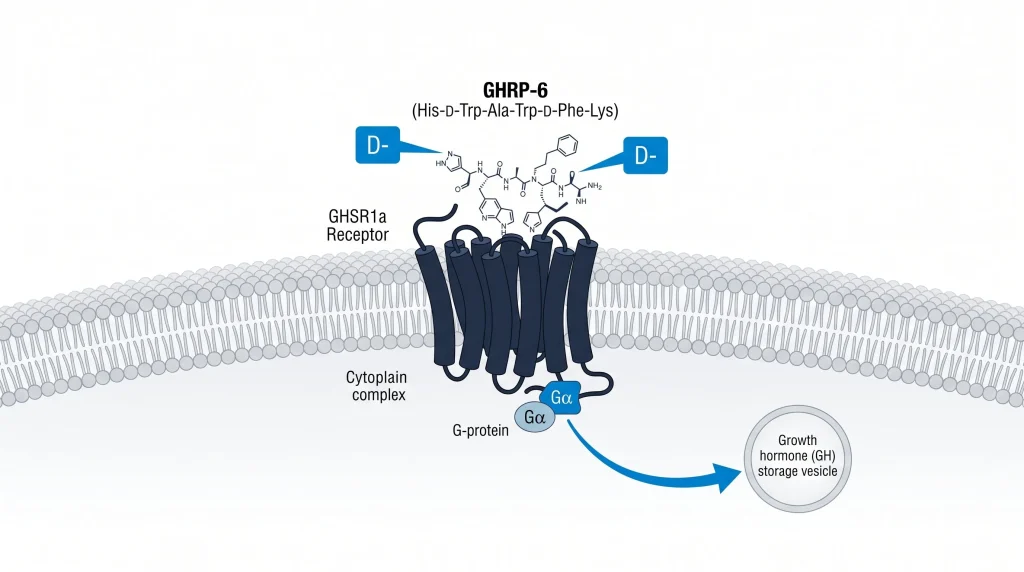
A GHRP-6 research compound is a synthetic hexapeptide. It is used in cell-based receptor binding assays. GHRP-6 stands for Growth Hormone Releasing Peptide-6. Its sequence is His-D-Trp-Ala-Trp-D-Phe-Lys-NH2. It has 6 amino acids. The ghrelin receptor is also called GHSR1a. GHSR stands for growth hormone secretagogue receptor. According to NCBI (2020), GHSR agonists are used in receptor binding cell assays for GH secretion and downstream signaling research.
Next Level Pharm supplies research-grade GHRP-6. Each lot is HPLC-verified at ≥99% purity. MS confirms the 6-amino acid sequence. A COA ships with every order.
Studies compare GHRP-6 to other GHSR agonists. GHRP-2 and Ipamorelin are the main reference compounds. Each has a different selectivity profile at GHSR1a.
Key Takeaways
- Hexapeptide Sequence: GHRP-6 is a 6-amino acid synthetic peptide. The sequence is His-D-Trp-Ala-Trp-D-Phe-Lys-NH2 with a C-terminal amide.
- Ghrelin Receptor Agonist: GHRP-6 binds GHSR1a in cell models. Studies measure receptor binding and downstream signaling changes.
- Appetite Pathway Research: The ghrelin receptor is linked to appetite signaling in receptor research. Studies measure this pathway in cell models only.
- Selectivity Comparison: Research compares GHRP-6 to GHRP-2 and Ipamorelin. Each has a distinct GHSR1a binding and selectivity profile.
- COA-Verified Lots: Each lot is HPLC-verified at ≥99% purity. MS confirms the peptide sequence and amide terminus per lot.
GHRP-6 is also studied in GH signaling models. The ghrelin receptor is expressed in pituitary cell lines. Receptor activation triggers cAMP and calcium signaling in these cells.
What Is GHRP-6?
GHRP-6 is a synthetic hexapeptide. It was designed to activate the ghrelin receptor. The receptor is called GHSR1a. GHRP-6 has 6 amino acids. Its sequence has D-amino acids at positions 2 and 5. D-amino acids are synthetic forms. They increase stability in assay media. The C-terminus is amidated.
GHRP-6 is not a natural peptide. It is made by chemical synthesis. The sequence was designed to bind GHSR1a. Ghrelin is the natural GHSR1a ligand. GHRP-6 binds the same receptor. Its sequence differs from ghrelin. Cell assays measure receptor binding. They also measure downstream signaling. According to Journal of Peptide Science (2018), synthetic hexapeptides are used as receptor binding tools in cell-based GHSR1a assays.
How Does GHRP-6 Activate the Ghrelin Receptor?
GHRP-6 binds the GHSR1a receptor. GHSR1a is a G protein-coupled receptor. GPCRs signal through G proteins. Binding activates the Gq protein. This triggers phospholipase C. Phospholipase C (PLC) cleaves membrane lipids. IP3 is released. IP3 then raises calcium levels inside the cell.
Calcium release is a key readout. GHRP-6 causes calcium flux in cell models. This flux is measured in GHSR1a assays. cAMP levels also change after GHSR1a activation. Both are standard readouts in GPCR assay panels. They confirm receptor engagement. The assays use transfected cell lines. According to Journal of Peptide Science (2018), calcium flux and cAMP assays confirm GPCR agonist activity in receptor binding cell lines.
What Do Ghrelin Receptor Selectivity Studies Show?
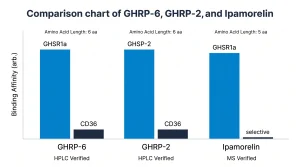
Selectivity studies compare GHSR1a binding across compounds. GHRP-6, GHRP-2, and Ipamorelin all bind GHSR1a. They differ in how selectively they bind. GHRP-6 also binds CD36. CD36 is a scavenger receptor. GHRP-2 binds GHSR1a with higher affinity. Ipamorelin is more selective. It has fewer off-target interactions.
Selectivity is measured by binding assay panels. These use transfected cells with specific receptors. A selective compound binds only the target. Less selective compounds bind multiple receptors. Each binding event changes assay readouts. Browse research-grade GHRP compounds at Next Level Pharm for COA-verified lots. Selectivity panels are standard in GHSR agonist research for comparing receptor profiles.
How Does GHRP-6 Compare to GHRP-2 and Ipamorelin?
GHRP-6 and GHRP-2 are both hexapeptides. Both bind GHSR1a. GHRP-2 has higher binding affinity in most assay models. Ipamorelin is a pentapeptide. It is shorter by one residue. It is more selective for GHSR1a. It binds fewer off-target receptors. GHRP-6 is the reference compound in many assays.
All three are compared in the same cell models. This allows direct selectivity comparisons. The table below shows the main differences.
| Feature | GHRP-6 | GHRP-2 | Ipamorelin |
| Length | 6 amino acids | 6 amino acids | 5 amino acids |
| GHSR1a binding | Moderate | Higher | Moderate |
| CD36 binding | Yes | Partial | No |
| Selectivity | Lower | Moderate | Higher |
| D-amino acids | Yes (2) | Yes (1) | Yes (2) |
| Verified by | HPLC + MS | HPLC + MS | HPLC + MS |
Shop research-grade GHRP peptides.
How Is GHRP-6 Synthesized for Research Use?
GHRP-6 is made by Fmoc SPPS. Fmoc is a standard protecting group. SPPS means solid-phase peptide synthesis. The 6-amino acid chain is built one residue at a time. D-amino acid building blocks go at positions 2 and 5. These need special coupling conditions. After assembly, the chain is cleaved from the resin.
The C-terminal amide comes from Rink amide resin. HPLC purifies the lot to ≥99%. MS confirms the 6-amino acid sequence. It also confirms the D-amino acid positions. The C-terminal amide is confirmed by mass. The molecular weight is approximately 873 Da. Each lot must match this mass. According to Journal of Peptide Science (2018), D-amino acid positions and amide termini are confirmed by MS for each synthetic hexapeptide lot.
How Is GHRP-6 Verified for Research Use?
HPLC runs a reverse-phase separation on each lot. The main peak area gives the purity percent. Research-grade GHRP-6 targets ≥99% purity. Next Level Pharm reports 99.4% average across 100 recent batches. Impurities include partial sequences. Deletion peptides also occur. Isomer impurities are a third type.
MS confirms identity per lot. The full sequence mass (~873 Da) must match. D-amino acid positions shift the expected mass. The C-terminal amide is also confirmed. Both modifications are verified per lot. The COA includes the HPLC chromatogram and MS spectrum. Both are required before lot release.
Frequently Asked Questions
What Is GHRP-6?
GHRP-6 is a synthetic hexapeptide. It stands for Growth Hormone Releasing Peptide-6. The sequence is His-D-Trp-Ala-Trp-D-Phe-Lys-NH2. It binds the GHSR1a ghrelin receptor in cell models. The ghrelin receptor drives GH signaling pathways in cells. Each lot is HPLC-verified at ≥99% purity. MS confirms the sequence per lot. According to NCBI (2020), GHSR agonists are used in cell-based receptor binding assays for GH secretion research.
How Does GHRP-6 Activate the Ghrelin Receptor?
GHRP-6 binds GHSR1a. This is a G protein-coupled receptor. Binding activates the Gq protein pathway. This triggers phospholipase C. PLC releases IP3. IP3 raises calcium levels in the cell. Calcium flux is the key assay readout. cAMP levels also change after binding. Both readouts confirm GHSR1a engagement in cell models. According to Journal of Peptide Science (2018), calcium flux and cAMP assays confirm GPCR agonist activity in GHSR1a cell lines.
Why Does GHRP-6 Affect Appetite Signaling Pathways?
The ghrelin receptor GHSR1a is linked to appetite signaling in cell research. GHRP-6 binds GHSR1a. Downstream changes are measured in cell models. These include calcium flux and cAMP changes. Appetite signaling is one downstream pathway in these models. Research focuses on receptor binding in cell systems only. This does not imply human appetite effects. According to NCBI (2020), GHSR1a signaling includes appetite-related pathway components studied in cell-based assays.
How Does GHRP-6 Compare to GHRP-2?
Both are synthetic hexapeptides that bind GHSR1a. GHRP-2 shows higher binding affinity in most assay models. GHRP-6 also binds CD36. GHRP-2 has partial CD36 binding. GHRP-6 is less selective than GHRP-2. Both are used as reference compounds. Comparisons run in the same cell lines. Head-to-head assays compare GHSR1a agonists by binding affinity and receptor selectivity.
How Does GHRP-6 Compare to Ipamorelin?
GHRP-6 is a hexapeptide. Ipamorelin is a pentapeptide. Ipamorelin has higher selectivity for GHSR1a. It does not bind CD36. GHRP-6 binds both GHSR1a and CD36. Ipamorelin is chosen when selectivity is the research priority. GHRP-6 is the standard reference for GHSR1a binding assays. Selectivity profiling between GHRP compounds is standard in GHSR agonist binding panels.
How Is GHRP-6 Made?
GHRP-6 is made by Fmoc SPPS on Rink amide resin. D-amino acid building blocks go at positions 2 and 5. Each residue is coupled one at a time. The lot is cleaved after full assembly. HPLC purification achieves ≥99% purity. MS confirms the 6-amino acid sequence and C-terminal amide. The molecular weight is approximately 873 Da. According to Journal of Peptide Science (2018), Fmoc SPPS is the standard route for D-amino acid hexapeptide synthesis in research.
What Assays Are Used in GHRP-6 Research?
GHSR1a binding assays measure receptor affinity. Calcium flux assays confirm GPCR agonist activity. cAMP assays provide a second signaling readout. Selectivity panels test binding across multiple receptor types. Stability assays track compound levels in serum media over time. High-purity lots are required for reliable assay results. According to NCBI (2020), confirmed lot purity is required before peptide receptor binding assays.
What Purity Level Is Standard for Research Use?
Research-grade GHRP-6 targets ≥99% HPLC purity. Common impurities include partial sequences and deletion peptides. Isomer impurities at D-amino acid positions also occur. Each type changes assay binding results. The average purity is 99.4% per lot from the last 100 batches. According to Journal of Peptide Science (2018), lot-level purity data is required for D-amino acid peptide identity confirmation in receptor binding assays.
What Is Selectivity in GHRP Research?
Selectivity is the degree to which a compound binds one receptor over others. GHRP-6 binds GHSR1a and CD36. Ipamorelin binds mainly GHSR1a. A selective compound gives cleaner assay readouts. Off-target binding adds confounding signals. Selectivity is measured with panels of transfected cells. Each cell line has a different receptor.
What Is the Difference Between Peptide Purity and Peptide Content?
Peptide purity is the HPLC ratio of target peptide to all compounds. It is expressed as a percent. Peptide content is the total mass in a vial. It includes counter-ions and water. Both are needed for accurate assay quantification. A lot at ≥99% purity still has a small non-target fraction. Both purity and content data are required for quantitative peptide receptor assays.
Summary
GHRP-6 is a synthetic hexapeptide used as a GHSR1a agonist in receptor binding research. Its sequence includes two D-amino acids. These increase stability in assay media. Selectivity studies compare GHRP-6 to GHRP-2 and Ipamorelin.
Each has a distinct binding and selectivity profile at GHSR1a. Research uses all three as reference compounds in comparative assays.
Research-grade lots from Next Level Pharm report 99.4% average purity. MS confirms D-amino acid positions and C-terminal amide per lot.
What Should You Do Next?
Researchers selecting GHRP-6 for receptor binding assays should confirm purity and D-amino acid positions before use. The following steps support consistent results:
- Check the COA for HPLC purity and MS confirmation of the full 6-amino acid sequence.
- Confirm D-amino acid positions are verified by mass in the COA.
- Record the lot number with each assay run for traceability.
- Run a parallel reference compound (GHRP-2 or Ipamorelin) to establish selectivity context.
Shop research-grade GHRP-6 with MS verification of sequence and D-amino acid positions.
People Also Read
- What Makes a Peptide Research Grade? Standards and Testing Explained
- BPC-157 vs TB-500: A Detailed Research Comparison Guide
About the Author
Next Level Pharm Research Team
The Next Level Pharm research team is composed of biochemists and laboratory scientists dedicated to providing researchers with the highest-purity, COA-verified research peptides available. Every batch is HPLC and mass spec verified before dispatch.
Disclaimer: The information provided on this page is for educational and research purposes only. Next Level Pharm’s products are intended for laboratory research use only. They are not intended for human consumption, diagnostic, therapeutic, or medicinal purposes. This content does not constitute medical advice. Always consult a licensed healthcare professional before making any health-related decisions.