Compounded vs Research-Grade Peptides Explained

Last updated: August 2026
A compounded peptide is a drug made by a state-licensed pharmacy for a specific patient. Research peptides are lab compounds made for non-human study only. These two types differ in their rules and testing standards. The records that come with each vial also differ. These gaps affect how labs acquire, store, and use each compound. Research peptides are central to work on novel signal paths and cell-based assays. A 2018 study in the Journal of Peptide Science found that key traits in these compounds affect how they bind their target sites during testing.
Next Level Pharm gives access to over 70 peptide SKUs across 7 research categories. Each batch goes through HPLC and mass spec testing. The team holds a 99.4% average purity across the last 100 batches. All vials are lyophilized, which means freeze-dried and sealed under an inert gas. This keeps them stable at room temperature. No cold chain is needed. Average dispatch time is about 48 hours.
Researchers should know that supplier records set the quality baseline for any study. Compounded drugs must meet pharmacy rules. Research-grade compounds rely on COA testing and batch-level mass spec data. Using stable, checked samples helps link study results to peer-reviewed literature. These records let researchers track source and purity of each sample throughout their work.
Key Takeaways
- Regulatory oversight differences: Compounded peptides follow state pharmacy board rules and USP standards. Research peptides are not classified as drugs and are not subject to those controls.
- Intended research use: Compounded compounds are made for therapeutic use under a prescription. Research peptides are sold for in vitro or lab study only.
- Quality testing standards: Compounding pharmacies check their own product quality. Research peptide quality is confirmed through a COA using HPLC and mass spec.
- Required safety records: Compounded compounds need a valid prescription and a pharmacy label. Research-grade peptides come with a COA and a Research Use Only label.
- Standard product form: Compounded peptides usually arrive as a sterile liquid ready for dispensing. Research peptides are sold as lyophilized powders that need lab prep before study.
The sections below explain how these distinctions affect which compound a lab selects for testing. Proper analysis helps researchers confirm that compounds meet the needs of their current protocols.
What Is a Compounded Peptide?
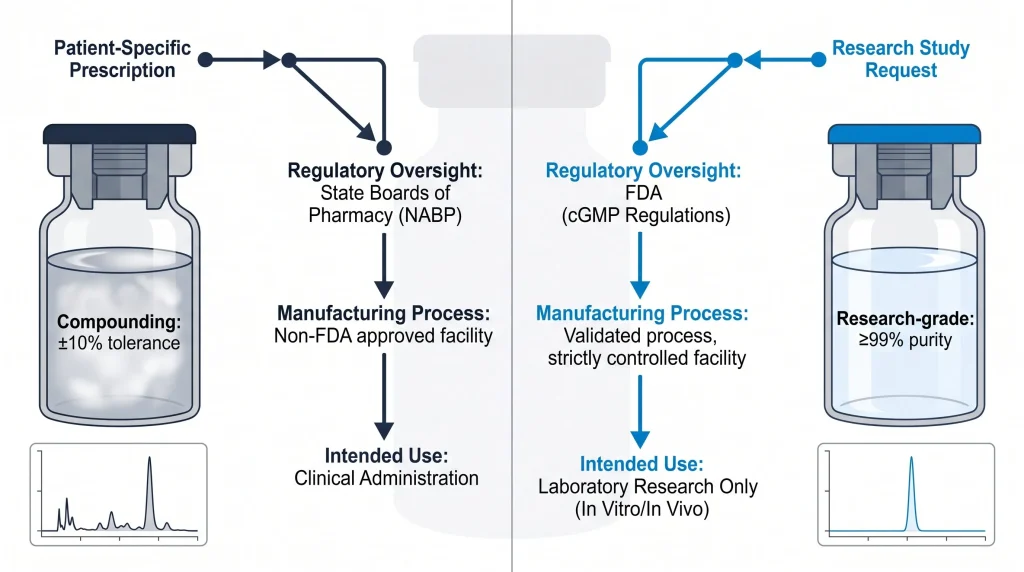
A compounded peptide is a drug made by a licensed pharmacist for one patient. The pharmacist follows a valid prescription as a guide. These drugs are made in labs overseen by state pharmacy boards. They fill needs that mass-made drugs cannot cover. Compounding teams follow strict rules. They use USP Chapter 795 for non-sterile forms and USP Chapter 797 for sterile forms. These rules ensure safety and purity at every stage.
These products are not FDA-approved drugs. They are lab creations made to fill specific needs. Pharmacists adjust the form, level, and delivery method to match the study plan. Technicians check sterility and purity in clean settings. BPC-157 is a COA-verified research peptide. Each lot is checked by HPLC and mass spec. By following quality rules, these labs give precise, stable compounds for a wide range of lab functions.
What Does ‘Research-Grade’ Mean?
Research-grade compounds are made only for lab research, such as in vitro studies or animal models. These compounds are not for human use. The label means the compound has met set quality targets for study validity. Scientists rely on research-grade compounds to get precise and repeatable data. These products are for research use only. Their sale does not follow the strict rules set for products used in human health.
Labs use High-Performance Liquid Chromatography (HPLC) to check purity. HPLC is a method that separates each part of a sample to measure its amount. Labs also use Mass Spectrometry (MS) to check molecular weight and compound identity. These results go into a Certificate of Analysis (COA), which is the main quality record for each batch. TB-500 is a COA-verified research peptide. Each lot is checked by HPLC and mass spec. Using this data lets researchers account for the specific chemical profile of their samples.
How Are They Regulated Differently?
Compounded peptides fall under state pharmacy boards and must meet USP rules. Research peptides are not regulated as drugs by the FDA. These two paths are distinct. Compounded compounds come from facilities with strict drug quality rules. Research-grade compounds fall under lab commerce law. They are not approved for medical use. Scientists who source these compounds must check the quality and purity of their peptides.
Lab commerce laws govern research peptides rather than drug rules. Suppliers sell these vials for lab tests only. Oversight groups allow the sale of these compounds for testing as long as the label says they are not for human use. Researchers should get records to confirm the peptide meets lab standards. Using independent lab testing ensures the compound fits the intended study. This keeps labs at a high standard without relying on consumer drug rules.
| Feature | Compounded Peptide | Research-Grade Peptide |
| Oversight | State pharmacy board + USP | Lab commerce law |
| Intended use | Therapeutic (with prescription) | Non-human lab study |
| Records | Pharmacy label | Certificate of Analysis |
| Testing | USP 795/797 | HPLC + mass spec |
| Physical form | Sterile liquid | Lyophilized powder |
Browse the full recovery peptide catalog to review COA data for each available research compound.
Why Is Purity Verification Critical?
Purity analysis is critical because it ensures that study results come from the target compound alone. High-quality inputs are the base of repeatable science. If a sample has hidden synthesis byproducts or wrong chains, these can skew study data. This can ruin results entirely. This is a key risk. Checking the compound against set benchmarks helps researchers reduce the risk of false findings.
HPLC checks the active compound percentage in each sample. Mass spec confirms the correct molecular weight. These two tests ensure the compound is exactly what it claims to be. Using checked compounds protects compound integrity. This allows focused study of the target peptide without interference from stray compounds or synthesis errors. Each lot comes with checked purity data to support the rigor of lab work.
What Documentation Accompanies Each?
Compounded peptides come with a pharmacy label. This label includes patient details, the prescriber’s name, and delivery instructions, as required by state law. Research-grade peptides come with a batch-specific COA. The COA details purity, compound identity, and total level. These lab compounds are labeled For Research Use Only. They do not include instructions for human use or medical application.
Lab staff reviewing source quality use these batch records to check compound integrity. Each COA gives the analysis needed to check compound accuracy before testing begins. This is a core step. Researchers use these records to ensure the chemical profile stays consistent during each phase of their work. Researchers can also source bacteriostatic water separately for lab reconstitution needs.
How Does Intended Use Dictate Form?
The intended use of a compound sets its physical form. It may be a liquid for direct lab study, or a stable powder for long-term storage. Research protocols need a specific physical form that balances compound integrity with readiness for testing. When a compound is a sterile mix, it is prepared for immediate use in liquid-phase assays. Researchers often work with lyophilized (freeze-dried) powders. This form stops moisture loss and keeps the compound stable before testing.
Researchers reconstitute the powder in a proper solvent to get the needed study level. This multi-step process allows precise control over the mix. Proper steps protect the molecular structure during the move from solid to liquid. This method ensures the resulting sample meets data collection needs in various lab models. Each lot ships with verified purity data to support rigorous lab work.
According to PubMed (2012), drug compounding quality varies compared to research-grade purity standards. According to PubMed (2019), compounded preparations show higher impurity profiles than reference-standard peptides in HPLC analysis. According to PubMed (2018), research-grade peptide specifications include identity, purity, and potency criteria beyond standard compounding requirements.
Frequently Asked Questions
What Is a Compounded Preparation?
A compounded preparation is a chemical mix made by a licensed pharmacy to fill a custom need. This differs from mass-made drugs. These mixes are created to meet set levels or delivery needs that standard products cannot fill. They are for use in medical settings only, where a doctor has asked for a tailored mix for a specific patient. The pharmacy follows the prescription closely to meet the patient’s exact needs.
What Does Research-Grade Mean?
Research-grade refers to compounds made for use in lab settings. These compounds are made to high purity standards but lack the approval needed for any medical use. The label means the compound is for non-clinical work, like assay testing, receptor binding studies, and cell research. Researchers use this level to ensure their findings are based on chemically stable and checked starting materials.
How Do Oversight Pathways Differ?
Compounded preparations are managed by state pharmacy boards and focus on compounding rules. Research-grade compounds are not subject to these pharmacy rules, as they are made for non-clinical lab settings only. Oversight for research compounds centers on lab output protocols and purity records rather than medical practice rules. Labs must follow local handling rules for these compounds to maintain compound integrity in their work.
Why Are Labeling Requirements Different?
Labels for research compounds must clearly state the compound is for research use only. This stops confusion with medical products. The USP (2022) notes that clear compound ID is vital for lab safety and data integrity. These products do not go through the approval process for clinical settings. So they lack the labels linked to therapeutic dosing. Proper labels help researchers find the compound and its specific handling needs.
What Documentation Accompanies Each?
Compounded preparations must have labels consistent with the specific order and pharmacy instructions. Research-grade peptides often ship with a Certificate of Analysis, or COA. This document gives quantitative data on purity and chemical findings from internal and third-party testing. Researchers use this COA to confirm the compound meets the required quality benchmarks for their study protocols. This ensures consistency in their data collection.
Is it legal to purchase research-grade peptides?
The purchase of research-grade peptides for lab study is generally allowed in the United States. These compounds are marketed to scientists or institutions for research, analytical, and lab testing needs. The legality depends on the stated intent that the compounds are not intended for and may not be used outside of lab research. Buyers must align their purchase with these non-clinical, academic, or industrial research goals.
Can a doctor prescribe a peptide designated as research-grade?
A physician cannot prescribe a research-grade peptide. These compounds have not received regulatory approval for clinical use. They are made solely for specialized lab protocols and scientific study. Prescribing implies a therapeutic intent that does not apply to non-clinical compounds. Any attempt to use research-grade compounds for patient care bypasses safety protocols and regulatory rules essential for maintaining the integrity of medicine.
What is a Certificate of Analysis (COA)?
A Certificate of Analysis is a formal report detailing the chemical profile of a specific batch. According to research in Molecules (2018), this document confirms the compound has been tested for identity and purity. Labs use this report to confirm they are working with the expected compound. A high-quality COA includes data from HPLC or mass spec to validate the chemical makeup of the batch.
Are compounded peptides automatically safer than research-grade peptides?
Compounded peptides are made within a pharmacy framework. This requires different oversight than making research-grade compounds. Safety in a pharmacy relies on sterile practices for medical use. Research-grade peptides are made for non-clinical data collection, not for biological use. Comparing the two directly is hard because they serve distinct ends. One is for clinical use under pharmacy control. The other is strictly for controlled lab research.
Summary
Compounded peptides and research-grade peptides serve distinct purposes. Compounded preparations are patient-specific drugs made under pharmacy oversight. Research-grade compounds are verified lab reagents for non-human study only. Purity records, including HPLC and mass spec data, are the key quality markers for research-grade compounds. These differences help researchers select the right compound for their specific work.
Researchers sourcing these peptides can explore the catalog at Next Level Pharm. Each vial arrives with a COA and full lot tracking to support lab inventory management.
What Should You Do Next?
Researchers sourcing research-grade peptides for lab studies can follow these steps:
- Review purity records. Confirm that COA data is available for the batch before ordering. Lot-specific COA access is provided for each vial.
- Check compound storage needs. Lyophilized peptides stay stable at room temperature during shipping. Confirm your lab has the correct storage protocol before starting work.
- Request technical support if needed. PhD-level biochemist support is available for researchers with protocol-specific questions about research applications.
People Also Read
- What Makes a Peptide Research Grade? Standards and Testing Explained
- BPC-157 vs TB-500: A Detailed Research contrast Guide
About the Author
Next Level Pharm Research Team
The Next Level Pharm research team is composed of biochemists and laboratory scientists dedicated to providing researchers with the highest-purity, COA-verified research peptides available. Every batch is HPLC and mass spec verified before dispatch.
Disclaimer: The information provided on this page is for educational and research purposes only. Next Level Pharm’s products are intended for laboratory research use only. They are not intended for human consumption, diagnostic, therapeutic, or medicinal purposes. This content does not constitute medical advice. Always consult a licensed healthcare professional before making any health-related decisions.