ISO 17025 Labs: Why Accreditation Matters in Testing

Last updated: August 2026
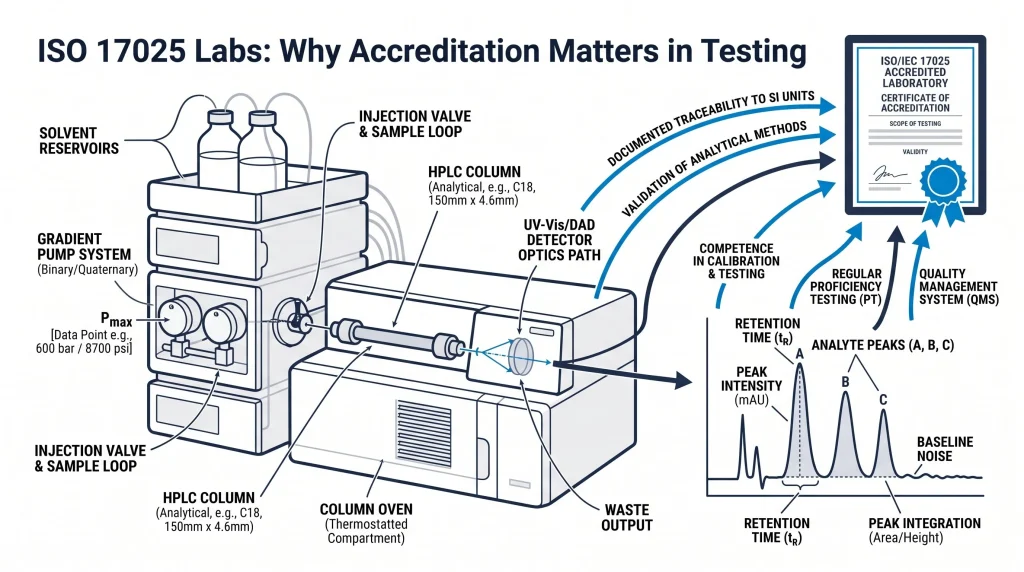
ISO 17025 accreditation is a global standard that proves a lab maintains technical competence. It also confirms precise tuning systems for formal testing. This framework ensures that any data produced by a lab follows strict, steady methods. Labs that meet these rules give sound, objective results. Their tools are tuned and staff are skilled. High testing standards protect research data integrity for peptide studies.
Next Level Pharm maintains internal quality controls to ensure steady batch performance for researchers. All inventory goes through HPLC and mass spectrometry testing. This confirms compounds meet or exceed the required grade. A 99.4% average purity mark has been confirmed across the last 100 batches. Each vial arrives as a lyophilized powder. It stays stable at room temperature with no cold chain needed.
Researchers need clear records to confirm their study designs are sound. Peptide synthesis can produce minor side products. Third-party testing proves structure and lab purity. Verified lot data allows accurate tracking through research cycles. These records confirm the quality of the compound and ensure that all findings rely on precise, written metrics.
Key Takeaways
- ISO 17025 Confirms Lab Competence: This accreditation shows a lab follows strict protocols and runs tests with high accuracy. It confirms precise tuning systems and skilled testing standards are in place.
- Certification Differs from Accreditation: Certification like ISO 9001 audits general business systems. Accreditation proves a lab’s testing competence and remains the primary standard for valid test performance.
- Accredited COA Provides Higher Quality: Data from an approved lab includes method check and formal error-margin calculation. This lowers the risk of errors and improves trust in reported purity values.
- Scope of Accreditation Limits Relevance: A lab must list specific peptide tests like HPLC within their official scope. Researchers must confirm that this status applies to the actual methods used for their sample.
- Public Verification Is Necessary: Any researcher can check a lab’s status through the online registry of the issuing body. Confirming this status ensures records provided are current and based on real testing.
These foundational concepts help researchers verify outside lab reports and internal test data. Knowing these testing frameworks ensures lab work relies on precise, verified measurements. The questions below cover quality control and testing steps. They also cover how to assess formal lab records.
What Is ISO/IEC 17025 Accreditation?
ISO/IEC 17025 is the primary global standard for testing and calibration labs. This credential confirms a lab operates with rigorous protocols to ensure sound data. Labs must meet these benchmarks. This confirms their work is ready for outside review.
This standard covers two distinct categories. First, it addresses baseline operational needs such as staff training and record management. Second, it covers the actual testing equipment and tuning methods used for assay work. These combined goals ensure each lab result remains accurate and free from bias. By meeting these criteria, a lab confirms its testing environment produces high-quality data. BPC-157 is one research compound where COA data from approved labs carries the most test weight.
How Does Accreditation Differ from Certification?
Accreditation is formal proof of lab competence for specific testing tasks. Certification confirms that a quality system meets a stated requirement. This status focuses on a lab’s skill to perform specific tasks with precision. Certification, like ISO 9001, confirms that internal business management steps meet a published standard. A lab earns certification to show its framework works. Accreditation proves its data is sound.
Earning this status requires a rigorous on-site audit by lab experts. Experts review lab equipment, methods, and staff skills against a defined scope. The scope lists valid tests. Only tests in the scope carry full accreditation weight. Third-party attestation from an outside body acts as the final check. This dual layer protects all raw data from testing. Proper scope for this status is a prerequisite for sound peptide purity data.
Why Does This Affect COA Quality?
A Certificate of Analysis (COA) is more sound from an approved lab. These standards require rigorous testing steps. This global credential confirms the lab adheres to verified methods for each test it performs. By following these protocols, a lab ensures its findings remain consistent and formally sound.
A lab with this status must establish clear tracking. This means tracking the full history of each sample. This links each result back to its source and to the tuning of testing equipment. These labs also quantify error margins. This shows the range of possible deviation in any given result. Using checked methods cuts the risk of incorrect data in reports. Without these controls, purity data lacks the weight for serious research. BPC-157 and related recovery compounds benefit from this level of records. Each vial carries batch-specific test data for full accountability.
What Are the Key Technical Requirements?
The key technical requirements include tuned equipment, method check, ongoing skill testing, and qualified staff. These components create a framework for testing that produces accurate and steady results. HPLC hardware must undergo regular tuning to ensure precise readings. Method check confirms that a specific test can detect the target peptide with sensitivity and selectivity.
Next Level Pharm provides key research compounds that align with these high lab standards. Each element in the ISO 17025 framework cuts test error. Tuned equipment gives sound signals. This applies to all testing steps. Proper method check blocks bias from unexpected lab interference. Qualified staff shield data processing from common interpretive errors. These safeguards confirm the validity of lab reports. Researchers sourcing Recovery peptides benefit from suppliers who align with these quality benchmarks. Skill testing acts as an outside check. It verifies that the lab’s performance aligns with peer benchmarks.
How Can a Lab’s Accreditation Be Verified?
This status must be checked through the official online directories of the body that performed the audit. Relying on a printed certificate alone is insufficient. These records can be outdated or inaccurate. Official registries give real-time proof that a lab holds its credentials.
In the United States, common status bodies include the A2LA (American Association for Lab Accreditation) and the ANAB (ANSI National Accreditation Board). Each has a public search database. It is free to use. Anyone can enter the name of a lab to confirm if this status is active. Some labs hold accreditation for one type of test but not for the HPLC or mass spectrometry for peptide samples. Confirm the scope first. This ensures the lab can perform the right work. GHK-Cu and other research compounds require labs with confirmed scope coverage for peptide purity methods.
What Does ‘Scope of Accreditation’ Mean?
The scope of accreditation lists every test and material a lab is qualified to analyze. It marks the limits of a lab’s skill. If a lab only holds certification for water quality or environmental testing, its status does not cover the analysis of research peptides. Confirm purity tests are within the scope. Only then accept the data.
Check if the lab uses HPLC for peptide testing. Mass spectrometry is also key. These methods confirm sequence quality. A lab might have the right equipment but lack official proof for these specific protocols. A report from an out-of-scope lab may not meet rigorous standards. Next Level Pharm matches each batch against outside lab testing. Quality in data hinges on the scope matching the intended test task.
According to PubMed (2019), ISO 17025 this status ensures measurement tracking and error-margin records in test labs. According to PubMed (2019), lab accreditation standing directly affects the defensibility of test results in regulatory and research contexts. According to PubMed (2003), skill testing under ISO 17025 identifies systematic errors in peptide quantification methods.
| Requirement | ISO 17025 Accreditation | ISO 9001 Certification |
| Focus | Technical lab competence | Business management systems |
| Assessment | On-site audit by technical experts | Document and process review |
| Scope | Specific tests and methods | Entire organization |
| Outcome | Valid test results | Consistent process adherence |
Frequently Asked Questions
What Is ISO/IEC 17025 Accreditation?
ISO/IEC 17025 is a global standard for test labs. It defines the rules for proving a lab is sound. Accreditation requires an outside audit. Staff, tools, and methods are all reviewed. Labs that earn this credential are proven competent. They generate valid, repeatable results. This credential is the main proof of lab quality. It is used in research settings worldwide.
How Does Accreditation Differ from Certification?
Accreditation proves a lab can perform specific tests accurately. Certification, such as ISO 9001, covers business processes only. It does not prove test accuracy. A lab can hold a certificate without lab accreditation. These are two separate credentials. Only accreditation validates test data reliability. Researchers must look for accreditation, not just certification.
Why Does Accreditation Affect COA Reliability?
A COA from an accredited lab is more trustworthy. These labs follow strict, formal testing steps. Accreditation mandates protocols that cut error risk. Labs must keep written evidence of all methods. Researchers get higher confidence in purity data. This oversight reduces poor-quality test results. It is the main reason researchers prefer accredited COAs.
How Can a Lab’s Accreditation Be Verified?
Find the name of the accrediting body on the lab’s document. Go to their official website. Use the public search directory. Look up the lab by name or registration number. Confirm the accreditation is active. Confirm it covers the specific tests you need. A printed certificate can be outdated. The online registry gives real-time proof. Always verify through the registry.
What Does Scope of Accreditation Mean?
The scope lists every test a lab is qualified to perform. A lab may hold accreditation for one test but not others. Holding accreditation does not mean all work is covered. Researchers must review the scope first. Confirm it includes HPLC and mass spectrometry for peptides. Without this, a COA from that lab may not apply. Match the scope to your specific testing needs.
Does ISO 17025 Accreditation Guarantee Correct Results?
No credential can guarantee a perfect result every time. All testing has inherent limits. Accreditation confirms a lab has the right staff and tools. It cuts the risk of errors significantly. But researchers must still read data carefully. Instrument drift or environmental factors can still affect results. Accreditation sets a high floor for quality. It does not remove all sources of doubt.
Is ISO 17025 a Legal Requirement for Analytical Labs?
ISO 17025 is a voluntary global standard. It is not a universal legal rule. Many labs adopt it to prove technical skill. Many research programs require it. Without it, a lab’s data may be questioned. It helps labs stand out as trusted partners. Labs with this status are more broadly accepted by researchers worldwide.
What Is Measurement Uncertainty on a Lab Report?
Measurement uncertainty is a numeric range of doubt around a result. No measurement is perfectly exact. Instruments drift. Room conditions shift. These factors add to the possible range of error. The NIH (2024) confirms this value helps researchers judge a result. It shows how much a purity reading might vary. Accredited labs must report and calculate this value per their protocol.
How Often Do Accredited Labs Undergo Reassessment?
Accredited labs must pass periodic audits to keep their status. The frequency depends on the accrediting body and the lab’s history. Most labs face reviews every year or two. These audits check that instruments are calibrated and methods are current. Staff skill is also reviewed. Failing to maintain standards means losing the credential. Regular reassessment keeps quality systems active and effective.
Why Is Tracking Important for ISO 17025 Compliance?
Tracking links each result back to a recognized global standard. It proves that instruments use correct units of measure. Without tracking, a result has no verifiable reference. Labs must document an unbroken chain of checks from measurement to standard. The Journal of Peptide Science (2020) confirms tracking is key for accurate peptide testing. It is a core part of ISO 17025 compliance.
Summary
ISO 17025 this credential is the most sound external marker of lab competence for peptide testing. Accredited labs operate under strict protocols for tuning, method check, and tracking that certification schemes like ISO 9001 do not require. For researchers working with research-grade compounds, the difference between an approved COA and an unapproved one can directly affect result validity. Confirming scope, checking online registries, and knowing error margins are the practical steps that separate sound data from unverified claims.
What Should You Do Next?
Review the COA for your lot. Confirm purity and molecular weight. Every batch is third-party tested.. Confirm test data matches the ID numbers on your vial. These steps align your lab benchmarks with verified test results.
- Confirm lab this status scope. Before accepting a COA, verify the testing lab holds active this status for HPLC and mass spectrometry.
- Check tracking records. Confirm the COA includes tuning references and error-margin values.
- Review a lot of data online.Every batch is third-party tested.. Researchers can access batch-specific records at any time.
People Also Read
- What Makes a Peptide Research Grade? Standards and Testing Explained
- BPC-157 vs TB-500: A Detailed Research contrast Guide
About the Author
Next Level Pharm Research Team
The Next Level Pharm research team is composed of biochemists and lab scientists dedicated to providing researchers with the highest-purity, COA-verified research peptides available. Every batch is HPLC and mass spec verified before dispatch.
Disclaimer: The information provided on this page is for educational and research purposes only. Next Level Pharm’s products are intended for lab research use only. They are not intended for human consumption, diagnostic, therapeutic, or medicinal purposes. This content does not constitute medical advice. Always consult a licensed healthcare skilled before making any health-related decisions.