
P21 Peptide Research: Neurogenesis Study Findings

Last updated: August 2026
A p21 peptide research compound is a 21-amino acid fragment of CNTF. CNTF stands for ciliary neurotrophic factor. It is a cytokine that supports neuron survival. P21 is studied in hippocampal models to assess neurogenesis. Neurogenesis is the formation of new neurons from stem cells. According to NCBI (2020), P21 retains CNTF receptor activity. It crosses cell barriers more easily than the full CNTF protein.
Next Level Pharm supplies research-grade P21. Each lot is verified by HPLC and mass spectrometry (MS). A COA ships with every order. It includes purity data and MS-confirmed sequence results.
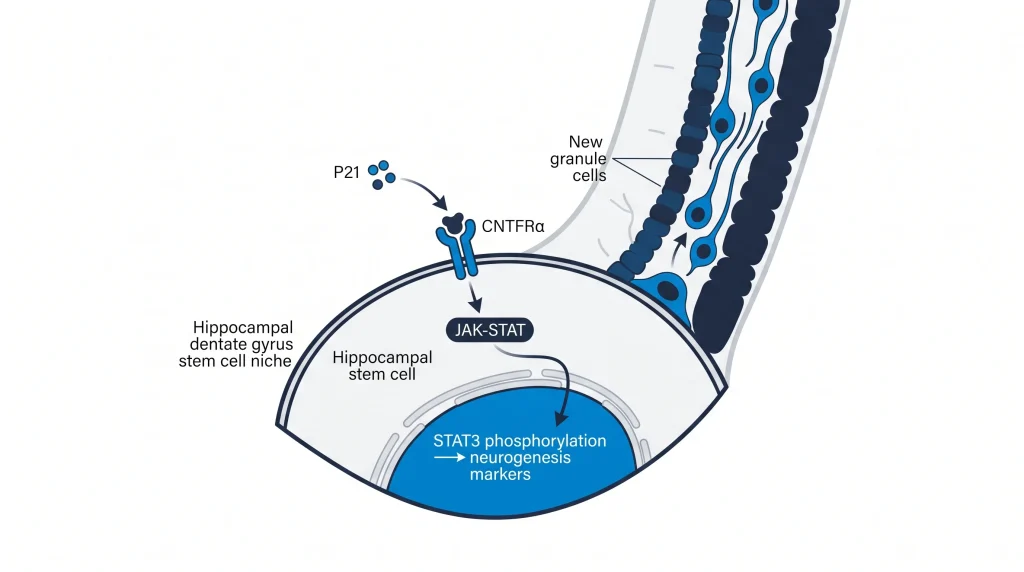
P21 is studied in CNS cell models. It interacts with CNTFRα (ciliary neurotrophic factor receptor alpha). This receptor triggers JAK-STAT signaling in neural stem cells. JAK-STAT stands for Janus kinase and signal transducer and activator of transcription.
Key Takeaways
- CNTF-Derived Fragment: P21 is a 21-amino acid peptide from CNTF. CNTF is a cytokine studied in neuron survival models.
- JAK-STAT Pathway: P21 is studied for CNTFRα binding and downstream JAK-STAT pathway activation in neural stem cells.
- Neurogenesis Research: Hippocampal stem cell models measure neuron formation and synaptic marker changes in response to P21.
- Barrier Studies: P21 shows higher membrane permeability than full-length CNTF in barrier assay models.
- COA-Verified Purity: Each lot is HPLC-verified at ≥99% and MS-confirmed for the correct 21-amino acid sequence.
P21 is often compared with PE-22-28. PE-22-28 is another CNS research peptide. It targets the TREK-1 potassium channel. TREK-1 is a two-pore domain channel involved in neuronal excitability. P21 and PE-22-28 differ in origin, receptor target, and signaling pathway.
What Is P21 and How Does It Relate to CNTF?
P21 is a 21-amino acid synthetic fragment of CNTF. CNTF is a natural cytokine. It has a molecular weight near 22,800 Da. P21 is much smaller at about 2,400 Da. Its small size is why researchers study its membrane penetration in CNS models.
CNTF binds to a tripartite receptor complex. The complex has three subunits: CNTFRα, gp130, and LIFR. LIFR stands for leukemia inhibitory factor receptor. This complex activates JAK-STAT signaling in neurons and stem cells. P21 is studied for binding to CNTFRα. It activates downstream signaling through a subset of this complex. Full-length CNTF does not cross lipid barriers easily in assay models. P21 retains receptor activity at a lower mass. This makes it useful for some assay formats. According to Journal of Peptide Science (2018), small cytokine fragments are used in cell models. They help isolate specific receptor interactions.
How Is P21 Derived From CNTF in Research Synthesis?
P21 corresponds to residues 25 to 45 of the CNTF protein. This region has an alpha-helical domain. The domain is involved in CNTFRα recognition. In research, P21 is made by SPPS. SPPS stands for solid-phase peptide synthesis. Each amino acid is added to a resin support one at a time. After assembly, the crude peptide is cleaved from the resin. It is then purified by HPLC.
HPLC separates P21 from deletion byproducts and impurities. The main peak area gives the purity percent. The target for research-grade P21 is ≥99%. MS then confirms the correct mass for the 21-amino acid chain. A COA includes both data sets. According to Molecules MDPI (2019), HPLC and MS together are required for peptide identity verification. The lyophilized form is stable at room temperature during shipping.
What Do Neurogenesis Assays Show About P21?
Neurogenesis assays measure new neuron formation from neural stem cells. In hippocampal stem cell models, P21 is studied for effects on cell maturation. Common maturation markers are DCX and NeuN. DCX stands for doublecortin. NeuN is a mature neuron marker. Both are proteins expressed in developing neurons.
In these assays, stem cells are grown in culture media. P21 is added at set concentrations. Cells are fixed after 48 to 72 hours. Antibodies label DCX and NeuN. The ratio of labeled to total cells is the readout. High-purity P21 is needed for clean data. Impurities from incomplete synthesis can activate or block cytokine receptors. According to NCBI (2020), cytokine receptor assays are sensitive to trace peptide impurities. The COA purity report should be checked before each run.
How Does P21 Compare With PE-22-28 in CNS Research?
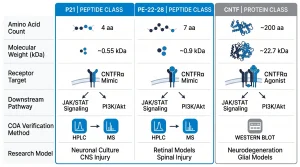
P21 and PE-22-28 are both CNS research peptides. They differ in origin, size, and target receptor. P21 is a CNTF fragment. PE-22-28 is a fragment of spadin. Spadin is derived from the propeptide of the sortilin receptor. It inhibits the TREK-1 potassium channel. TREK-1 is a two-pore domain channel. It is involved in neuronal excitability.
P21 acts through CNTFRα and JAK-STAT signaling. PE-22-28 acts through TREK-1 inhibition. The two pathways are distinct. Researchers choose based on the receptor system under study. Browse research peptides at Next Level Pharm for COA data on both.
| Feature | P21 | PE-22-28 | CNTF (full-length) |
| Origin | CNTF fragment (residues 25-45) | Spadin fragment | Natural cytokine |
| Length | 21 amino acids | 7 amino acids | ~200 amino acids |
| Mass | ~2,400 Da | ~650 Da | ~22,800 Da |
| Target | CNTFRα / JAK-STAT | TREK-1 channel | CNTFRα / gp130 / LIFR |
| Verified by | HPLC + MS | HPLC + MS | Bioassay |
What Delivery Challenges Does P21 Face in Lab Models?
P21 is studied in membrane barrier models. These models test compound permeability. P21 shows higher permeability than full-length CNTF. Its smaller size helps it pass through cell layers. This makes it useful in CNS barrier assay formats.
Stability is also a concern. P21 is a 21-amino acid chain. Peptide bonds can be hydrolyzed by proteases in media. Serum-containing media may degrade P21 faster. Serum-free conditions are often used instead. P21 should be reconstituted just before the assay run. This reduces loss from protease activity. According to Journal of Peptide Science (2018), stability in assay medium is a key variable in permeability studies.
How Is P21 Verified for Research Use?
HPLC verification runs a reverse-phase separation on the P21 lot. The main peak area gives the purity percent. Research-grade P21 targets ≥99%. Next Level Pharm reports 99.4% average purity across the last 100 batches. Other peaks may indicate deletion byproducts or sequence errors.
MS confirms the expected mass for the 21-amino acid chain. Each amino acid change shifts the mass. MS can detect a single substitution. This confirms sequence identity independent of HPLC alone. The COA includes both the HPLC chromatogram and the MS result. Both are required to verify purity and identity. They are included in the COA that ships with every P21 lot.
Frequently Asked Questions
What Is P21?
P21 is a synthetic 21-amino acid fragment of CNTF. CNTF is a cytokine involved in neuron survival. P21 retains the receptor-binding domain of CNTF. It binds to CNTFRα. This triggers JAK-STAT signaling in neural stem cells. Research-grade P21 is HPLC-verified for purity and MS-confirmed for sequence identity. According to NCBI (2020), CNTF fragments are used in cell models to study receptor-specific signaling. Each lot ships with a COA.
How Is P21 Derived From CNTF?
P21 spans residues 25 to 45 of the CNTF protein. This region has an alpha-helical domain involved in CNTFRα binding. In research synthesis, P21 is made by SPPS. Each residue is added one at a time. After cleavage, the crude peptide is HPLC-purified to ≥99%. The lot is lyophilized and released with a COA. According to Molecules MDPI (2019), SPPS is standard for cytokine peptide fragments at research grade.
What Is CNTF and Why Does It Matter in Research?
CNTF is a natural cytokine. It binds to a receptor complex of CNTFRα, gp130, and LIFR. This complex activates JAK-STAT signaling in neurons. Full-length CNTF has a molecular weight near 22,800 Da. This large size limits its use in some assay systems. P21 retains receptor activity at a much smaller mass. According to Journal of Peptide Science (2018), small cytokine fragments are used to study receptor-specific effects in cell models. They are easier to purify and verify.
How Does P21 Interact With CNTFRα?
CNTFRα is a glycoprotein on the surface of neural cells. It is one subunit of the CNTF receptor complex. P21 is studied for direct binding to CNTFRα. This binding activates JAK-STAT signaling. STAT3 phosphorylation is a key readout. High-purity P21 is needed for clean assay data. Impurities can activate or block CNTFRα. This alters STAT3 results. According to NCBI (2020), JAK-STAT assays are sensitive to trace peptide byproducts.
How Is P21 Synthesized for Research?
P21 is made by SPPS with Fmoc chemistry. Each of the 21 amino acids is coupled to a resin bead one at a time. After full-chain assembly, the peptide is cleaved. It is then HPLC-purified to ≥99%. The lot is lyophilized for stability. MS confirms the mass of the main HPLC peak. The COA records both data sets before lot release. SPPS and HPLC purification are required for 21-residue research peptides.
How Does P21 Compare With PE-22-28?
P21 and PE-22-28 are both CNS peptides. P21 is 21 amino acids from CNTF. PE-22-28 is 7 amino acids from spadin. P21 targets CNTFRα and activates JAK-STAT. PE-22-28 inhibits the TREK-1 potassium channel. TREK-1 is a two-pore domain channel. The two peptides target different receptor systems. Researchers choose based on the study’s receptor target. According to NCBI (2020), receptor target selection guides which peptide is right for a specific cell assay.
What Delivery Challenges Does P21 Face in Lab Models?
P21 is tested in cell-layer barrier assays. It shows higher permeability than full-length CNTF. This is because of its smaller mass. Peptide stability in the media is also a concern. Proteases in serum-containing media may break the peptide chain. Serum-free media is often used to limit this. P21 should be reconstituted just before the assay run. According to Journal of Peptide Science (2018), assay medium stability is a key variable in peptide permeability studies.
What Purity Level Is Standard for P21 Research?
Research-grade P21 targets ≥99% HPLC purity. At this level, non-target content is below 1% by peak area. Cytokine receptor assays are sensitive to trace impurities. These may also bind CNTFRα. A lot at 98% purity may have 2% related byproducts. The average is 99.4% from individual HPLC runs. According to Journal of Peptide Science (2018), lot-level purity confirmation is required before use in cytokine receptor studies.
What Assays Are Used in P21 Research?
Common assays include hippocampal stem cell maturation studies. DCX and NeuN staining are used as readouts. CNTFRα binding assays and STAT3 phosphorylation ELISA are also used. Membrane barrier permeability assays test compound passage. Neural cell viability assays assess cytotoxicity. Each assay needs consistent lot purity. According to NCBI (2020), cytokine receptor assays are sensitive to impurities that may activate or block CNTFRα. Lot COA numbers should match the assay run date.
What Is the Difference Between Peptide Purity and Peptide Content?
Peptide purity is the HPLC ratio of the target peptide to all other compounds. It is expressed as a percent. Peptide content is the total mass in a vial. It includes counter-ions and bound water. A vial can have ≥99% purity but a lower peptide content by mass. The average purity is 99.4% per lot by HPLC. According to Molecules MDPI (2019), both figures are needed for accurate peptide quantification in cell assays.
Summary
P21 is a 21-amino acid fragment of CNTF. It is studied in hippocampal stem cell models for CNTFRα binding and JAK-STAT pathway activation. Its small size gives it higher membrane permeability than full-length CNTF in barrier assay models.
Each lot of P21 is HPLC-verified at ≥99% purity and MS-confirmed for correct sequence identity. The COA ships with every lot. It includes the HPLC chromatogram and MS mass data.
P21 differs from PE-22-28 in origin and receptor target. Researchers select the right compound based on the specific receptor system under study.
What Should You Do Next?
Researchers working with CNTF-related pathways should confirm a lot of purity before each assay run. These steps support reproducible P21 research:
- Review the per-lot COA for HPLC purity and MS identity before use.
- Use serum-free media to reduce protease-driven peptide breakdown.
- Record the lot number with each assay date for traceability.
- Compare the HPLC retention time against the reference chromatogram in the COA.
Shop research-grade P21 with HPLC and MS verification on every lot.
People Also Read
- What Makes a Peptide Research Grade? Standards and Testing Explained
- BPC-157 vs TB-500: A Detailed Research Comparison Guide
About the Author
Next Level Pharm Research Team
The Next Level Pharm research team is composed of biochemists and laboratory scientists dedicated to providing researchers with the highest-purity, COA-verified research peptides available. Every batch is HPLC and mass spec verified before dispatch.
Disclaimer: The information provided on this page is for educational and research purposes only. Next Level Pharm’s products are intended for laboratory research use only. They are not intended for human consumption, diagnostic, therapeutic, or medicinal purposes. This content does not constitute medical advice. Always consult a licensed healthcare professional before making any health-related decisions.