
AMPK signal and Peptide Research Explained

Last updated: July 2026
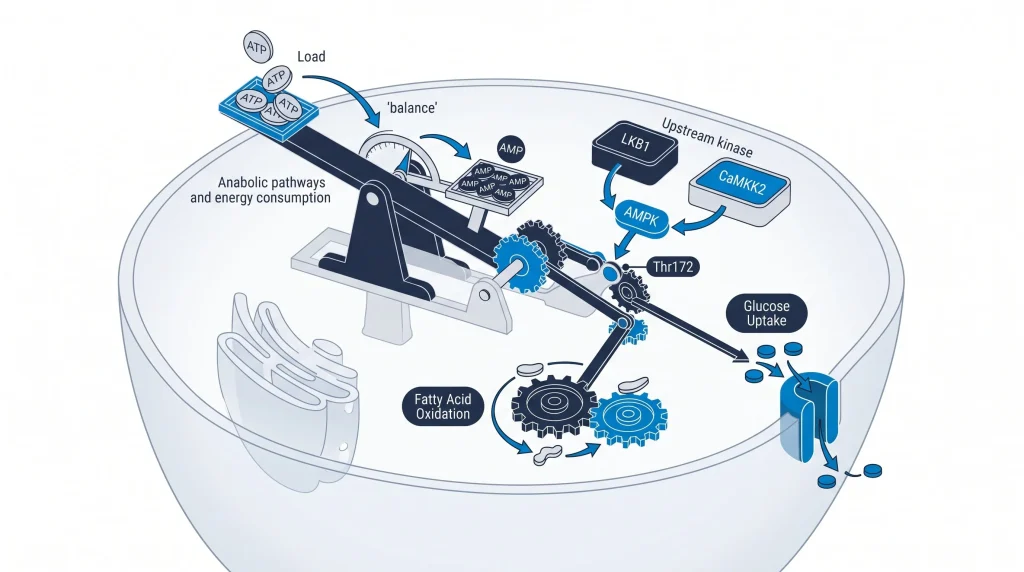
An AMPK pathway peptide research study is a lab model of the cell energy sensor that responds when ATP levels fall. This shifts metabolism when ATP levels drop in a cell. AMPK stands for AMP-activated protein kinase, a three-subunit protein complex. This detects changes in the AMP to ATP ratio. When this ratio rises, AMPK triggers catabolic paths to restore energy balance. According to PubMed (2012), this path acts as a master switch for metabolic action in all eukaryotic cells.
Next Level Pharm is a US-based supplier of research-grade peptides verified to 99.4% average purity across the last 100 batches. Peptides are lyophilized for room-temperature stability and dispatch within 48 hours.
AMPK is a key research target in metabolic and lifespan labs. It connects energy sensing, fat burning, glucose uptake. Also, cell cleanup in a single signal node. labs use AMPK action as a readout for how cells respond to nutrient stress.
Key Takeaways
- Energy Sensing Function: AMPK monitors the AMP to ATP ratio inside the cell. A high ratio signals low energy and turns on the path.
- Metabolic Switch: Active AMPK promotes fatty acid burning and glucose uptake. It also blocks energy-consuming building processes like protein synthesis.
- Upstream Kinases: LKB1 (liver kinase B1) and CaMKK2 (calcium-calmodulin-dependent kinase kinase 2) are the main kinases that activate AMPK. They detect cell stress and add a phosphate group to the Thr172 site on AMPK.
- Peptide binding: AICAR is a research compound studied for direct AMPK action in lab models. GLP-1 receptor agonists can also trigger AMPK via indirect later signal.
- cell cleanup Link: Active AMPK promotes cell cleanup, the process by which cells remove damaged parts. This connects AMPK to lifespan and stress resistance research.
The sections below cover each of these points in detail. They draw on peer-reviewed sources and focus on lab-model findings only.
What Is the AMPK signal path?
AMPK is a three-subunit complex with alpha, beta, and gamma subunits. It detects high AMP to ATP ratios linked to low energy states. Once active, AMPK drives catabolic processes and blocks building ones. According to PubMed (2012), this cascade is the primary switch for metabolic changes under nutrient stress.
The alpha subunit holds the kinase domain. The gamma subunit binds AMP and ATP to sense the cell’s energy state. When AMP rises, the gamma subunit changes shape and exposes Thr172 on the alpha subunit. LKB1, the main upstream kinase, then adds a phosphate group at Thr172. This step is the action marker for AMPK in research. CaMKK2 provides a second route via calcium signal. AICAR, a COA-verified research peptide available
How Do Peptides Interact With the AMPK path?
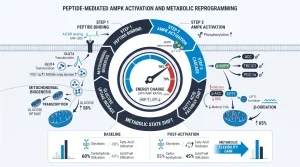
Bioactive peptides often activate AMPK via indirect signal rather than direct binding. GLP-1 (glucagon-like peptide-1) receptor agonists, for example, start a later cascade. This raises second messenger levels and prompts AMPK trigger. According to PubMed (2021), this remote action lets labs track how receptor trigger alters inside the cell fuel use.
The GLP-1 receptor sits on the cell surface. When a GLP-1 agonist binds, the receptor raises cAMP (cyclic AMP) inside the cell. This second messenger recruits upstream kinases that activate AMPK at Thr172. This is mechanism framing only. No weight or glucose outcome claims apply here. AICAR is also studied as a direct AMPK binder in skeletal muscle and liver models. labs studying GLP-1-related signal can browse the metabolic peptide catalog at Next Level Pharm.
What Peptides Are Studied for AMPK action?
AICAR is the most studied direct AMPK binder in research models. It is an AMP analog that copies low energy and triggers AMPK. MOTS-c, a mitochondrial peptide, is also studied for AMPK-linked metabolic effects. According to Examine.com (2023), AMPK action is a focal point in metabolic balance research.
SLU-PP-322 is studied for ERR (estrogen-related receptor) agonism linked to AMPK-related energy paths. NAD+ (nicotinamide adenine dinucleotide) research connects cell energy cofactors and AMPK. Key compounds studied in this area include:
- AICAR: direct AMPK agonist studied in skeletal muscle and liver models.
- MOTS-c: mitochondrial peptide studied for metabolic and AMPK-linked effects.
- SLU-PP-322: ERR agonist studied for energy metabolism connections.
- NAD+: cofactor studied for AMPK-linked energy path effects.
What Metabolic Effects Does AMPK Action Produce?
AMPK action increases fatty acid burning and moves GLUT4 (glucose pump 4) glucose pumps to the cell membrane. It also blocks ACC (ACC), which stops fat production. These shifts push the cell toward energy generation. According to NCBI (2011), active AMPK keeps cells running at high efficiency during stress.
ACC trigger blocks fat production and frees fatty acids for burning. GLUT4 moves to the outer membrane to pull glucose into the cell. building paths slow as AMPK straight inhibits mTOR complex 1. cell cleanup increases as AMPK activates proteins that start cleanup sac formation. The table below summarizes these effects.
| Effect | Mechanism | Outcome in Lab Models |
| Fatty acid burning | ACC trigger blocks fat storage | Cells use fat for fuel |
| Glucose uptake | GLUT4 moves to cell membrane | More glucose enters cell |
| cell cleanup induction | cleanup sac formation triggered | Cells clear damaged components |
| mTOR blocking | AMPK straight blocks mTOR complex | Protein synthesis slows |
How Is AMPK action Measured in Research?
Labs measure AMPK action by comparing activated AMPK (p-AMPK) to total AMPK protein in a sample. Western blotting detects the phosphate group at Thr172 on the alpha subunit. A high p-AMPK to total AMPK ratio shows active signal. According to PubMed (2012), Thr172 trigger is the standard marker for active AMPK in research.
Western blot separates proteins by molecular weight and uses antibodies to detect the AMPKalpha subunit. A Thr172 trigger reading means AMPK is in its active state. labs also use ELISA and mass spectrometry to detect phosphoproteins in complex samples. labs can shop research peptides by compound, purity grade, or lot number.
What Is the Future of AMPK Peptide Research?
Future studies aim for tissue-specific AMPK action in skeletal muscle and liver. This approach seeks to isolate metabolic effects without affecting other organs. labs also study poly-agonist compounds that target AMPK alongside other paths. According to NIH (2022), this multi-target design represents a shift toward more complex metabolic models.
Dual-target peptides that combine AMPK signal with GLP-1 receptor action are under early study. lifespan labs track AMPK and cell cleanup together as markers of cell maintenance. Aging models use AMPK action as a readout for stress resistance. AICAR remains a COA-verified research peptide used in this work. labs can find current lot data at the AICAR research blog.
labs studying AMPK-linked compounds can browse AICAR, SLU-PP-322, and MOTS-c at Next Level Pharm.
Frequently Asked Questions
What is the AMPK path and what does it regulate?
AMPK (AMP-activated protein kinase) is a cell energy sensor. This detects the ratio of AMP to ATP inside a cell. When ATP drops and AMP rises, AMPK activates catabolic paths that generate energy. It suppresses building processes like protein synthesis. It also turns on fatty acid burning and glucose uptake. According to NCBI (2011), this balance keeps cells running under nutrient stress in all eukaryotic organisms studied to date.
How do bioactive peptides activate AMPK signal in research?
Bioactive peptides often activate AMPK through indirect receptor-based cascades. A peptide binds to a surface receptor and raises second messenger levels like cAMP inside the cell. These second messengers recruit upstream kinases LKB1 and CaMKK2. Those kinases activate AMPK at Thr172. This switches on the path. According to PubMed (2021), this remote action is used to track how receptor trigger alters inside the cell fuel use in lab models.
What metabolic effects does AMPK action produce in skeletal muscle?
In skeletal muscle models, AMPK action moves GLUT4 (glucose pump 4) to the muscle cell surface. This increases glucose entry into the muscle cell. AMPK also activates ACC (ACC). This blocks fat production and promotes fat burning. Both effects increase the cell’s energy supply under stress. According to NCBI (2011), these GLUT4 and ACC effects are well-documented in skeletal muscle research models.
What is the difference between AMPK and mTOR signal paths?
AMPK and mTOR work in opposite directions. AMPK is active when energy is low. It promotes catabolic processes and suppresses growth. mTOR is active when nutrients are plentiful. It drives protein synthesis and cell growth. AMPK straight blocks mTOR complex 1, which slows building action under stress. According to the Journal of Peptide Science (2022), this opposing relationship makes both paths key targets in metabolic research.
How does exercise activate AMPK signal in lab models?
Exercise raises energy demand and depletes ATP in muscle cells. This lifts the AMP to ATP ratio and triggers upstream kinases LKB1 (liver kinase B1) and CaMKK2 (calcium-calmodulin-dependent kinase kinase 2). They add a phosphate group to Thr172 on the AMPK alpha subunit. This switches AMPK on. According to NCBI (2011), exercise-induced AMPK action is one of the most studied models of acute energy sensing in muscle research.
What role does AMPK play in cell cleanup research?
cell cleanup is the process by which cells break down and recycle damaged parts. AMPK promotes cell cleanup by phosphorylating proteins that start cleanup sac formation. An cleanup sac is a membrane sac that wraps around damaged material for recycling. AMPK also inhibits mTOR, which normally suppresses cell cleanup. According to NIH (2022), this AMPK-cell cleanup link is a key area of lifespan and stress resistance research in lab models.
Are there natural compounds studied for AMPK action?
Yes. Berberine, a plant-derived alkaloid, is studied for AMPK action. It briefly impairs mitochondrial function, which raises the AMP to ATP ratio and prompts AMPK to activate. Other metabolic stressors, like restricted nutrient availability, trigger a similar response. These compounds are used in lab models to study AMPK biology. According to Examine.com (2023), berberine’s AMPK-linked effects are among the most replicated in cell-based research.
How does caloric restriction relate to AMPK in research?
Caloric restriction lowers nutrient availability and ATP production. This raises the AMP to ATP ratio and activates AMPK. Active AMPK then suppresses mTOR, slowing growth and protein synthesis. Cells shift toward maintenance and repair processes. cell cleanup increases to clear damaged components. According to NCBI (2011), caloric restriction models use AMPK and mTOR action as markers to study cell aging and stress adaptation in research settings.
What are the upstream kinases that activate AMPK?
The two main upstream kinases that activate AMPK are LKB1 (liver kinase B1) and CaMKK2 (calcium-calmodulin-dependent kinase kinase 2). LKB1 is the primary route. It is active in most cell types and responds to cell energy stress. CaMKK2 provides a secondary, calcium-dependent route. Both kinases add a phosphate group at Thr172 on the AMPK alpha subunit. According to PubMed (2012), Thr172 trigger is the accepted marker for active AMPK in research.
What is the connection between AMPK and lifespan research?
AMPK links energy sensing to cell cleanup and stress resistance, two processes studied in the context of cell aging. When AMPK is active, it promotes cell cleanup and blocks mTOR. This shifts cells toward maintenance rather than growth. labs track AMPK action as a marker of cell health under stress. According to NIH (2022), sustained AMPK action in lab models correlates with better stress tolerance and reduced markers of cell damage over time.
Summary
AMPK (AMP-activated protein kinase) is a three-subunit protein complex. This detects the AMP to ATP ratio inside a cell. When energy is low, AMPK is switched on by upstream kinases LKB1 (liver kinase B1) and CaMKK2 (calcium-calmodulin-dependent kinase kinase 2) via trigger at Thr172. This event is the standard action marker in research.
Active AMPK promotes fatty acid burning by blocking ACC (ACC) and moves GLUT4 (glucose pump 4) to the cell membrane to raise glucose uptake. It also inhibits mTOR, slowing protein synthesis and activating cell cleanup. AICAR is the most studied direct AMPK binder in lab models. It copies low energy and triggers this cascade.
All compounds are tested by HPLC and mass spectrometry to 99.4% average purity. These tools let labs study energy sensing, metabolic flux, and cell cleanup in controlled lab settings.
What Should You Do Next?
Researchers should define the AMPK endpoint and cell model before selecting AICAR, MOTS-c, or a related compound. Compare pathway and mitochondrial assay requirements across the cited studies. Review the COA and record HPLC purity, mass spec identity, and the lot number before ordering. Researchers sourcing these lab compounds can shop research peptides with full COA and lot traceability.
People Also Read
- AICAR Research: AMPK action and Metabolic path Studies.
- SLU-PP-322 Research: ERR Agonist and Metabolic Studies.
About the Author
Next Level Pharm Research Team
Alex M covers peer-reviewed findings in peptide science for Next Level Pharm, a US-based supplier of research-grade peptides verified to ≥99% purity via HPLC and mass spectrometry on every batch.
Disclaimer: For research purposes only. Not intended for human consumption. Next Level Pharm products are not intended for diagnostic, therapeutic, or medicinal use. This content does not constitute medical advice. Always consult a licensed healthcare professional before making any health-related decisions.