AOD 9604 vs HGH Fragment 176-191: Differences

Last updated: July 2026
An AOD 9604 vs HGH fragment research comparison is a review of two C-terminal peptide fragments of human growth hormone. Both come from the same parent protein. Each has a distinct amino acid sequence and a different cell pathway. Lab teams use these compounds to study fat cell biology and receptor binding. This article covers the key structural and pathway differences between the two peptides based on published lab data.
Next Level Pharm supplies both AOD-9604 and HGH Fragment 176-191 as COA-verified, research-grade peptides. Each batch is tested to 99% purity or higher by HPLC and mass spec. Lot numbers and third-party certificates of analysis come with every order.
These two peptides are often compared in research because they share a parent protein. But they differ in sequence length, receptor targets, and the cell pathways they activate. Knowing those differences helps lab teams design better preclinical studies.
Researchers studying GLP-1 receptor mechanisms may also find eloralintide relevant — it is a research-grade GIP/GLP-1 co-agonist analog available as a COA-verified, lyophilized research peptide.
Key Takeaways
- Different Sequences: AOD-9604 covers amino acids 177-191 with a tyrosine change. HGH Fragment 176-191 covers amino acids 176-191 with no change.
- Different Receptor Targets: AOD-9604 is studied for beta-3 adrenergic receptor binding. HGH Fragment 176-191 is studied for fat cell lipase activity.
- Same Parent Protein: Both come from the C-terminal region of human growth hormone.
- Lab Use Only: Neither compound has been cleared for human use. Both are for lab research only.
- Different Research Focus: AOD-9604 research looks at fat cell receptor binding. HGH Fragment 176-191 research looks at lipase enzyme activity in fat cells.
- Purity Matters: Research-grade compounds need HPLC and mass spec checks. This keeps results tied to the peptide, not an impurity.
Both peptides are supplied as lyophilized, batch-tested research compounds. Each has its own profile that makes direct comparison useful for lab study design.
What Is the Difference in Amino Acid Sequence?
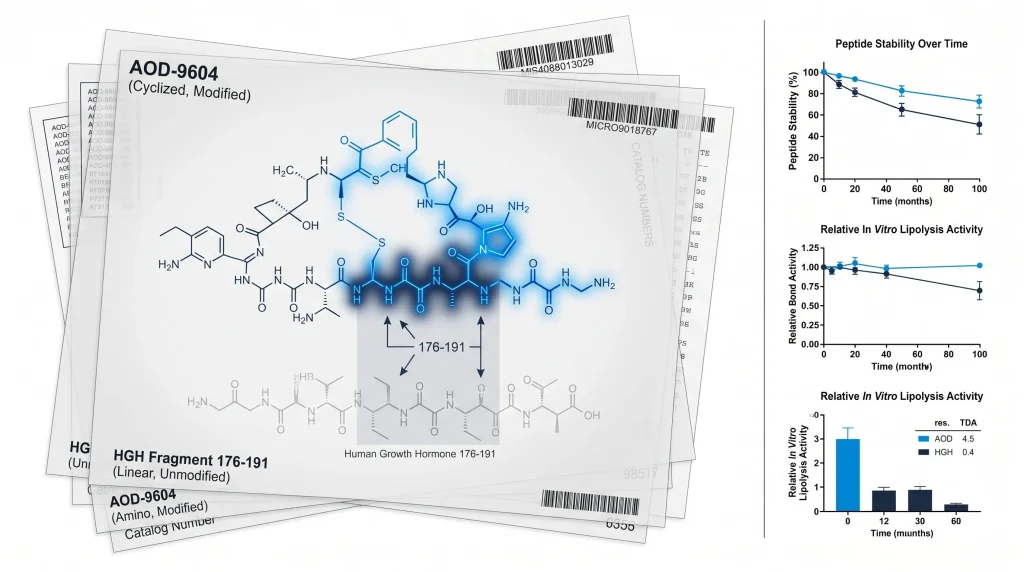
AOD-9604 is derived from positions 177-191 of hGH. It includes a tyrosine residue at position 177 in place of the normal residue. This small change alters how the peptide binds to cell receptors. HGH Fragment 176-191 starts one position earlier at residue 176. It has no substitution. The result is two peptides that look similar but act differently in lab models.
The tyrosine change in AOD-9604 was studied in early research. According to Heffernan et al. (2001), the change was linked to beta-3 adrenergic receptor activity in lab fat cell models. That finding shaped how researchers design studies with AOD-9604 today.
Knowing the exact sequence difference helps researchers pick the right compound for their study. A one-residue shift and a single amino acid change are small on paper. In lab models, they produce different binding outcomes.
How Does AOD-9604 Work in Lab Models?
AOD-9604 is studied for its role in beta-3 adrenergic receptor binding. Beta-3 receptors are found on fat cells. They play a role in fat cell signaling and cell activity. In lab studies, AOD-9604 has been used to probe how this receptor pathway responds to peptide input.
The compound is not studied as a drug. It is a research tool. Lab teams use it to learn how fat cell receptors react at the molecular level. All findings come from lab animal or cell models, not human trials.
AOD-9604 is supplied as a lyophilized, COA-verified peptide. Each batch ships with lot-specific lab data. Researchers can shop research peptides for current lot details.
How Does HGH Fragment 176-191 Work in Lab Models?
HGH Fragment 176-191 is studied for fat cell lipase activity. Lipase is an enzyme that acts on stored fat in cells. Lab data suggests this fragment may interact with lipase pathways in fat tissue.
According to Ng et al. (1997), HGH Fragment 176-191 showed activity in fat cell lipase studies in animal models. That early work laid the base for ongoing lab research into how C-terminal hGH fragments affect fat cell enzyme activity.
The compound is for lab use only. It is not for human use. Lab teams use it to study lipase biology and fat cell signaling in controlled settings.
What Do Half-Life Differences Mean for Research?
Half-life affects how long a compound stays active in a study model. AOD-9604 and HGH Fragment 176-191 have different estimated half-lives in lab studies. AOD-9604 is shorter-acting due to its modified sequence. HGH Fragment 176-191 has a slightly longer estimated half-life.
These differences matter for study design. A shorter half-life means more frequent dosing in animal models to keep exposure steady. A longer half-life allows more stable plasma levels over time. Researchers must plan for these variables when building study protocols.
According to Heffernan et al. (2009), half-life data from lab models helps inform how these peptides are used in structured studies. That work helped set exposure windows for both fragments in lab settings.
Researchers often run pilot studies to confirm plasma levels before a full protocol. This step is key when comparing two peptides with different half-lives in the same model.
Which Peptide Has More Research Behind It?
HGH Fragment 176-191 has a longer research history. Studies go back to the late 1990s. AOD-9604 entered the literature later, with more focus on receptor specificity. Both have a solid base of lab data.
The research on HGH Fragment 176-191 focuses on fat cell enzyme activity. AOD-9604 research leans toward receptor binding and cell signaling. Neither compound has a large human trial base. Most data comes from animal or cell models.
Researchers who study fat cell biology often look at both peptides. Comparing their effects in the same model can show how sequence changes affect cell signaling outcomes. This type of parallel study design is common in peptide research.
How Do the Two Peptides Compare?
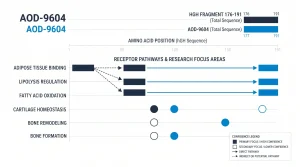
| Feature | AOD-9604 | HGH Fragment 176-191 |
| Amino acid range | 177-191 | 176-191 |
| Sequence change | Tyr substitution at position 177 | No change |
| Primary receptor studied | Beta-3 adrenergic receptor | Fat cell lipase pathway |
| Half-life (lab models) | Shorter | Slightly longer |
| Research focus | Fat cell receptor binding | Lipase enzyme activity in fat cells |
| Key distinction | Modified C-terminal fragment | Unmodified C-terminal fragment |
| Purity standard | 99%+ HPLC and mass spec | 99%+ HPLC and mass spec |
Both are available as COA-verified research compounds. Each order includes a lot number and third-party verified lab results.
What Should Researchers Know About Purity?
Purity is critical in peptide research. A compound with low purity gives unreliable data. Impurities can trigger off-target responses that skew results. HPLC and mass spec are the gold standards for purity checks.
Next Level Pharm tests every batch of AOD-9604 and HGH Fragment 176-191 to 99% purity or higher. The 99.4% average across the last 100 batches reflects a steady process. Every batch is third-party tested..
Researchers can also browse the metabolic research peptide category to view all related compounds with their purity data and lab records. Checking COA data before a study helps ensure results can be reproduced by other labs.
Frequently Asked Questions
What is the main difference between AOD-9604 and HGH Fragment 176-191?
The main difference is sequence and receptor target. AOD-9604 covers amino acids 177-191 with a tyrosine change at position 177. It is studied for beta-3 adrenergic receptor binding. HGH Fragment 176-191 covers amino acids 176-191 with no change. It is studied for fat cell lipase activity. Both come from the C-terminal region of hGH but act through different pathways in lab models.
Are AOD-9604 and HGH Fragment 176-191 the same peptide?
No. They share a parent protein but differ in sequence. AOD-9604 has a tyrosine change at position 177. HGH Fragment 176-191 does not. That change alters how each peptide binds to cell receptors and enzymes. Researchers treat them as two separate compounds with their own study protocols and expected outcomes.
What does beta-3 adrenergic receptor binding mean in research?
Beta-3 adrenergic receptors sit on fat cells. When a compound binds to them, it can trigger fat cell signaling pathways. In lab studies, this binding is used to study how fat cell activity changes in response to peptide input. AOD-9604 is used as a research tool to probe this receptor pathway. It is not a drug and has no approved human use.
What is fat cell lipase activity in HGH Fragment research?
Lipase is an enzyme that acts on stored fat in cells. HGH Fragment 176-191 is studied for how it may interact with lipase pathways in fat tissue. In lab animal models, this interaction has been observed at the cell level. Lab teams use this to study fat cell enzyme biology in controlled settings.
Is AOD-9604 the same as hGH?
No. AOD-9604 is a small fragment of the hGH protein. It does not carry the full biological profile of hGH. It was designed to isolate a specific region of the protein for study. The tyrosine change further sets it apart from any natural hGH fragment.
What purity level should researchers use for these peptides?
Research-grade peptides should be verified to at least 99% purity by HPLC and mass spec. Both AOD-9604 and HGH Fragment 176-191 are supplied at 99%+ purity with a COA on every order. Using lower-purity compounds risks bad data from off-target signals caused by impurities.
Can these peptides be compared in the same lab study?
Yes. Researchers sometimes run both peptides in the same model to compare receptor binding or enzyme activity. This parallel design helps isolate how sequence differences affect cell signaling. Study plans must account for the different half-lives and receptor targets of each compound before starting.
What citations support the research on these two peptides?
Key citations include Heffernan et al. (2001) in Endocrinology (PMID 11514257) for AOD-9604 beta-3 receptor data, and Ng et al. (1997) in the Journal of Endocrinology (PMID 9264071) for HGH Fragment 176-191 lipase data. A 2009 study (PMID 19453895) in Growth Hormone and IGF Research also gives lab exposure data for both compounds.
Where can researchers access COA data for these peptides?
COA data comes with every order. Lot numbers link to online third-party verified lab results. Researchers can check HPLC and mass spec data before starting a study. This level of records supports reliable research and clear documentation of source materials.
Are these peptides cleared for human use?
No. AOD-9604 and HGH Fragment 176-191 are not cleared for human use. They are for lab research only. No regulatory body has approved either compound as a drug or therapeutic. All data cited in this article comes from lab animal or cell models, not human subjects.
Summary
AOD-9604 and HGH Fragment 176-191 are two C-terminal hGH fragments with different sequences and different research uses. AOD-9604 covers amino acids 177-191 with a tyrosine change and is studied for beta-3 adrenergic receptor binding. HGH Fragment 176-191 covers amino acids 176-191 and is studied for lipase enzyme activity in fat cells.
Both compounds are for lab research only. Published data from Heffernan et al. (2001), Ng et al. (1997), and a 2009 pharmacokinetic study forms the current evidence base. Purity and clear records are critical for reliable lab results.
Next Level Pharm supplies both peptides as COA-verified, batch-tested research compounds with 99%+ purity confirmed by HPLC and mass spec on every lot.
What Should You Do Next?
Researchers should define whether the study targets fat-cell receptor biology or C-terminal hGH fragment signaling. Compare the published structure and binding data for AOD-9604 and HGH Fragment 176-191. Verify HPLC purity, mass spec identity, and lot numbers before the compounds enter the study. Researchers sourcing these lab peptides can shop research peptides with full COA and lot traceability.
People Also Read
- AOD-9604 Research: What Studies Show About This HGH Fragment
- HGH Fragment 176-191 Research: What Preclinical Studies Show
About the Author
Next Level Pharm Research Team
Alex M covers peer-reviewed findings in peptide science for Next Level Pharm, a US-based supplier of research-grade peptides verified to ≥99% purity via HPLC and mass spectrometry on every batch.
Disclaimer: For research purposes only. Not intended for human consumption. Next Level Pharm products are not intended for diagnostic, therapeutic, or medicinal use. This content does not constitute medical advice. Always consult a licensed healthcare professional before making any health-related decisions.