
Bioregulators vs Peptides: How Mechanisms Differ

Last updated: July 2026
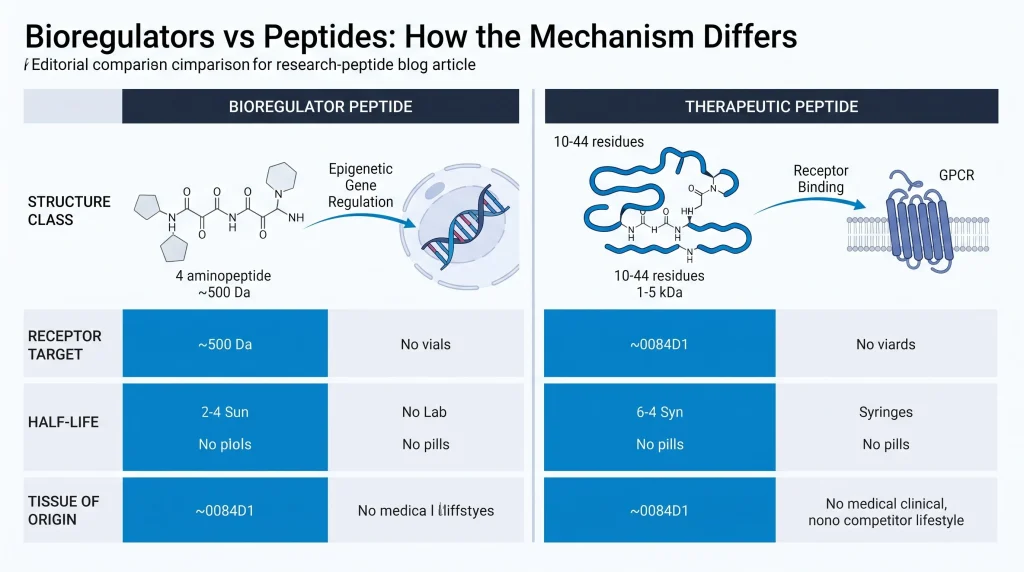
A bioregulator is a short amino acid chain studied for effects on gene activity inside cells. A research peptide is also an amino acid chain, but it usually acts on cell surface receptors. Both are lab-synthesized. Both are tested in cell and animal models. According to Khavinson VKh et al. (2002) (PMID 11756978), short 2-4 amino acid peptides showed tissue-specific effects on gene expression by acting on chromatin (DNA-protein complexes) inside cells. All cited data come from cell and animal studies.
Next Level Pharm is a US-based supplier of research-grade peptides. Both bioregulators (Epithalon, Cardiogen, Cortagen) and longer research peptides (BPC-157, Semax, SS-31) are available as COA-verified compounds. Each lot is tested to ≥99% purity by HPLC and mass spec. The average purity across the last 100 batches is 99.4%.
These compounds are not approved drugs. They are studied only in cell and animal models. All findings cited here come from such models.
Key Takeaways
- Bioregulators Are 2 to 4 Amino Acids Long: Khavinson bioregulators have very short sequences. Cardiogen is 2 amino acids (Ala-Glu). Epithalon is 4 amino acids (Ala-Glu-Asp-Gly). Their short length lets them enter the nucleus and act on DNA.
- Longer Peptides Act on Cell Surface Receptors: Research peptides like BPC-157 and Semax bind to receptors on the cell surface. These receptors trigger signals inside the cell.
- Bioregulators Are Tissue-Specific: Each Khavinson bioregulator is linked to a specific tissue type. Cardiogen is linked to cardiac tissue. Crystagen is linked to eye tissue. This specificity comes from their gene-level mechanism.
- Longer Peptides Often Cross Tissue Types: Signaling peptides like BPC-157 and SS-31 show effects in multiple tissue types in cell and animal models. Their receptor targets are found in many cell types.
- Both Types Are for Lab Research Only: Neither bioregulators nor research peptides are approved for human clinical use. All data come from cell and animal models.
Researchers use both types to study how amino acid chains affect gene activity in cell models. The two classes target different steps in the cell signaling chain.
What Is a Bioregulator?
A bioregulator is a very short peptide (2 to 4 amino acids) studied for effects on gene activity at the chromatin level. Chromatin is the complex of DNA and proteins inside the cell nucleus. When a bioregulator binds to chromatin, it can change which genes are active.
This model was developed by Vladimir Khavinson and his team at the St. Petersburg Institute of Bioregulation and Gerontology. They isolated short peptides from organ extracts in the 1970s and 1980s. They found that these peptides had tissue-specific effects on gene expression.
Bioregulator examples from the Khavinson program include: Epithalon (pineal gland, Ala-Glu-Asp-Gly), Cardiogen (cardiac tissue, Ala-Glu), Cartalax (cartilage, Ala-Glu-Asp-Arg), and Crystagen (eye tissue, Lys-Glu-Asp-Ser). Each targets a different tissue type.
What Is a Research Peptide?
A research peptide is a lab-synthesized amino acid chain (usually 5 to 43 amino acids) studied for effects on cell surface receptors or enzyme targets. These peptides do not typically enter the cell nucleus. Instead, they bind to proteins on the outside of the cell.
Surface receptors include G protein-coupled receptors (GPCRs), receptor kinases, and integrins. When a peptide binds a receptor, it starts a chain of events inside the cell. This chain is called a signaling pathway.
Examples of longer research peptides include BPC-157 (15 amino acids, VEGF signaling) and SS-31 (4 amino acids, mitochondrial target). Others include Semax (7 amino acids, BDNF signals) and TB-500 (actin-binding properties). Each binds to a different target.
How Do Bioregulators Enter the Cell Nucleus?
Bioregulators are small enough to pass through the cell membrane and the nuclear membrane. Normal cells have a size limit for what can enter the nucleus. Short peptides (under about 500 daltons) can pass through nuclear pore channels without active transport.
Inside the nucleus, short peptides can bind to histone proteins (the proteins wrapped by DNA in chromatin) or to specific DNA sequences. This changes how easily genes in that region are read. The result is a change in gene expression for that tissue type.
According to Khavinson VKh et al. (2020) (doi:10.3390/molecules25215156), short bioregulator peptides show gene expression changes consistent with direct chromatin interaction in cell models. These are in vitro findings. They do not reflect results in humans.
What Is Tissue Specificity in Bioregulator Research?
Tissue specificity means that a bioregulator changes gene activity in one tissue type but not in others. Cardiogen changes gene markers in cardiac cells. Crystagen changes gene markers in eye cells. The same peptide does not always show the same effects in a different cell type.
This specificity is studied by exposing different cell types to the same bioregulator. Scientists then compare gene expression profiles. If the change is larger in one cell type, the peptide is said to be tissue-specific for that type.
Tissue specificity is a key feature of the Khavinson model. It supports the idea that bioregulators interact with chromatin sequences that are active only in certain tissue types.
How Do Longer Peptides Act on Receptors?
Longer research peptides (5 to 43 amino acids) bind to specific proteins on the cell surface. These proteins are called receptors. The match between a peptide and its receptor is like a key in a lock. Only the right shape fits.
When the peptide binds, the receptor changes shape. This shape change starts a signal inside the cell. The signal may turn on a gene, activate an enzyme, or change how the cell moves or divides.
According to Seiwerth S et al. (2017) (PMID 28087487), BPC-157 showed tissue-protective gene marker changes in cell models through growth factor receptor systems. This is different from the direct chromatin mechanism of Khavinson bioregulators. These are in vitro and animal model findings only.
How Do These Two Classes Compare in Research?
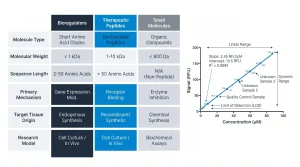
| Feature | Khavinson Bioregulator | Longer Research Peptide |
| Length | 2 to 4 amino acids | 5 to 43 amino acids |
| Molecular weight | Under 500 daltons | 500 to 5,000+ daltons |
| Primary target | Chromatin (nucleus) | Cell surface receptor or enzyme |
| Tissue specificity | High (tissue-derived) | Variable (receptor-dependent) |
| Research origin | Soviet/Russian bioregulator program | International peptide research |
| Purity standard | ≥99% HPLC + mass spec | ≥99% HPLC + mass spec |
| Research use | Gene expression assays | Receptor binding and signaling assays |
| Application | Lab research only | Lab research only |
Frequently Asked Questions
What Is the Difference Between a Bioregulator and a Peptide?
All bioregulators are peptides, but not all peptides are bioregulators. The term bioregulator refers to very short 2-4 amino acid peptides studied for direct gene expression effects at the chromatin level. Longer research peptides (5 to 43 amino acids) work at the cell surface. They bind to receptors that trigger signaling pathways. Both types are lab-synthesized amino acid chains and both are studied in cell and animal models only.
What Is a Khavinson Bioregulator?
A Khavinson bioregulator is a short peptide (2 to 4 amino acids) developed by Vladimir Khavinson and his team. They isolated these peptides from organ extracts. Each bioregulator is linked to a specific tissue type. Cardiogen (Ala-Glu) is linked to cardiac tissue. Epithalon (Ala-Glu-Asp-Gly) is linked to the pineal gland. Cortagen (Ala-Glu-Asp-Pro) is linked to brain tissue. All are studied for gene expression changes in cell models.
How Do Bioregulators Act on Gene Expression?
Short bioregulators (2 to 4 amino acids) can enter the cell nucleus through nuclear pore channels. Inside, they are studied for interactions with chromatin (the DNA-protein complex). These interactions may change which genes are active. Scientists measure RNA output before and after bioregulator exposure to track gene activity changes. This is the core model in Khavinson bioregulator research. All data come from in vitro and animal model studies.
How Do Longer Peptides Differ in Mechanism?
Longer research peptides (5 to 43 amino acids) are too large to enter the nucleus through passive diffusion. They bind to receptors on the cell surface instead. Receptor binding starts a signaling pathway inside the cell. The pathway may turn on or off specific genes. The result is a gene expression change, but the mechanism starts at the cell surface rather than the nucleus. BPC-157, Semax, SS-31, and TB-500 are examples of longer research peptides.
What Is Tissue Specificity?
Tissue specificity means a compound shows gene activity changes in one tissue type more than in others. In bioregulator research, each Khavinson bioregulator is derived from a specific organ extract. This is thought to match the gene activity patterns of that tissue. Cardiogen changes cardiac cell gene markers more than other cell types. Crystagen changes eye cell markers. Scientists test this by comparing gene expression profiles across different cell types after exposure.
What Is Chromatin?
Chromatin is the complex of DNA and histone proteins inside the cell nucleus. DNA is wrapped around histone proteins to fit inside the nucleus. The winding of DNA around histones controls which genes can be read. Tight winding turns genes off. Loose winding lets genes be read. Bioregulators are studied for effects on chromatin structure in cell models. Changes in chromatin affect which proteins the cell makes. All data come from in vitro studies.
Are Bioregulators the Same as Peptide Hormones?
No. Peptide hormones are large signaling proteins made in glands (like insulin from the pancreas or IGF-1 from the liver). They bind to specific surface receptors on target cells. Bioregulators are much shorter (2 to 4 amino acids) and are studied for a different mechanism involving nuclear chromatin. Peptide hormones and Khavinson bioregulators are distinct classes with different lengths, origins, and research mechanisms.
Which Class Is More Tissue-Specific?
In research models, Khavinson bioregulators show higher tissue specificity than longer signaling peptides. This is because bioregulators target gene sequences that are active mainly in one tissue. Longer signaling peptides bind to receptors that are present in many cell types. For example, SS-31 binds to cardiolipin in mitochondria, which are present in most cell types. Cardiogen shows gene activity changes most strongly in cardiac-derived cells. Both are for lab research use only.
Can Both Types Be Used in the Same Research Protocol?
Yes. Cell and animal models can test both classes in the same protocol. Scientists compare gene expression changes from a bioregulator vs. a signaling peptide in the same cell type. This lets researchers study whether the chromatin-level mechanism and the receptor-level mechanism produce the same or different gene outputs. Both types are tested at ≥99% purity for reliable results. All research is conducted in cell or animal models only.
Are These Compounds Verified for Research Use?
Research-grade bioregulators and research peptides are both tested by HPLC and mass spec per batch. HPLC confirms ≥99% purity for the target compound peak. Mass spec confirms molecular weight matches the expected amino acid sequence. A COA with lot number is provided per batch. All compounds are for lab research use only and are not for clinical or personal use of any kind.
Summary
Bioregulators and research peptides are both amino acid chains studied in cell and animal models, but they differ in length and mechanism. Khavinson bioregulators are 2 to 4 amino acids long. They are studied for direct gene expression effects at the chromatin level. Longer research peptides (5 to 43 amino acids) bind to cell surface receptors and trigger signaling pathways.
Both classes are for lab research use only. All cited findings come from cell and animal models. Neither class is approved for human use.
What Should You Do Next?
Researchers studying gene expression and cell signaling should source verified compounds for lab protocols. Before any study, confirm HPLC purity is ≥99% and mass spec matches the expected molecular weight. Record the lot number from the COA for batch traceability.
Shop research peptides. Epithalon, Cardiogen, BPC-157, and Semax are available with HPLC and mass spec data on every COA.
People Also Read
- What Are Bioregulator Peptides? Mechanisms and Research
- What Is a Peptide? Types, Sequences, and Research
About the Author
Next Level Pharm Research Team
Alex M covers peer-reviewed findings in peptide science for Next Level Pharm, a US-based supplier of research-grade peptides verified to ≥99% purity via HPLC and mass spectrometry on every batch.
Disclaimer: The information provided on this page is for educational and research purposes only. Next Level Pharm products are intended for laboratory research use only. They are not intended for human consumption, diagnostic, therapeutic, or medicinal purposes. This content does not constitute medical advice. Always consult a licensed healthcare professional before making any health-related decisions.