
Neuroprotective Peptide Research: Semax, Selank, PE-22-28

Last updated: June 2026
A neuroprotective peptide research compound is a short amino acid chain. It is studied in neuronal cell models. Semax, Selank, and PE-22-28 are three such compounds. Each targets a distinct receptor system. Semax raises BDNF and NGF in cell studies. Selank modulates GABA-A receptors. PE-22-28 binds the TrkB receptor directly. Researchers use hippocampal and HT-22 cell models. These models allow controlled biomarker measurement.
Next Level Pharm is a US-based supplier of research-grade Semax, verified to ≥99.4% purity by HPLC and mass spectrometry on every batch. Each lot ships with a COA and a lot number for full traceability.
Key Takeaways
- Semax raises BDNF and NGF: Semax is an ACTH(4-7) fragment with a Pro-Gly-Pro tail. Cell studies show it raises BDNF and NGF in hippocampal models.
- Selank modulates GABA-A receptors: Selank is a tuftsin derivative. It modulates GABA-A receptors and shifts IL-6 and TNF-alpha levels.
- PE-22-28 binds TrkB receptors: PE-22-28 is a BDNF mimetic peptide. It binds TrkB and drives CREB phosphorylation in neuronal cells.
- COA-verified lots: Next Level Pharm ships lyophilized Semax lots with HPLC and mass spec data on every batch. Each lot has a traceable number.
- Research use only: All Semax in this catalog is for laboratory research use only. No clinical outcomes are claimed.
What Is the Origin of Semax as a Research Compound?
Semax is a synthetic ACTH(4-7) fragment. It is extended with Pro-Gly-Pro for cell research.
Semax carries the sequence Met-Glu-His-Phe-Pro-Gly-Pro. It does not stimulate the adrenal gland. This makes it useful for neuroprotection studies. According to Dolotov et al. (2006), Semax raises BDNF and NGF mRNA. This was seen in rat hippocampal cell cultures. The effect appeared at low nanomolar levels. HIF-1alpha, a low-oxygen marker, also shifted in treated cells. Researchers measure BDNF by ELISA kit. NGF mRNA is tracked by RT-PCR. All findings are from cell or animal models only.
How Does Selank Affect GABA-A Pathways in Cell Models?
Selank modulates GABA-A receptor activity. It also shifts IL-6 and TNF-alpha levels in neuronal assays.
Selank is a heptapeptide from tuftsin (Thr-Lys-Pro-Arg). Its full sequence is Thr-Lys-Pro-Arg-Pro-Gly-Pro. The Pro-Gly-Pro tail improves metabolic stability. According to Zozulya et al. (2001), Selank modulates GABA-A receptors. This was seen in cortical cell preparations. Patch-clamp assays show changes in chloride channel activity. Cytokine ELISA panels detect lower IL-6 and TNF-alpha. These cytokine shifts are relevant to brain research models. Cell viability (MTT) assays confirm baseline cell health. All effects are from cell or animal studies only.
What TrkB Binding Data Exists for PE-22-28 Research?
PE-22-28 binds TrkB receptors in neuronal cell models. It drives CREB phosphorylation, a key signaling marker.
PE-22-28 is a seven-residue BDNF mimetic peptide. It targets the TrkB receptor on neuronal cells. According to Chubarev et al. (2020), PE-22-28 activates TrkB and CREB. Western blot detects phospho-CREB in HT-22 cells. Signal at Ser133 confirms receptor-level kinase activation. PC12 cells show similar results in neurite assays. BDNF ELISA panels run in parallel to confirm context. This rules out autocrine BDNF as a variable. PE-22-28 gives direct TrkB engagement without full BDNF. All data here are from cell research models only
Which Cell Models Are Used in Neuropeptide Research?
Rat hippocampal cultures, HT-22 cells, and PC12 cells are used. Each model supports a distinct part of the signaling study.
Primary rat hippocampal cultures contain neurons and glial cells. They preserve in vivo cell diversity. Researchers seed them on coated plates at defined density. HT-22 cells are mouse hippocampal neuronal cells. They lack functional NMDA receptors. This simplifies glutamate pathway studies. PC12 cells grow into neuron-like cells with NGF. They express TrkA and TrkB after this step. Neurite length is a readout for TrkB agonists. All three models appear in peer-reviewed neuropeptide research.
How Do Researchers Compare Semax, Selank, and PE-22-28?
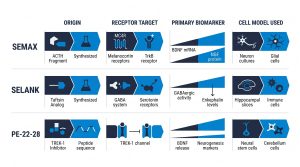
Researchers compare these compounds by receptor target. They also compare by biomarker and cell model used.
A structured comparison helps teams pick the right compound. Each peptide targets a different receptor system. Each has distinct biomarkers for lab measurement.
| Compound | Origin | Target | Biomarker | Cell Model |
| Semax | ACTH(4-7) Pro-Gly-Pro | BDNF/TrkB (indirect) | BDNF ELISA, NGF mRNA | Rat hippocampal cultures |
| Selank | Tuftsin derivative | GABA-A receptor | IL-6 and TNF-alpha cytokines | Cortical cell preparations |
| PE-22-28 | BDNF loop-2 mimetic | TrkB (direct) | Phospho-CREB western blot | HT-22 and PC12 cells |
Use Semax for BDNF and NGF upregulation studies. Use Selank for GABA-A and cytokine panel studies. Use PE-22-28 for direct TrkB receptor studies. All three are for laboratory research use only.
What Research Tools Are Available for Semax Studies?
COA-verified peptide lots are the core research tool. BDNF ELISA, phospho-CREB blot, and cytokine kits are also needed.
Research teams need a verified Semax lot to run any study. The lot must match the published reference standard for molecular weight and purity. Next Level Pharm verifies each Semax lot by HPLC and mass spectrometry before shipping. BDNF ELISA kits, phospho-CREB western blot reagents, and cytokine multiplex panels are the core assay tools for this peptide class. Labeled muscimol binding kits are used for GABA-A assays in Selank studies. View the Semax product page for lot-specific COA and mass spec data.
Frequently Asked Questions
What is a neuroprotective peptide in research terms?
A neuroprotective peptide is a short amino acid chain. It is studied in neuronal cell models. Researchers measure biomarkers like BDNF and CREB. Cytokine panels are also used as readouts. These tools map neuronal survival pathways. They are for laboratory use only. No clinical outcomes are claimed or implied.
What does BDNF stand for in peptide cell research?
BDNF stands for brain-derived neurotrophic factor. It is a protein that supports neuronal cell survival. In cell research, BDNF is measured by ELISA. The assay runs on culture media supernatant. Semax and PE-22-28 both influence the BDNF pathway. This is a key readout in neuropeptide studies. All findings are from cell or animal models.
How do researchers measure CREB phosphorylation in neuronal cells?
CREB phosphorylation is measured by western blot. The antibody targets Ser133 on the CREB protein. Signal bands are measured by densitometry. Total CREB is used as a loading control. PE-22-28 studies in HT-22 cells use this method. PC12 cells also show this result in published data. Western blot confirms TrkB-level kinase activation.
What is the structure of Semax and how does it differ from ACTH?
Semax carries the sequence Met-Glu-His-Phe-Pro-Gly-Pro. It is based on ACTH residues 4 to 7. A Pro-Gly-Pro tail is added for stability. Full ACTH stimulates the adrenal gland. Semax does not have this activity. This makes Semax useful for neuroprotection studies. It is used in cell and animal models only.
What cytokines does Selank affect in cell model studies?
Cell studies show Selank shifts IL-6 and TNF-alpha levels. These changes are seen in cortical cell preparations. Researchers use cytokine ELISA panels to measure them. IL-6 and TNF-alpha mark neuroinflammatory activity in vitro. Selank also modulates GABA-A receptor binding. These two pathways are studied as separate readouts. All findings are from cell or animal studies only.
What is the tuftsin origin of Selank?
Tuftsin is a natural tetrapeptide: Thr-Lys-Pro-Arg. It is produced in the spleen. Selank adds Pro-Gly-Pro to the tuftsin sequence. The full sequence is Thr-Lys-Pro-Arg-Pro-Gly-Pro. This extension improves stability in cell culture media. Selank is used to study GABA-A modulation. It is also used in cytokine signaling research.
Why is PE-22-28 called a BDNF mimetic peptide?
PE-22-28 mimics a short loop-2 region of BDNF. This region is the main TrkB receptor contact site. By mimicking it, PE-22-28 binds TrkB directly. It does not need the full BDNF protein. This is useful for receptor-selective cell studies. It avoids autocrine BDNF confounds in the culture. All data are from cell research models only.
What is HIF-1alpha and why does it appear in Semax research?
HIF-1alpha is a transcription factor. It stands for hypoxia-inducible factor 1-alpha. It activates under low-oxygen conditions in cells. Semax studies detect HIF-1alpha shifts in hippocampal cells. These shifts appear alongside BDNF and NGF changes. This suggests Semax may interact with oxygen-sensing pathways. All findings are from in vitro or animal models only.
What is the GABA-A receptor assay used with Selank?
GABA-A binding assays use labeled muscimol as a reference. Selank competes with muscimol for receptor binding sites. Patch-clamp assays also measure GABA-A receptor activity. They record chloride channel open-time changes in live cells. Together, these methods confirm GABA-A engagement by Selank. All results are from cell or animal models. No human use claims are made.
Are these neuroprotective peptides approved for clinical use?
Semax, Selank, and PE-22-28 are research compounds. They are not FDA-approved for clinical use in the US. Published data come from cell and animal studies. They are supplied for laboratory research only. No human-use or outcome claims are made. All lots ship with a COA and lot number. This is for research traceability only.
Summary
Semax, Selank, and PE-22-28 are three distinct research peptides. Semax raises BDNF and NGF in hippocampal cell models. Selank modulates GABA-A and shifts cytokine levels. PE-22-28 binds TrkB and drives CREB phosphorylation. Each peptide targets a different receptor system.
BDNF ELISA suits Semax studies. Cytokine ELISA and GABA-A binding assays suit Selank. Western blot for phospho-CREB suits PE-22-28. Rat hippocampal cultures, HT-22, and PC12 are the main models. All three are for laboratory research use only.
A COA-verified lot at 99% purity is needed for each compound. Lot traceability supports reproducible data. All findings here come from cell or animal models. No human use or clinical outcome claims are made.
What Should You Do Next?
- Review the BDNF ELISA assay format before ordering Semax for hippocampal cell studies.
- Confirm GABA-A binding assay reagents are ready before starting Selank cytokine panels.
- Set up phospho-CREB western blot protocols before running PE-22-28 in HT-22 or PC12 cells.
- Request the lot COA and mass spec data for any peptide before any cell assay begins.
- Browse brain research peptides for related research tools.
- Shop research peptides at https://nextlevelpharm.com/shop/.
People Also Read
About the Author
Next Level Pharm Research Team
Alex M covers peer-reviewed findings in peptide science for Next Level Pharm, a US-based supplier of research-grade peptides verified to ≥99% purity via HPLC and mass spectrometry on every batch.
Disclaimer: The information provided on this page is for educational and research purposes only. Next Level Pharm products are intended for laboratory research use only. They are not intended for human consumption, diagnostic, therapeutic, or medicinal purposes. This content does not constitute medical advice. Always consult a licensed healthcare professional before making any health-related decisions.