Disulfide Bond Peptide Research: Stability Studies

Last updated: October 2026
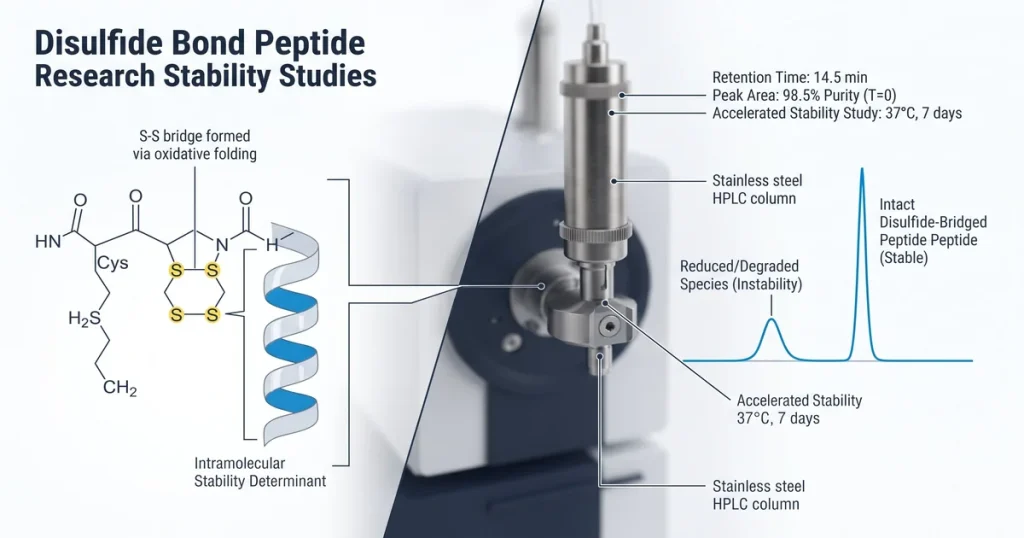
A disulfide bond in peptide research is an S-S link between two Cys sites in a chain. This bridge forms when thiol groups lose a hydrogen atom in an S-S bond step. The bridge locks the chain into a fixed shape, raises heat resistance, and blocks enzyme cleavage in lab models.
Next Level Pharm stocks research-grade peptides for these in vitro studies. Each lot reaches 99.4% average purity, confirmed by HPLC and mass spec. Vials ship lyophilized and a COA comes with every order.
S-S bridges are a core tool in peptide science. Their resistance to heat, proteases, and pH shifts makes them useful in long-term lab work. The sections below cover how these bonds form, how they stabilize peptides, and how labs verify them.
Key Takeaways
- Covalent S-S link: A disulfide bond is a sulfur-sulfur bridge between two Cys sites that forms in an S-S bond step.
- Structural rigidity: The bond locks the chain into a compact fold and limits chain motion in assay conditions.
- Protease resistance: The fixed shape blocks enzyme access to cleavage sites, extending sample stability in biological models.
- Thermal stability: The S-S bridge resists unfolding at high heat, improving data consistency in heat-stress tests.
- Controlled synthesis: Labs form the bond after solid-phase synthesis using a redox buffer or direct chemical oxidants.
- Analytical confirmation: Mass spec mass-shift data and HPLC traces confirm bond formation before testing begins.
These properties shape how researchers plan studies with S-S peptides. The sections below examine each point with data from peer-reviewed sources.
What is the role of disulfide bonds in peptide stability?
An S-S bridge holds two chain regions in a fixed covalent link. This stiffness lowers the chance of the chain unfolding in heat tests. According to the Journal of Peptide Science (2018), this fixed shape raises the strength of research peptides in lab assays.
The bond limits chain flex during heat-stress runs. Active sites stay in place and yield clear binding data. Labs that run enzyme panels over long time points gain the most.
How are disulfide bonds formed in peptide synthesis?
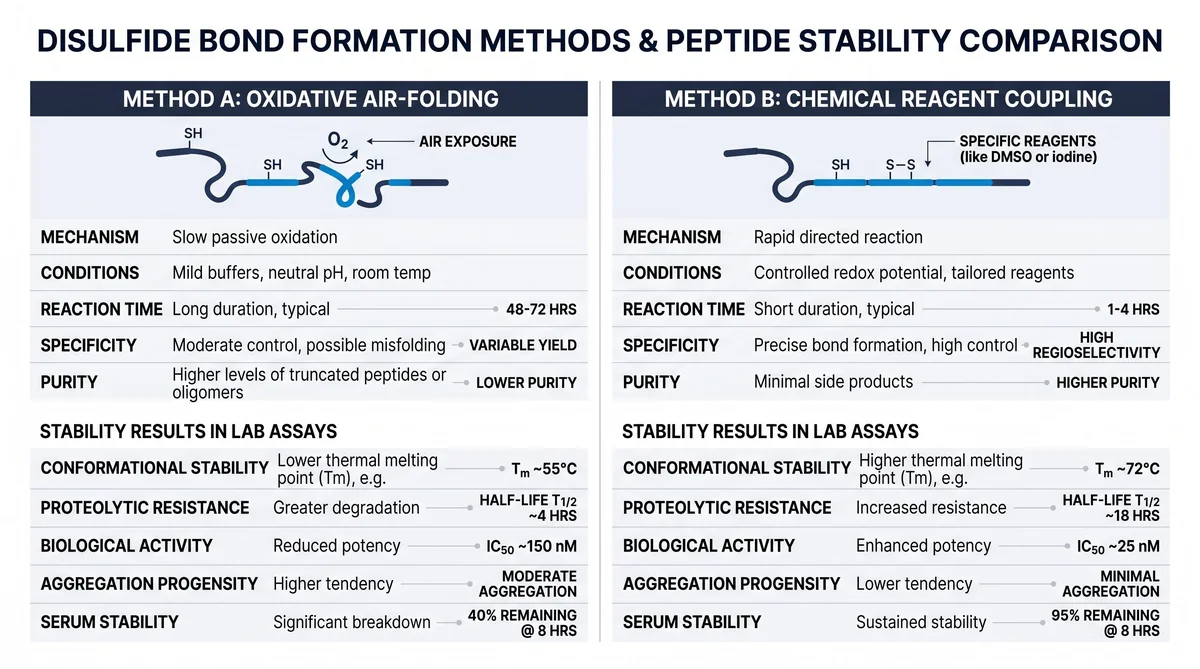
S-S bridge steps start after the full chain is built during SPPS. Researchers cleave the chain and run a bond step to link the Cys thiol groups. According to Molecules (MDPI) (2021), GSH/GSSG buffers allow precise control over the folding step.
The GSH/GSSG buffer holds both an oxidant and a reductant in one mix. This balance lets the chain find its most stable fold. Researchers adjust the ratio to steer the reaction toward the target shape.
What conditions trigger disulfide bond formation?
S-S bond steps need an oxidant to convert two thiol groups into a bridge. Labs use air in a basic buffer or add iodine or DMSO as chemical oxidants. According to a 2019 NCBI review, pH control is the most critical factor for correct bond selectivity.
Peptide level also steers the result. High level favors cross-chain links between two separate chains. Low level keeps bonds within one chain.
Labs sourcing COA-checked compounds can browse the research peptide catalog. Every vial ships with HPLC trace data and full lot records.
How does bond position shape peptide fold?
Bond location sets the loop size and the three-dimensional fold of the chain. A bond near key Cys sites locks the active region into a tight, precise shape. According to NCBI PMC (2024), small shifts in bond location change binding data in cell-free assay models.
A bond placed too tight may cut off binding events in the active site. One placed far from the active site may not improve fold at all. Labs test multiple bond spots to find the correct structure for each sequence.
What analytical methods confirm disulfide bond connectivity?
Ellman’s reagent is the first-line test for free thiols. A negative result means all Cys sites have bonded. According to Molecules (MDPI) (2021), mass spec confirms the 2-Da mass shift, which is the main check for S-S bridge formation.
Reversed-phase HPLC follows to check purity by elution time. For multi-bridge chains, MS/MS confirms that each Cys paired with its target. Labs sourcing recovery peptides and beauty peptides apply the same checks.
What challenges exist in disulfide-rich peptide synthesis?
Poor site control is the main problem in multi-bridged chains. When a chain has more than two Cys sites, each thiol can link to any open partner. According to a 2024 NCBI review, blocking groups are the key tool for setting which Cys bonds at each step.
S-S scrambling is a second issue, where bonds break and re-form at wrong spots. Clumping is a third problem, as reactive Cys sites link two chains instead of forming the target loop. Each issue needs a specific fix at the synthesis step.
How does redox folding guide S-S bridge formation?
Redox folding uses a mix of GSH and GSSG to guide S-S bridge steps. This mix lets the chain find its most stable fold. According to NCBI PMC (2024), redox folding cuts the rate of misfolded forms in research samples.
The GSH-to-GSSG ratio can be tuned to speed up or slow down the process. A fast redox step may produce more wrong pairings. A slow step gives the chain more time to find the right fold.
| Analytical Method | Primary Use | Data Output |
|---|---|---|
| Ellman’s reagent | Detect free thiols | Absorbance at 412 nm |
| Mass spectrometry | Confirm 2-Da mass shift | Molecular weight |
| Reversed-phase HPLC | Check purity | Retention time / % area |
| Peptide mapping MS/MS | Confirm bond site | Fragment mass list |
Frequently Asked Questions
What is the role of disulfide bonds in peptide stability?
An S-S bridge locks a peptide into a fixed shape by linking two Cys sites in one chain, which limits chain motion and heat-driven unfolding. This stiffness cuts the risk of heat damage and blocks enzyme attack on exposed backbone sites in lab assay conditions. According to the Journal of Peptide Science (2018), this fixed shape raises the overall strength of the molecule in research settings.
How are disulfide bonds formed in peptide synthesis?
Formation involves an S-S bond step after the chain is built and cleaved from the resin, with pH and temperature controlling the rate. A redox buffer such as GSH/GSSG holds both an oxidant and a reductant, letting the chain find its most stable fold. According to Molecules (MDPI) (2021), this approach limits wrong pairings during the S-S folding step in research-grade synthesis.
What oxidation conditions are used for disulfide bond formation?
Labs use air, iodine, or DMSO as oxidants, with the choice based on the sequence length and total Cys site count. pH must stay within 7.5 to 8.5 for controlled, selective S-S bridge formation without scrambling side reactions. According to the Journal of Peptide Science (2018), extreme pH values cause scrambling and produce wrong bond pairings that hurt sample quality.
How does bond position shape peptide fold?
Bond location sets the loop size and fold, with bonds near key Cys sites locking the active region into a precise shape. A bond placed too far from the active region may not improve fold or affinity at all in assay models. According to NCBI PMC (2024), even a one-site shift in bond location can produce measurable changes in cell-free assay binding data.
What analytical methods confirm disulfide bond connectivity?
Ellman’s reagent provides a fast thiol check for Cys sites, with a negative result confirming complete S-S bridge formation. Mass spec confirms the 2-Da mass shift per bond, and HPLC checks purity by detecting the shifted elution time of the bonded form. According to Molecules (MDPI) (2021), these three methods together let labs confirm the correct S-S structural form in the sample.
Can peptides contain multiple disulfide bonds?
Peptides can carry two or more S-S bridges to achieve complex folds, as insulin demonstrates with its three required bonds. Managing multiple bonds requires blocking groups to ensure each Cys pairs only with its target during synthesis. According to the Journal of Peptide Science (2018), strict blocking protocols are essential for obtaining the correct structural form in multi-bridged synthesis work.
What is the difference between intramolecular and intermolecular disulfide bonds?
A within-chain S-S bond forms a loop between two Cys sites, while a cross-chain bond links separate chains and causes dimerization. Keeping peptide level low steers the reaction toward the within-chain form and limits unwanted cross-chain dimers. According to NCBI PMC (2024), diluting to below 1 mg/mL is the standard approach for favoring within-chain S-S bond formation in research samples.
How does pH affect disulfide bond stability?
Basic conditions above pH 7 strip a hydrogen from Cys thiol groups to form reactive thiolate ions that drive S-S bridge steps during synthesis. Extreme alkaline values above pH 9 cause scrambling, where bonds break and re-form at wrong sites and create inactive structural forms. According to Molecules (MDPI) (2021), keeping pH between 7.5 and 8.5 is the standard protocol for repeatable and selective S-S bridge formation.
Why is regioselectivity important in disulfide bond formation?
Site control ensures each sulfur pairs with its target Cys partner, as wrong pairings create inactive structural forms in assay models. Producing a single, well-checked structural form is essential for consistent and reliable data in binding and inhibition research. According to the Journal of Peptide Science (2018), orthogonal blocking strategies are the main tool for directing bond formation to specific Cys sites.
How does disulfide cyclization differ from head-to-tail cyclization?
S-S cyclization joins Cys side chains via a covalent sulfur-sulfur bond, while head-to-tail cyclization joins the chain ends via an amide bond. Each method produces a distinct fold with different stability and binding properties for researchers to assess. According to Molecules (MDPI) (2021), the choice of ring-forming method affects the structural rigidity and target specificity of the target research peptide.
Summary
Disulfide bond peptide research examines how S-S bridges between Cys sites shape peptide stability and function. The bond forms by an S-S step and locks the chain into a fixed fold. This stiffness raises resistance to heat and proteases in lab models.
Labs check bond formation using Ellman’s reagent, mass spec, and HPLC before releasing material. Next Level Pharm provides COA-checked, HPLC-tested research peptides for scientists who need reliable starting materials.
What Should You Do Next?
Review your study design to confirm the target peptide has Cys sites in good positions for S-S bridge formation. Check the COA for your lot to verify purity and mass spec data before any assay.
Researchers can browse the full research peptide catalog for COA-checked compounds. Every vial ships with batch-specific purity data and full lot tracking.
People Also Read
- Peptide Cyclization Research: Cyclic Stability Studies
- MAPK ERK Pathway Peptide Research: Kinase Cascade
About the Author
Next Level Pharm Research Team
The Next Level Pharm research team is composed of biochemists and laboratory scientists dedicated to providing researchers with the highest-purity, lab-tested peptides available. Every batch is HPLC and mass spec verified before dispatch.
Disclaimer: The information provided on this page is for educational and research purposes only. Next Level Pharm’s products are intended for laboratory research use only. They are not intended for human consumption, diagnostic, therapeutic, or medicinal purposes. This content does not constitute medical advice. Always consult a licensed healthcare professional before making any health-related decisions.