Peptide Synthesis Explained: SPPS and Purity Standards

Last updated: June 2026
A peptide synthesis is the lab process of joining amino acids in a fixed order. The result is a chain with a known structure. The most common method is solid-phase peptide synthesis, or SPPS. SPPS builds the chain on a resin bead, one amino acid at a time. After synthesis, labs use HPLC (high-performance liquid chromatography) to confirm purity. Mass spec then checks the peptide identity. Research-grade peptides must reach ≥99% purity before use in lab studies.
Next Level Pharm is a US-based supplier of research-grade peptides verified to ≥99% purity. Each vial ships with a COA (certificate of analysis) that lists the HPLC trace, mass spec result, and lot number.
Peptide synthesis methods have advanced since the 1960s. Early approaches were slow and yielded impure product. Modern SPPS runs on automated synthesizers that complete a 10-residue chain in a few hours. Knowing these steps helps researchers judge the quality claims on any COA they receive.
Key Takeaways
- SPPS Is the Lab Standard: Solid-phase peptide synthesis builds chains on a solid resin bead. Reagents are added and washed away in each cycle without moving the growing chain.
- Fmoc Groups Protect Each Residue: Fmoc blocks the amine end of each amino acid during coupling. A mild base removes the block before the next residue is added.
- Purity Must Reach ≥99%: HPLC raises crude peptide from 70-80% to ≥99% purity. A valid COA shows the HPLC trace and mass spec result for every batch.
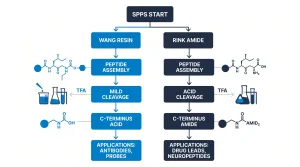
- Resin Choice Sets the C-Terminus: Wang resin releases peptides with a free acid at the C-terminus. Rink Amide resin releases peptides with an amide group instead.
- Cleavage Frees the Chain: After synthesis, a TFA-based cocktail cuts the chain from the resin. The crude product is then purified by HPLC.
These five steps are not just chemistry. They are quality gates. Each one affects the final purity of the product.
What Makes SPPS the Lab Standard for Peptides?
SPPS became the standard method in the 1960s. Bruce Merrifield developed the first solid-phase approach. According to a review in Amino Acids (2018), his method cut synthesis time from weeks to days. The Nobel Committee gave him the Chemistry Prize in 1984.
SPPS works by anchoring the first amino acid to a resin bead. Each new amino acid is added in a repeating cycle. The cycle has three parts: coupling, washing, and deprotection. The chain grows from the C-terminus to the N-terminus.
Reagents flow through the resin during each step. They are washed away before the next cycle begins. Automated synthesizers run these cycles with high precision. This cuts human error and improves batch consistency.
How Does Fmoc Chemistry Build Peptide Chains?
Fmoc is a protecting group used in SPPS. The full name is 9-fluorenylmethoxycarbonyl. It blocks the amine end of each amino acid during coupling. The block stops side reactions between residues.
After coupling, piperidine removes the Fmoc group. Piperidine is a mild base. The exposed amine is then ready for the next amino acid. This cycle repeats for every residue in the target sequence.
According to a review in Nature Protocols (2015), Fmoc chemistry is preferred over older Boc chemistry for most research peptides. Fmoc uses mild steps that keep sensitive amino acids intact. Boc chemistry requires strong acid for deprotection and can damage some residues.
Side-chain protecting groups are also used. These block reactive groups on amino acids like lysine, serine, and cysteine. They stay in place until the final cleavage step.
What Resins Anchor Peptides During Synthesis?
The resin bead is the base of SPPS. It holds the first amino acid and supports the growing chain. The chain stays attached through every coupling cycle.
Two resins are common in research. Wang resin gives peptides a free acid at the C-terminus. Rink Amide resin gives peptides an amide group instead. The choice depends on the target peptide structure.
Resin loading affects yield. Loading is measured in mmol of sites per gram of resin. Most labs use 0.4-0.8 mmol/g for reliable yield. High loading can reduce coupling efficiency for long sequences.
How Are Side-Chain Groups Removed After Synthesis?
After the last coupling step, the chain is still bound to the resin. Side-chain protecting groups are still in place. A cleavage cocktail removes both at once.
The cocktail uses TFA (trifluoroacetic acid) as the main reagent. Scavengers are added to prevent side reactions. The step takes 2-4 hours.
According to the Journal of Peptide Science (2022), scavengers protect sensitive residues during cleavage. Without them, reactive ions can alter cysteine, tryptophan, and methionine. Proper scavenger use is critical for sequence integrity.
The freed peptide is filtered from the resin. It is dried and dissolved for HPLC purification.
How Is Purity Confirmed After HPLC Purification?
Crude peptide from cleavage is not pure enough for research. It contains deletion products, truncated sequences, and reagent residues. HPLC separates these on a C18 column.
The target peptide binds to the column and elutes at a set time. Impurities elute at other times and are discarded. The target fraction is collected and analyzed.
HPLC runs on every batch before release. The COA shows the chromatogram trace with the main peak area. Batches that fall below ≥99% purity are rejected. Researchers can review purity data for beauty peptides and other categories before purchase.
What Does Mass Spectrometry Confirm in Peptide Research?
Mass spec confirms the molecular weight of the synthesized peptide. It does not directly measure purity. It verifies that the correct sequence was built.
The instrument measures the mass-to-charge ratio of sample ions. This result is compared to the expected molecular weight. A match confirms the correct sequence.
Mass spec can detect deletions, oxidation, and substitutions that HPLC may miss. BPC-157 and other research peptides are verified by both HPLC and mass spec on every batch at Next Level Pharm. These two tests form the dual-check standard for research-grade quality.
| Feature | HPLC | Mass Spectrometry |
| What it measures | Purity (%) | Molecular weight |
| What it confirms | Impurity profile | Sequence identity |
| Result format | Chromatogram trace | Mass-to-charge spectrum |
| Research gate | ≥99% purity required | Identity match required |
| COA data | Peak area percentage | Observed vs. expected mass |
Frequently Asked Questions
What is the process of peptide synthesis?
Peptide synthesis joins amino acids in a fixed order to form a chain. In SPPS (solid-phase peptide synthesis), the chain grows on a resin bead. Each cycle adds one amino acid, removes a protecting group, and washes the resin. After all residues are added, a cleavage cocktail frees the chain from the resin. The crude peptide is then purified by HPLC to reach research-grade purity.
What is Fmoc chemistry in peptide synthesis?
Fmoc (9-fluorenylmethoxycarbonyl) is a protecting group that blocks the amine end of each amino acid during coupling. It stops unwanted reactions between residues. Piperidine, a mild base, removes the Fmoc group after each coupling step. This cycle repeats for every amino acid in the sequence. Fmoc chemistry is preferred for most research peptides because it uses mild steps that protect sensitive residues.
What is the difference between crude and research-grade purity?
Crude peptide from cleavage typically reaches 70-80% purity. The mixture contains deletion products, truncated sequences, and residual reagents from the synthesis process. HPLC purification separates and removes these impurities using a C18 column. Research-grade peptides must reach ≥99% purity after this step. Labs confirm purity with an HPLC chromatogram showing the main peak at ≥99% of the total signal area.
How do HPLC and mass spec verify a peptide?
HPLC measures purity by separating the target peptide from impurities on a C18 column. It records the result as a chromatogram trace showing each component. Mass spec confirms identity by comparing the sample molecular weight to the expected value. Together, these two tests check that the peptide is the correct molecule and free of major impurities. A valid COA for any research-grade batch should include both results.
What resins are used in solid-phase peptide synthesis?
Wang resin and Rink Amide resin are the most common SPPS resins. Wang resin releases peptides with a free carboxylic acid at the C-terminus after cleavage. Rink Amide resin releases peptides with an amide group at that position. The choice depends on the structure of the target peptide. Resin loading of 0.4-0.8 mmol/g is the standard range for research-grade synthesis batches.
What food has the highest natural peptide content?
Many foods release bioactive peptides during digestion, though these differ from research-grade lab compounds. Collagen-rich foods like bone broth, fish skin, and eggs are common natural sources. Dairy proteins such as casein and whey also release peptides when enzymes break them down during digestion. These natural peptides differ from SPPS-synthesized lab peptides in structure, chain length, and confirmed purity. Research-grade peptides are made to exact sequence specs under lab conditions.
How many lab days does peptide synthesis require?
The time needed depends on the length of the target sequence. A 10-amino-acid peptide can be completed on an automated synthesizer in 2-4 hours. Sequences of 30 or more residues may fill a full lab day. HPLC purification adds several more hours to the schedule. Total time from synthesis start to a COA-verified, lyophilized vial is typically 2-5 lab days. The figure varies with batch size and quality checks required.
What is a COA in peptide research?
A COA (certificate of analysis) is the document that records all test results for a specific peptide batch. It includes the HPLC purity percentage, mass spec molecular weight confirmation, lot number, and recommended storage conditions. A valid COA also shows the synthesis date and quantity per vial. This document lets researchers confirm research-grade standards and trace any vial back to its specific production batch.
How does lyophilization preserve synthesized peptides?
Lyophilization (freeze-drying) removes water from the peptide sample under vacuum and low heat conditions. The process leaves behind a dry powder that stays stable at room temperature throughout shipping. This is critical for maintaining sequence integrity without cold-chain logistics. Lyophilized peptides are less prone to breakdown than liquid solutions and have a longer shelf life. Shop research peptides to view lyophilized, COA-verified batches with lot-numbered traceability.
Summary
Peptide synthesis follows SPPS: amino acid chains grow on a resin bead through repeating cycles of coupling, deprotection, and washing. Fmoc chemistry is the standard approach. After synthesis, cleavage frees the chain. HPLC raises purity to ≥99%, and mass spec confirms sequence identity.
Researchers who know these steps are better placed to judge supplier claims. A COA with both HPLC and mass spec data meets the minimum standard for research-grade quality.
What Should You Do Next?
When sourcing synthesized peptides for lab use, verify three items on every COA. First, confirm the HPLC purity is ≥99%. Second, confirm the mass spec result matches the expected molecular weight. Third, check that the lot number links to in-house lab data.
Shop research peptides at Next Level Pharm. Every batch ships with HPLC and mass spec results and a traceable lot number.
People Also Read
- Peptide Purity Testing: What HPLC and Mass Spec Confirm
- What Is HPLC Testing? How Peptide Purity Is Verified in Research Labs
About the Author
Next Level Pharm Research Team
Alex M covers peer-reviewed findings in peptide science for Next Level Pharm, a US-based supplier of research-grade peptides verified to ≥99% purity via HPLC and mass spectrometry on every batch.
Disclaimer: The information provided on this page is for educational and research purposes only. Next Level Pharm products are intended for laboratory research use only. They are not intended for human consumption, diagnostic, therapeutic, or medicinal purposes. This content does not constitute medical advice. Always consult a licensed healthcare professional before making any health-related decisions.