What Is a Peptide? Types, Sequences, and Research

Last updated: June 2026
A peptide is a molecule made of amino acids. These units link by bonds called peptide bonds. The human body produces thousands of natural peptide sequences. These act as hormones and signaling agents. Research peptides range from 2 to 50 amino acid units. Chains above 50 units are classified as proteins. The FDA had approved more than 60 peptide-based compounds as of 2021. This reflects decades of study into peptide structure and function.
Next Level Pharm supplies COA-verified, research-grade peptides for lab use. Every batch is tested by HPLC (a lab method that checks compound purity) and mass spectrometry (a test that confirms molecular identity). The average purity across the last 100 batches is 99.4%. A COA (Certificate of Analysis, a lab report confirming purity for each batch) ships with every order.
Understanding peptide structure helps researchers pick the right compound. The sections below explain how peptides are defined, grouped, and tested. They also summarize what published preclinical studies report.
Key Takeaways
- Chain length: Peptides contain 2 to 50 amino acids. Sequences above 50 units are proteins.
- Peptide bond: Amino acids link by a covalent bond between the carboxyl group of one and the amine group of the next.
- Research categories: Scientists group peptides by function: recovery, growth hormone, metabolic, beauty, and neuroprotective.
- Purity standard: Lab research uses compounds verified to ≥99% purity. This ensures results reflect the peptide, not contaminants.
- Stability: Lyophilized (freeze-dried) peptides stay stable at room temperature during shipping.
Peptide research has grown across many fields over the last 30 years. Synthetic sequences in lab models range from two-unit dipeptides to protein fragments of 43 amino acids. The sections below answer the most common questions about peptide structure, testing, and study findings.
What Makes a Molecule a Peptide?
A peptide is any amino acid chain linked by peptide bonds with fewer than 50 units. The peptide bond forms between the carboxyl group of one amino acid and the amine group of the next. This reaction releases a water molecule. It defines the backbone of every research peptide.
The term “peptide” was introduced by Emil Fischer in 1901. He used it to name short fragments of proteins. According to a review in Biochimica et Biophysica Acta (2017), the boundary between peptides and proteins is set by chain length. Researchers use 50 amino acids as a practical threshold. Some fields set it as low as 40 or as high as 100.
How Are Peptide Sequences Written?
Peptide sequences are strings of amino acid codes. They run from the N-terminus (amine end) to the C-terminus (carboxyl end). The 20 standard amino acids each have a one-letter code. Glycine is G, alanine is A, leucine is L. BPC-157 has a 15-letter sequence. GHK-Cu has just three amino acid units.
Sequence order determines function. According to a study in the Peptides journal (2019), one amino acid swap can change a peptide’s binding profile. This is why sequence accuracy and purity are non-negotiable in preclinical work.
What Types of Peptides Do Researchers Study?
Researchers classify synthetic peptides by their primary mechanism. Recovery peptides such as BPC-157 and TB-500 have been studied for tissue and blood vessel signaling in animal models. Growth hormone peptides such as Ipamorelin and CJC-1295 are examined for GH pulse patterns in rodent studies. Neuroprotective peptides such as Semax and Selank are studied for BDNF expression in brain tissue models. BDNF (brain-derived neurotrophic factor) is a protein that supports neuron health.
Five categories appear most in the peptide literature.
- Recovery peptides: BPC-157, TB-500, KPV, and GHK-Cu are studied for tissue signaling and wound-model biology.
- Growth hormone secretagogues: CJC-1295, Ipamorelin, Sermorelin, and GHRP-2 are examined for GH pulse modulation in animal hormone studies.
- Metabolic peptides: AOD-9604, 5-AMINO-1MQ, and HGH Fragment 176-191 are studied for adipose tissue signaling in metabolic models.
- Beauty peptides: GHK-Cu, AHK-Cu, and SNAP-8 are studied for collagen and elastin signaling in dermal cell cultures.
- Neuroprotective peptides: Semax, Selank, PE-22-28, and Epithalon are examined for brain growth factor and stress-axis signaling.
Next Level Pharm catalogs research peptides across all five categories. The recovery peptide range includes lyophilized, COA-verified compounds from US inventory.
Next Level Pharm supplies research-grade peptides at ≥99% purity, COA-verified for lab use. Browse the full research catalog.
How Do Scientists Verify Peptide Purity?
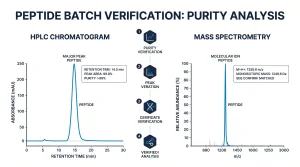
HPLC (high-performance liquid chromatography) is the primary method for checking peptide purity. A sample is pushed through a column of packing material. Compounds separate by polarity and exit at different times. The chart shows the target peptide as a share of all detected compounds. According to a review in Molecules journal (2015), HPLC and mass spectrometry together are the standard for confirming purity and identity in research-grade peptides.
Mass spectrometry adds a second check. It measures the mass-to-charge ratio of each molecule. A compound can pass HPLC but fail if its molecular mass is wrong. Both tests together confirm the compound is correct at the stated purity level.
What Does Preclinical Research Show?
Research on synthetic peptides covers many lab systems. BPC-157, a 15-amino-acid sequence, has been studied in rat models for blood vessel and cell-protective signaling. TB-500, a fragment of thymosin beta-4 (a 43-amino-acid protein), has been examined for actin-binding activity in muscle and cardiac models. GHK-Cu, a copper-binding tripeptide, has been studied in cell cultures for collagen synthesis and skin enzyme activity.
| Peptide | Amino Acids | Category | Primary Research Focus |
| BPC-157 | 15 | Recovery | Blood vessel signaling, tissue models |
| TB-500 | Fragment of 43-AA protein | Recovery | Actin binding, cardiac models |
| GHK-Cu | 3 | Beauty | Collagen synthesis, skin biology |
| Ipamorelin | 5 | Fitness and GH | GH pulse modulation |
| Semax | 7 | Brain | BDNF expression |
| AOD-9604 | 16-AA fragment | Metabolic | Adipose tissue signaling |
Findings vary by compound, model type, and study design. Cell culture results do not apply to animal models without further testing.
How Are Research Peptides Stored Safely?
Lyophilized (freeze-dried) peptides are the most stable form for shipping. The process removes water from the peptide under vacuum. This leaves a dry powder that resists breakdown without refrigeration. According to an analysis in the Journal of Pharmaceutical Sciences (2014), lyophilized peptides in sealed vials retain integrity for at least 24 months. Storage away from light and heat is required.
All peptides in the Fitness and GH range ship in lyophilized form from US inventory. This removes the need for cold-chain logistics during transit. Researchers working with reconstituted solutions should follow the stability data in each COA.
Frequently Asked Questions
What do peptides do in research models?
In lab models, peptides interact with specific receptors or binding proteins. This triggers cell signals. BPC-157 has been studied for effects on VEGF (a protein that helps blood vessels form) in rat tissue models. Each peptide’s research profile depends on its amino acid sequence and the receptors in the study system.
Are peptides the same as steroids?
No. Peptides and steroids are chemically unrelated. Peptides are chains of amino acids with amine and carboxyl groups. Steroids are lipid-based molecules built on a four-ring carbon skeleton. Cholesterol and cortisol are examples. The two classes act through different receptor types. They trigger different cell signaling cascades. In lab research, peptides and steroids are studied as separate compound classes with distinct mechanisms.
What foods are naturally high in peptides?
Animal proteins are rich sources of food-derived peptides. Collagen from bone broth, casein from dairy, and myosin from muscle tissue break down into short peptide fragments during digestion. Plant proteins in soy, wheat gluten, and hemp also yield peptide segments. These food-derived peptides are transient in lab systems. They are distinct in structure and function from synthetic research peptides studied in lab models.
How many amino acids are in a peptide?
A peptide contains at least two amino acids and typically no more than 50. Two-unit chains are called dipeptides. Chains between 2 and 10 units are oligopeptides. Chains between 10 and 50 units are polypeptides. Above 50 units, the molecule is a protein, though this boundary varies by field. BPC-157 is a 15-unit polypeptide. GHK-Cu is a tripeptide with three amino acid units.
What is the difference between a peptide and a protein?
Chain length is the key distinction. Peptides contain fewer than 50 amino acids. Proteins contain 50 or more. Proteins typically fold into complex three-dimensional shapes. These shapes let them act as enzymes or structural elements. Proteins also have higher molecular weights, generally above 5 kDa. Peptides often act as signaling molecules such as hormones or neuropeptides. Both are built from the same 20 standard amino acids.
What is HPLC testing in peptide research?
HPLC (high-performance liquid chromatography) measures purity by separating sample components in a column. Each compound exits at a different time and produces a peak on a chart. The area of the target compound’s peak divided by total peak area gives the purity percentage. Research-grade peptides require ≥99% purity on HPLC testing before qualifying for study use. Every result is listed in the lot’s COA.
What does COA-verified mean for research peptides?
A COA (Certificate of Analysis) is a lab document listing test results for a specific batch. It includes HPLC purity data and mass spectrometry results showing the correct molecular weight. It also lists the lot number, manufacturing date, and expiration date. Researchers use the lot number to trace each vial to its batch test data. This allows result verification before study use.
What is lyophilization in peptide storage?
Lyophilization is a freeze-drying process. It removes water from a peptide solution under vacuum at low temperature. The result is a dry, shelf-stable powder. This powder resists oxidation and microbial growth during shipping without cold-chain handling. Once reconstituted with a research-grade solvent, the solution should be used within the stability window listed in the COA. Lyophilized form is the standard for research-grade peptide supply.
How are synthetic research peptides made?
Most research peptides are produced by SPPS (solid-phase peptide synthesis). In SPPS, amino acids are added one at a time to a resin-bound chain in a defined sequence. After assembly, the peptide is cleaved from the resin. It is then purified by HPLC and lyophilized. Post-synthesis HPLC and mass spectrometry testing confirm the product matches the intended sequence at ≥99% purity.
Summary
A peptide is a chain of 2 to 50 amino acids linked by peptide bonds. Sequence order and chain length determine which receptors a peptide reaches in research models. Synthetic peptides are produced by SPPS and verified by HPLC and mass spectrometry before research use.
Lab literature covers hundreds of research peptides across recovery, growth hormone, metabolic, beauty, and neuroprotective categories. Compounds such as BPC-157, GHK-Cu, and Ipamorelin have generated substantial published data in cell and animal models. Research outcomes depend on model type, compound purity, and study design.
COA-verified, lyophilized research peptides at ≥99% purity ship from US inventory with full testing documentation for lot-level traceability.
What Should You Do Next?
- Review the research category that fits your study: recovery peptides for tissue model work or Fitness and GH peptides for endocrine studies.
- Check the COA for any compound you plan to source. Confirm HPLC purity ≥99% and mass spectrometry identity match.
- Browse all research-grade peptides by category at the shop.
People Also Read
- What Makes a Peptide Research Grade? Standards and Testing Explained
- Peptide Purity Testing: What HPLC and Mass Spec Confirm
About the Author
Next Level Pharm Research Team
Alex M covers peer-reviewed findings in peptide science for Next Level Pharm, a US-based supplier of research-grade peptides verified to >=99% purity via HPLC and mass spectrometry on every batch.
Disclaimer: The information provided on this page is for educational and research purposes only. Next Level Pharm products are intended for laboratory research use only. They are not intended for human consumption, diagnostic, therapeutic, or medicinal purposes. This content does not constitute medical advice. Always consult a licensed healthcare professional before making any health-related decisions.