
AICAR Research: AMPK Activation and Metabolic Studies

Last updated: May 2026
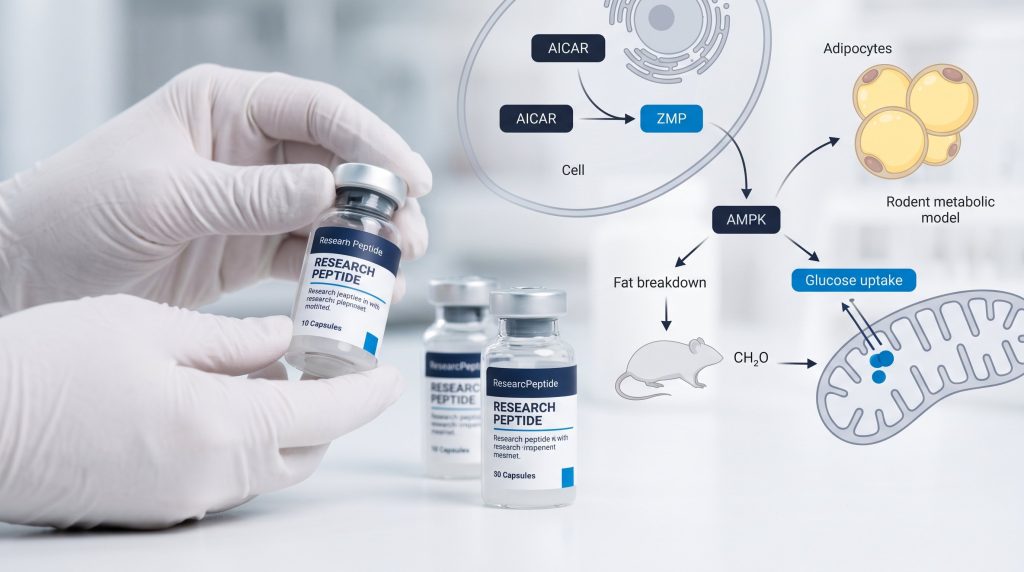
AICAR (5-aminoimidazole-4-carboxamide ribonucleotide) is a cell-permeable nucleoside analog. Researchers study it as a trigger of AMPK (AMP-activated protein kinase). AMPK is a key enzyme in energy sensing and metabolic control. Inside cells, AICAR is converted to ZMP (AICAR monophosphate). Mimics AMP and activates AMPK. Over 2,000 PubMed papers cover AICAR and its role in metabolic, exercise, and cancer research models.
Next Level Pharm supplies COA-verified, research-grade AICAR for qualified labs. Every batch is HPLC-tested and mass spec confirmed before dispatch. Each order ships with a lot-specific COA for study records.
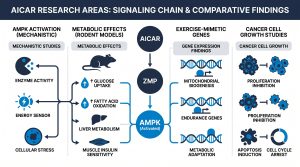
AICAR research covers AMPK activation, lipid metabolism, exercise-mimetic models, and cancer science. This overview covers the key data from each area.
Key Takeaways
- AMPK Activation: AICAR is converted to ZMP inside cells. ZMP mimics AMP and activates AMPK, a key energy-sensing enzyme.
- Metabolic Effects: AMPK activation by AICAR has been linked to increased fat breakdown. Reduced fat synthesis in rodent models.
- Exercise Mimetic Research: Narkar et al. (2008) studied AICAR as an exercise-mimetic compound in mice. It turned on genes tied to endurance and fat use.
- Cancer Metabolism: AICAR has been studied in cancer cell models for its effects on tumor cell energy use and growth.
- Heart Protection: AICAR has been studied in heart ischemia (blood block) models for its effects on cell survival markers.
- Research Use Only: AICAR supplied for lab use is a research-grade reagent. It is not for clinical or consumer use.
These data points make AICAR one of the more studied AMPK triggers in metabolic and cancer research. Labs use it to probe AMPK signaling in controlled cell and animal settings.
What Is AICAR and How Does It Work?
AICAR is a nucleoside analog that enters cells through adenosine transporters. Inside the cell, it is converted to ZMP by adenosine kinase. ZMP is the active form. It mimics AMP and binds to the control sites on AMPK. This turns on AMPK by raising the AMP-to-ATP ratio signal in the cell.
AMPK turning on sets off a chain of shifts. Fatty acid breakdown is increased. Lipid making is suppressed. Glucose uptake is enhanced. According to J Biol Chem (1997), AICAR well activates AMPK in muscle tissue in rats. This study set AICAR as a key tool for AMPK signaling research in metabolic models.
How Does AICAR Activate AMPK?
AMPK has three subunits: alpha, beta, and gamma. The gamma subunit has sites that sense AMP levels. ZMP (from AICAR) binds these sites and turns on the alpha subunit kinase. This turns on AMPK without needing actual AMP rises or energy stress in the cell. Labs use this trait to study AMPK effects in extract from other metabolic signals.
Once active, AMPK adds phosphate groups to many downstream targets. These include ACC (acetyl-CoA carboxylase). Controls fat synthesis, and PGC-1 alpha, which drives mitochondria growth. According to J Appl Physiol (1999), AMPK acts as a master metabolic switch in muscle and liver. AICAR is one of the few cell-permeable compounds that can turn on this switch in intact cells. Labs can view AICAR purity data at the metabolic peptide catalog.
What Do Metabolic Study Models Show?
Rodent and cell culture models have been used to map AICAR’s metabolic effects. In rat muscle strips, AICAR infusion raises fat breakdown markers and reduces lipid-making enzyme action. In liver cell lines, AICAR reduces glucose-making output by activating AMPK. These effects are blocked by AMPK blockers. Shows AMPK as the key target.
In ob/ob obese mice, AICAR treatment reduced lipid markers in plasma in several studies. Fat breakdown in muscle tissue was increased as measured by tracer uptake. These findings inform how labs design AMPK studies. They do not confirm human metabolic outcomes. All data comes from cell and animal models.
What Have Exercise Mimetic Studies Found?
In 2008, Narkar et al. published a key paper studying AICAR and the PPAR-d agonist GW501516 in mice. According to Cell (2008), AICAR alone increased endurance in untrained mice by 44% in treadmill tests. It turned on a set of genes tied to fat use and oxidative metabolism in muscle. This led to the label of AICAR as an exercise-mimetic compound in research.
| Study | Model | Outcome Measured | Finding |
| J Biol Chem (1997) | Rat muscle strips | AMPK action | AICAR well activates AMPK |
| J Appl Physiol (1999) | Rat liver and muscle | Metabolic markers | AMPK acts as metabolic switch |
| Cell (2008) | Untrained mice | Treadmill endurance | 44% rise with AICAR alone |
| Diabetes (2002) | ob/ob mice | Lipid and glucose markers | AMPK-linked changes confirmed |
| Cancer Res (2010) | Human cancer cell lines | Cell growth | AICAR reduced cell growth markers |
This exercise-mimetic research area has drawn wide interest. Labs study AICAR to understand how AMPK can produce exercise-like gene expression. These are cell and animal findings only, not human outcome claims.
What Does Cancer Metabolism Research Show?
AICAR has been studied in cancer cell lines for its effects on tumor cell energy use. Cancer cells rely on high glucose use (the Warburg effect). AMPK activation by AICAR has been shown to disrupt this energy pattern in several cell line models. Tumor cell growth markers were reduced in treated groups in many published studies.
In human cancer cell lines, AICAR reduced cell growth markers in leukemia, colorectal, and liver cancer models. AMPK was shown as the agent using AMPK knockdown controls. The cancer research area uses AICAR as a reference compound for AMPK-driven metabolic change studies. These are cell line findings, not clinical cancer treatment data.
How Is Research-Grade AICAR Verified?
Research-grade AICAR is checked by several methods before lab use. HPLC confirms purity and identity per lot. Mass spec verifies the cell weight and structure. Endotoxin levels are checked by LAL assay to confirm safe standards for cell culture and animal work.
COAs for research-grade AICAR should include:
- HPLC purity (percent).
- Mass spec cell weight proof.
- LAL toxin test result.
- Lot number for tracking.
- Storage conditions (typically -20 degrees Celsius in dry form).
Next Level Pharm provides lot-specific COA data with every AICAR order. Labs can access the records online by lot number. This supports audit and peer-review records.
Frequently Asked Questions
What is AICAR and why is it used in research?
AICAR is a cell-permeable nucleoside analog that activates AMPK in cell and animal models. It is converted to ZMP inside cells. Is the active AMPK-activating form. AMPK is a central enzyme in energy sensing and metabolic control. Labs use AICAR to study AMPK-driven metabolic changes in cell and rodent models. It is a research-grade compound only and is not for human use.
How does AICAR activate AMPK inside a cell?
AICAR enters cells through cell transporters and is converted to ZMP by a cell enzyme. ZMP binds the gamma subunit of AMPK and mimics the effect of a high AMP-to-ATP ratio. This turns on the alpha subunit kinase domain without needing actual energy stress. AMPK then turns on targets that control fat breakdown, fat synthesis, and glucose uptake. AMPK blockers block all these effects in lab models.
What metabolic changes does AICAR produce in rodent models?
In rodent cell and tissue models, AICAR activates AMPK and produces several metabolic shifts. Fat breakdown markers in muscle tissue rise. Lipid-making enzyme action falls. Glucose uptake increases in muscle and fat tissue. These changes are seen in rat and mouse models. They do not reflect human health outcomes. All findings are from in vitro and animal model research.
What did the 2008 Cell study show about AICAR?
Narkar et al. (2008) studied AICAR as an exercise-mimetic compound in mice. AICAR-treated untrained mice showed a 44% rise in treadmill endurance. AICAR turned on a set of genes tied to fat use and oxidative metabolism in muscle. This gene set overlaps with those turned on by endurance exercise. The study set AICAR as a reference compound for exercise-mimetic AMPK research. These findings are in mice only.
Is AICAR used in cancer research?
Yes. AICAR has been studied in cancer cell lines for its effects on tumor cell energy use. Cancer cells use high levels of glucose via the Warburg effect. AMPK activation by AICAR disrupts this energy pattern in leukemia, colorectal. Liver cancer cell lines. Cell growth markers were reduced in treated groups. AMPK knockdown controls showed AMPK as the agent. These are cell line findings, not clinical cancer data.
What is the role of ZMP in AICAR research?
ZMP is the active form of AICAR inside the cell. It is produced when adenosine kinase adds a phosphate group to AICAR inside the cell. ZMP binds to the gamma subunit of AMPK and mimics the effect of AMP. This turns on AMPK at normal cell conditions without needing energy loss. ZMP is the key agent of all AICAR effects seen in cell and animal models.
How is research-grade AICAR quality confirmed?
Research-grade AICAR is checked by HPLC purity testing, mass spec structure proof, and LAL toxin testing. COAs include lot-specific results for each test. Lot numbers allow full tracking from production to lab entry. COA data is on file with each order for audit and records. Labs should request a current COA before using any AICAR lot in cell or animal studies.
What storage conditions does AICAR need?
Research-grade AICAR is stored at -20 degrees Celsius in dry (lyophilized) form. Avoid repeated freeze-thaw cycles. Once prepared in solution, store at 4 degrees Celsius. Use within the time frame noted in the COA. Short-term room exposure during shipping is fine for sealed, dry vials. Check the lot-specific COA for exact storage and solution stability guidance.
Are there published human studies on AICAR?
AICAR has been studied in human contexts, mainly in heart protection research. Acadesine (the clinical name for AICAR) was tested in cardiac surgery trials for its effects on heart cell survival markers. Several cardiac surgery RCTs have been published on acadesine. PubMed indexes over 2,000 AICAR-related papers including preclinical and human data. ClinicalTrials.gov lists completed studies on acadesine in cardiac and oncology contexts.
How does AICAR differ from other AMPK triggers?
AICAR is a direct AMPK trigger via ZMP conversion. Other common AMPK triggers include metformin (which raises the AMP-to-ATP ratio indirectly). A769662 (a direct AMPK trigger). Unlike metformin, AICAR does not need mitochondrial complex I inhibition to activate AMPK. This makes AICAR a cleaner research tool for studying pure AMPK signaling. Labs choose between triggers based on their specific study design and model system.
Summary
AICAR research has shown it to be a key tool for AMPK activation studies. Its conversion to ZMP inside cells triggers AMPK in a controlled, reliable way. This has made it a reference compound in metabolic research, exercise mimetic studies, and cancer research models.
Key findings include increased fat breakdown markers and reduced fat synthesis in rodent models. Exercise-like gene expression changes in mice. Cancer cell line data shows AMPK-driven changes in tumor cell energy use.
For labs studying AMPK signaling or metabolic pathway control, AICAR is a well-studied. Widely cited research compound.
What Should You Do Next?
Labs sourcing AICAR for AMPK or metabolic studies should confirm HPLC purity, mass spec structure data. Lot-specific COA supply before ordering.
Research-grade AICAR is available at the metabolic peptide catalog.
- View AICAR product specs and COA data.
- Browse the full metabolic peptide research catalog.
- Shop the full research peptide catalog.
People Also Read
- HGH Fragment 176-191 Research: What Preclinical Studies Show
- AOD-9604 Research: What Studies Show About This HGH Fragment
About the Author
Next Level Pharm Research Team
Alex M covers peer-reviewed findings in peptide science for Next Level Pharm, a US-based supplier of research-grade peptides verified to >=99% purity via HPLC and mass spectrometry on every batch.
Disclaimer: The information provided on this page is for educational and research purposes only. Next Level Pharm’s products are intended for laboratory research use only. They are not intended for human consumption, diagnostic, therapeutic, or medicinal purposes. This content does not constitute medical advice. Always consult a licensed healthcare professional before making any health-related decisions