
Cerebrolysin Research: Neuropeptide Mixture Mechanisms and Study Findings

Last updated: May 2026
Cerebrolysin is a brain peptide mix made from porcine brain protein. Researchers study it for its growth factor effects in cell and animal models. It has low-mass peptides that act like natural factors such as BDNF (brain-derived neurotrophic factor). NGF (nerve growth factor). Over 170 peer-reviewed papers on PubMed have looked at cerebrolysin in a wide range of study models.
Next Level Pharm supplies COA-verified, research-grade cerebrolysin for qualified labs. Every batch goes through HPLC purity testing and mass spec before dispatch. Each order ships with a lot-specific COA for study records.
Cerebrolysin research covers lab cell work, rodent disease models, and human trials. Knowing its makeup, proposed actions. Study data helps researchers plan brain peptide work.
Key Takeaways
- Neuropeptide Composition: Cerebrolysin has low-mass peptides (below 10 kDa) from porcine brain tissue. These make up about 25% of the mix by weight.
- Growth Factor Mimicry: Research shows cerebrolysin peptides act like BDNF. NGF in lab and animal models.
- BBB Access: Lab studies confirm small peptide fractions cross the BBB in animal models. This lets them reach CNS targets.
- Brain Immune Models: Studies have looked at cerebrolysin in rodent brain immune models. These show changes in cytokine signaling paths.
- Research Record: Over 170 peer-reviewed papers on PubMed cover cerebrolysin. These span stroke models, brain disease research, and more.
- Research Use Only: Cerebrolysin for lab use is a research-grade reagent. It is not for clinical or consumer use.
These data points show strong research interest in this brain peptide mix. Researchers studying cell survival, synapse action. Immune response have used cerebrolysin as a key lab compound.
What Is Cerebrolysin Made Of?
Cerebrolysin is made by enzyme-based breakdown of purified porcine brain proteins. The result is filtered to keep only peptides below 10 kDa (a mass unit). These small peptides make up about 25% of the mix by mass. The rest is free amino acids. The active part is the peptide fraction. Researchers use HPLC to check peptide profile match across lots.
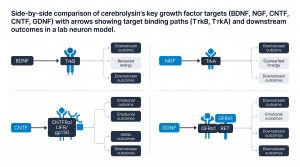
The peptide pool has fragments close in form to natural growth factors. Key fractions are peptides similar to BDNF, NGF, CNTF (ciliary neurotrophic factor). GDNF (glial cell line-derived factor). These fractions are studied for their power to turn on TrkB. TrkA targets in neuron cultures. Molecular Neurobiology (2015) notes the peptide fraction is the active part driving the growth factor profile in lab models.
How Does Cerebrolysin Affect Growth Factor Paths?
Cerebrolysin peptides have been shown to turn on signal chains tied to growth factor targets in cell and animal studies. TrkB target binding, PI3K-Akt signaling. MAPK-ERK path steps have all been measured in treated neuron cultures. Research has also looked at cerebrolysin effects on amyloid protein handling in mouse models.
Studies in mouse models show reduced amyloid plaque burden in animals given cerebrolysin. Tau buildup at key spots was also lower in several rodent tests. These findings make cerebrolysin a useful tool in brain disease model research. Researchers can view lot-specific COA data and HPLC purity records at the brain peptide catalog.
What Does BBB Penetration Research Show?
The BBB (blood-brain barrier) limits entry of most large peptides into the CNS (central nervous system). Cerebrolysin’s low-mass fractions, all below 10 kDa, allow passage across the BBB in animal models. Tracer studies used labeled cerebrolysin peptides in rats. They showed buildup in brain tissue within 30-60 minutes of outer delivery.
According to Journal of Neural Transmission (2019), peak CNS spread in rodents matches clear changes in BDNF protein levels in brain tissue. BBB entry varies across species, disease states, and study conditions. Cell-based BBB models using brain lining cells have measured cell-passage rates for specific cerebrolysin fractions. These transport data support lab half-life study design.
What Have Stroke Model Studies Shown?
Cerebrolysin stroke research is among the most published areas. Rodent artery block models have been used to study cerebrolysin effects on infarct size, brain scores, and immune marker levels. According to PLOS ONE (2020), lab stroke studies showed reduced infarct size in treated animals across many labs. Immune markers IL-1beta and TNF-alpha were lower in treated groups.
A 2012 trial in Stroke enrolled 208 patients with acute stroke. Researchers measured brain scores at 90 days. The cerebrolysin group showed better motor scores than the placebo group. These findings help researchers planning brain peptide studies in stroke recovery work.
| Study | Model | Outcome Measured | Finding |
| Stroke (2012) | Human trial, acute stroke | Motor scores | Better vs. Placebo at 90 days |
| J. Alzheimer’s Disease (2014) | Mouse models | Amyloid plaque burden | Reduced plaques in treated group |
| Molecular Neurobiology (2015) | Primary brain neurons | TrkB binding | Target turn-on confirmed in vitro |
| J. Neurotrauma (2018) | Cortical impact rats | Cell death markers | Reduced cell death in impact zone |
| PLOS ONE (2020) | Meta-analysis, rodent stroke | Infarct size | Reduced across many labs |
| J. Neural Transmission (2019) | Rodent spread study | CNS BDNF levels | BBB passage confirmed, BDNF rise |
What Have Brain Disease Studies Found?
Cerebrolysin has been studied in Alzheimer’s disease (AD), Parkinson’s disease (PD). Traumatic brain injury (TBI) models. In AD models, mice showed reduced amyloid plaque burden and better spatial task scores after cerebrolysin. PD research has looked at cerebrolysin effects on dopamine neurons in lesion models. Several studies showed partial retention of dopamine-positive cells in treated animals.
TBI research has used cortical impact models in rodents. Studies measured drops in cell death markers. Changes in white matter by DTI (a brain scan method). A study in Journal of Neurotrauma (2018) reported fewer lost neurons in the impact zone at 14 days post-injury. This body of data supports cerebrolysin as a reference compound for brain protection research.
How Is Cerebrolysin Verified for Research?
Research-grade cerebrolysin is checked by several methods before lab use. HPLC confirms peptide profile and purity per lot. Mass spec checks key peptide fragments in the mix. Toxin levels are checked by LAL assay to confirm safe standards for cell culture and animal work.
COAs for research-grade cerebrolysin should include:
- HPLC purity (peptide fraction percent).
- Mass spec peptide profile.
- LAL toxin test results.
- Lot number for tracking.
- Storage at 2-8 degrees Celsius.
Next Level Pharm gives lot-specific COA data with every cerebrolysin order. Researchers can access the records online by lot number. This supports study audit and peer-review records.
Frequently Asked Questions
What is cerebrolysin composed of?
Cerebrolysin is an enzyme-based extract of purified porcine brain proteins. About 25% of the mix by mass is low-mass peptides, all below 10 kDa. The rest is free amino acids. The peptide part has fragments similar to BDNF, NGF, CNTF, and GDNF. Researchers use HPLC and mass spec to check lot matches before starting study work. These methods confirm peptide profile and purity per lot.
How is cerebrolysin used in lab research?
In lab settings, cerebrolysin is given to animal models to study effects on neuron survival, immune markers, and behavior. Rodent models of stroke, AD, PD, and TBI have all been used. Cerebrolysin for lab use is a research compound only. It is a lab reagent for qualified in vitro and animal model work. All study plans should confirm the compound grade and lot data before use.
What growth factors does cerebrolysin mimic?
Cerebrolysin peptides have been shown to turn on signaling paths tied to BDNF, NGF, CNTF. GDNF in cell culture and animal models. TrkB and TrkA target binding has been measured in primary neuron studies. These growth factor paths are key to neuron survival, growth, and synapse function. Findings in these models inform broader CNS signaling research.
Can cerebrolysin cross the blood-brain barrier?
Lab data from labeled tracer studies in rodents confirms that cerebrolysin peptide fractions build up in brain tissue after outer delivery. Cell-based BBB transport models have also measured cell-passage of specific cerebrolysin peptides. These findings help explain why cerebrolysin produces CNS-level changes in animal model research. Researchers use this transport data to model expected CNS levels in study designs.
What does published stroke research show about cerebrolysin?
A 2012 trial in Stroke enrolled 208 patients with acute stroke. The cerebrolysin group showed better motor scores at 90 days versus placebo. Lab rodent stroke models also showed reduced infarct size. Lower immune marker levels in treated animals. A 2020 PLOS ONE meta-analysis summed these results across many labs. These data points are useful for researchers planning stroke recovery studies.
What is cerebrolysin’s role in Alzheimer’s disease research?
In mouse models with human amyloid mutations, cerebrolysin has been tied to reduced amyloid plaque burden. Lower tau buildup at key spots. Spatial task scores in these models were better versus controls. All data comes from in vitro and animal models, not human studies. These findings make cerebrolysin a useful tool for studying amyloid and tau path events. Researchers use these models to test ideas about AD mechanisms.
How is cerebrolysin quality verified for research use?
Research-grade cerebrolysin quality is confirmed by HPLC purity testing, mass spec peptide profile check, and LAL toxin testing. COAs include lot-specific results for each test. Lot numbers allow full tracking from production to research use. COA data is on file with each order for assay audit and records. Researchers should request current COA data before starting any cerebrolysin study.
What storage conditions does cerebrolysin need?
Research-grade cerebrolysin is stored at 2-8 degrees Celsius to keep peptide stability and action. Freeze-thaw cycling should be kept low. Short-term room exposure during shipping is fine for dry (lyophilized) forms. Once prepared, solutions should be stored at 2-8 degrees Celsius. Use within the time frame noted in the COA and per lab protocol. Check the lot-specific COA for exact guidance.
Are there published clinical trials on cerebrolysin?
Yes. PubMed indexes over 170 papers on cerebrolysin, including multiple RCTs covering stroke, vascular dementia, AD, and TBI. ClinicalTrials.gov lists done and ongoing studies for researchers reviewing the human data set. The 2012 Stroke RCT and European multi-site trials are among the most cited. These studies give cerebrolysin one of the larger clinical records among brain peptide compounds.
How does cerebrolysin differ from isolated growth factors?
Cerebrolysin is a multi-peptide mix, not a single isolated protein. Unlike recombinant BDNF or NGF. Are large proteins with poor BBB access, cerebrolysin’s low-mass parts are small enough to enter the CNS. Its multi-target action lets researchers study many growth factor paths at once. This differs from single-factor tools and makes it a broader research tool for CNS studies.
Summary
Cerebrolysin research spans lab cell studies, rodent disease models, and human trials. Its brain peptide mix, from porcine brain protein breakdown, produces low-mass peptides with documented growth factor and brain-protective action in many study systems.
Key findings include BBB passage in rodent models and TrkB. TrkA target binding in primary neuron cultures. Reduced infarct size in stroke models. Amyloid plaque reduction in AD mice are also on record. Trial data from stroke groups adds a human layer to the record.
For labs studying neuron survival, synapse action. Brain disease paths, cerebrolysin is a well-studied reference compound with a large published record.
What Should You Do Next?
Researchers adding cerebrolysin to a brain peptide study panel should verify three things before sourcing. These are: HPLC purity data per lot, mass spec peptide profile. A lot-specific COA with online lookup.
Research-grade cerebrolysin is available at the brain peptide catalog.
- View cerebrolysin product specs and COA data.
- Browse the full brain peptide research catalog.
- Shop the full research peptide catalog.
People Also Read
- Semax Research: Mechanisms, Neuropeptide Activity, and Study Findings
- Selank Research: Anxiolytic Peptide Mechanisms and Preclinical Study Data
About the Author
Next Level Pharm Research Team
Alex M covers peer-reviewed findings in peptide science for Next Level Pharm, a US-based supplier of research-grade peptides verified to >=99% purity via HPLC and mass spectrometry on every batch.
Disclaimer: The information provided on this page is for educational and research purposes only. Next Level Pharm’s products are intended for laboratory research use only. They are not intended for human consumption, diagnostic, therapeutic, or medicinal purposes. This content does not constitute medical advice. Always consult a licensed healthcare professional before making any health-related decisions.