
mTOR Signaling in Peptide Research: mTORC1 and PI3K Studies

Last updated: September 2026
mTOR signals peptide research is the study of the mechanistic target of rapamycin (mTOR) pathway, a critical cell regulator of growth, protein output, and breakdown. This pathway acts as a primary sensor that integrates outside signals and nutrient availability to control basic cell states. Staff often use set peptide compounds to probe these mechanisms in controlled lab settings.
Next Level Pharm gives high-purity research items to support these investigative efforts across 70+ active peptide SKUs. The brand keeps an average purity of 99.4% across its last 100 batches. Each vial goes through dual-method testing using HPLC and mass spectrometry to ensure accurate results.
All compounds are provided in a lyophilized state, meaning they are freeze-dried and sealed under an inert atmosphere for stability. This method allows for storage at room temperature with no cold chain needed for transit. The brand dispatches orders from USA-stored inventory with an average dispatch time of ~48 hours. Research teams can access a Certificate of test (COA) for any lot through the online lookup tool.
Key Takeaways
- Central Control Point: The mTOR pathway integrates nutrient and growth signals to control cell breakdown and survival.
- Distinct Protein Complexes: Research finds two unique complexes, mTORC1 for growth and mTORC2 for survival, with set blocking sensitivities.
- before PI3K Action: The PI3K/Akt signaling cascade serves as a primary activator of mTORC1. Responding to insulin or growth factors.
- Peptide control Research: Studies study IGF-1 variants and growth hormone releasers to check their affect on the mTOR signaling architecture.
- Blocking and Cell Health: Staff use rapamycin as a primary tool to probe mTOR action during aging and autophagy in lab models.
The following sections study the set protein contacts. Lab methods used to study mTOR signals. Researchers can test how targeted changes to these pathways affect core growth. Energy control in controlled tissue models.
What is the mTOR pathway’s primary function?
The mechanistic target of rapamycin (mTOR) functions as a central regulator of cell breakdown. Growth. Growth in response to outside cues. It acts as a primary control point, integrating inputs from nutrient availability, cell energy status, and growth factors to dictate cell behavior. By modulating these pathways, the complex balances energy use against the need for core expansion.
This control complex acts as a gatekeeper for key anabolic processes, including the output of proteins and lipids. When nutrient levels remain high, the pathway triggers these output actions to support mass accumulation. Conversely, it suppresses catabolic processes like autophagy when settings favor growth. This control is vital for maintaining cell homeostasis under shifting settings. mTOR Modulator is ready as a COA-checked research peptide. Each lot is checked by HPLC and mass spec. Researchers use this system to map how shifts in outside signals affect fundamental cell structures.
How do mTORC1 and mTORC2 differ in research?
The key difference between these two complexes involves their distinct protein makeup. Their response to rapamycin blocking. mTOR Complex 1 (mTORC1) includes the Raptor protein, making it sensitive to rapamycin. Conversely, mTOR Complex 2 (mTORC2) uses the Rictor protein, rendering it largely insensitive to this set inhibitor. According to NCBI (2020), these unique structures allow the complexes to keep separate signals roles within the cell.
mTORC1 mainly controls cell growth and protein output by signaling through the S6K1 target. In contrast, mTORC2 controls cell survival and cytoskeletal structure by activating the Akt pathway. This functional split allows researchers to study anabolic processes and core health as distinct cell events. mTOR Modulator is ready as a COA-checked research peptide. Each lot is checked by HPLC and mass spec. By isolating these pathways in lab models, staff track how single protein subunits dictate after action.
What is the role of the PI3K/Akt pathway?
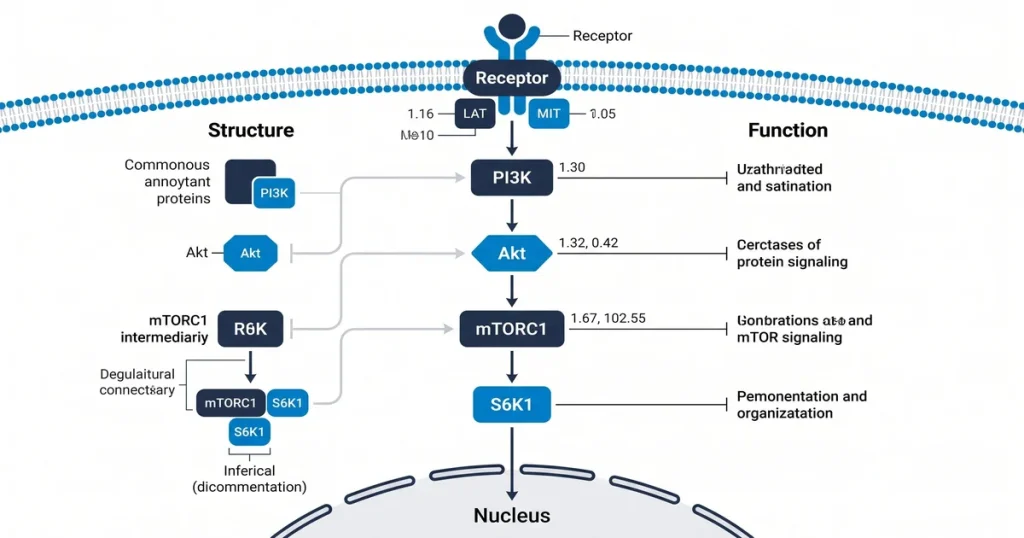
What is the role of the PI3K/Akt pathway? The PI3K/Akt pathway serves as a major before activator of the mTOR signals system. It relays signals from growth factor receptors on the cell surface to the mTORC1 complex located inside the cell. According to PubMed (2020), this signal relay governs energy shifts and cell growth patterns.
Growth factor binding starts the chain by activating PI3K at the membrane. This enzyme then triggers the action of Akt through activation. Once active, Akt targets the TSC complex (tuberous sclerosis complex) for blocking. By phosphorylating the TSC complex, Akt removes the normal brake this protein exerts on mTORC1. This deactivation allows mTORC1 to start protein output and promote cell development. IGF-1 LR3 is ready as a COA-checked research peptide. Each lot is checked by HPLC and mass spec. The precise interplay between these proteins ensures the cell responds correctly to outside growth signals.
Which peptides are studied for mTOR modulation?
Several research peptides control the mTOR pathway. Mainly through the insulin-like growth factor 1 (IGF-1) axis. Growth hormone releasers (GHS). These compounds affect signaling cascades that control cell growth, protein output, and energy homeostasis. The IGF-1 pathway acts as a primary initiator of the PI3K/Akt signaling chain, directly controlling the mechanistic target of rapamycin (mTOR) complex.
IGF-1 LR3 is a long-acting variant frequently studied for its power to activate the PI3K/Akt pathway before of mTOR. By bypassing certain control proteins, it allows for sustained signals in isolated cell models. In contrast, GHSs like GHRP-2 and CJC-1295 are studied for their indirect effects on growth pathways via the signals of normal hormone release. These compounds trigger after growth signals that intersect with mTOR action.
CJC-1295 and GHRP-2 are ready as COA-checked research peptides. Each lot is checked by HPLC and mass spec.
How is mTOR blocking studied in lab models?
In lab models, mTOR blocking is mainly studied using compounds like rapamycin. Its variants to study the pathway’s role in aging, autophagy, and cell senescence. Researchers use these inhibitors to suppress mTORC1 action. Can induce autophagy and help map the atomic mechanisms of longevity research.
By blocking the mTORC1 complex, staff can see how a shift from growth to recycling affects cell lifespan. This process gives a way to study how suppressed mTOR signaling affects energy function across various tissue samples. Next Level Pharm gives high-grade research items for these studies. Rapamycin is ready as a COA-checked research peptide. Each lot is checked by HPLC and mass spec. According to the NIH (2018), such blocking mimics the effects of calorie restriction in many models. This observation serves as a foundation for understanding how energy regulators add to the maintenance of cell health.
What are future directions for mTOR research?
Future directions for mTOR research involve the creation of selective modulators to refine pathway control. Staff prioritize tissue-set control to isolate how these signals impact distinct cell groups. Such as muscle fibers or neurons. This shift toward precision allows for a deeper view of how the pathway operates in varied cell contexts.
Researchers are also exploring novel peptide design to target set components within the mTORC1 and mTORC2 complexes. These compounds aim to bypass general blocking, focusing instead on internal feedback loops that control the action of the cascade. By mapping these signals, researchers can study how cells keep homeostasis under set settings. mTOR Modulator is ready as a COA-checked research peptide. Each lot is checked by HPLC and mass spec. This approach helps clarify the involvement of mTOR in energy disease models according to PubMed (2021).
Frequently Asked Questions
What is mTOR in peptide research?
The mechanistic target of rapamycin (mTOR) is a protein kinase that serves as a central hub for cell signals. It integrates signals from nutrients, hormones, and stress to control growth and breakdown. According to NCBI (2012), this kinase dictates whether cells engage in protein output or cell maintenance. In research, it is studied as a primary sensor that coordinates how cells process outside signals.
How does the PI3K/Akt/mTOR pathway work?
This pathway starts when growth factors bind to membrane receptors, activating phosphatidylinositol 3-kinase (PI3K). PI3K produces lipids that recruit Protein Kinase B (Akt) to the cell membrane. Once activated, Akt inhibits the Tuberous Sclerosis Complex (TSC). According to PubMed (2020), this blocking removes a normal brake on mTOR, allowing the complex to promote anabolic processes. This cascade serves as the main transmission line for growth signals.
Which peptides are studied in mTOR signals research?
Studies often focus on insulin-like growth factor 1 (IGF-1) variants and various growth hormone releasers. These peptides affect the pathway by activating receptors that feed into the PI3K/Akt cascade. By monitoring how set peptide structures affect receptor binding, researchers assess the intensity of downstream signaling. Research shows these compounds give a way to control growth inputs in isolated lab cell models without the spread of normal hormones.
What activates the mTOR pathway in cells?
Action occurs through the presence of growth factors, insulin, and amino acids. Nutrients give the signal that energy is ready for growth. Hormones trigger the PI3K/Akt cascade to start the process. According to PubMed (2020), the integration of these signals ensures that protein output only proceeds when settings are favorable. This multi-input system allows the cell to match its rate of growth to the current outside state.
What happens when mTOR signals is inhibited?
Blocking stops the anabolic state, leading to a reduction in protein output and cell growth. The cell shifts its focus from growth to maintenance or repair processes. According to NCBI (2012), inhibiting this pathway often triggers autophagy, a mechanism where cells recycle damaged components. Research uses this transition to study how cells preserve energy and survive during periods of reduced nutrient availability or energy stress in lab settings.
Is the mTOR pathway related to muscle protein output?
Yes. This pathway is recognized as a key mediator of protein output in muscle tissues. mTORC1 controls the translation of mRNA into new proteins by activating set after targets like S6 kinase. Research on this connection explores how growth signals shift muscle tissue toward an anabolic state. According to PubMed (2020), this control is fundamental to how cells manage protein turnover. Keep core health in response to outside signals.
What is the connection between mTOR and autophagy?
The mTOR pathway and autophagy keep an inverse relationship within the cell. When mTOR is active, it promotes anabolic processes and suppresses the catabolic process of autophagy. When mTOR action decreases, the blocking on autophagy is lifted, allowing the cell to break down internal structures for fuel. According to NCBI (2012). This feedback loop acts as a balance between growth and cell recycling. Staff study to understand longevity mechanisms.
How do researchers measure mTOR activity in the lab?
Staff measure the activation status of downstream targets to track pathway action. Common indicators include the activation levels of S6 kinase 1 (S6K1) and 4E-BP1. Are direct markers of mTORC1 function. Western blotting is often used to visualize these proteins in cell lysates. These tests allow for the quantitative test of how peptide ligands affect set nodes within the mTOR signaling architecture.
What is the difference between mTORC1 and mTORC2?
The two complexes differ in their core makeup and cell roles. mTORC1 is mainly linked to growth, protein output, and nutrient sensing, and it is sensitive to rapamycin. mTORC2 is mainly linked to cell survival, cytoskeletal structure, and Akt action. According to PubMed (2020), these complexes operate in different cell spaces and respond to unique inputs, allowing the cell to decouple growth signals from long-term core maintenance and survival needs.
Why is rapamycin significant in mTOR research?
Rapamycin is a receptor inhibitor that researchers use to probe the function of the mTORC1 complex. By applying this item, staff can selectively block mTORC1 action to see the resulting changes in cell breakdown. According to NCBI (2012), this tool has defined the understanding of how the mTOR pathway adds to cell growth and aging. It remains a standard reference for validating how other test modulators affect the pathway in different models.
What Should You Do Next?
Review the gave study data to find set markers relevant to your lab goals. Compare your current research objectives against the ready peptide chain profiles to ensure proper alignment. Secure a copy of the Certificate of test for your chosen lot. Confirm the purity. Test testing results before you begin your assessment.
Researchers sourcing peptides for their studies can explore the catalog at Next Level Pharm. Each vial ships with a COA and full lot tracking.
People Also Read
- What Is Ipamorelin? Mechanism of Action and Research Overview
- CJC-1295 Research: How This GHRH variant Works in Lab Models
About the Author
Next Level Pharm Research Team
The Next Level Pharm research team is composed of biochemists and lab scientists dedicated to providing researchers with the highest-purity, COA-verified research peptides available. Every batch is HPLC and mass spec verified before dispatch.
Disclaimer: The information provided on this page is for educational and research purposes only. Next Level Pharm products are intended for lab research use only. They are not intended for human consumption, diagnostic, therapeutic, or medicinal purposes. This content does not constitute medical advice. Always consult a licensed healthcare professional before making any health-related decisions.