
Washout Periods in Peptide Research: How They Are Calculated

Last updated: September 2026
Washout period calculation is the process of determining the time needed, ensuring a test compound is fully cleared from a subject’s system before another factor is introduced. Accurate timing allows for the clear observation of cell baseline states. Researchers use this method. Separate the effects of set compounds from normal system shifts. When calculations remain precise, data health improves across the entire test duration.
Next Level Pharm gives high-purity items for use in lab settings. Its internal plan ensures 99.4% average purity across its last 100 batches. Each vial goes through testing via high-performance liquid chromatography and mass spectrometry to confirm identity. Staff researchers monitor these metrics to ensure each lot meets rigorous standards for consistency.
Researchers rely on these gaps to prevent the accumulation of residual compounds. These breaks allow cell mechanisms to recover from the stress of outside signals. Helps keep the validity of findings, according to the NIH (2020). This approach protects the model from the affect of lingering action. Planning these periods correctly supports the accuracy of study results over long periods.
Key Takeaways
- setting Scientific Baseline: A washout period creates a necessary window for clearing test compounds from cell models. This practice ensures that new data remains untainted by the previous phase.
- Applying the Five Half-Lives Rule: Most studies calculate duration by estimating the time. Clear 97 percent of the agent. This standard approach aligns with absorption data found on PubMed.
- Monitoring Compound Removal: The removal half-life serves as the primary metric for defining the total washout window. Researchers must track this rate to find when the system reaches a neutral state.
- Accounting for core Factors: Factors like atomic size. Enzyme-based stability can alter the speed of compound clearance. These factors often need researchers to adjust the washout duration for set study needs.
- Ensuring Crossover Study Validity: Correct washout timing limits carryover effects. Often invalidate findings in compared research designs. This oversight is key for maintaining accuracy across all test phases.
The following sections test how energy factors to study design impact clearance timing in lab models. These details give the foundation for planning gaps. Preserve the health of longitudinal research data.
What Is a Washout Period in Clinical Research?
A washout period is a drug-free interval in a research study. to ensure a before administered compound is eliminated from the system. This break allows any residual amount of the item to clear the subject entirely. By preventing carryover effects, researchers ensure, the results of the final phase do not merge with the initial phase. This process allows the subject to return. A baseline state before the next trial segment begins. Such precision is a requirement for the validity of crossover trials. The same group is exposed to two or more settings.
Tirzepatide is ready as a COA-checked research peptide. Each lot is checked by HPLC and mass spec, maintaining a void state is vital because it limits data distortion. If the body keeps high levels of a compound, new data becomes hard to isolate, according to the NIH (2020). Controlled gaps help find the true response to an intervention. Without this gap, the study may mistake a lingering effect for a new reaction. These gaps remain the most effective method, keeping clean data sets during complex research.
How Is a Peptide’s Half-Life Determined?
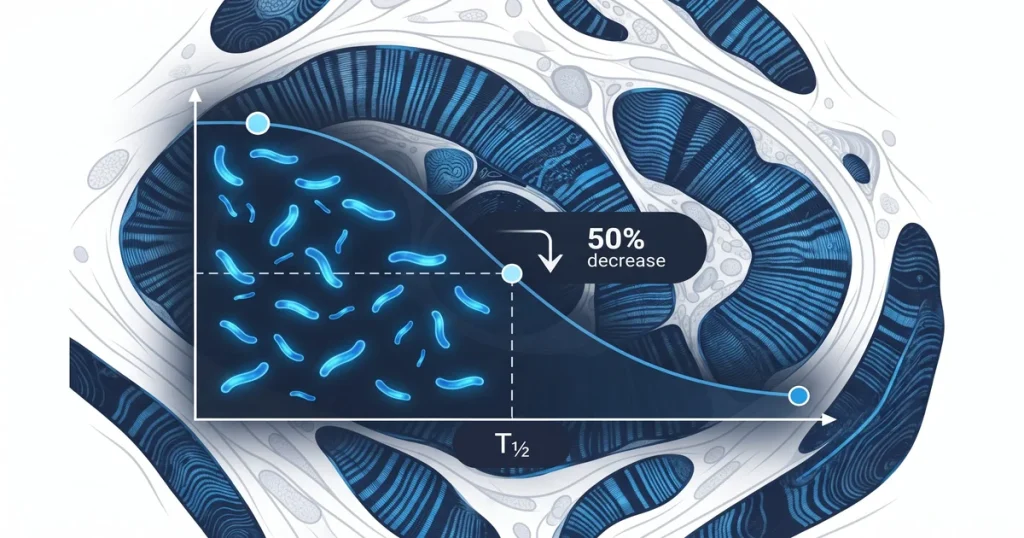
A peptide’s removal half-life (t½) is the time it takes for its amount in blood plasma, reducing by half. Researchers find this value by drawing serial blood samples after transport. Measuring the peptide amount over time. To ensure precise results, staff use liquid chromatography-mass spectrometry (LC-MS) to test these samples. This process allows them to plot a decay curve. Maps the amount of the peptide as it clears from the circulatory system. This data is key for understanding how long a peptide remains active in a cell model, according to the Journal of Peptide Science (2014). Accurate measurement of these kinetics gives the basis for defining effective test timing.
Tirzepatide is ready as a COA-checked research peptide. Each lot is checked by HPLC and mass spec. The resulting decay curve gives a clear picture of the drug’s persistence in the body. Researchers use this curve to find the point. The plasma amount falls below the threshold of action. This helps them design better studies for growth hormone or metabolic pathway research. Steady sampling at set gaps ensures that the measured rate of clearance reflects the true cell profile of the peptide. Data from these tests are often compared to known kinetic models to confirm accuracy.
What Is the ‘Five Half-Lives’ Rule of Thumb?
The five half-lives rule is a standard absorption rule used. Estimate the time needed for the near-complete clearance of a research item. This rule dictates. A compound is considered well eliminated from a system after five cell half-lives have passed. After the first half-life, 50% of the item remains in the model. This amount drops to 25% after the second cycle. Continues to decrease with each duration. By the end of five half-lives, only about 3% of the original amount remains, this low level is often viewed as a complete exit for most lab research needs.
Reaching a steady-state needs a similar number of cycles. Arrive at a constant amount in the blood. Researchers monitor this progression to avoid unintended accumulation. Tirzepatide is ready as a COA-checked research peptide. Each lot is checked by HPLC and mass spec. This 97% removal threshold helps ensure the model returns. A baseline state before any new chain starts, maintaining this focus allows for clear data collection without the interference of residual compounds. Next Level Pharm gives items that allow for precise timing in these plans.
Which Factors Influence Peptide Washout Times?
Which factors affect peptide washout times? The needed duration for a washout phase depends on the half-life of the item. Other traits like atomic weight, clearance pathways, as core changes also alter the necessary interval. Large compounds often move through the body more slowly than small ones. Can delay renal clearance. If a peptide remains in the system longer, the model needs a longer rest period to reach a clear baseline state.
Changes like PEGylation, or adding a polyethylene glycol chain, increase the atomic weight, shielding the peptide from enzyme-based breakdown. This extends the active life of the compound in a research model. For example, BPC-157 has a set half-life. Dictates the timing of its research plan to ensure accurate observations. Researchers must account for these distinct factors to avoid residual action.
BPC-157 is ready as a COA-checked research peptide. Each lot is checked by HPLC and mass spec. Proper study design ensures the model returns to homeostasis before any new cycles begin, according to the Journal of Peptide Science (2018), understanding the energy stability. Excretion rate of a peptide is vital for defining the duration of test gaps.
Why Are Washout Periods Important for Study Validity?
Washout periods are critical for maintaining data health in crossover study designs by ensuring a clean baseline between test phases. Without these gaps, drug-effect effects from the first compound often persist. Obscure the results of the second agent. This carryover creates unintended confounding factors. Make the final findings difficult to interpret or prove.
In a crossover study, each subject serves as their own control to reduce variance. However, if the initial compound is still active. The next phase begins, the internal validity of the study fails. Researchers must allow enough time for the system. Return to its normal state to avoid measuring a combined. Rather than distinct, lab response. Proper timing limits the overlap of test affects. CJC-1295 is ready as a COA-checked research peptide. Each lot is checked by HPLC and mass spec. This precise management of the washout phase is key for isolating the set cell outcomes of single peptides.
How Do Cycling Strategies Differ From Washout Periods?
Cycling strategies differ from washout periods by utilizing planned off-cycle breaks, managing receptor density rather than focusing on compound removal. A washout period serves. Clear an test model of a residual compound before starting a new test phase. In contrast. An off-cycle phase is a deliberate interval within a study plan to prevent cell shifts. Research models often go through cycling to keep homeostasis. A researcher monitors long-term signals capacity.
During the on-cycle phase, persistent binding may lead to receptor drop. This cell adjustment decreases the number of ready sites on the surface of the cell, according to PubMed (2009), this mechanism serves to dampen signal transmission. A receptor receives a high volume of stimuli. By using an off-cycle, the researcher gives the system time to restore normal response. This process ensures the model remains responsive. Avoids the accumulation of signals that could skew data.
Frequently Asked Questions
What is a washout period for peptides?
A washout period is a defined interval of time. No research compound is administered to the test model. This pause allows the system to clear residual compounds. Return to its baseline state, according to the NIH (2020), this period is key for preventing carryover effects. Might skew findings in longitudinal studies. By removing the stimulus, researchers ensure, next data points reflect a neutral starting point rather than residual action.
How long will a 10mg vial of peptide last?
The duration of a 10mg vial depends entirely on the set mass requirements of the study plan. Researchers divide the total 10mg content by the amount used per transport cycle. Estimate the total lifespan of the vial. Because test needs vary across different models, there is no set timeframe for consumption. The vial remains stable until reconstituted. Long as it is kept in a dry and sealed state.
How to figure out dosing for peptides?
Determining the amount of a peptide for study needs calculating the molar amount based on the mass of the compound. The volume of the diluent. Researchers often refer to published literature for established ranges used in similar models, according to the Journal of Peptide Science (2018). Precise measurement is critical to keep consistency and avoid exceeding the intended study scope. All calculations must account for the set potency of the batch as as shown by the COA.
How long should you cycle off of peptides?
The duration of a cycle-off period is usually found by the half-life of the compound. The goals of the set study. A common standard involves waiting for a period equal. At least five half-lives of the item to ensure near-complete removal, according to the NCBI (2023). This washout duration allows receptor density to recover from any possible drop. Researchers adjust this length based on found system responses. The set peptide being studied.
What is the difference between a peptide’s half-life and its clearance rate?
Half-life refers to the set time needed for the amount of a peptide in the system, reducing by fifty percent. Clearance rate, however, describes the volume of plasma. Is fully cleared of the compound over a set duration. While both metrics relate to how the body removes a item, the half-life gives a time-based measurement, whereas clearance rate offers a measure of energy volume. Both are vital for predicting whole-body persistence.
Is peptide cycling necessary for all research compounds?
Cycling is not needed for each research peptide. The need depends on how the compound interacts with cell pathways. Compounds, affecting core. Genomic processes without triggering receptor blunting may not need the same washout gaps as potent receptor agonists. Research suggests. Only compounds capable of inducing major drop or blunting necessitate a formal cycling plan. Researchers check the mechanism of action for each set compound before finalizing the test design.
Can you calculate a washout period without knowing the half-life?
Calculating a solid washout period without the half-life is difficult. Possibly inaccurate for research purposes. Absorption data gives the only evidence-based way, ensuring a system has returned to its baseline. Without the half-life, researchers might rely on estimates. These carry a risk of residual compound presence. If the half-life is unknown, researchers often opt for extended rest periods to be certain. The system is fully clear before continuing.
How do researchers confirm a washout period was sufficient in a study?
Researchers confirm the adequacy of a washout period through test testing. Such as measuring plasma levels or observing cell markers of action. By comparing data from the end of the washout phase to baseline measurements, they can find if the item has been cleared, according to PubMed (2009). The absence of measurable cell effects during the rest phase serves as a common indicator. The compound has reached an inactive, baseline state.
What happens to study data if a washout period is too short?
When a washout period is too short. Residual amounts of the research peptide can remain in the system during the next phase. This results in the accumulation of the compound. May lead to skewed observations and inaccurate conclusions about its effects, according to the NIH (2020), this error often manifests as heightened or erratic cell responses. Do not well represent the study factors. Data collected under these settings can invalidate the entire longitudinal study chain.
Do different peptide salts (e.g., acetate) affect washout times?
The salt form of a peptide. Such as acetate or chloride, mainly affects its dissolving. Stability rather than its fundamental half-life or clearance rate. While the salt form can affect how quickly the peptide is absorbed or reconstituted, the absorption of the active chain remain steady, according to Molecules (2014), the active peptide moiety finds the cell clearance. Meaning the salt form does not often need an adjustment to the established washout period.
Summary
Review your set research plans to ensure the length of your study cycles. Rest gaps aligns with the absorption properties of the selected peptides. Confirm. You have documented the baseline state of your research model before beginning any new transport phase. Consult the lot-set Certificate of test provided with your items to test purity. Amount levels for your records.
Researchers sourcing these compounds can explore the full catalog at Shop. Each vial ships with a Certificate of test. Full lot tracking to support your set project goals.
What Should You Do Next?
Apply this research to your lab protocol by sourcing compounds with full lot-level traceability. Each batch should include a COA with HPLC and mass spec data for your records. Shop research peptides at Next Level Pharm for COA-verified, lab-grade compounds.
People Also Read
- What Makes a Peptide Research Grade? Standards and Testing Explained
- BPC-157 vs TB-500: A Detailed Research contrast Guide
About the Author
Next Level Pharm Research Team
The Next Level Pharm research team is composed of biochemists and lab scientists dedicated to providing researchers with the highest-purity, COA-verified research peptides available. Every batch is HPLC and mass spec verified before dispatch.
Disclaimer: The information provided on this page is for educational and research purposes only. Next Level Pharm products are intended for lab research use only. They are not intended for human consumption, diagnostic, therapeutic, or medicinal purposes. This content does not constitute medical advice. Always consult a licensed healthcare professional before making any health-related decisions.