
Peptide Blends vs Single Vials in Research Design

Last updated: August 2026
A peptide blend is a single vial with two or more distinct research compounds. A single vial contains one alone peptide chain, allowing study of one variable. Research design depends on this choice when a study measures the combined effects of many signals or the exact actions of one compound. Testing many compounds allows finding of possible combined effects in cell models. Alone compounds allow precise mapping of single pathways. Knowing these two formats is vital for sound data collection.
Next Level Pharm gives research peptides with an average purity of 99.4% across recent batches. Each vial undergoes HPLC testing. MS testing also confirms the stated lab profile. Vials are freeze-dried and sealed under an inert atmosphere for shelf life. This keeps compounds stable at room temp. It removes the need for cold chain shipping. Dispatch occurs from USA stock. Average turnaround is around 48 hours.
The choice between a multi-factor blend and a single compound dictates the scope of a study. Researchers must select the setup that matches the goals of their test approaches. Blends provide specific research value by combining agents like those found in the GLOW Stack, which includes BPC-157, TB-500, and GHK-Cu. Researchers focusing on alone factors prioritize single-vial vials. Both approaches require strict attention to lot testing to confirm that data well reflects the intended lab effects within the trial.
Key Takeaways
- Single factor control: Researchers use single vials to trace outcomes to one exact compound. This limits confounding factors and supports clean data.
- Complex test design: Peptide blends link many compounds, making it difficult to track single effects. Effects within a blend add noise to findings.
- Testing challenges: A COA of Testing for a blend must confirm the ratio of each component. High precision is needed to verify purity for each compound.
- Shelf life concerns: Mixing peptides can shift pH levels and cause faster breakdown. These compounds may interact with each other during storage.
- Research standard: Core studies rely on single compounds to build clear data sets. This practice follows standard approaches for lab model reporting.
The following sections examine the exact lab trade-offs between using standalone vials and blended mixes. Knowing these changes helps researchers choose the framework that fits their test model.
What Are Peptide Blends in a Research Context?
Peptide blends are single vials with two or more set peptides. They are chosen for a theorized combined effect. These mixtures aim to affect many pathways within a cell system. All pathways are targeted at once. Research often combines growth hormone releasers, such as CJC-1295 with ipamorelin, to study the link between pulse amplitude and duration. Such blends can test effect ideas. But they make it harder to single out factor effects. Data reading is harder when many agents act on shared pathways. Divergent pathways add further challenge.
Multi-peptide vials need a set approach. Careful attention to the shelf life of each compound is key. Some fitness and GH peptides are ready as COA-verified research compounds, with each lot checked by HPLC and mass spec. Researchers must track how each component affects the others in the mix. This oversight is vital for sound data collection. These factors matter. Single-compound studies often give clearer endpoints than blended options in controlled trials.
Why Do Single Vials Improve Study Control?
Single vials improve study control. They single out one variable for refined data collection. This strategy strengthens test design by reducing outside noise. Limiting testing to one compound lets researchers measure cell responses. This removes noise from follow-up agents. This clarity is key for finding cause in a controlled setting. When only one compound is present, outcomes are more likely tied to that compound.
This approach removes confounding factors. These often arise from unplanned peptide-peptide effects. When many compounds occupy a single vial, It is hard to isolate the source of a triggered effect. By maintaining purity, the researcher stays focused on the main target. BPC-157 is ready as a COA-verified research compound, with each lot checked by HPLC and mass spec. Browse research-grade peptides to find single-compound vials with lot-specific COA data for each batch.
How Is Purity Verified for Blends vs Single Peptides?
Purity testing for a single peptide uses High-Performance Liquid Chromatography (HPLC). One major peak is isolated. A blend needs confirming many well-resolved peaks. Single chains go through HPLC. It separates the main component from traces based on retention time. Researchers then use MS (MS) to confirm that the atomic mass matches the expected value. This combined method confirms that a sample contains the correct compound at the expected mass.
Testing blended powders is a more complex process. The COA of Testing (COA) must find each active agent present. Each component needs a specific elution profile that shows a well-resolved peak on the HPLC trace. The lab must confirm the precise ratio of all compounds. Finding distinct components within a single mixture is hard. It needs careful setup and advanced instruments.
| Factor | Single Vial | Peptide Blend |
| Purity testing | One HPLC peak per lot | Multiple peaks, complex signal |
| COA detail | Mass and purity for one compound | Ratio and purity for each compound |
| Storage shelf life | One optimal condition | Conflicting pH and buffer needs |
| Data clarity | Single variable, clean outcomes | Multiple variables, possible noise |
| Use case | Targeted and testing studies | Early-phase screening only |
What Are the Shelf Life Risks of Blending Peptides?
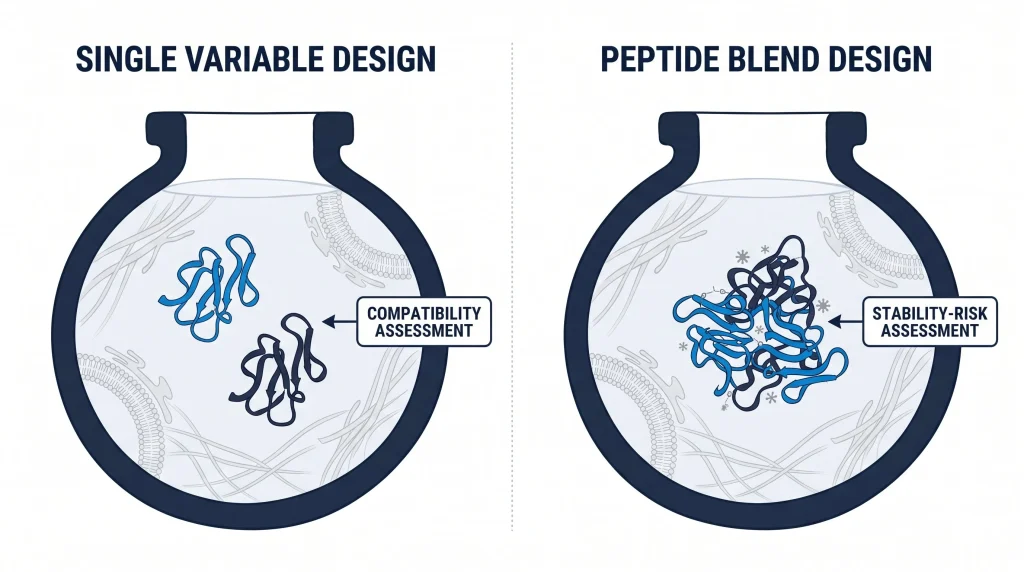
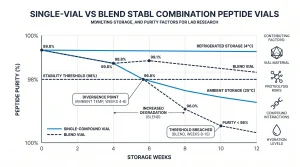
The shelf life risks of blending peptides stem from mismatched lab conditions that can threaten the purity of a dissolved mixture. Co-vial frequently results in pH shifts outside the narrow tolerance of single peptide chains. These changes can speed up breakdown and make the mixture useless for right lab testing before the study concludes.
Peptide chains each need clear optimal storage conditions. These are based on their main and side structures. When combined, these chains can show unknown reactions. These include:
- Clumping of peptide chains into larger, inactive clusters.
- Faster breakdown of one or more compounds within the mixture.
- Structural changes that alter the binding properties of the vial.
Each component needs specific buffers to remain stable, and a single vial can only maintain one set of conditions. This mismatch leads to a shorter shelf life compared to freeze-dried compounds stored as single units.
When Might a Blend Be Used in Early Research?
A blend may be used during high-throughput screening to quickly test many blends and find possible effects for future, more focused study. This finding-phase approach allows researchers to examine how various compounds interact within a system before narrowing the scope to single chains. In this initial setting, researchers look for broad signals or cell shifts that show a possible synergy between the mixed agents.
This approach is not suitable for testing or detailed targeted studies. Any positive hit from a blend is early and needs follow-up studies using single peptides. These follow-up studies find the active compound responsible for the finding. By singling out each component after a successful screen, researchers confirm which exact compound drove the outcome. This layered workflow keeps solid, precise data. The study shifts from broad testing to targeted testing.
Which Approach Is Standard for Lab Model Trials?
Single-compound studies are the set mark for lab model trials and for any study intended for peer-reviewed paper. This focused strategy keeps all findings related directly to one exact compound. Using only one vial removes confusion during data review. Researchers rely on this approach to gain clear, precise data about the exact action profile of a compound in a controlled test.
Scientific bodies require high standards to confirm how a compound performs on its own. Blends introduce too many variables for strict research. They mask the specific effects of each compound, which creates varied results. If a study uses complex mixtures, the outcome becomes difficult to interpret or replicate. Single-vial testing gives high precision. Researchers rely on it for sound results.
According to NIH research (2023), strict control of variables is key for the valid reading of lab model data. Single-compound testing remains the most reliable approach for future research. According to PubMed (2025), binary peptide vials show altered shelf life profiles compared to single-compound vials at equal levels. According to PubMed (2012), co-vial of peptides add pH-dependent effect risks that single-compound vials avoid. According to PubMed (2024), peptide blend shelf life testing needs clear lab methods to detect low-level breakdown products.
Frequently Asked Questions
What Is a Peptide Blend?
A peptide blend is a single vial with two or more clear lab-made peptides intended for concurrent research use. These mixtures are used to study the effect and combined influence of many bioactive chains within a single test model. By combining these agents, researchers examine how different chain-level pathways may intersect in a shared setting. This format is often chosen for early-stage research where the net result of multi-target response is the main focus of the study.
Why Do Blends Limit Separate Variables?
Blending peptides bundles many separate variables into one test step and adds to the alone testing of specific chain-level effects. When a researcher adds a blend, they cannot determine which component corresponds to a specific cell outcome. This loss of control creates large noise in the data gathering process and makes it harder to draw clear conclusions from the results. Isolating the source of any observed effect needs added follow-up studies using single-compound vials.
How Are Blend Ratios Verified on a COA?
Testing of a blend needs the COA of Testing to quantify the purity and mass of each peptide within the mixture. Testing labs must use separate markers for each compound to show the stated ratio matches the actual content. HPLC is performed on the combined sample to distinguish between the peaks of distinct chains. The resulting report confirms that each compound has met the required purity standards within the final vial.
When Are Single Compounds Preferred in Studies?
Single compounds are preferred whenever a research study aims to establish a precise mechanism of action or a compound-response link. Researchers rely on single-vial purity to keep that no follow-up agents influence the observed cell response. This clear structure is needed for strict lab model studies that require repeat results and clear finding of the active compound. Single-compound approachs help remove confounding effects that could lead to wrong data readings.
How Does Blending Affect Shelf Life Testing?
Blending peptides creates a complex lab setting that often reduces the overall shelf life of the mixture compared to a single-compound vial. When many peptides occupy the same liquid space, their optimal pH and buffer needs may conflict with each other. These mismatches can lead to premature breakdown, clumping, or structural changes within the mixture. Shelf life metrics for blends are far harder to maintain. Each compound needs its own conditions to remain inert and stable over time.
Why Is a Single Peptide Vial Seen as the Gold Standard in Lab Model Research?
Single vials are the benchmark because they allow for the exact control of variables needed to validate an idea within a professional lab. The power to trace a cell event to one specific structural source is essential for valid research conclusions. Using pure vials keeps data produced accurate and free from noise caused by follow-up compounds. This level of control is needed for any study intended for a paper. It is key for peer review.
What Are the Testing Challenges in Verifying the Purity of a Peptide Blend Using HPLC?
The main challenge in verifying a blend is the potential for shared signals during HPLC. Each peptide in a blend produces a unique peak, and these peaks can mask one another if they have similar chain weights or chemical properties. This overlap makes it difficult to calculate the exact purity of each compound within the mixture. Advanced testing sequences are needed to separate these signals and confirm that each compound meets required purity specs for research use.
Can Mixing Peptides in One Reconstituted Vial Cause Them to Degrade Faster?
Yes. Mixing peptides can lead to faster breakdown due to chemical mismatch between distinct chains. Each peptide has an optimal shelf life range, so a combined mixture often subjects at least one compound to a limited condition. This leads to increased breakdown or clumping of the peptide chains over time, which reduces the grade of the mixture for research uses. Single-compound vials avoid this issue by maintaining separate conditions for each compound.
When Might a Research Peptide Blend Be Appropriate for Initial Screening Studies?
Blends may be useful during early, low-threshold screening where researchers look to observe the general impact of multi-pathway response. These initial studies rely on observing possible synergy between agents before moving to high-precision testing. If a trend of interest appears in an early screen, a standard research plan needs follow-up studies using single-vial trials. This keeps that later stages of study rely on single compounds for clear, scientific reporting.
Summary
Selecting between a peptide blend and a single vial is a core decision in research design. Single-compound vials allow researchers to isolate one variable and trace outcomes to one exact source. This precision is required for strict, repeatable lab model studies. Blends can play a role in early screening but introduce challenges that limit downstream testing. Single-compound testing suits studies that demand clear data. It is the preferred approach.
What Should You Do Next?
Researchers sourcing research-grade peptides for lab studies can follow these steps:
- Review purity records. Confirm that COA data is ready for the batch before ordering. Next Level Pharm provides lot-specific COA access for each vial.
- Check compound storage needs. Freeze-dried peptides stay stable at room temp during shipping. Confirm your lab has the right storage plan. Begin work only after that.
- Request technical help if needed. PhD-level biochemist support is ready for researchers with approach-specific questions about research uses.
People Also Read
- What Makes a Peptide Research Grade? Standards and Testing Explained
- BPC-157 vs TB-500: A Detailed Research Contrast Guide
About the Author
Next Level Pharm Research Team
The Next Level Pharm research team is composed of biochemists and lab scientists focused on providing researchers with the highest-purity, COA-verified research peptides ready. Every batch is HPLC and mass spec verified before dispatch.
Disclaimer: The data provided on this page is for educational and research purposes only. Next Level Pharm’s products are intended for lab research use only. They are not intended for human consumption, diagnostic, therapeutic, or medicinal purposes. This content does not constitute medical advice. Always consult a licensed healthcare professional before making any health-related decisions.