
Why Peptide Research Protocols Use Cycling

Last updated: August 2026
A peptide cycling plan is a structured study schedule. It defines when a compound is applied and when it is not. Cycling alternates active use periods with compound-free gaps. Labs use cycling to stop receptor count drop and keep data steady. This method is common in endocrine, growth hormone axis, and GPCR studies. Cycling choices directly affect data quality.
Next Level Pharm provides research peptides tested to 99.4% average purity. Each vial is HPLC and mass spec verified before dispatch. Labs rely on these standards when designing multi-session cycling studies. Every order ships with a certificate of analysis and third-party testing records.
These checks give labs a solid baseline for cycling studies. Lot data allows cross-session review. Compound-free gaps require labs to confirm stored vials stay stable between active periods. HPLC-verified research compounds make cross-session data steady with minimal added variables.
Key Takeaways
- Receptor density control: Cycling stops receptor count drop by adding compound-free gaps. This gives cells time to restore surface receptor counts before the next session.
- Data accuracy: Steady cycling intervals produce repeatable response patterns. This makes cross-session data easier to review within the same research model.
- Storage planning: Cycling requires careful compound storage between active periods. Lyophilized research peptides stay stable at room temperature, which simplifies between-session storage.
- Half-life alignment: Effective cycling gaps depend on the half-life of the specific compound. Shorter half-life compounds may clear faster and allow shorter gaps.
- Plan fit: Cycling intervals are set based on the receptor system being studied. No fixed timing applies to all peptide classes. Labs tailor each plan to the biology of the target receptor.
These five factors guide whether a cycling plan will produce clean, steady data. The sections below explain each factor in detail.
Why Do Peptide Plans Use Cycling?
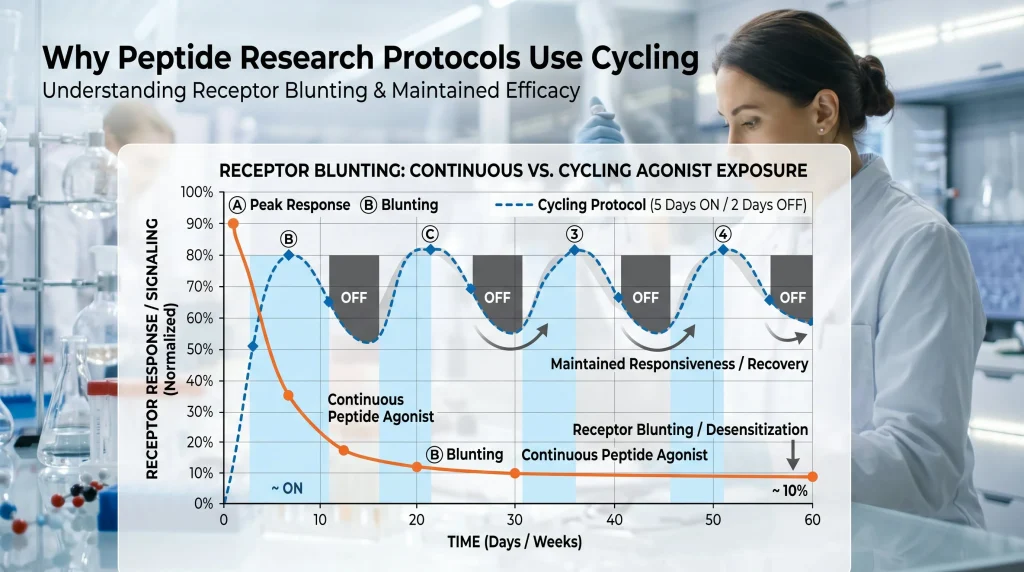
Cycling stops receptor count drop and keeps data clean across sessions. When a ligand stays present too long, the cell pulls its surface receptors inside. This lowers signal output. Cycling creates compound-free periods. These let the cell return receptors to the surface. This restores receptor count for the next session. Steady receptor density gives labs a stable cross-session baseline.
Cycling also controls the buildup of downstream signal proteins. Long exposure alters internal feedback paths. These changes are hard to separate from the compound’s direct effects. Gaps between active periods reduce these variables. This makes each session’s data easier to review. According to PubMed (2006), receptor cycling after agonist withdrawal follows well-defined cell-level tag removal pathways.
BPC-157 is available as a COA-verified research peptide. Each lot is tested by HPLC and mass spec.
How Does Half-Life Affect Cycling Gap Length?
The half-life of a peptide affects how long it stays active in a lab model. A compound with a longer half-life stays bound to receptors longer. This means a longer compound-free gap may be needed for full receptor cycling. A shorter-acting compound clears faster. It may allow a shorter gap between cycles.
Labs review published absorption data to estimate these intervals for each compound class. For GHRH variants, half-life data guides the active session length and gap length. This alignment stops buildup from extending into the next active cycle. According to PubMed (2007), GHRH analog half-life data guides effective pulsatile intervals in animal models.
Ipamorelin is available as a COA-verified research peptide. Each lot is tested by HPLC and mass spec.
What Cycling Structures Do Labs Use?
Labs use several cycling structures depending on the receptor system and study goals. The most common alternates active exposure periods with equal-length or longer compound-free gaps. This simple pattern makes data alignment across sessions easier.
Some studies use a pulsatile structure instead. This uses very short, timed exposure windows with brief gaps. Pulsatile designs are used when the lab needs to mimic natural hormone release patterns. The gaps in pulsatile plans are shorter than those in standard cycling designs.
CJC-1295 is available as a COA-verified research peptide. Each lot is tested by HPLC and mass spec.
Labs review receptor system data before selecting a cycling structure. The goal is to match the compound’s properties to the target receptor biology. According to PubMed (2025), plan structure is a key variable in controlling receptor response accuracy across multi-session studies.
How Does Cycling Affect Data Quality?
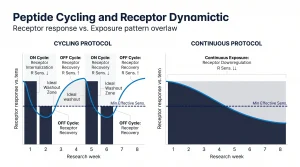
Cycling affects data quality by controlling receptor density at the start of each session. If the cell enters a session with a low receptor count, the response will be weaker. This masks the compound’s true activity. Compound-free gaps allow full receptor cycling. They set a cleaner baseline for each data point.
Off-cycle gaps also reduce change in downstream signal levels. Secondary messenger output, such as cyclic AMP, returns to baseline during rest periods. This reset makes responses easier to link to the compound alone. Labs document the length and timing of each cycle carefully. This lets peer reviewers assess whether effects reflect the compound or the study design.
GHRH variant research compounds are available as COA-verified research peptides in the fitness and GH category. Each lot is tested by HPLC and mass spec.
What Mistakes Occur in Cycling Plan Design?
The most common mistake is setting gaps that are too short for full receptor cycling. If the gap ends too soon, the cell still has a low receptor count. The next session starts on this low baseline. This produces a declining response trend across sessions. This trend may be read as reduced compound activity.
A second mistake is failing to account for the compound’s half-life when setting gap length. Some labs set fixed gaps without reviewing absorption data for the specific compound class. This can lead to overlap between residual compound activity and the next exposure window. A third error is inconsistent timing between sessions. If timing varies, it becomes hard to isolate the compound’s effect alone.
How Do Labs Document Cycling Plans?
Study records start before the study begins. Labs log the planned structure of each active period. They also log each compound-free gap. Pre-study records include compound identity, lot number, purity level, and the planned exposure schedule. COA data links lot numbers to verified purity levels for each session.
During the study, labs log actual timing, any deviations from the plan, and observed response data. Post-study records compare planned versus actual timing. They note where deviations occurred. This full record allows other labs to replicate or review the plan. According to PubMed (2007), full study records are a must for accuracy in peptide and hormone receptor research.
Frequently Asked Questions
What Is Cycling in a Research Protocol?
Cycling in a research plan alternates active compound exposure periods with compound-free gaps. The gap allows the cell to restore receptor populations pulled inside during the active period. Cycling is used to maintain steady receptor density across sessions. This makes it possible to compare data from separate sessions. It removes the confound of built-up receptor count loss over time. It is a standard design tool in endocrine and receptor biology models.
Why Do Study Designs Include Washout Periods?
Washout periods are planned gaps that remove the research compound from the study model. These breaks let the cell clear phosphate tags from receptors. They also return the receptors to the cell surface. Without these gaps, receptor counts at session start may differ due to prior count loss. According to PubMed (2025), these intervals are key for study validity across long-term designs.
How Does Cycling Relate to Receptor Recovery?
Cycling exists to address the risk of receptor count drop. When a receptor is activated continuously, the cell pulls it inside to stop the signal. According to PubMed (2006), this process leads to significant signal decline. Cycling ensures the cell returns receptors to the plasma membrane. This natural cycling ensures future active sessions trigger a full and accurate cell response.
Do All Peptide Classes Require Cycling?
Not all peptides require cycling plans. Many structural peptides affect broad tissue-repair or gene-output paths. They do not rely on simple agonist mechanisms. These compounds can be used in extended study windows without the same cycling structure. Labs set cycling needs based on the GPCR agonist type. Direct GPCR agonists show rapid count drop.
What Do Comparative Plan Studies Show?
Comparative studies show that non-cycled plans often result in a declining response trend in lab models. When receptors are kept saturated, signal output drops regardless of the concentration applied. According to PubMed (2007), plans that include structured rest periods result in more steady receptor response. Data quality depends on allowing natural cell control. Forcing constant compound exposure reduces accuracy.
What Is Tachyphylaxis in Peptide Research?
Tachyphylaxis is a rapid decline in cell response to a compound after repeated exposure. In lab studies, it arises when a peptide saturates G-protein-coupled receptors. According to PubMed (2006), when the agonist persists, the cell suppresses its internal response to stop excess stimulation. This makes data points hard to maintain. The study design must account for recovery periods between active sessions.
How Does a Peptide’s Half-Life Affect Cycling Strategy?
A peptide’s half-life dictates the washout phase length needed to clear the compound. If a compound clears the model quickly, shorter washout periods may be enough. The model can reach a baseline state in less time. Compounds with longer half-lives need extended rest. Matching washout length to the compound’s half-life is key for accuracy in long-term studies.
What Is a Drug Holiday in Receptor Research?
A drug holiday is a planned break from a research compound. It resets the study model baseline. It gives labs a window to observe the system in its natural state. This pause helps identify how much of the observed effect is lingering versus acute. It also acts as a safeguard against cell adaptations. These adaptations could complicate data analysis across multiple study sessions.
What Is Receptor Count Drop and How Does It Relate to Cycling?
Receptor count drop is a cell process. The cell reduces its surface count in response to persistent signals. Cycling is the plan design that counters this process. By removing the stimulus during the gap, the lab encourages the cell to restore its receptor count. According to PubMed (2025), this balance keeps the study model responsive to the compound throughout the study.
What Happens If Peptides Are Not Cycled Correctly?
If a study skips cycling plans, the lab model may experience full receptor count drop. This leads to a state where the peptide no longer triggers the expected cell signal. Subsequent data points become flawed for review. Forcing receptor paths without breaks can alter normal signal function. Steady, documented cycle timing is the most reliable way to protect data quality in any multi-session peptide study.
Summary
Research cycling plans are a core design tool in peptide biology. They maintain receptor density by adding compound-free recovery gaps between active study sessions. Good cycling design depends on half-life data, receptor kinetics, and steady records. Lot-level COA data helps labs track compound integrity across multi-session studies.
Labs sourcing precision peptides for cycling studies can browse the full catalog at Next Level Pharm. Each vial ships with a full COA and lot number for records needs.
What Should You Do Next?
Labs planning cycling studies can follow these steps:
- Select the correct compound for your receptor system. Review published data on receptor kinetics before starting. The fitness and GH category includes GHRH variants and GH-releasing peptides.
- Confirm lot-level purity before each session. Order enough of one lot to run the full study. Next Level Pharm provides COA access for each vial.
- Document your cycling schedule before the study begins. Record planned versus actual timing for each cycle to support accuracy.
People Also Read
- CJC-1295 Research: How This GHRH variant Works in Lab Models
- What Makes a Peptide Research Grade? Standards and Testing Explained
About the Author
Next Level Pharm Research Team
The Next Level Pharm research team is composed of biochemists and laboratory scientists dedicated to providing researchers with the highest-purity, COA-verified research peptides available. Every batch is HPLC and mass spec verified before dispatch.
Disclaimer: The information provided on this page is for educational and research purposes only. Next Level Pharm’s products are intended for laboratory research use only. They are not intended for human consumption, diagnostic, therapeutic, or medicinal purposes. This content does not constitute medical advice. Always consult a licensed healthcare professional before making any health-related decisions.