
Peptide Receptor Desensitization: Tachyphylaxis

Last updated: August 2026
A cell’s response to a ligand drops over time through peptide receptor desensitization. This drop is often called tachyphylaxis. It occurs when a cell pulls its surface receptors inside to stop excess signal input. The process is common in GPCR (G-protein-coupled receptor) systems. Cells use it to stop excess stimulation during long ligand exposure. It is well-studied in endocrine and growth factor research.
Next Level Pharm stocks research peptides with an average purity of 99.4% across recent batches. Each vial is HPLC and mass spec verified before dispatch. These standards help labs maintain baseline integrity in multi-session studies. Every batch is third-party tested..
These checks give labs a solid starting point for receptor-based assays. Lot data allows cross-session comparison. Verified purity removes a key variable when results shift across study runs. Consistent compounds help isolate receptor behavior from batch-to-batch differences.
Key Takeaways
- Signal blocking: Beta-arrestin blocks the G-protein signal after a receptor is tagged. This stops the pathway from running during long ligand exposure.
- Fast response drop: Tachyphylaxis is a rapid cell response drop after repeated ligand binding. The cell acts to stop excess input from overstimulating key pathways.
- Cells can recover: Removing the ligand allows tag removal and receptor surface return. This brings the cell back to its baseline response level.
- Short loss vs. long decline: A brief response loss differs from a long-term receptor count drop. Labs track both states to map how cells adapt over time.
- Timing in study design: Pulsed or cycling exposure limits response loss during a study. Timing control is key for consistent data across sessions.
These five points guide how labs design studies around receptor-based assays. The sections below break down each area in detail.
What Causes Receptor Desensitization
A cell detects high ligand levels and adjusts its output to stop excess signaling. This acts as a protective loop. The cell pulls receptors inside and slows transcription of new ones. Without this, unchecked signal chains can exhaust cell resources. When the ligand drops, the cell begins to restore its receptor surface count.
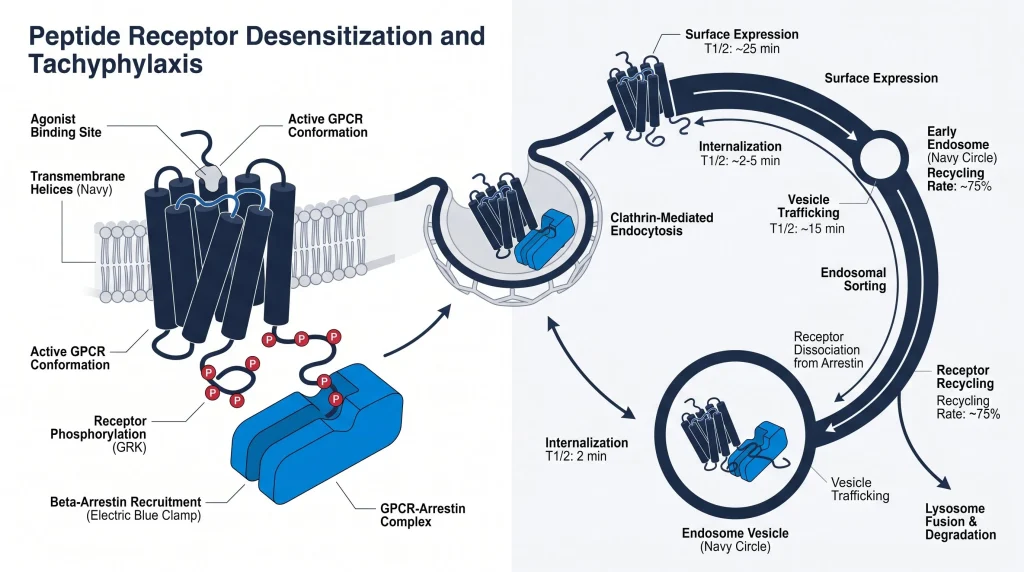
Specific enzymes called GRKs (G protein-coupled receptor kinases) start this process. GRKs attach phosphate tags to the receptor after a ligand binds. These tags recruit a protein called beta-arrestin. Beta-arrestin blocks the receptor from sending further signals. The cell then takes the tagged receptor inside via cell uptake (endocytosis).
BPC-157 is available as a COA-verified research peptide. Each lot is tested by HPLC and mass spec.
How Fast Does Tachyphylaxis Occur?
Tachyphylaxis can develop within minutes of continuous ligand exposure. The rate varies by receptor type and local ligand level. No fixed timeline applies across all cell models.
Two types exist. Homologous forms target only the receptor that bound the specific ligand. Heterologous forms can affect other receptors in the same cell. Both types reflect how cells control signal load. The GLP-1 receptor and opioid receptor are two well-studied examples. GRK-mediated signaling control is key in both cases.
Ipamorelin is available as a COA-verified research peptide. Each lot is tested by HPLC and mass spec. The same GRK pathway drives response loss across many GPCR classes.
What Is Receptor Downregulation?
Receptor count decline is the long-term loss of surface receptors due to sustained signaling. While response loss acts fast to stop excess input, count decline is a slower shift. The cell marks excess receptors for breakdown in lysosomes. This lowers the total number of binding sites on the surface.
CJC-1295 is available as a COA-verified research peptide. Each lot is tested by HPLC and mass spec.
At the gene level, the cell also lowers the output of new receptor proteins. This ensures fewer binding sites reach the surface. The cell reduces gene output to match its lower signal need. According to PubMed (2025), this balance is key for steady-state control in studied cell models.
How Can Receptor Sensitivity Be Restored?
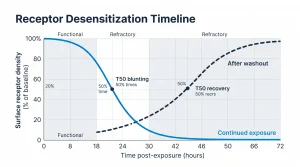
Removing the ligand lets the cell start its recovery. The cell clears the phosphate tags and returns receptors to the plasma membrane. This resets the cell’s ability to receive future signals.
The first step is tag removal (dephosphorylation). Enzymes clear the tags that held beta-arrestin in place. Without the tags, the receptor moves back to the surface. Labs use pulsed exposure or compound-free gaps to stop deep response loss. By alternating exposure with rest, the cell keeps its receptor count high throughout the study.
Why Is This Important for Peptide Research?
Labs need consistent receptor response to get clean, repeatable data. If a study design does not account for response loss, data may not reflect the compound’s true activity. Researchers must separate receptor efficacy from cell defense effects.
Untracked response drops often confuse study outcomes. This is common in GHRH variant research and melanocortin receptor studies. The signal cascade wanes even with the peptide still present. According to PubMed (2006), signal decline must be built into research modeling. Adjusting timing and concentration helps labs control complex signaling factors.
GHRH variant research compounds are available as COA-verified research peptides in the fitness and GH category. Each lot is tested by HPLC and mass spec.
How Are Agonist Types Related to Desensitization?
The type of ligand determines how fast and how deep the response drops. Full agonists cause the most response loss. They push the receptor to maximum activation, which speeds up the tagging process. Partial agonists cause a less intense shift. This leads to slower or shallower response loss.
Biased agonism offers a different path. A ligand activates one pathway but not the full cascade. This bypasses the circuits that flag the receptor for removal. If the active pathway does not trigger the tagging process, the response stays stable longer. Research published in PubMed (2024) shows biased ligands help study receptors while limiting typical feedback loops.
According to PubMed (2025), GPCR desensitization follows beta-arrestin recruitment and receptor uptake pathways. According to PubMed (2006), repeated agonist exposure leads to homologous response loss within hours in cell models. According to PubMed (2024), receptor recovery after washout depends on resynthesis rate and internal recycling pathways.
Frequently Asked Questions
What Is Receptor Desensitisation?
Receptor desensitization is a cell defense where a cell reduces its response to a ligand after long or repeated activation. This acts as a guard against excess stimulation. By blocking the receptor from its signal path, the cell limits its total output. This applies no matter how much peptide is present. It is a key control system in GPCR biology and endocrine research. It helps prevent runaway signaling in lab-based cell models.
How Does Continuous Signalling Downregulate Receptors?
Continuous signaling leads to receptor count loss when a cell pulls receptors inside to manage high ligand exposure. Once inside, the cell reduces the number of binding sites on the surface. If the ligand stays present too long, the cell stops returning receptors to the membrane. This limits the cell’s ability to receive further signals. Over time, the result is a lower baseline of surface receptor counts for any new signal input.
Which Peptide Classes Show Rapid Desensitization?
Peptides that bind GPCRs often display rapid response decline. Research shows GnRH variants exhibit fast response decay due to high receptor affinity. The speed depends on binding strength and the internal cascades triggered. Many lab studies confirm potent agonists cause control shifts faster than weaker variants. Researchers review response loss patterns before finalizing a study design for any given receptor class.
How Does Pulsatile Exposure Preserve Response?
Pulsatile exposure stops deep response loss by allowing time for receptor cycling between sessions. By pausing ligand exposure, the cell clears phosphate tags and returns receptors to the surface. This cycle keeps the density of available receptors high for the next signal window. According to PubMed (2006), intermittent exposure patterns help sustain response in endocrine and growth models. Timing control is a key tool in receptor study design.
How Is Desensitisation Measured?
Researchers measure the response loss by comparing cell output to equal ligand levels over time. A common method tracks the decline in cyclic AMP after an initial stimulus. If output drops while ligand level stays high, it signals a loss of response. These tests give a clear view of how cells control their signal paths after long ligand exposure. The data helps labs identify where to adjust timing protocols.
Does Receptor Desensitisation Happen to All Peptide Types?
Most peptides that bind cell surface receptors can trigger some form of response loss. The degree and speed vary based on the core properties of the peptide and the receptor type. Some pathways show rapid adaptation while others need much longer to reach a lower response state. Researchers check if a specific receptor system has known response loss patterns before setting a study design for that peptide class in a lab model.
What Is the Role of Beta-Arrestin in Tachyphylaxis?
Beta-arrestin is the protein that ends the signal from an activated GPCR. After a receptor is tagged with phosphate groups, beta-arrestin binds to it. This blocks further G-protein contact. The action stops the main signal chain and starts receptor uptake. Beta-arrestin is central to tachyphylaxis because it physically cuts the receptor off from its signal partners at the cell membrane.
Is Peptide Receptor Desensitisation Permanent?
Receptor desensitization is often a short-term state rather than a lasting loss of function. Most cells can recycle and restore receptor counts once the ligand is removed. Tag removal and receptor return to the surface restore baseline response. If exposure is too intense or too long, cell damage may lead to a more lasting reduction in response within the studied model. This is rare under standard lab conditions.
How Is Desensitisation Relevant in Peptide Research?
Response loss affects data consistency and reliability in lab studies. If a researcher does not account for this drop, observed effects may decline as the study runs. Understanding this dynamic allows labs to refine timing so each session generates useful data. According to PubMed (2025), managing these signal paths is a key factor in research accuracy. Protocol timing is central to repeatable findings.
What Is the Difference Between Desensitisation and Drug Tolerance?
Desensitization refers to specific shifts at the receptor level, such as uptake or tagging. Tolerance is a broader pattern where a model shows a smaller response to the same compound level. Desensitization is one root cause of tolerance. Other factors like faster compound breakdown or gene output shifts can also reduce the effect. Researchers study desensitization to find the root cause of broader tolerance patterns in a specific research model.
Summary
Confirm that your study protocol accounts for receptor response loss across sessions. Review the COA for each compound to ensure purity levels match your study needs. Lot numbers can be checked via the online lookup tool for full batch records.
Researchers sourcing precision peptides can browse the full catalog at Next Level Pharm. Each vial ships with a full COA to ensure lot tracking for lab use.
What Should You Do Next?
Researchers sourcing research-grade peptides for lab studies can follow these steps:
- Review purity records. Confirm COA data is available before ordering. Next Level Pharm provides lot-specific COA access for each vial.
- Check compound storage needs. Lyophilized peptides stay stable at room temperature. Confirm your lab has the right storage setup before starting work.
- Request technical support if needed. PhD-level biochemist support is available for labs with protocol questions.
People Also Read
- CJC-1295 Research: How This GHRH variant Works in Lab Models
- What Is PT-141? Melanocortin Receptor Research Explained
About the Author
Next Level Pharm Research Team
The Next Level Pharm research team is composed of biochemists and laboratory scientists dedicated to providing researchers with the highest-purity, COA-verified research peptides available. Every batch is HPLC and mass spec verified before dispatch.
Disclaimer: The information provided on this page is for educational and research purposes only. Next Level Pharm’s products are intended for laboratory research use only. They are not intended for human consumption, diagnostic, therapeutic, or medicinal purposes. This content does not constitute medical advice. Always consult a licensed healthcare professional before making any health-related decisions.