Intranasal Peptide Delivery: Absorption Research

Last updated: July 2026
Intranasal peptide delivery applies compounds to the nasal cavity for research. This route avoids the gut and lets compounds enter the blood more directly. Research shows some peptides reach peak blood levels within minutes of nasal delivery. Their structure stays more intact than via oral routes. This makes the intranasal route a key topic in peptide research. Lab teams select it when studying how compounds interact with systemic or neural targets.
Next Level Pharm provides COA-verified research peptides for laboratory use. Each vial is tested by HPLC and mass spec for identity and purity. The catalog covers 70-plus active peptide SKUs across 7 research areas. Average purity holds at 99.4% across the last 100 batches. Every order ships with a COA and lot-level traceability.
The nasal route matters because the nasal lining is thin and rich in blood vessels. This allows direct entry into the blood without liver processing. Choosing this route changes how compounds behave in the body during study. Researchers track these traits to understand how peptides interact with neural and systemic pathways.
Key Takeaways
- Direct Nasal Absorption: The nasal lining is rich in blood vessels. Peptides pass directly into the bloodstream. They bypass the gut entirely.
- No Liver First Pass: Nasal delivery avoids first-pass liver breakdown. This raises the amount of compound that enters the blood for study.
- Brain Access Routes: The olfactory and trigeminal nerve pathways run through the nasal cavity. Both pathways link the nasal cavity to the brain. They offer a possible direct route that bypasses standard barriers.
- Absorption Variables: Molecular size, fat solubility, and pH all affect nasal absorption. Nasal clearance rate also changes the uptake window.
- Common Research Compounds: Semax and Selank appear often in intranasal studies. Oxytocin and hormone-related peptides are also studied via this route.
The sections below examine how the nasal route works in a lab context. Each section covers one factor that affects how peptides behave in research.
What Is the Intranasal Route of Administration?
The intranasal route applies compounds to the nasal mucosa for research. This thin, vascular tissue lines the inside of the nasal cavity. It allows substances to pass into the blood quickly. This process avoids the breakdown that occurs in the gut or liver.
The route bypasses both the gut and liver first-pass breakdown. Gut and liver enzymes degrade fragile research peptides fast. Avoiding them helps the compound stay more stable. The nasal cavity also offers access routes to the brain. COA-verified Semax and related brain peptides are used in these studies. Researchers study these pathways to learn how molecules interact with neural structures. According to NCBI (2019), intranasal delivery gives direct access to central nervous system targets via olfactory and trigeminal nerve pathways.
How Does Nasal Absorption Work in Detail?
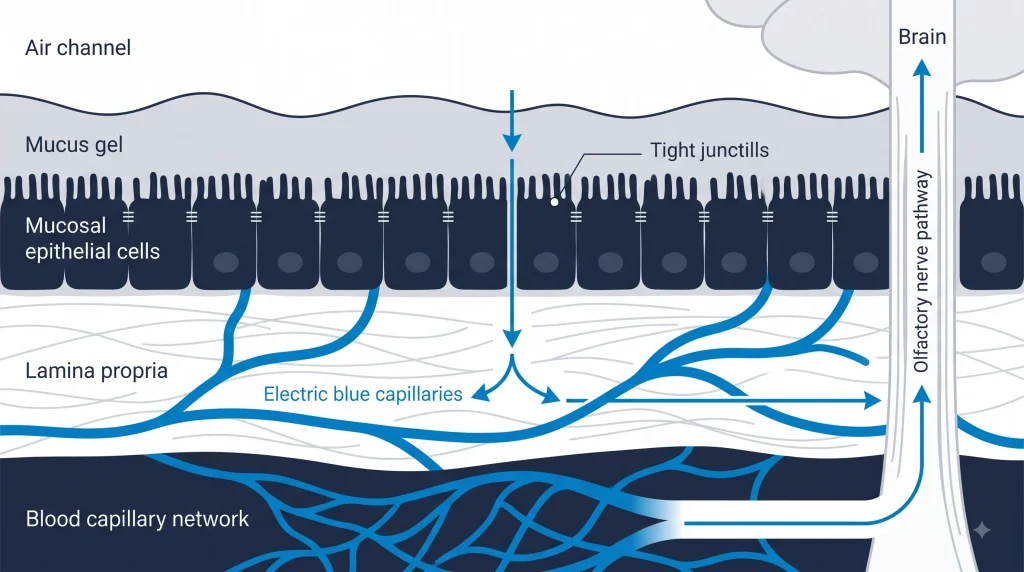
Nasal absorption works through the nasal lining, a thin, vascular membrane. This tissue acts as the main entry point for molecules. Compounds cross this barrier to reach the blood vessel network. Two main transport pathways exist.
Paracellular transport moves molecules through the tiny gaps between nasal lining cells. This path is limited by cell gap size. Larger peptides often cannot pass through this route. Transcellular transport moves substances through the cells directly. It uses carriers or passive diffusion. The olfactory region is also studied for a direct path to the brain. Its nerves can bypass standard barriers. According to NCBI (2020), both transport types contribute to nasal peptide uptake. Transcellular routes are favored for smaller, fat-soluble compounds.
Why Does Nasal Delivery Bypass First-Pass Metabolism?
Nasal delivery bypasses first-pass breakdown because the nasal mucosa drains into the blood directly. This path avoids the liver portal vein. First-pass breakdown occurs when ingested compounds enter the liver portal vein first. Liver enzymes then break down a large share before the compound reaches the blood.
Nasal tissue does not link to this vein. So the compound enters the blood without liver processing. This avoids the loss caused by liver enzymes. This lets researchers study compound behavior at higher blood levels. Next Level Pharm supplies research peptides with HPLC-verified purity for these studies. According to NCBI (2021), bypassing the liver portal system raises the fraction of intact compounds available for observation.
Which Factors Affect Intranasal Absorption?
Nasal absorption depends mainly on molecular size, fat solubility, and the pH of the solution. Larger molecules struggle to pass through the nasal lining. More fat-soluble molecules cross nasal cell membranes more easily. Adjusting pH changes the charge of the peptide. This charge shift affects how well it passes through the lining.
Nasal clearance removes substances from the cavity before they cross the lining. This self-clearing process cuts the time the peptide has to absorb. Nasal enzymes may also break down the peptide before it reaches the blood. Researchers must account for these variables to keep results steady. They track each factor across replicate samples to reduce variance. According to Molecules (MDPI) (2021), nasal clearance and enzyme activity are the primary limits on nasal peptide absorption.
What Brain-Targeting Advantages Does This Route Offer?
This route offers direct nose-to-brain delivery via nerve pathways. The blood-brain barrier blocks many large or polar molecules from reaching the brain. Nasal delivery lets some research compounds reach the cranial space without crossing this barrier. Peptides may reach the brain’s fluid within minutes of nasal delivery.
The mechanism uses the olfactory and trigeminal nerve pathways. Olfactory nerves run from the upper nasal cavity into the brain’s olfactory bulb. This provides a direct path that avoids standard systemic routes. Trigeminal nerves span from the nasal cavity into the brainstem. They hold channels that permit transport into the central nervous system. Labs study these pathways to measure how molecules reach specific brain regions. Tracking these routes helps teams see if a compound reaches its intended target.
Which Peptides Are Studied Via the Intranasal Route?
Peptides often studied via the intranasal route include Semax and Selank. Researchers choose them for activity in the central nervous system. Oxytocin, vasopressin, and insulin analogs are also studied via this route. Scientists focus on these molecules due to their size and nasal lining crossing properties. Next Level Pharm offers COA-verified Selank for research labs.
These peptides are studied for their ability to reach the brain while staying stable. The nasal route offers fast onset because it avoids gut and liver processing. Lab teams monitor peptide movement to see if a compound reaches specific receptor sites. This research gives data on how structural changes keep a molecule functional during transport. Teams also record lot-level purity data to control for batch variation across studies.
What Are the Key Research Parameters for Nasal Delivery?
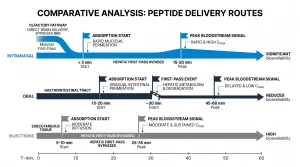
The table below compares intranasal delivery to oral and injection-based research routes. Each row covers one factor that affects how compounds behave during a study.
| Parameter | Intranasal | Oral | Injection-Based |
| First-pass liver breakdown | Avoided | Present | Avoided |
| Gut enzyme degradation | Avoided | Present | Avoided |
| Nasal clearance risk | Present | None | None |
| Brain barrier bypass | Possible | No | No |
| Onset speed | Minutes | 30-90 min | 5-15 min |
| Invasive procedure | No | No | Yes |
Frequently Asked Questions
How Do Peptides Absorb Through Nasal Mucosa?
Peptides enter the blood through the nasal lining by two routes. The first moves molecules through the gaps between nasal lining cells. The second moves them through the cells via carriers or passive diffusion. The nasal lining is thin and full of blood vessels. This allows fast entry into the venous system. Smaller, fat-soluble peptides cross this lining faster than large or water-bound molecules.
Which Peptides Are Studied Intranasally?
Research focuses often on smaller signal peptides like Semax and Selank. These are chosen for their stability and potential for brain pathway interaction. Oxytocin and growth hormone-related peptides are also studied for systemic effects. Labs select these sequences for their ability to survive the nasal environment. Lab data help determine which peptide types reach target tissue with the most accuracy.
Why Does Nasal Delivery Bypass First-Pass Breakdown?
Nasal delivery lets compounds enter the blood through the nasal mucosa’s venous drain. This avoids the liver portal vein and its first-pass enzyme breakdown. Liver enzymes break down many substances before they reach the blood via oral routes. By skipping this step, more compounds stay intact for study. According to NCBI (2019), this cuts the loss of compound to liver-based breakdown.
How Stable Are Peptides in Nasal Solution?
Stability depends on the peptide’s chemical makeup and the additives in the solution. Many peptides are prone to oxidation or hydrolysis in liquid form. Freeze-dried powders reduce this risk. Researchers prepare fresh solutions for each study from these powders. Certain buffers and stabilizing agents extend shelf life. They do this by stopping aggregation and decay in the liquid medium.
What Limits Intranasal Absorption?
Nasal absorption faces limits from both mechanical and biological clearance. Nasal clearance moves substances toward the pharynx before they can cross the lining. Nasal enzymes may break down peptide sequences before they reach the blood. These factors create a short time window for absorption. According to Molecules (MDPI) (2021), these barriers greatly reduce the peptide amount that enters the bloodstream.
Is Intranasal Delivery the Same as Inhalation?
Intranasal delivery and inhalation are distinct routes. Nasal delivery targets the upper nasal cavity and mucosa. It can also access nerve pathways that lead to the brain. Inhalation delivers substances to the lungs and bronchial tree. Both methods avoid the gut, but their targets and barriers differ. The final distribution of the compound also differs by route.
Can Larger Peptides Be Delivered Nasally?
Larger peptides face challenges because their structure limits passage through the tight gaps in the nasal lining. Molecular size acts as a physical barrier to passive diffusion. Scientists use permeation enhancers to temporarily change the lining’s passage ability. Specialized carriers also help move larger molecules through. These methods help researchers study compounds that would otherwise stay on the tissue surface.
What Is the Role of Mucoadhesive Polymers in Nasal Formulas?
Sticky adhesive polymers bind to the mucous layer of the nasal mucosa. This keeps the research compound on the absorptive surface longer. By slowing nasal clearance, these polymers give the peptide more time to cross the lining. Longer contact may improve uptake of sensitive peptides. Researchers study these formulas to see if they raise the absorption of specific sequences.
How Fast Is the Onset of Action for Nasal Peptides?
Onset varies based on peptide type, concentration, and transport mechanism. Many nasally delivered compounds show detectable blood levels within minutes. This is faster than standard oral delivery. Because the route avoids the gut and liver, the agent reaches the blood more quickly. Labs track these timelines to understand how different formulas affect arrival speed.
Does the pH of a Nasal Solution Affect Absorption?
The pH of a nasal solution changes the electrical charge of the peptide. A charged peptide may struggle to cross the waxy cell membranes of the nasal lining. Setting pH to a neutral level often improves uptake. Labs test a range of pH values to find the right level for each compound. According to NCBI (2018), researchers test various pH levels to find the optimal conditions for nasal absorption.
Summary
Intranasal peptide delivery is a research route that applies compounds to the nasal mucosa. It gives direct entry into the bloodstream or brain. The route avoids gut breakdown and liver first-pass processing. This makes it useful for studying compounds that lose integrity via oral routes. Key variables that affect absorption include molecular size, fat solubility, pH, and nasal clearance rate. Semax, Selank, and oxytocin are commonly studied via this route for their neurological and systemic properties.
What Should You Do Next?
Researchers planning intranasal peptide assays should review the COA and specs before starting. Confirm the molecular weight and purity of each lot. Check that lot number and batch date match the COA on file. This step stops errors caused by expired or mis-labeled samples. Browse COA-verified Semax, Selank, and other brain peptides at Next Level Pharm for batch-specific purity data.
People Also Read
- What Are Nootropic Peptides? Mechanisms, Research Review
- What Is Selank? GABA Pathways, Mechanisms, and Study Findings
About the Author
Next Level Pharm Research Team
The Next Level Pharm research team is composed of biochemists and laboratory scientists dedicated to providing researchers with the highest-purity, COA-verified research peptides available. Every batch is HPLC and mass spec verified before dispatch.
Disclaimer: The information provided on this page is for educational and research purposes only. Next Level Pharm’s products are intended for laboratory research use only. They are not intended for human consumption, diagnostic, therapeutic, or medicinal purposes. This content does not constitute medical advice. Always consult a licensed healthcare professional before making any health-related decisions.