
Ipamorelin vs Hexarelin: GH Secretagogue Research

Last updated: July 2026
An ipamorelin vs hexarelin comparison examines two synthetic growth hormone secretagogues (GHS) that act on the ghrelin receptor (GHS-R1a). GHS-R1a is a cell surface protein that controls hormone signals. According to ClinicalTrials.gov (2024), GH secretagogues are studied for receptor sensitivity and hormonal regulation in lab models. Ipamorelin is a pentapeptide (5 amino acids). Hexarelin is a hexapeptide (6 amino acids). Their different structures affect receptor binding strength and signal profiles in research assays.
Next Level Pharm is a US-based supplier of research-grade peptides. Both ipamorelin and hexarelin are available with HPLC purity data and mass spectrometry results on every COA. Average purity across the last 100 batches is 99.4%. A lot number ships with every order.
Understanding how these two GHS-R1a agonists differ helps researchers design better GH signals studies. Ipamorelin is noted for its targeted GH release profile. Hexarelin is noted for its greater strength and broader receptor reach.
Key Takeaways
- Greater GH Potency: Hexarelin gives a stronger GH signal than ipamorelin in GH secretagogue assays.
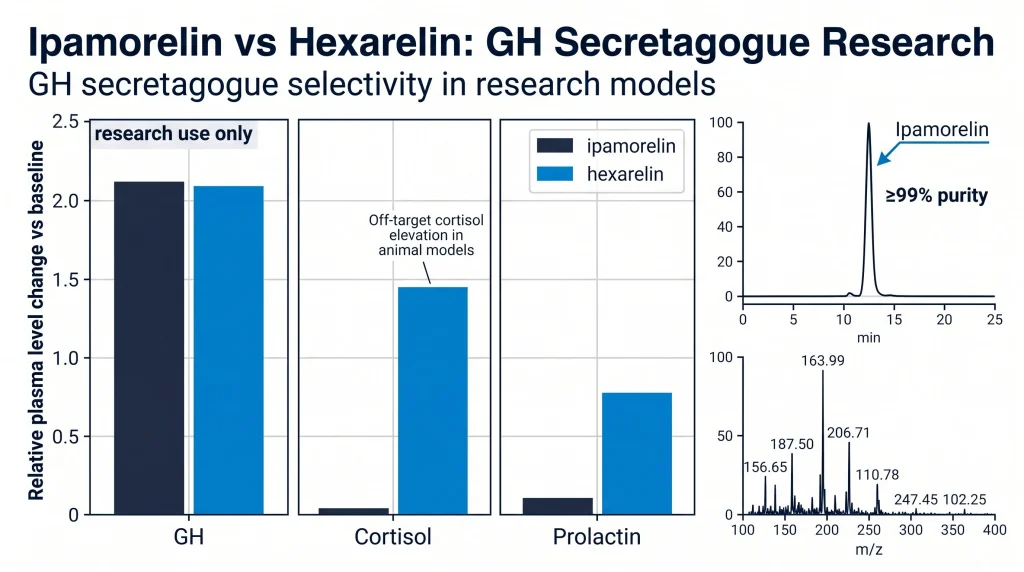
- Targeted GH Signaling: Ipamorelin activates GHS-R1a without raising cortisol or prolactin in research models.
- Broader Hormonal Impact: Hexarelin raises cortisol and prolactin alongside GH in studies.
- Heart Cell Research Potential: Hexarelin has been studied for heart-protective effects via CD36 receptor binding.
- Shared Ghrelin Receptor Mechanism: Both act as GHS-R1a agonists that mimic ghrelin’s receptor binding pattern.
These differences guide study design decisions. Studies on clean GH axis signaling often weigh GH signal strength against off-target hormone effects.
What Are GH Secretagogues Ipamorelin and Hexarelin?
GH secretagogues are research compounds that act on the GHS-R1a receptor to trigger GH signals. GHS-R1a is also called the ghrelin receptor. It was first linked to GH release in the late 1990s. Ipamorelin is a pentapeptide with 5 amino acid building blocks. Hexarelin is a hexapeptide with 6 amino acid building blocks. Both were designed as synthetic ghrelin mimics for lab research.
Both peptides act on the same primary receptor but have different chain lengths. Chain length affects how each peptide docks into the GHS-R1a binding site. A longer chain can interact with more parts of the receptor. This may explain hexarelin’s greater strength in assays. Ghrelin is a 28-amino-acid peptide produced in the stomach. It signals GH release via GHS-R1a. Neither ipamorelin nor hexarelin is approved for use in humans.
How Do Their Mechanisms of Action Compare?
According to PubMed (1998), ipamorelin is a targeted GHS-R1a agonist. It activates the receptor and produces GH release without engaging other hormone pathways. Hexarelin binds GHS-R1a with higher receptor affinity than ipamorelin. This gives a stronger GH signal in assay models.
Receptor affinity is how tightly a compound holds to a receptor site. Hexarelin’s higher affinity means it stays in contact longer. This leads to stronger downstream signaling. Ipamorelin uses a more refined activation pattern. It engages GHS-R1a to produce GH release but does not trigger cortisol or prolactin pathways. Studies on pure GH axis signaling often note this difference in their study designs.
What Does Research Show About Their Potency?
Hexarelin is more potent than ipamorelin in GH secretagogue assays. At equal concentrations in animal models, hexarelin produces larger GH peaks. This greater strength comes from its stronger binding to GHS-R1a. Ipamorelin gives a biomimetic pulsatile GH signal. Pulsatile means the GH release follows a rhythmic wave pattern that matches natural GH release in animal biology.
Pulsatile GH release matters in research that studies GH rhythm. Natural GH is released in bursts, not as a steady flow. Ipamorelin’s signal pattern has been compared to this natural rhythm in published models. Hexarelin’s stronger but less targeted signal is useful in studies that need to drive high GH output. Researchers select between them based on study endpoint.
How Selective Is Ipamorelin vs Hexarelin?
Ipamorelin is highly targeted for GHS-R1a. It does not raise cortisol or prolactin in research assays. According to PubMed (1994), hexarelin raises both cortisol and prolactin alongside GH. This makes ipamorelin the more focused compound for studies that require clean GH data.
Cortisol is a stress hormone from the adrenal gland (a small gland above each kidney). Prolactin is a hormone from the pituitary gland. Both are in distinct biological pathways. When a GHS compound raises cortisol or prolactin, these signals can interfere with assay results. Ipamorelin avoids these extra signals. Studies on GH axis signaling alone often prefer it for this reason.
Do These Peptides Present Off-Target Effects?
Hexarelin has two main off-target effects in research. First, it elevates ACTH (adrenocorticotropic hormone, a pituitary signal that drives cortisol release) and prolactin. Second, it shows reduced receptor response over repeated use cycles. According to Peptides Journal (2006), this reduced response has been documented in cell-based assays. Ipamorelin does not show these off-target effects in published models.
Reduced receptor response means the receptor becomes less sensitive after repeated compound exposure. In some cell models, repeated hexarelin activation gives a weaker GH signal over time. Ipamorelin does not show this pattern in published data. This makes it more stable for protocols with repeated assay cycles. Researchers using hexarelin in multi-cycle designs should account for this in data analysis.
Which Peptide Has More Cardiovascular Research?
Hexarelin has more heart cell research than ipamorelin. According to PubMed (2007), hexarelin binds the CD36 receptor (a heart cell surface protein involved in fatty acid transport). This binding has been studied in low-oxygen heart cell models. Ipamorelin does not bind CD36. Its research is focused on GH axis studies only.
CD36 is a scavenger receptor found on heart cells. Research has explored how hexarelin interacts with CD36 in low-oxygen environments. These are in vitro and animal model studies only. The CD36 findings make hexarelin of interest to studies covering heart cell biology. Both compounds are for lab research use only. They are not studied as treatments for any condition.
How Do Ipamorelin and Hexarelin Compare in Research?
Both ipamorelin and hexarelin are GHS-R1a agonists studied in GH secretagogue research. Ipamorelin is a pentapeptide with targeted GH signals and minimal off-target effects. Hexarelin is a more potent hexapeptide with broader hormone impact and CD36 receptor binding. The table below summarizes their key differences as observed in published research models.
| Feature | Ipamorelin | Hexarelin |
| Structure | Pentapeptide (5 aa) | Hexapeptide (6 aa) |
| Primary receptor | GHS-R1a | GHS-R1a (+ others) |
| GH strength | Moderate, targeted | High, less targeted |
| Cortisol/prolactin effect | Minimal | Elevated |
| Cardiovascular research | Limited | CD36 receptor studies |
| Reduced receptor response | Low | Observed with repeated use |
Both compounds are available as research-grade peptides. View fitness and GH peptides for the full range. Each lot is COA-verified with HPLC and mass spectrometry data on file.
Frequently Asked Questions
What Is the Difference Between Ipamorelin and Hexarelin in GH Research?
Ipamorelin is a pentapeptide (5 amino acids) that targets GHS-R1a with minimal off-target hormone effects. Hexarelin is a hexapeptide (6 amino acids) with greater strength at GHS-R1a but a broader receptor profile. Ipamorelin does not raise cortisol or prolactin in research models. Hexarelin raises both. The key difference is between GH signal strength and targeting precision in research assays.
Is Ipamorelin More Selective Than Hexarelin for GH Release?
Yes. In research assays, ipamorelin activates GHS-R1a without triggering cortisol or prolactin pathways. Hexarelin is more potent at GHS-R1a but also raises cortisol and prolactin. Ipamorelin is described as a targeted GH secretagogue in published research. Hexarelin is described as a potent but less focused compound. The choice between them depends on whether targeting or potency matters more for a given study.
How Does Hexarelin Affect Cortisol and Prolactin Compared to Ipamorelin?
According to PubMed (1994), hexarelin raises cortisol and prolactin alongside GH in research models. Ipamorelin does not produce this effect. The difference matters for assay design. Elevated cortisol in assay data can complicate result interpretation. Researchers who need clean GH signal data without cortisol or prolactin interference are more likely to use ipamorelin in their protocols.
What Cardiovascular Research Has Been Done on Hexarelin?
Hexarelin has been studied for heart cell effects via CD36 receptor binding. According to PubMed (2007), hexarelin has been observed to interact with CD36 in low-oxygen heart cell models. These are in vitro and animal model studies only. Ipamorelin has not been studied for CD36 binding or heart cell effects. All studies are for research purposes only.
Which Peptide Produces Fewer Off-Target Hormonal Effects in Studies?
Ipamorelin shows fewer off-target hormone effects in research assays. Published data show it does not raise ACTH, cortisol, or prolactin. Hexarelin raises all three in addition to GH. Ipamorelin’s clean research profile makes it useful in studies where only GH axis data is needed. For research purposes only. Neither compound is studied as a treatment for any health condition.
What Are the Molecular Structures of Ipamorelin and Hexarelin?
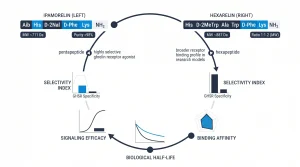
Ipamorelin is a pentapeptide: Aib-His-D-2-Nal-D-Phe-Lys-NH2. Hexarelin is a hexapeptide: His-D-2-MeTrp-Ala-Trp-D-Phe-Lys-NH2. Both have synthetic sequences not found in nature. Their different lengths affect how each compound binds to GHS-R1a. Hexarelin’s extra amino acid adds to its receptor binding strength. Both are COA-verified research-grade compounds.
Can Receptor Desensitization Be Observed With Hexarelin in Studies?
In research models, hexarelin has shown reduced receptor response over repeated activation cycles. This effect has been documented in cell-based assays. Ipamorelin shows a lower level of this effect in published data. Researchers running multi-cycle hexarelin protocols should note this reduced receptor response in their study design. This reduced sensitivity may affect GH signal size in later assay cycles. For research purposes only.
Do Ipamorelin and Hexarelin Function as Ghrelin Mimics?
Yes. Both peptides mimic ghrelin at the GHS-R1a receptor. Ghrelin is a peptide hormone produced in the stomach. It activates GHS-R1a to signal GH release in animal models. Ipamorelin and hexarelin bind GHS-R1a and produce similar downstream signaling. They were developed to replicate this function in research settings. Neither is a pharmaceutical drug or a naturally occurring ghrelin variant.
How Does the Potency of Hexarelin Compare to Ipamorelin in Scientific Models?
Hexarelin is more potent than ipamorelin in GH secretagogue assays. At equal concentrations in animal models, hexarelin produces larger GH peaks. According to PubMed (1998), ipamorelin gives a more targeted, lower-amplitude GH signal. Both are GHS-R1a agonists. Their potency difference is a key factor when studies select between them for a specific study design.
What Is the Significance of the CD36 Receptor in Hexarelin Research?
CD36 is a heart cell surface protein involved in fatty acid transport. According to Peptides Journal (2006), hexarelin has been found to bind CD36 in heart cell studies. This binding has been explored in low-oxygen heart cell models. CD36 binding is unique to hexarelin among GHS-R1a agonists studied to date. Ipamorelin does not bind CD36 in published research. All findings are from in vitro and animal model studies only.
Summary
Ipamorelin and hexarelin are both GHS-R1a agonists studied in GH secretagogue research. Ipamorelin is a pentapeptide with a targeted GH signal. It does not raise cortisol or prolactin in research models. Hexarelin is a more potent hexapeptide. It raises cortisol and prolactin alongside GH.
Hexarelin also binds the CD36 receptor, making it a focus of heart cell research not seen with ipamorelin. Ipamorelin shows a cleaner research profile. This makes it useful for studies where targeted GH data is the primary endpoint. Both are available as COA-verified research compounds from Next Level Pharm.
What Should You Do Next?
Researchers comparing GHS-R1a agonists should confirm HPLC purity and mass spec identity on every lot before use. Request a COA with lot number. Record the result in protocol files alongside the study design parameters.
Shop research peptides at Next Level Pharm. Both ipamorelin and hexarelin are available with full COA documentation on every batch. Purity is verified to ≥99% by HPLC and mass spectrometry.
People Also Read
- CJC-1295 Research: How This GHRH Analog Works in Lab Models
- What Is Ipamorelin: Mechanism of Action and Research Overview
About the Author
Next Level Pharm Research Team
Alex M covers peer-reviewed findings in peptide science for Next Level Pharm, a US-based supplier of research-grade peptides verified to ≥99% purity via HPLC and mass spectrometry on every batch.
Disclaimer: The information provided on this page is for educational and research purposes only. Next Level Pharm’s products are intended for laboratory research use only. They are not intended for human consumption, diagnostic, therapeutic, or medicinal purposes. This content does not constitute medical advice. Always consult a licensed healthcare professional before making any health-related decisions.