
Peptide Bioavailability: Absorption and Stability Research

Last updated: June 2026
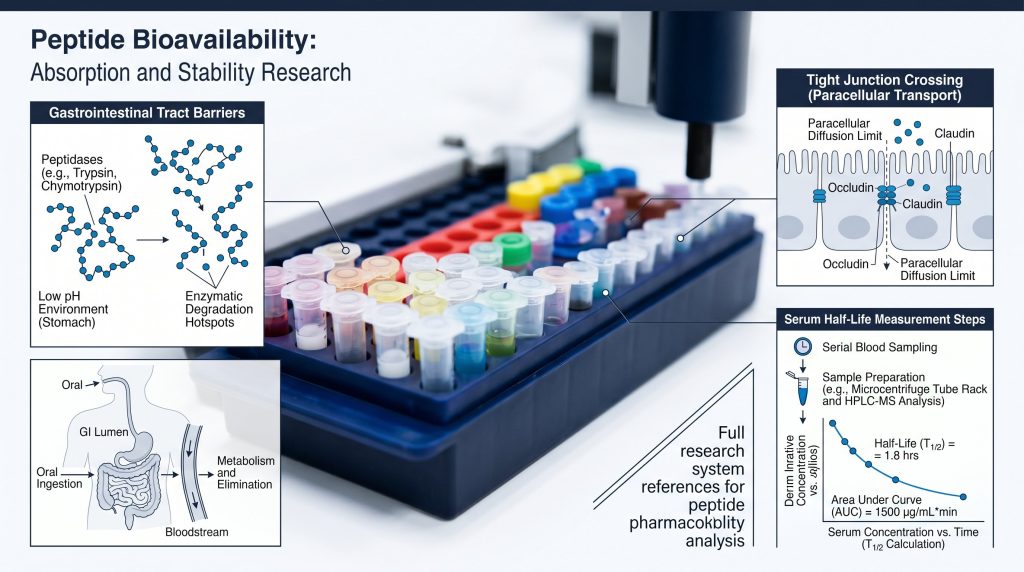
A peptide bioavailability research study measures how much of a peptide reaches its target receptor after delivery in a model system. Bioavailability depends on molecular size, charge, and stability in biological fluids. Short peptides (under 10 amino acids) are often broken down by enzymes in the gut or blood before reaching their receptor target. Lab models use cell monolayers and enzyme stability assays to map absorption. Animal PK data add further context. All results come from in vitro and preclinical models.
Next Level Pharm is a US-based supplier of research-grade research peptides, verified to ≥99.4% purity by HPLC and mass spectrometry on every batch. Each lot ships with a COA and a lot number for full traceability.
Key Takeaways
- Oral absorption barrier: Most research peptides are broken down by enzymes in the gut before absorption. Cell monolayer assays (Caco-2) measure how much peptide crosses the gut wall in research models.
- Lyophilization stability: Freeze-drying (lyophilization) removes water from peptides and makes them stable at room temperature during transit. Reconstituted solutions must be used within the study window.
- Half-life in cell assays: Peptide half-life in serum or cell medium depends on enzyme levels in the model. Researchers add enzyme inhibitors or use cyclized peptides to extend stability in assays.
- COA-verified lots: Next Level Pharm ships lyophilized research peptides lots with HPLC and mass spec data on every batch. Each lot has a traceable number.
- Research use only: All research peptides in this catalog is for laboratory research use only. No clinical outcomes are claimed.
What Factors Affect Peptide Bioavailability in Models?
Molecular size, charge, enzyme stability, and lipophilicity all affect how much peptide reaches its receptor target in a model system.
Peptides above 1,000 daltons (Da) cross cell membranes less easily. Smaller molecules cross more readily. Charge also matters: highly charged peptides bind the membrane surface instead of crossing it. Enzyme stability is the main barrier in oral delivery models. Proteases in the gut break down most linear peptides before absorption. Lipophilicity is measured as log P. A higher log P means easier membrane crossing. According to Fosgerau and Hoffmann (2015), the main challenges for therapeutic peptide delivery include short half-life, poor membrane crossing, and rapid kidney clearance. Lab teams measure these same parameters to check new peptide lots.
How Is Peptide Absorption Measured in Cell Models?
Caco-2 cell monolayers are the standard model for oral peptide absorption. TEER (transepithelial electrical resistance) confirms monolayer integrity before the assay starts.
Caco-2 cells form a tight layer that mimics the gut wall. When researchers add a peptide to the top of the monolayer, they measure how much appears on the other side. The crossing ratio is called the apparent permeability, or Papp. A Papp above 10 x 10-6 cm/s shows good crossing ability in this model. TEER is measured before and after each assay. This confirms the monolayer stayed intact. According to Hamman et al. (2005), tight junction disruption and lipid raft transport are two main crossing routes for peptides in Caco-2 models. Results predict absorption trends in preclinical studies.
How Is Peptide Stability Measured in Serum Assays?
Serum stability assays add a peptide to serum and track how much intact peptide remains at set time points by LC-MS.
Standard protocols add a set amount of peptide to serum at 37°C. At set time points, researchers remove a sample. They stop enzyme activity with methanol. Then they measure intact peptide by LC-MS. The time when 50% of peptide is gone is the half-life (t½) in that model. According to Vlieghe et al. (2010), peptide half-life in plasma ranges from seconds for linear peptides to hours for cyclic or modified forms. Lab teams use t½ data to set the study time window for receptor binding assays.
How Does Lyophilization Affect Peptide Research Quality?
Lyophilization removes water and locks peptides in a dry, stable form. Dry peptide powders hold their activity longer than solutions and are stable at room temperature during shipping.
Freeze-drying freezes a peptide solution. Then the chamber pressure drops. Ice converts to vapor without passing through liquid. This removes water without heat, which protects peptide structure. The resulting dry powder is called lyophilized peptide. It is stable at room temperature for shipping. Store at -20°C for long-term use. Once dissolved in buffer, the peptide must be used within the study time window.
| Form | Stability | Use Case | Key Note |
| Lyophilized powder | Room temp. transit stable | Long-term lab storage | Reconstitute just before use |
| Solution in buffer | Hours to days at 4°C | Same-day assays | Enzyme degradation begins immediately |
| Cyclic peptide | Serum stable (hours to days) | Extended half-life studies | Higher synthesis cost |
What Biomarkers Are Used in Peptide Bioavailability Studies?
Key markers include Papp from Caco-2 assay, serum t½ by LC-MS, TEER integrity score, and receptor binding confirmed by competitive binding assay.
Papp from Caco-2 assays gives a numeric crossing rate. Serum t½ by LC-MS gives the degradation rate in a serum model. Receptor binding Kd confirms that the peptide still binds its receptor. This shows it survived the crossing step. TEER score confirms that the Caco-2 monolayer was intact during the assay. Researchers also measure recovery rate. This is the percent of peptide found in the receiver chamber after the assay. Together, these markers show how well a peptide reaches its receptor.
What Research Tools Support research peptides Research?
Lab teams need COA-verified peptide, Caco-2 cell monolayers, TEER meter, LC-MS system, and serum stability kits for bioavailability studies.
Research teams need a verified research peptides lot to run any study. The lot must match the published reference standard for molecular weight and purity. Next Level Pharm verifies each research peptides lot by HPLC and mass spectrometry before shipping. Caco-2 monolayers must reach a TEER of at least 150 ohm/cm2 before use. LC-MS columns for peptide separation should be validated against reference standards before the first stability run. View the research peptides product page for lot-specific COA and mass spec data.
Frequently Asked Questions
What is peptide bioavailability in research?
Peptide bioavailability is the fraction of a peptide that reaches its receptor target in a model system. It depends on enzyme stability, cell membrane crossing ability, and clearance rate. Laboratory models use Caco-2 cells, serum stability assays, and animal PK models to measure these factors. All data come from research models, not clinical use.
What is apparent permeability (Papp)?
Papp is the crossing rate of a peptide through a Caco-2 cell monolayer. It is measured by comparing peptide amount in the receiver chamber to the total added to the donor chamber. A higher Papp means better cell-crossing ability in this model. Papp above 10 × 10−6 cm/s is considered good crossing ability in published Caco-2 research.
Why do most peptides have low oral bioavailability?
Most peptides are broken down by proteases in the gut before crossing the gut wall. Even if they cross, they face further enzyme breakdown in the blood. Their large size and charge also limit passive membrane crossing. Researchers use cyclization, chemical modification, or formulation strategies to study improved stability in preclinical models.
What is serum half-life and how is it measured?
Serum half-life (t½) is the time it takes for 50% of a peptide to break down in serum or plasma. It is measured by adding peptide to serum at 37°C, taking samples at set time points, and measuring intact peptide by LC-MS. Short t½ means the peptide breaks down quickly in the model. Lab teams use t½ data to plan the timing of receptor binding assays.
What is TEER and why is it important in peptide absorption studies?
TEER (transepithelial electrical resistance) measures the tightness of a Caco-2 cell monolayer. A high TEER (above 150 ohm/cm2) means the monolayer is intact and tight junctions are closed. If TEER drops during an assay, it means the monolayer was damaged. Researchers check TEER before and after each Papp assay to confirm that crossing data are valid.
How does lyophilization help peptide research quality?
Lyophilization removes water from peptide lots without using heat. The result is a dry powder that is stable at room temperature during shipping and at -20°C for long storage. This protects peptide structure from enzyme and oxidation damage. Once reconstituted, researchers must use the solution within the stability window stated in the COA or published protocol.
What is the role of cyclization in peptide stability research?
Cyclization links the ends of a peptide chain to form a ring. This ring structure makes the peptide harder for proteases to break down. In serum stability assays, cyclic peptides have longer t½ than their linear forms. Lab teams compare linear and cyclic versions of the same peptide to measure the stability gain from cyclization in the chosen model.
What published research covers peptide bioavailability?
Fosgerau and Hoffmann (2015) in Drug Discovery Today reviews delivery barriers for therapeutic peptides (PMID 25735990). Hamman et al. (2005) in BioDrugs covers strategies to improve peptide oral absorption (PMID 16173941). Vlieghe et al. (2010) in Drug Discovery Today covers synthetic peptide design for stability (PMID 20155902).
What purity standards apply to peptides used in bioavailability assays?
Research-grade peptides used in bioavailability assays must be verified to ≥99% purity by HPLC and mass spectrometry. Each lot must have a COA with purity value and molecular weight data. Low-purity lots produce false Papp and t½ readings because impurities may cross the membrane or break down at a different rate than the target peptide.
Summary
Peptide bioavailability research measures how much of a peptide reaches its receptor target in a model system. Key parameters are Papp from Caco-2 assays, serum t½ by LC-MS, and TEER integrity. Published data from Fosgerau and Hoffmann (2015) and Vlieghe et al. (2010) outline the main delivery barriers.
Lyophilized peptide lots provide stable research starting material. Lab teams must confirm lot purity by HPLC and mass spec before running any absorption or stability assay. All data come from in vitro and preclinical models.
What Should You Do Next?
- Confirm Caco-2 monolayer TEER before running any peptide absorption assay.
- Review serum stability protocols in published peptide half-life literature before ordering.
- Check COA data for lot purity and molecular weight before starting bioavailability studies.
- Pair Papp data with serum t½ results for a complete peptide delivery profile.
- Browse research peptides for related research tools.
- Shop research peptides at https://nextlevelpharm.com/shop/.
People Also Read
- BPC-157 Research: Gastric Pentadecapeptide Mechanism Studies
- TB-500 Research: Thymosin Beta-4 and Actin Binding Studies
About the Author
Next Level Pharm Research Team
Alex M covers peer-reviewed findings in peptide science for Next Level Pharm, a US-based supplier of research-grade peptides verified to ≥99% purity via HPLC and mass spectrometry on every batch.
Disclaimer: The information provided on this page is for educational and research purposes only. Next Level Pharm products are intended for laboratory research use only. They are not intended for human consumption, diagnostic, therapeutic, or medicinal purposes. This content does not constitute medical advice. Always consult a licensed healthcare professional before making any health-related decisions.